


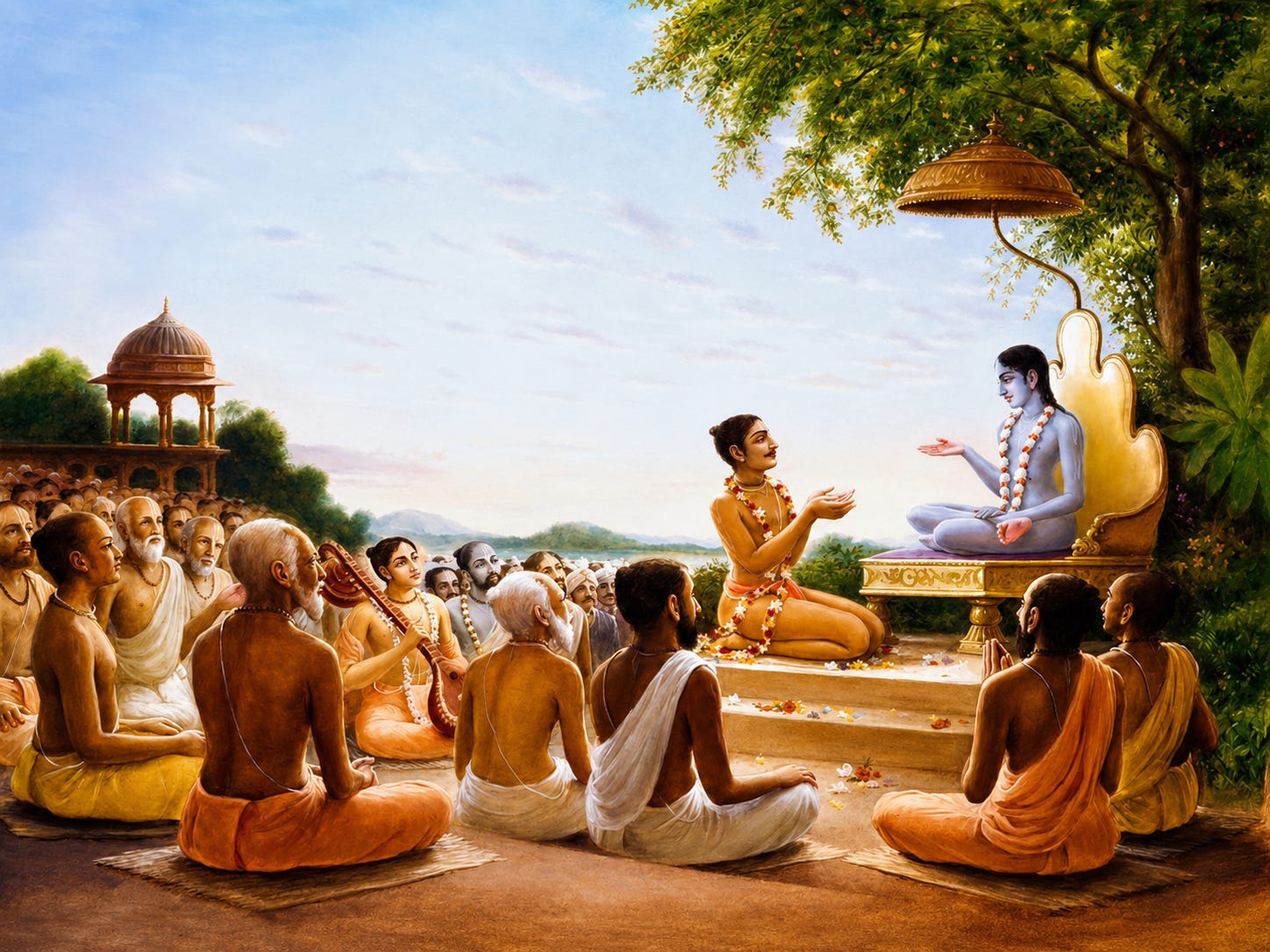
In Śrīmad-Bhāgavatam (9.21.25), Śrila Prabhupāda gives some interesting details about the life of Śukadeva Goswami.
Both Vyāsadeva and Śukadeva are far from being ordinary persons. Vyāsadeva is an incarnation of Kṛṣṇa. In CC Adi. 2.97 Prabhupāda mentions that Vyāsadeva is a prābhava expansion of Kṛṣṇa, which means he is Kṛṣṇa Himself, but in a different form.
Vyāsadeva comes to restore Vedic knowledge when it’s almost lost at the end of Dvāpara Yuga. By that time, the eternal path of the Vedas had degenerated into separate philosophies that were mainly atheistic. Vyāsadeva appeared to divide and thus preserve the original Vedas, but to give their conclusion in the form of the Vedānta-sūtra and the Śrīmad-Bhāgavatam.
Śukadeva Goswami, in turn, is considered to be an incarnation of the parrot of Śrīmatī Rādhārāṇī, who came especially to speak the Śrīmad-Bhāgavatam, illuminating thus the otherwise inauspicious age of Kali. Being such an exalted soul, Śukadeva had a very profound understanding of spiritual relationships and was thus elected as the speaker of the Śrīmad-Bhāgavatam, even though both Vyāsadeva and his spiritual master, Nārada Muni, were present at the assembly.
1- Vyāsadeva performed austerities before begetting him:
The first interesting fact is that even a great personality like Vyāsadeva didn’t get a pure son like Śukadeva Goswami automatically. Both he and his wife practiced austerities for many years before Śukadeva Goswami came as their son. There are other similar cases, like Vasudeva and Devakī practicing austerities as Sutapā and Pṛśni with the goal of obtaining Kṛṣṇa as their son. Although great personalities like Vasudeva and Vyāsadeva are already perfect, they still give us the example of how the practice of authorized austerities as part of our spiritual practice is a way to get a spiritually inclined child.
2- He was a brahmavādī before hearing the Bhāgavatam:
The second fact was that Śukadeva Goswami played the role of a brahmavādī while inside the womb, showing fear of the material energy and thus refusing to come out. In total, he stayed inside the womb for 12 years, coming out only when Kṛṣṇa Himself reassured him that he would not be captured by Māyā. Even then, he immediately ran away from home, taking shelter in the forest as a renunciant. With great difficulty, Vyāsadeva was able to bring him back for a short period to listen to the Bhāgavata Purana, which Śukadeva later expanded in the form of the Śrīmad-Bhāgavatam, which he spoke to Maharaja Parīkṣit. In SB 1.19.26, it is mentioned that Śukadeva appeared like a sixteen-year-old youth when he approached Mahārāja Parīkṣit. That refers to his physical appearance and may also be interpreted as the chronological age; it does not directly refer to the duration of the pregnancy.
Why was he a brahmavādī? To make the point that Kṛṣṇa is completely transcendental and attracts even pure transcendentalists who are fixed in the Brahman platform. If Kṛṣṇa had a material form, as argued by Māyāvādis, liberated souls would not be attracted in hearing about Him.
This point is emphasized in the famous ātmārāmāś verse by Sūta Gosvāmī. Śukadeva Gosvāmī took the role of the embodiment of it:
ātmārāmāś ca munayo
nirgranthā apy urukrame
kurvanty ahaitukīṁ bhaktim
ittham-bhūta-guṇo hariḥ“Sūta Gosvāmī said: All different varieties of ātmārāmas [those who take pleasure in the ātmā, or spirit self], especially those established on the path of self-realization, though freed from all kinds of material bondage, desire to render unalloyed devotional service unto the Personality of Godhead. This means that the Lord possesses transcendental qualities and therefore can attract everyone, including liberated souls.”
3- The Bhāgavatam was compiled in two stages:
The third fact is that Vyāsadeva actually wrote the Śrīmad-Bhāgavatam two times, the first as the original Bhāgavata Purana, which he compiled before the Mahabharata as one of the eighteen Puranas. This is confirmed on SB 1.4.19-20, where it is mentioned:
“He saw that the sacrifices mentioned in the Vedas were means by which the people’s occupations could be purified. And to simplify the process he divided the one Veda into four, in order to expand them among men. The four divisions of the original sources of knowledge [the Vedas] were made separately. But the historical facts and authentic stories mentioned in the Purāṇas are called the fifth Veda.”
As described in the Śrīmad-Bhāgavatam, after compiling all the Vedas, including the original Bhāgavata Purana, Vyāsadeva was still dissatisfied, which led to the appearance of Nārada Muni, who ordered him to write a new book, directly describing the pastimes of the Lord and pure devotional service. This led to the appearance of the Śrīmad-Bhāgavatam we have today, as explained by Śrila Baladeva Vidyābhūṣaṇa in his comment to the Tattva Sandarbha.
I used to think Vyāsadeva had waited until the Bhāgavatam was spoken by Suta Goswami before finally writing it in palm leaves, but it seems more probable that he wrote the whole Śrīmad-Bhāgavatam, exactly in the way it would be later spoken by Suta Goswami to the sages of Naimiṣāraṇya immediately after his meeting with Nārada Muni. This is possible because Vyāsadeva has a vision of the past, present, and future, and thus he could see events that would happen later. When we keep in mind that Vyāsadeva is an expansion of Kṛṣṇa, this possibility doesn’t sound very surprising.
4- Śukadeva Goswami expanded himself into two forms:
Another interesting fact is that after hearing the Bhāgavata Purana from Vyāsadeva, Śukadeva Goswami expanded himself, with the original Śukadeva Goswami remaining as a lifelong brahmacārī, later narrating the Śrīmad-Bhāgavatam to Pariksit Maharaja, and the expansion returning home to stay with his father. This expansion of Śukadeva later entered family life and had a daughter.
Here is what Śrila Prabhupāda mentions in his purport on SB 9.21.25:
“Śukadeva Gosvāmī, the son of Vyāsadeva, is described in great detail in the Brahma-vaivarta Purāṇa. There it is said that Vyāsadeva maintained the daughter of Jābāli as his wife and that after they performed penances together for many years, he placed his seed in her womb. The child remained in the womb of his mother for twelve years, and when the father asked the son to come out, the son replied that he would not come out unless he were completely liberated from the influence of māyā. Vyāsadeva then assured the child that he would not be influenced by māyā, but the child did not believe his father, for the father was still attached to his wife and children. Vyāsadeva then went to Dvārakā and informed the Personality of Godhead about his problem, and the Personality of Godhead, at Vyāsadeva’s request, went to Vyāsadeva’s cottage, where He assured the child in the womb that he would not be influenced by māyā. Thus assured, the child came out, but he immediately went away as a parivrājakācārya. When the father, very much aggrieved, began to follow his saintly boy, Śukadeva Gosvāmī, the boy created a duplicate Śukadeva, who later entered family life. Therefore, the śuka-kanyā, or daughter of Śukadeva, mentioned in this verse is the daughter of the duplicate or imitation Śukadeva. The original Śukadeva was a lifelong brahmacārī.”