

« The Song of God—Volume 2, chapters 7-12
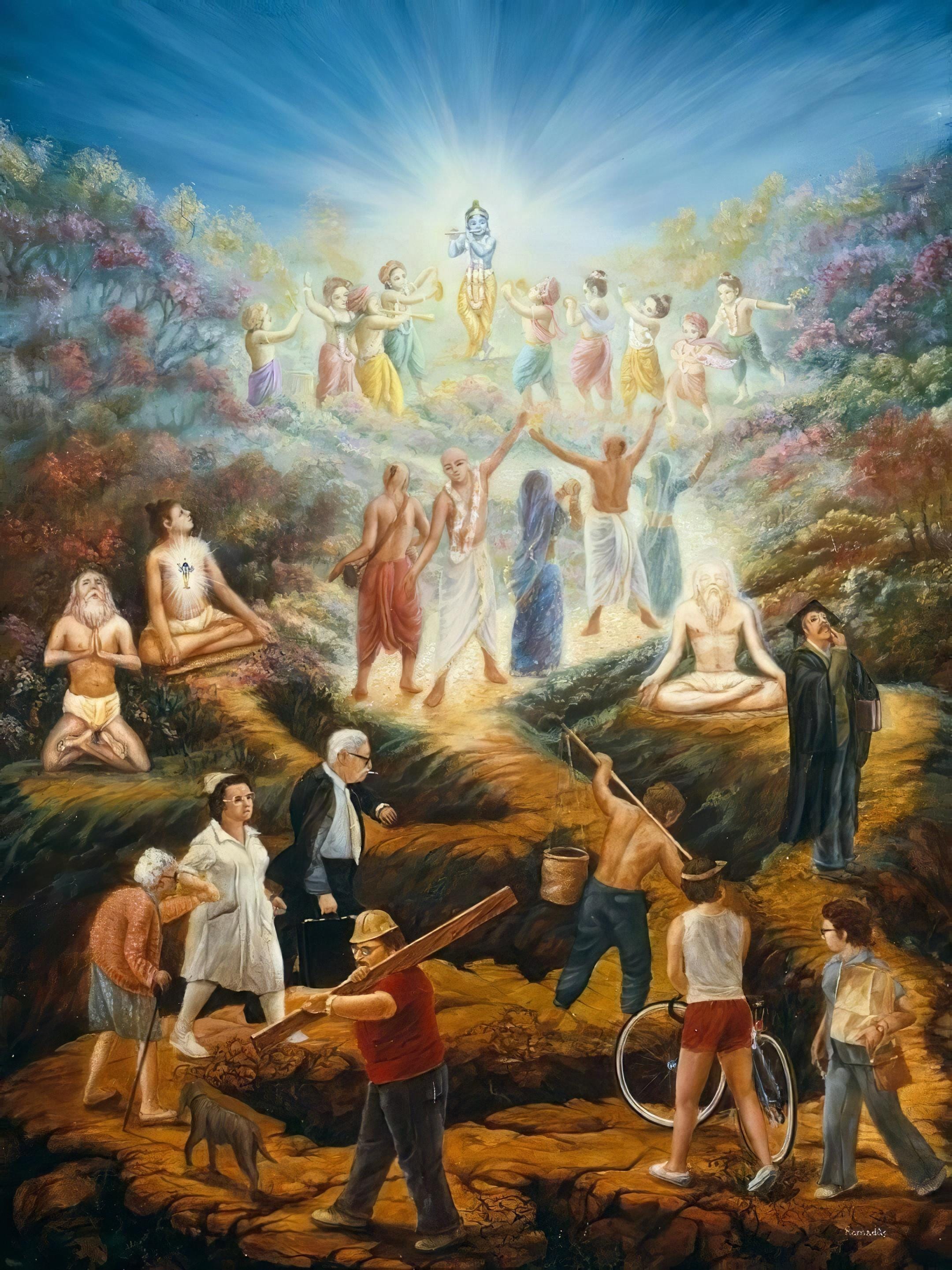
From material hankering to complete surrender (Bg 7.16 to 7.19)
In the previous section, Kṛṣṇa described four classes of people who refuse to surrender unto Him. Now, He describes the opposite side: the four classes of pious persons who come to Him. The distinction between the two classes is made by the words duṣkṛtinaḥ and sukṛtinaḥ. The first are impious people who, despite their material qualifications, always go in the wrong direction, while the second are pious people who approach Kṛṣṇa and thus advance towards perfection. The decisive factor is not one’s initial qualification, because the process itself purifies us. The point is to approach Kṛṣṇa sincerely, even if only to ask for material relief. It doesn’t matter whether one is full of material desires, free of desires, or desiring liberation.
Text 16: catur-vidhā bhajante māṁ, janāḥ su-kṛtino ’rjuna
ārto jijñāsur arthārthī, jñānī ca bharatarṣabha
O best among the Bhāratas, four kinds of pious men begin to render devotional service unto Me—the distressed, the desirer of wealth, the inquisitive, and he who is searching for knowledge of the Absolute.
Text 17: teṣāṁ jñānī nitya-yukta, eka-bhaktir viśiṣyate
priyo hi jñānino ’tyartham, ahaṁ sa ca mama priyaḥ
Of these, the one who is in full knowledge and who is always engaged in pure devotional service is the best. For I am very dear to him, and he is dear to Me.
Text 18: udārāḥ sarva evaite, jñānī tv ātmaiva me matam
āsthitaḥ sa hi yuktātmā, mām evānuttamāṁ gatim
All these devotees are undoubtedly magnanimous souls, but he who is situated in knowledge of Me I consider to be just like My own self. Being engaged in My transcendental service, he is sure to attain Me, the highest and most perfect goal.
Text 19: bahūnāṁ janmanām ante, jñānavān māṁ prapadyate
vāsudevaḥ sarvam iti, sa mahātmā su-durlabhaḥ
After many births and deaths, he who is actually in knowledge surrenders unto Me, knowing Me to be the cause of all causes and all that is. Such a great soul is very rare.
The mūḍhas are often in distress, and the narādhamas are certainly desirous of material wealth. Why then do they not approach Kṛṣṇa? There is an essential difference between the four previous classes and the ones Kṛṣṇa describes now: they are pious. These are generally people who follow general religious and moral principles and are more or less devoted to God, be it in this life or in previous lives. Because of this religious practice, when they have some need, they often approach Kṛṣṇa and thus start on the path of devotional service. The four classes of duṣkṛtinaḥ and the four classes of sukṛtinaḥ are thus not incidental; they describe two opposite paths. Prabhupāda emphasizes this in his purport to 7.16:
“When these four kinds of persons come to the Supreme Lord for devotional service and are completely purified by the association of a pure devotee, they also become pure devotees. As far as the miscreants are concerned, for them devotional service is very difficult because their lives are selfish, irregular and without spiritual goals. But even some of them, by chance, when they come in contact with a pure devotee, also become pure devotees.”
We can practically see that when ordinary persons face difficulties, they often become angry at God, and when one becomes curious about what exists after death, one approaches many mental speculators. The determining factor here is the absence of piety. That’s why it is said that one who comes to Kṛṣṇa in this life must have practiced many great pious deeds in previous lives; otherwise, this would not generally be possible. Without at least some piety, one tends to go in the wrong direction when difficulties appear.
So, is it impossible for impious people to join Kṛṣṇa consciousness? No. There is another side: One can obtain some sukṛti (spiritual merit) by coming into contact with pure devotees, taking prasādam, reading transcendental books, and so on, and thus become eligible for practicing devotional service even without previous merits. That’s why one of the bases for spreading Kṛṣṇa consciousness is approaching people, and trying to engage them in some form of devotional service, even if involuntarily, distributing transcendental books, organizing public festivals, and so on. Kṛṣṇa is transcendental and pure, and so are devotees who are constantly engaged in His service. The mere association with these devotees can give us the piety necessary to approach Kṛṣṇa and start the process of purification that gradually brings us back to our original nature.
Kṛṣṇa divides the pious souls who approach Him into four classes:
1) Ārtaḥ (the distressed): The ārtaḥ is generally absorbed in fruitive activities, trying to obtain happiness by working and making different material arrangements. As long as everything goes well, he may feel no particular need to approach God. However, when a seriously distressing situation appears, and ordinary means fail to solve the problem, he may pray or come in contact with pure devotees. The baseline is that one has some preliminary form of faith or devotion to God, but the helplessness is the trigger that makes him finally approach Kṛṣṇa and begin devotional service.
The point is that distress itself is not what makes him pious. An ordinary person in distress may beg from powerful people or demigods, or try to solve his problems by simply working hard. However, pious souls remember God when they face difficulties, recognizing Him as the ultimate shelter. The distress brings them toward Kṛṣṇa instead of away from Him, and when they come in contact with devotees, this search for shelter can evolve into genuine inquisitiveness and foster a genuine attitude of devotional service.
An example of ārtaḥ is Gajendra, the celestial elephant, whose story is described in the Eighth Canto of Śrīmad-Bhāgavatam. He was bathing in a lake when a strong crocodile bit his leg. He fought for a long time, but was gradually overpowered by the crocodile, who was fighting in his natural habitat. In great distress, Gajendra took a lotus flower with his trunk and offered it to Lord Viṣṇu, fully surrendering to Him. Gajendra was previously King Indradyumna, who was cursed to become an elephant. In this animal body, he forgot about his devotional service and became absorbed in sensual enjoyment, but when a distressful situation appeared, he remembered his previous devotion, even in an animal body.
2) Jijñāsuḥ (the inquisitive): The jijñāsu is described by Prabhupāda as someone who has become frustrated with material life and begins to inquire about what is beyond. He realizes that ordinary material pursuits cannot give a satisfactory answer to deeper existential questions, and therefore seeks spiritual knowledge and the association of devotees to understand what is beyond.
His original motivation is curiosity or inquiry, and not devotion itself. He simply wants to know what happens after death, what the purpose of life is, how to put an end to material suffering, and so on. The baseline is this existential inquiry, and previous piety makes him come to devotees instead of mental speculators.
Association with devotees, then, becomes the trigger for the jijñāsu to begin the process of devotional service. The initial motivation is finding answers, but good association and spiritual practice make it evolve into authentic spiritual realization.
Thousands of years ago, Śaunaka Ṛṣi heard from great devotees about self-realization. He heard the Mundaka Upaniṣad from Aṅgiras, Puranas from Romaharṣaṇa, and so on. When he enquired from Aṅgiras, his initial question was, “By knowing what does everything become known?”
However, by the time he came to inquire from Sūta Gosvāmi, he was already eager to directly hear about Vāsudeva, Kṛṣṇa, the Personality of Godhead, and His incarnations. In text 7.19, Kṛṣṇa mentions that a person becomes a great soul and comes to know Him as the cause of all causes after many births and deaths. The example of Śaunaka Rṣi exemplifies this progression from the level of jijñāsuḥ to genuine spiritual realization.
3) Artha-arthī (one who desires material gain): Until we become fixed on the platform of Kṛṣṇa consciousness, we have many material desires, and one who is pious may come to worship Kṛṣṇa for that. Again, this is not pure devotion, but it is still positive, because Kṛṣṇa reciprocates in such a way that He gives the material blessings one may ask for in ways that purify the devotee of material contamination, solving the root cause of the problem.
The perfect example is Dhruva Mahārāja. As a prince, Dhruva was expected to inherit the kingdom of his father, Uttānapāda. However, his stepmother deprived him of this right. Instructed by his mother, and later by Nārada Muni, Dhruva practiced great austerities in the forest with the goal of satisfying Lord Viṣṇu and obtaining a kingdom greater than his father’s. As he practiced, his heart was purified, and by the time Lord Viṣṇu appeared to grant him rulership over the entire world for 36,000 years and after that sovereignty over his own Vaikuṇṭha planet, Dhruva already wanted nothing apart from serving the Lord.
This is the main difference between approaching Kṛṣṇa and approaching demigods. A demigod, just as any powerful person, may give us what we ask for, but this will be very impermanent, because tomorrow we will need something else. When we ask Kṛṣṇa, He solves the underlying problem, by bringing us to the platform of devotional service. As Prabhupāda mentions in his purport to 7.18:
“The devotees who want some benefit out of devotional service are accepted by the Lord because there is an exchange of affection. Out of affection they ask the Lord for some material benefit, and when they get it they become so satisfied that they also advance in devotional service.”
4) Jñānī (one who knows things as they are): The position of the jñānī was already discussed in the previous chapters. A jñānī is frustrated with material life and pursues transcendental knowledge, but does so through a dry, non-devotional process. There are different classes of jñānīs, which go all the way from an ordinary mental speculator to a niṣkāma-sannyāsī (a renunciant free from material desires) who has attained Brahman or Paramātmā realization. In both cases, the baseline is frustration with material life and the search for spiritual realization and liberation, and the trigger is dissatisfaction with the dry philosophical process, which may lead one to associate with devotees and thus approach Kṛṣṇa. As in the other cases, the intention is initially not completely pure. One approaches Kṛṣṇa to obtain knowledge or liberation, but spiritual practice gradually makes one pure.
As Prabhupāda explains in his purport, “Similarly, when the dry philosophers are frustrated in every field of knowledge, they sometimes want to learn of God, and they come to the Supreme Lord to render devotional service and thus transcend knowledge of the impersonal Brahman and the localized Paramātmā and come to the personal conception of Godhead by the grace of the Supreme Lord or His pure devotee.”
There are many examples of dry philosophers becoming devotees after becoming dissatisfied with the process, and also examples of high-class jñānīs approaching Kṛṣṇa, as in the case of the four Kumāras. They were initially Brahmavādīs, attracted to the impersonal aspect of the Absolute Truth. However, they were attracted to the worship of Lord Viṣṇu simply by the aroma of the tulasī leaves offered to Him. Attaining perfect realization, they later instructed King Pṛthu, as described in the Fourth Canto of Śrīmad-Bhāgavatam.
A progression
In general, the jñānī starts from a level higher than the other three. A real jñānī is already free from material desire and situated in a preliminary platform of spiritual realization, as in the case of the Kumāras. That’s why Prabhupāda translates jñānī as “one who knows things as they are” in the word-for-word. At the same time, however, there are also less exalted jñānīs who come to worship Kṛṣṇa after becoming dissatisfied with their process of mental speculation. These are mentioned by Prabhupāda in the purport, as dry philosophers frustrated in every field of knowledge. These ordinary jñānīs are, however, very different from the māyayāpahṛta-jñānāḥ described in the previous section, because they come to Kṛṣṇa.
Śrīla Baladeva Vidyābhūṣaṇa makes another point: Kṛṣṇa mentions the jijñāsuḥ between the ārta and the artha-arthī in the verse to indicate that the two naturally progress to the jijñāsuḥ platform as they advance in Kṛṣṇa consciousness, coming to a process of philosophical inquiry. If this philosophical awakening does not happen, they may lose interest in Kṛṣṇa consciousness over time.
This is a progression we can observe in practical life. Thousands of persons come to Kṛṣṇa consciousness, because of distress, seeing it as a way to satisfy different needs, or due to other superficial aspects. From these thousands, a few start the process of studying and seriously hearing from advanced devotees, and acquiring a philosophical understanding; they continue until the end of their lives. The others tend to gradually abandon or slacken their practice over time. One who is sentimental about Kṛṣṇa consciousness today will tend to become sentimental about something else tomorrow. Philosophical understanding is what helps us become fixed in the process.
And how does the progression from ārta or artha-arthī to jijñāsuḥ happen? This is the natural path of progression of the conditioned soul.
The jijñāsuḥ who is now seeking knowledge comes to this point after experiencing material reverses at some point, be it earlier in this life, or in past lives. The ārta approaches Kṛṣṇa in distress, and later may come to inquire philosophically. Similarly, the artha-arthī, who is now seeking material wealth, will eventually come to the point of experiencing the inevitable material difficulties that are part of life in this world. At this point, he may start the process of philosophical inquiry, looking for solutions for the real problems of life. In this way, we can see that the distressed and the seekers of material possessions also gradually progress and become part of the group seeking knowledge.
On the other hand, the group that comes to Kṛṣṇa already situated in knowledge (the advanced jñānīs) is composed of advanced students who have already surpassed the previous stages. At some point, they were looking for wealth, and then they experienced the inevitable pains of material life. This pain led them to look for spiritual knowledge, and having obtained this transcendental knowledge they are now surrendering to Kṛṣṇa, understanding this as the perfection of life.
This potential multi-life progression is acknowledged by Kṛṣṇa in 7.19 with the words bahūnāṁ janmanām ante (after many births and deaths). However, one can come to Kṛṣṇa at any of the four stages, and Kṛṣṇa will help him or her to advance and come to the ultimate goal. Prabhupāda makes the point that one can become fully Kṛṣṇa conscious even in one second; it’s all about accepting our eternal position as loving servants of Kṛṣṇa. It is just that often we take time to fully understand this simple point.
Why does Kṛṣṇa say that the jñānī is the best?
In text 7.17, Kṛṣṇa mentions that “Of these, the one who is in full knowledge and who is always engaged in pure devotional service is the best. For I am very dear to him, and he is dear to Me.” If we look into the Sanskrit, the word used is “jñānī.” Taken literally, the verse appears to suggest that the jñānī is the most dear to Kṛṣṇa. What does it mean?
Prabhupāda explains in his purport:
“Free from all contaminations of material desires, the distressed, the inquisitive, the penniless and the seeker after supreme knowledge can all become pure devotees. But out of them, he who is in knowledge of the Absolute Truth and free from all material desires becomes a really pure devotee of the Lord. And of the four orders, the devotee who is in full knowledge and is at the same time engaged in devotional service is, the Lord says, the best.”
“Jñānī” in this verse does not mean the ordinary mental speculator who comes to Kṛṣṇa consciousness, but a devotee who comes to the platform of full knowledge, and, based on this spiritual realization, comes to the platform of nitya-yukta eka-bhaktir (being always engaged in pure, unalloyed devotional service, free from contamination of karma and jñāna). This is the mature fruit of the progress of philosophical inquiry combined with devotional service performed by both the jijñāsuḥ and the jñānī. The distressed and the seeker of wealth are also on the path, but they will first have to transition to the jijñāsu level. Then, as Prabhupāda explains, “and when they fully understand that material remuneration has nothing to do with spiritual improvement, they become pure devotees.”
In this way, all four classes are on the path, but on different levels. When one abandons the pursuit of material benefits and comes to the platform of combining full knowledge about Kṛṣṇa with practical realization that inspires him or her to be always engaged in pure devotional service, seeing Kṛṣṇa as the most dear, one becomes priyaḥ, very dear to Kṛṣṇa.
Śrīla Viśvanātha Cakravartī Thākura gives a similar conclusion in his commentary, arguing that the jñānī mentioned by Kṛṣṇa in text 7.17 is a jñānī in name only, for his main attachment is to the process of devotional service. Knowledge has made him one-pointed, and bhakti has become dominant. In other words, he is the jñānī who has become a pure devotee:
“[After describing the four classes of pious souls who approach Him], Kṛṣṇa, anticipating the question, ‘Among the four classes of pious souls who are qualified to perform bhakti, who is the best?’ answers that among them, the one who is in full knowledge (jñānī) is special; he is the best. Nitya-yuktaḥ means one who is always engaged in Me, one who is always engaged in Me. Because his mind has been brought under control by transcendental knowledge, his mind is one-pointed. The other three, beginning with the distressed person (ārta), are not like this. Arjuna then could object: ‘Does not every jñānī come to worship You simply out of fear that his pursuance of knowledge may otherwise become fruitless?’ To this, Kṛṣṇa answers: eka. It refers to one in whom bhakti has become predominant. Alternatively, it refers to one who has become attached exclusively to bhakti alone. Such a devotee is a jñānī in name only.”
Kṛṣṇa concludes this description of the jñānī in 7.18: “All these devotees are undoubtedly magnanimous souls, but he who is situated in knowledge of Me I consider to be just like My own self. Being engaged in My transcendental service, he is sure to attain Me, the highest and most perfect goal.”
Here again Kṛṣṇa uses the word “jñānī” in the sense of a devotee who comes to understand Him. The other devotees, who are not so complete in knowledge, are also dear, but the devotee who is in full knowledge is especially dear. Why? Because the mature fruit of this knowledge is to serve Kṛṣṇa with love and devotion. Without proper knowledge, we may take spiritual life lightly, or we may serve Kṛṣṇa to obtain some material goal. We may hanker for fame and prestige, and so on. But when we attain factual realization, everything else looks insignificant, and we become fixed in the service of Kṛṣṇa. This lack of interest in anything else apart from Kṛṣṇa is the proof of this state of ultimate realization.
Some look for shortcuts to spiritual realization, cheap ways to attain Kṛṣṇa without having to follow the regulations of spiritual life. Kṛṣṇa, however, gives us the proper process in the pages of the Gītā. We can realize Him by carefully studying this knowledge He gives us, under proper supervision, and while engaged in devotional service.
Śrīla Prabhupāda makes a similar point in his purport to 4.28.51:
“In conclusion, if a disciple is very serious to execute the mission of the spiritual master, he immediately associates with the Supreme Personality of Godhead by vāṇī or vapuḥ. This is the only secret of success in seeing the Supreme Personality of Godhead. Instead of being eager to see the Lord in some bush of Vṛndāvana while at the same time engaging in sense gratification, if one instead sticks to the principle of following the words of the spiritual master, he will see the Supreme Lord without difficulty.”
Everyone wants something from Kṛṣṇa. One may even desire prema with an idea of personal satisfaction, understanding that devotees who have it enjoy the highest bliss. The perfect devotee avoids all these traps. Situated in knowledge, he wants nothing apart from Kṛṣṇa Himself. Such a devotee doesn’t want to enjoy Kṛṣṇa, but simply offers his sincere loving service unto Him. Kṛṣṇa makes an extraordinary statement: “I consider him to be just like My own self” and reassures us that “he is sure to attain Me, the highest and most perfect goal.”
Chapters seven to twelve are where Kṛṣṇa describes how we can attain this elevated platform. We are not studying them as a hollow intellectual exercise. Our goal is to develop this perfect, mature knowledge that can bring us to the association of Kṛṣṇa.
As Prabhupāda explains:
“But the devotee in full knowledge is considered to be very dear to the Lord because his only purpose is to serve the Supreme Lord with love and devotion. Such a devotee cannot live a second without contacting or serving the Supreme Lord. Similarly, the Supreme Lord is very fond of His devotee and cannot be separated from him.”
After many births and deaths
People in this world have different concepts of perfection. For a gross materialist, having a few million in the bank may already be seen as perfection. For a karma-kāndī, elevation to Svargaloka may be seen as the ultimate goal. Yogīs often aspire for mystical perfections, and so on. Even among transcendentalists, many aspire for impersonal liberation, or Paramātmā realization. When Parīkṣīt Mahārāja asked the great sages at the bank of the Ganges about the ultimate goal of life, the sages couldn’t agree on a single answer.
In text 7.19, Kṛṣṇa gives us a definitive answer: the perfection of knowledge is to know Him as the Supreme Personality of Godhead, the cause of all causes, and fully surrender unto Him.
The words vāsudevaḥ sarvam iti (Vāsudeva is everything) used by Kṛṣṇa summarize the points discussed in the previous sections:
Everything comes from Kṛṣṇa and rests upon Him.
Both material nature and the jīvas are energies of Kṛṣṇa.
Nothing exists independently of Kṛṣṇa, but material illusion prevents us from seeing this.
Real realization means to escape this veil and understand everything in relation to Kṛṣṇa.
Why is this understanding of Kṛṣṇa as a person important? Impersonal Brahman realization brings an understanding of the eternal spiritual nature of the Absolute Truth; Paramātmā realization brings knowledge of the localized feature, but realization of the Bhagavān aspect brings the realization of one’s eternal relationship with God. This personal relationship with Kṛṣṇa, which is possible only for a devotee for whom Kṛṣṇa becomes everything, is the ultimate goal of life. After attaining that, there is nothing else to be attained.
The conditioned living entity is called nitya-baddha, eternally conditioned. This means that it is not possible to trace the beginning of our conditioning. We have been here for a very long time. Similarly, spiritual development typically takes many lives. We may not remember, but Kṛṣṇa remembers, and thus He mentions bahūnāṁ janmanām ante. After many births and deaths, a devotee comes to this point of fully surrendering unto Him. Such a mahātmā is very rare.
In this way, Kṛṣṇa concludes this point: most people don’t surrender unto Him because they are covered by material illusion. Some are gross materialists; others waste the opportunities of human life; others are learned but have their knowledge stolen by illusion, and others are directly atheistic and envious of Him. For these four classes, there is nothing good ahead. Unless they are somehow rescued by a pure devotee, they just sink into the material pool.
On the other side are the pious, who initially come to Kṛṣṇa searching for something else, but who gradually progress due to good association. This culminates in the perfect devotee described in texts 7.17 and 7.18.
Main points in the purports of Śrīla Prabhupāda:
“O best among the Bhāratas, four kinds of pious men begin to render devotional service unto Me—the distressed, the desirer of wealth, the inquisitive, and he who is searching for knowledge of the Absolute.”
a) For the miscreants, devotional service is very difficult because they are selfish, irregular and devoid of spiritual goals. These four are different. They start from a platform of piety, following general principles from the scriptures, like moral and social laws, and are more or less devoted to God.
b) They initially come to serve Kṛṣṇa out of the desire for obtaining something. Some are in distress or searching for wealth; others are inquisitive or frustrated with the dry philosophical process. They come to Kṛṣṇa looking for something else apart from Kṛṣṇa. However, by the mercy of Kṛṣṇa or His pure devotee, they can all advance.
c) Pure devotional service means without a desire for material profit, or gain through fruitive activities or philosophical speculation. Although these four classes are still tainted with fruitive activities, desire for mundane knowledge, etc., they can be elevated to the platform of pure devotion if they become purified by the association of a pure devotee. At this point they become free from material desires and desire true spiritual advancement.
“Of these, the one who is in full knowledge and who is always engaged in pure devotional service is the best. For I am very dear to him, and he is dear to Me.”
a) Prabhupāda distinguishes three levels. 1) Devotees from all four classes can become pure devotees after they become free from material desires. 2) The devotee who is situated in knowledge and already free from material desires is more advanced. He can become a really pure devotee. 3) A devotee who is in full knowledge and always engaged in devotional service is the best.
b) Transcendental knowledge plays an essential role in this progression. What are the stages of development? First one realizes the difference between the body and the soul, then comes to the knowledge of the impersonal Brahman and Paramātmā. After being fully purified, one realizes his constitutional position as an eternal servant of Kṛṣṇa. All of this can be obtained by the association of a pure devotee. Thus, the devotee who is situated in full knowledge and always engaged in devotional service is very dear to Kṛṣṇa. His devotional service protects him from all material contamination.
“All these devotees are undoubtedly magnanimous souls, but he who is situated in knowledge of Me I consider to be just like My own self. Being engaged in My transcendental service, he is sure to attain Me, the highest and most perfect goal.”
a) Anyone who comes to the Lord for any purpose is called a mahātmā. They are accepted because even when one comes to ask for material benefits, there is an exchange of affection. When devotees ask the Lord for some benefit and receive it, they become satisfied and advance on devotional service.
b) However, a devotee who is in knowledge is especially dear, because there is no purpose apart from serving the Lord with affection. Such a devotee cannot live even a second without contacting or serving Kṛṣṇa, and similarly, Kṛṣṇa cannot be separated from him.
“After many births and deaths, he who is actually in knowledge surrenders unto Me, knowing Me to be the cause of all causes and all that is. Such a great soul is very rare.”
a) Usually, one comes to the position of pure spiritual knowledge after many births of practice. In the beginning, one battles material attachments, and there is an inclination to impersonalism, but as one advances further, this is replaced by understanding of the activities in the spiritual platform.
b) Understanding this platform of transcendental service, one becomes attached to the Lord and surrenders unto Him. At this point, one can understand that Kṛṣṇa is everything, that He is the cause of all causes, and everything is connected with Him. Based on this realization, one sees everything in connection with Kṛṣṇa, and equipped with this realized knowledge, the devotee fully surrenders unto Him, understanding Him as the ultimate goal. This is the rare great soul referred to in the verse.
Next: Demigod worship and its temporary results (Bg 7.20 to 7.23)
Read the entire book:
« The Song of God—Volume 2, chapters 7-12

This is a publication for thoughtful readers who want to go deeper into Kṛṣṇa consciousness. I publish daily, trying to offer high-quality spiritual content, and all posts are available to free subscribers. If you wish, you can also choose a paid subscription to support this work.
You can also receive the updates on WhatsApp or Telegram.
If you would like to contribute further, you can find the donation links here.