

Subscribe to receive new articles by e-mail. It’s free, but if you like, you can pledge a donation:
Join the Telegram group if you would like to join the live lessons. This course is maintained with your donations. Click here to donate.
💬 Text of the lesson
Bhūmi worships Varāha in Uttarakuru-varṣa
“Śukadeva Gosvāmī said: Dear King, the Supreme Lord in His boar incarnation, who accepts all sacrificial offerings, lives in the northern part of Jambūdvīpa. There, in the tract of land known as Uttarakuru-varṣa, mother earth and all the other inhabitants worship Him with unfailing devotional service by repeatedly chanting the following Upaniṣadic mantra.” (SB 5.18.34)
The word “bhūḥ” means “earth” and indicates both Bhū-mandala and the earth as the planet we live on. Somehow, these two exist simultaneously in two levels of reality, and Bhūmi is the personification of both.
Hiranyākṣa mined the earth for gold and other mineral resources so intensely that it disturbed the equilibrium of forces that keep it in its proper place. As a result, the earth fell into the depths of the Garbhodaka ocean, and the Lord decided to personally come to save her and kill the demon.
The same Lord Varāha is present in His deity form in Uttarakuru-varṣa, the northernmost tract of land in Jambūdvīpa, where He is worshiped by Bhūmi Devi.
“O Lord, we offer our respectful obeisances unto You as the gigantic person. Simply by chanting mantras, we shall be able to understand You fully. You are yajña [sacrifice], and You are the kratu [ritual]. Therefore all the ritualistic ceremonies of sacrifice are part of Your transcendental body, and You are the only enjoyer of all sacrifices. Your form is composed of transcendental goodness. You are known as tri-yuga because in Kali-yuga You appeared as a concealed incarnation and because You always fully possess the three pairs of opulences.” (SB 5.18.35)
This is one of the verses in the Śrīmad Bhāgavatam that predicts the advent of Śrī Caitanya Mahāprabhu. Just like all other incarnations, His advent is predicted in the sastras, but because He is channāvatāra, a concealed incarnation, his advent is described in a hidden way.
Bhūmi-devī refers to the Lord as tri-yugāya (one who appears in three of the four yugas), which Prabhupāda translates as “You are known as Triyuga because in Kali-yuga You appeared as a concealed incarnation”.
One could argue that this is interpretative, but it is not when the whole Bhāgavatam is taken in context. Again, isolated verses out of context have little value. To understand, we have to take the verses in the context of the whole scripture.
The term “tri-yugā” is clarified later in the Śrīmad Bhāgavatam in the prayers of Prahlāda Maharaja to Lord Nṛsiṁhadeva (SB 7.9.38), where he states: dharmaṁ mahā-puruṣa pāsi yugānuvṛttaṁ, channaḥ kalau yad abhavas tri-yugo ’tha sa tvam. The Lord is dharma pāsi, the protector of the principles of religion, appearing in every age (as indicated by the word yuga-anuvṛttam). He, however, is called Triyuga (tri-yugaḥ) because, channaḥ kalau: In the age of Kali, He appears in a concealed form.
Prabhupāda translates this passage as:
“According to the age, O my Lord, You protect the principles of religion. In the Age of Kali, however, You do not assert Yourself as the Supreme Personality of Godhead, and therefore You are known as Triyuga, or the Lord who appears in three yugas.”
This statement is further expanded on SB 11.5.32, where the advent of the Golden Avatāra is directly described:
kṛṣṇa-varṇaṁ tviṣākṛṣṇaṁ, sāṅgopāṅgāstra-pārṣadam
yajñaiḥ saṅkīrtana-prāyair, yajanti hi su-medhasaḥ“In the Age of Kali, intelligent persons perform congregational chanting to worship the incarnation of Godhead who constantly sings the names of Kṛṣṇa. Although His complexion is not blackish, He is Kṛṣṇa Himself. He is accompanied by His associates, servants, weapons and confidential companions.”
The saṅkīrtana movement is then described in texts 11.5.36 to 40:
“Those who are actually advanced in knowledge are able to appreciate the essential value of this Age of Kali. Such enlightened persons worship Kali-yuga because in this fallen age all perfection of life can easily be achieved by the performance of saṅkīrtana. Indeed, there is no higher possible gain for embodied souls forced to wander throughout the material world than the Supreme Lord’s saṅkīrtana movement, by which one can attain the supreme peace and free oneself from the cycle of repeated birth and death.
My dear King, the inhabitants of Satya-yuga and other ages eagerly desire to take birth in this Age of Kali, since in this age there will be many devotees of the Supreme Lord, Nārāyaṇa. These devotees will appear in various places but will be especially numerous in South India. O master of men, in the Age of Kali those persons who drink the waters of the holy rivers of Draviḍa-deśa, such as the Tāmraparṇī, Krtamālā, Payasvinī, the extremely pious Kāverī and the Pratīcī Mahānadī, will almost all be purehearted devotees of the Supreme Personality of Godhead, Vāsudeva.”
Therefore, when the Four Kumāras describe the Lord as tri-yuga on SB 3.16.22, and when Bhūmi describes Him similarly in SB 5.18.35, it appears that they are stating that the Lord appears only in the first three yugas, and not in the age of Kali, but when the verses are taken in context, the true meaning is revealed. Because the Lord does not assert Himself as the Supreme Personality of Godhead in the age of Kali, He is known as Triyuga, the Lord who appears in three yugas. Prabhupāda gives references from other scriptures further supporting this point on CC Ādi 2.22.
“By manipulating a fire-generating stick, great saints and sages can bring forth the fire lying dormant within wood. In the same way, O Lord, those expert in understanding the Absolute Truth try to see You in everything — even in their own bodies. Yet you remain concealed. You are not to be understood by indirect processes involving mental or physical activities. Because You are self-manifested, only when You see that a person is wholeheartedly engaged in searching for You do You reveal Yourself. Therefore I offer my respectful obeisances unto You.” (SB 5.18.36)
It’s said that fire resides within wood. Of course, we will never find fire by breaking a piece of wood, but one who knows the appropriate process can indeed bring fire out of wood, using nothing but two pieces of wood, by a process of friction. Similarly, the Lord is present everywhere, but He remains concealed for the materialist. Only the devotee who knows the proper process can see the Lord.
What is this proper process? The Lord can’t be found by mechanical physical postures, by fruitive sacrifices, or even by intellectual inquiry. The Lord becomes visible only when He agrees to be seen by the soul who approaches Him wholeheartedly through the devotional process. As He explains in the Gītā: bhaktyā mām abhijānāti, yāvān yaś cāsmi tattvataḥ. One can understand Me as I am, as the Supreme Personality of Godhead, only by devotional service.
“The objects of material enjoyment [sound, form, taste, touch and smell], the activities of the senses, the controllers of sensory activities [the demigods], the body, eternal time and egotism are all creations of Your material energy. Those whose intelligence has become fixed by perfect execution of mystic yoga can see that all these elements result from the actions of Your external energy. They can also see Your transcendental form as Supersoul in the background of everything. Therefore I repeatedly offer my respectful obeisances unto You.
O Lord, You do not desire the creation, maintenance or annihilation of this material world, but You perform these activities for the conditioned souls by Your creative energy. Exactly as a piece of iron moves under the influence of a lodestone, inert matter moves when You glance over the total material energy.
My Lord, as the original boar within this universe, You fought and killed the great demon Hiraṇyakṣa. Then You lifted me [the earth] from the Garbhodaka Ocean on the end of Your tusk, exactly as a sporting elephant plucks a lotus flower from the water. I bow down before You.” (SB 5.18.37-39)
The whole material creation rests on the external potency of the Lord. When we are covered by the illusory potency, we see material objects as separated from Kṛṣṇa and desire to enjoy them. However, when we become purified, we can see that they are nothing but transformations of the external potency of Kṛṣṇa and thus always connected with Him. Behind the cosmic manifestation, we can see the Supersoul, the Supreme director.
However, what is the reason for the existence of this material world? Does the Lord create this world because He wants to see us suffering here? Some indirectly imply that when they conclude that Kṛṣṇa sends some of the souls to the spiritual world and others to the material world. Bhūmi, however, disagrees with this theory, stating that the Lord does not desire to create the material world; He does so for the sake of the souls who desire to enjoy without Him.
How can the soul desire something in his original state, without a material body? It may sound strange if we subscribe to the Māyāvādi theory of the soul as part of a desireless, qualityless Brahman, but when we consider that the soul is conscious and active in nature, the idea doesn’t sound so alien. In his original state, the soul has knowledge of Kṛṣṇa’s opulences and supremacy. When we misuse our independence and desire to be like Him, or to be Him, we come to this material world, the place where we can pretend to be so.
The next point is how the Lord manipulates matter to create this material world. Does the Lord directly associate with it? If so, then how can the Lord remain pure? The answer is that He manipulates matter while remaining at a distance, just like a magnet moves pieces of iron without ever touching them. The Lord appears inside the material creation in so many wonderful forms and performs activities in His original, eternal spiritual body, without ever touching matter. This is yet another example of the Lord’s inconceivability, which surpasses all human logic and understanding.
In his purport, Prabhupāda also calls our attention to the other side of the same argument: The Lord manipulates matter invisibly, like a magnet moving a piece of iron; therefore, matter does not act independently. As he mentions:
“The workings of nature are not going on automatically. It is only because the Lord glances over the material energy that it acts in wonderful ways, just as a lodestone causes a piece of iron to move here and there. Because materialistic scientists and so-called Sāṅkhya philosophers do not believe in God, they think that material nature is working without supervision. But that is not the fact.”
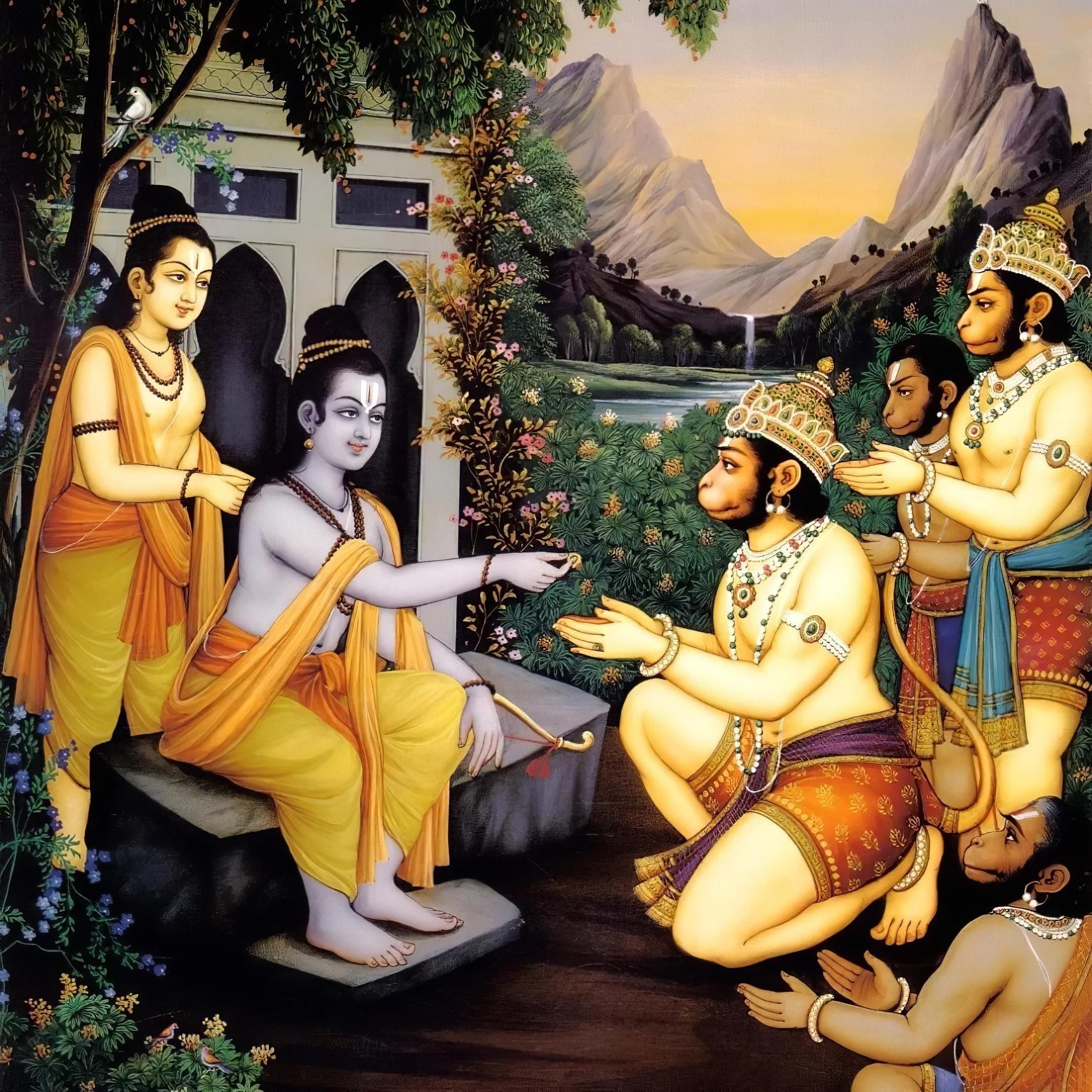
Hanumān worships Rāma in Kimpuruṣa-varṣa
The last two passages, the prayers of Hanumān in Kimpuruṣa-varṣa, and of Nārada Muni in Bhārata-varṣa, are placed on the next chapter 5.19.
In the Mahābhārata (Vana Parva), it is described that, during their exile, the Pandavas traveled through Jambūdvīpa in their quest for celestial weapons, passing through Kimpuruṣa-varṣa before reaching Mount Sumeru. There, it is described that Bhīma met Hanumān, who accepted him as his brother.
Just as Prahlāda Maharaja, Dhruva, and others, Hanumān still lives amongst us, giving association to conditioned souls and helping them to come closer to the Lord. It is described that he was blessed to remain in this world as long as Rama’s glories continue to be sung. In this way, he continues to serve the Lord in devotion.
“Śrīla Śukadeva Gosvāmī said: My dear King, in Kimpuruṣa-varṣa the great devotee Hanumān is always engaged with the inhabitants of that land in devotional service to Lord Rāmacandra, the elder brother of Lakṣmaṇa and dear husband of Sītādevī.
A host of Gandharvas is always engaged in chanting the glories of Lord Rāmacandra. That chanting is always extremely auspicious. Hanumānjī and Arṣṭiṣeṇa, the chief person in Kimpuruṣa-varṣa, constantly hear those glories with complete attention. Hanumān chants the following mantras.” (SB 5.19.1-2)
As Rāmacandra, the Lord plays many dramatic, human-like pastimes, having His wife kidnapped, making political alliances, fighting in a war, and so on. However, different from ordinary human activities, these pastimes are wonderful and fully transcendental. The Lord has no need for a wife or kingdom, and certainly has no need to fear any enemy. However, as Rāma, the Lord teaches by His own example how to follow the path of virtue and thus attain success in human life, alerting us about the difficulties we have to face when we try to obtain happiness in family life.
“Let me please Your Lordship by chanting the bīja-mantra oṁkāra. I wish to offer my respectful obeisances unto the Personality of Godhead, who is the best among the most highly elevated personalities. Your Lordship is the reservoir of all the good qualities of Āryans, people who are advanced. Your character and behavior are always consistent, and You always control Your senses and mind. Acting just like an ordinary human being, You exhibit exemplary character to teach others how to behave. There is a touchstone that can be used to examine the quality of gold, but You are like a touchstone that can verify all good qualities. You are worshiped by brāhmaṇas who are the foremost of all devotees. You, the Supreme Person, are the King of kings, and therefore I offer my respectful obeisances unto You.
The Lord, whose pure form [sac-cid-ānanda-vigraha] is uncontaminated by the modes of material nature, can be perceived by pure consciousness. In the Vedānta He is described as being one without a second. Because of His spiritual potency, He is untouched by the contamination of material nature, and because He is not subjected to material vision, He is known as transcendental. He has no material activities, nor has He a material form or name. Only in pure consciousness, Kṛṣṇa consciousness, can one perceive the transcendental form of the Lord. Let us be firmly fixed at the lotus feet of Lord Rāmacandra, and let us offer our respectful obeisances unto those transcendental lotus feet.” (SB 5.19.3-4)
A bīja-mantra is a sacred syllable that contains the seed of a spiritual principle. Mantras are not just sets of words, but incarnations of the Lord, or of different potencies of the Lord, and they are represented by transcendental seeds (bīja) like oṁ and klīṁ.
The Hare Kṛṣṇa mahā-mantra is a direct incarnation of Kṛṣṇa, the Supreme Lord. When we chant Hare Kṛṣṇa, the Lord is personally present, and as we become purified by His association, we can gradually perceive Him. The same applies to the praṇava oṁkāra, which is chosen by Hanumān as the start of his prayers.
In His purport to CC adī 7.128, Prabhupāda explains:
“Oṁkāra is a combination of the letters a, u and m. A-kāreṇocyate kṛṣṇaḥ: the letter a (a-kāra) refers to Kṛṣṇa, who is sarva-lokaika-nāyakaḥ, the master of all living entities and planets, material and spiritual. Nāyaka means “leader.” He is the supreme leader (nityo nityānāṁ cetanaś cetanānām). The letter u (u-kāra) indicates Śrīmatī Rādhārāṇī, the pleasure potency of Kṛṣṇa, and m (ma-kāra) indicates the living entities (jīvas). Thus oṁ is the complete combination of Kṛṣṇa, His potency and His eternal servitors. In other words, oṁkāra represents Kṛṣṇa, His name, fame, pastimes, entourage, expansions, devotees, potencies and everything else pertaining to Him. As Caitanya Mahāprabhu states in the present verse of Śrī Caitanya-caritāmṛta, sarva-viśva-dhāma: oṁkāra is the resting place of everything, just as Kṛṣṇa is the resting place of everything (brahmaṇo hi pratiṣṭhāham).”
Lord Rāmacandra gave the perfect example of a moral life, and thus Hanumān refers to Him as the reservoir of all the good qualities of Āryans. Even today in India, people are inspired by the example of Lord Rama, and this pushes them in the direction of a moral life, conducive to spiritual advancement.
In his commentary, Śrīla Viśvanātha Cakravartī Ṭhākura mentions that people are praised for having good qualities, such as truthfulness, compassion, etc. However, all these good qualities reach their perfection in the character of Lord Rāmacandra. He is the nikaṣaṇa, or testing stone against which the extent of one’s good qualities can be tested.
One could argue, however, that Rama should be accepted as simply a great personality, and not as the Supreme Personality of Godhead. Hanumān, however, dismisses that by explaining that Lord Rāma has a pure form, uncontaminated by the modes of material nature, which can be perceived only by one endowed with pure consciousness. He has no material activities, and no material form, meaning He is fully transcendental.
In his purport, Prabhupāda gives many additional details:
“Unless one is saturated with love for the Supreme Personality of Godhead, one cannot appreciate the transcendental value of Lord Rāmacandra; one cannot see Him with material eyes. Because demons like Rāvaṇa have no spiritual vision, they consider Lord Rāmacandra an ordinary kṣatriya king. Rāvaṇa therefore attempted to kidnap Lord Rāmacandra’s eternal consort, Sītādevī. Actually, however, Rāvaṇa could not carry off Sītādevī in her original form. As soon as she was touched by Rāvaṇa’s hands, she gave him a material form, but she maintained her original form beyond his vision. Therefore in this verse the words pratyak praśāntam indicate that Lord Rāmacandra and His potency, the goddess Sītā, keep themselves aloof from the influence of the material energy.”
-
“It was ordained that Rāvaṇa, chief of the Rākṣasas, could not be killed by anyone but a man, and for this reason Lord Rāmacandra, the Supreme Personality of Godhead, appeared in the form of a human being. Lord Rāmacandra’s mission, however, was not only to kill Rāvaṇa but also to teach mortal beings that material happiness centered around sex life or centered around one’s wife is the cause of many miseries. He is the self-sufficient Supreme Personality of Godhead, and nothing is lamentable for Him. Therefore why else could He be subjected to tribulations by the kidnapping of mother Sītā?” (SB 5.19.5)
Rāvana received a boon from Brahma that he could not be killed by any Gandharva, Yakṣa, Deva, Dānava or Rākṣa. With this, he was undefeatable by any of the powerful species of the universe. Once he invaded the hellish words and fought with Yamarāja himself, who (being a demigod) had to retreat because of this boom. Similarly, Rāvana fought with many other powerful beings all around the universe.
The Supreme Lord can do anything and is not restricted by boons granted by anyone. However, He usually respects the blessings given by the demigods, who are His devotees. Rāvana didn’t include human beings and animals in his request, considering them insignificant, and therefore the Lord appeared in the form a human being, leading an army of monkeys and bears to kill him.
These adventurous aspects of the Rāma-lila are extremely attractive, but killing Rāvana was actually secondary. The purpose of the appearance of the Lord is to perform sweet pastimes with His devotees and teach the principles of dharma. Prabhupāda explains these points in detail in his purport:
“When the Lord appears in this universe in the form of a human being, He has two purposes, as stated in Bhagavad-gītā — paritrāṇāya sādhūnāṁ vināśāya ca duṣkṛtām: to destroy the demons and protect the devotees. To protect the devotees, the Lord not only satisfies them by His personal presence but also teaches them so that they will not fall down from devotional service. By His personal example, Lord Rāmacandra taught the devotees that it is better not to enter married life, which is certainly followed by many tribulations.”
“Kṛpaṇas, those who are not advanced in spiritual knowledge and who are therefore just the opposite of brāhmaṇas, generally take to family life, which is a concession for sex. Thus they enjoy sex again and again, although that sex is followed by many tribulations. This is a warning to devotees. To teach this lesson to devotees and to human society in general, Lord Śrī Rāmacandra, although the Supreme Personality of Godhead Himself, underwent a series of tribulations because He accepted a wife, mother Sītā. Lord Rāmacandra underwent these austerities, of course, only to instruct us; actually He never has any reason to lament for anything.
Another aspect of the Lord’s instructions is that one who accepts a wife must be a faithful husband and give her full protection. Human society is divided into two classes of men — those who strictly follow the religious principles and those who are devotees. By His personal example, Lord Rāmacandra wanted to instruct both of them how to fully adopt the discipline of the religious system and how to be a beloved and dutiful husband. Otherwise He had no reason to undergo apparent tribulations. One who strictly follows religious principles must not neglect to provide all facilities for the complete protection of his wife. There may be some suffering because of this, but one must nevertheless endure it. That is the duty of a faithful husband. By His personal example, Lord Rāmacandra demonstrated this duty. Lord Rāmacandra could have produced hundreds and thousands of Sītās from His pleasure energy, but just to show the duty of a faithful husband, He not only rescued Sītā from the hands of Rāvaṇa but also killed Rāvaṇa and all the members of his family.”
If everyone would just stop all material activities to serve the Lord without distraction and go back to Godhead, this would be the best. The Lord wants us to go back; He can make other plans for the continuity of the material creation. However, because we are not ready for this, he makes arrangements for us to get into family life and live with a spouse and children. However, there is no way we can find a perfectly peaceful situation in this material world, and therefore, family life is always full of tribulations. By His personal example, however, the Lord teaches us how to be a dutiful, in our family life, acting in ways we can progress in the spiritual path.
“Since Lord Śrī Rāmacandra is the Supreme Personality of Godhead, Vāsudeva, He is not attached to anything in this material world. He is the most beloved Supersoul of all self-realized souls, and He is their very intimate friend. He is full of all opulences. Therefore He could not possibly have suffered because of separation from His wife, nor could He have given up His wife and Lakṣmaṇa, His younger brother. To give up either would have been absolutely impossible.” (SB 5.19.6)
In the Gītā (9.11), Kṛṣṇa says: avajānanti māṁ mūḍhā, mānuṣīṁ tanum āśritam, paraṁ bhāvam ajānanto, mama bhūta-maheśvaram, “Fools deride Me when I descend in the human form. They do not know My transcendental nature as the Supreme Lord of all that be.”
A materialist lives under the influence of the material potency, and due to that, he can’t at all understand the pastimes of the Lord, which are fully transcendental. Hearing that Rāvana kidnapped Sītā, for example, one becomes bewildered and concludes that Rāma is just like an ordinary man crying for his wife. However, both the Lord and His pure devotees are fully transcendental, well beyond all material lamentation. In the transcendental platform, separation manifests in the form of the highest transcendental bliss, which can’t be understood from the material platform.
Prabhupāda explains this point in his purport:
“Since the Lord is always spiritually qualified, He is attached to servants who always render transcendental loving service unto Him. He is attached to the truth in life, not to brahminical qualities. Indeed, He is never attached to any material qualities. Although He is the Supersoul of all living entities, He is specifically manifest to those who are self-realized, and He is especially dear to the hearts of His transcendental devotees. Because Lord Rāmacandra descended to teach human society how dutiful a king should be, He apparently gave up the company of mother Sītā and Lakṣmaṇa. Factually, however, He could not have given them up. One should therefore learn about the activities of Lord Rāmacandra from a self-realized soul. Then one can understand the transcendental activities of the Lord.”
The Lord and His associates are eternally connected and can’t be separated in any circumstances. Externally, it may appear they are separated, but in this so-called separation, their connection becomes even stronger. All the lilas of the Lord operate thus under this dynamic of meeting and separation, which causes the loving reciprocation to increase unlimitedly.
Because the spiritual reality is so intrinsically different from material existence, and the relationship of the Lord with His intimate associates is so inconceivable, the only way to properly understand all these points is to learn them from a self-realized soul.
“One cannot establish a friendship with the Supreme Lord Rāmacandra on the basis of material qualities such as one’s birth in an aristocratic family, one’s personal beauty, one’s eloquence, one’s sharp intelligence or one’s superior race or nation. None of these qualifications is actually a prerequisite for friendship with Lord Śrī Rāmacandra. Otherwise how is it possible that although we uncivilized inhabitants of the forest have not taken noble births, although we have no physical beauty and although we cannot speak like gentlemen, Lord Rāmacandra has nevertheless accepted us as friends?” (SB 5.19.7)
Being Kṛṣṇa so exalted, we may think we need a long list of material qualities and accomplishments to be able to become close to him, but in reality nothing of that is necessary. The only thing we need is devotion. Lord Rāma gave the example by associating with monkeys and bears in the forest, who lacked any high qualification by material standards.
A person attains a good material position and qualities because of past pious activities, and the natural next step is to become a devotee. When one starts worshiping the Supreme Lord, then these assets are properly utilized. If, however, one simply becomes proud, then these material assets become actually an impediment. Anyone can approach the Lord, the only factor needed is eagerness and devotion.
As Prabhupāda describes in his purport:
“Lord Śrī Caitanya Mahāprabhu had a very sincere devotee whose name was Kholāvecā Śrīdhara and whose only business was to sell pots made of the skin of banana trees. Whatever income he had, he used fifty percent for the worship of mother Ganges, and with the other fifty percent he provided for his necessities. On the whole, he was so very poor that he lived in a cottage that had a broken roof with many holes in it. He could not afford brass utensils, and therefore he drank water from an iron pot. Nevertheless, he was a great devotee of Lord Śrī Caitanya Mahāprabhu. He is a typical example of how a poor man with no material possessions can become a most exalted devotee of the Lord. The conclusion is that one cannot attain shelter at the lotus feet of Lord Kṛṣṇa or Śrī Caitanya Gosāñi through material opulence; that shelter is attainable only by pure devotional service.”
The description thus continues:
“Therefore, whether one is a demigod or a demon, a man or a creature other than man, such as a beast or bird, everyone should worship Lord Rāmacandra, the Supreme Personality of Godhead, who appears on this earth just like a human being. There is no need of great austerities or penances to worship the Lord, for He accepts even a small service offered by His devotee. Thus He is satisfied, and as soon as He is satisfied, the devotee is successful. Indeed, Lord Śrī Rāmacandra brought all the devotees of Ayodhyā back home, back to Godhead [Vaikuṇṭha].” (SB 5.19.8)
Sometimes, asuras perform great austerities, like Hiraṇyakaśipu, who meditated by standing upright for so long that all the flesh in his body was consumed by ants and parasites. A devotee, however, can approach the Lord simply by his or her attitude of service. Because of His wonderful pastimes and personal qualities, Lord Rāma inspires this attitude of service and is thus extremely potent in liberating practically all living entities who come in contact with Him. Prabhupāda, however, calls our attention to the fact that Lord Rāmacandra and Śrī Caitanya Mahāprabhu are one and the same. Lord Caitanya is represented in the six-armed form of ṣaḍ-bhūja-mūrti, showing that He is simultaneously Rāma and Kṛṣṇa. All the prayers of Hanumān, therefore, directly apply to all three of them. By worshiping these three forms, one can easily attain the goal of life.
This is a publication for thoughtful readers who want to go deeper into Kṛṣṇa consciousness. I publish daily, and all posts are available to free subscribers. If you wish, you can also choose a paid subscription to support this work. By subscribing, you also gain access to the manuscripts of the books I’m currently working on.
If you would like to contribute further, you can find the donation links here.