

« Things I Wish Someone Had Taught Me When I Started Krishna Consciousness
Hearing the spiritual master demands giving up our previous conditioning
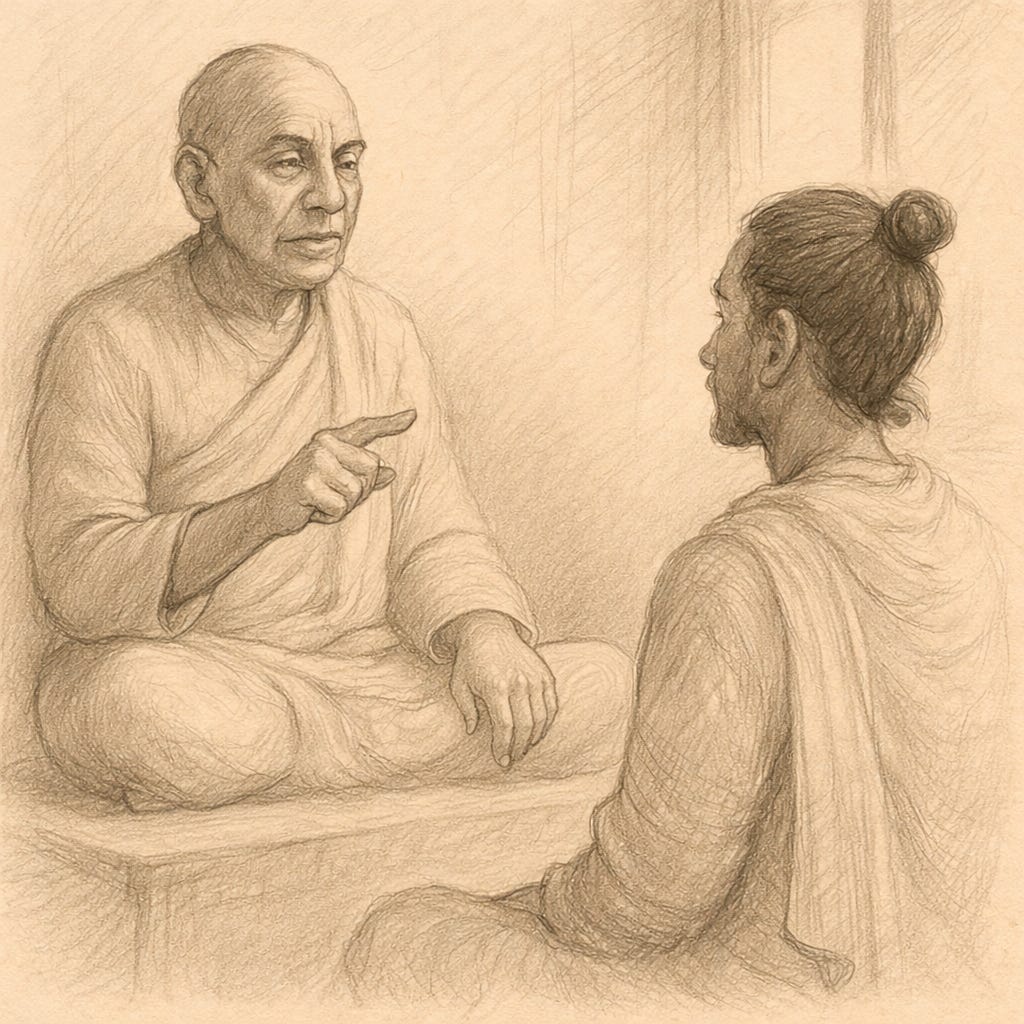
Can a disciple disagree with his or her spiritual master? This is a more complex point than it may seem at first. First of all, there is the question of preferences and personal habits. We are all individuals, and we have different personal tastes and preferences. This exists not only here but also in the spiritual world. The spiritual master may like rice and dhāl, while the disciple may prefer pasta, and that’s perfectly fine.
Then, there is the question of philosophical interpretations. Here, the disciple must be in line with the spiritual master. If the spiritual master teaches that God is a person, but the disciple is convinced that God is an impersonal light, or that in reality we are all God, there is no point in the relationship. The whole idea of a guru-disciple relationship is to learn the scriptures and their practical application from the spiritual master. If the disciple thinks he or she knows better, then there is no point in the relationship with the guru.
A third sphere is opinions around mundane topics. Here we have a giant gray area.
In general, the disciple should respect all the opinions of the spiritual master, even if they appear to disagree with his beliefs, because by definition the spiritual master is accepted as a wiser person and a representative of Kṛṣṇa. He has more experience, more knowledge, and a deeper spiritual vision than the disciple; therefore, when the spiritual master gives an opinion that is contrary to the disciple’s beliefs, he should take it respectfully and try to understand this different side. It may be that the disciple is actually not correct in his belief, or it may be that there are multiple sides to the question.
For example, a disciple may believe that the best for him is to join the army and go to fight for his country in a war, based on ideas like patriotism, or even Vedic principles like the right to kill an invader. The guru, however, may have a different opinion based on the principle of non-violence, the idea that practicing and spreading Kṛṣṇa Consciousness should have precedence over mundane causes and so on, which are higher principles. In such cases, the disciple can avoid serious mistakes by listening.
In many situations, it may also be that the differences in opinion are just not important, and the disciple may just choose to ignore them and focus on more important topics. This is probably also an acceptable instance in many cases.
What to do, however, if there is some disagreement on some important point, philosophical or otherwise? The process then is paripraśnena, to ask questions. The disciple may just respectfully submit his inquiry and share whatever information he has that makes him think differently. The whole idea of accepting a spiritual master is to be able to adjust our vision of the world and bring it closer to Kṛṣṇa Consciousness. By asking questions, the disciple can gradually clarify differences in opinion and acquire a higher understanding. If, however, the disciple consciously disagrees with the spiritual master, this will weaken the relationship. Once, a senior devotee who is now serving as an initiating spiritual master in our movement mentioned to me that, actually, most devotees in our society leave the shelter of their spiritual masters over time. They may not formally reject the guru, but they do this indirectly by just finding other guides and gradually stopping listening to them. This is a gradual process that starts by having unsolved doubts and gradually grows into open disagreement and finally breaks the faith in the competence of the guru.
Self-realized souls not only have a deeper knowledge of the scriptures (based on direct experience, and not just on book knowledge), but they can also offer higher insights even on mundane topics because they process such topics through the filter of Kṛṣṇa Consciousness, offering a higher understanding.
When disciples showed footage of the moon landings to Śrila Prabhupāda, he immediately exclaimed: “See, I told you they would not go!” Some could not understand how Prabhupāda could say that men did not go to the moon even when seeing the video footage on TV, but Prabhupāda had a higher understanding of the topic, being sure that the moon is a celestial planet, and not just a piece of rock orbiting our planet. It doesn’t matter if the Apollo program landed on the Earth’s satellite; they didn’t go to the celestial planet of Chandra mentioned in the Vedas.
Similarly, when Śrila Prabhupāda would speak against women’s liberation, something that was very dear to the hearts of many in the 1970s, this was not based on chauvinism, but on a higher understanding of how women are exploited in modern societies.
We then come to the center of the question. Many don’t see their spiritual masters as self-realized souls. It may be due to doubts raised by the fact that certain people posing as spiritual masters did terrible things in the past, due to the devotee whom we trust not being allowed to accept disciples, or due to our own conditioning, but in any case, it doesn’t change the outcome. Many take the acceptance of a spiritual master as an unavoidable chore that everyone has to do to be accepted as a member of the group. Because of peer pressure or institutional norms, one may accept someone on whom one has no faith, or even not accept the guru as a self-realized soul. Such so-called initiation is analogous to someone who marries someone just for the sake of gaining a surname.
Accepting a spiritual master is actually not so easy, especially nowadays, because it demands us to accept the existence of someone superior to ourselves. Nowadays, the fashion is to see everyone on the same level. Teachers are called “facilitators”, and so on. There is no principle of authority, and this is, of course, very comfortable since it gives us the freedom to think and do whatever we want. The problem is that this concept doesn’t work very well in high spheres of spiritual practice.
Once, a very senior devotee spoke (to a group of Brazilian devotees) about how Brazilians never go back to Godhead. If you go to Goloka and ask where the Brazilian community is, he said, they will send you back to the material world. This was a little concerning to me, since I was born there, so I decided to enquire about it. He explained that as long as one identifies with a material culture and all the faults related to that, there is no possibility of going back to Godhead, since going to the spiritual world includes giving up material labels and accepting one’s original position as a servant of Kṛṣṇa. There are no Brazilians in the spiritual world, just as there are no Americans, Russians, or Indians. They are all in the material world.
Accepting a spiritual master demands that we abandon our previous conditioning and gradually accept our original identity as servants of Kṛṣṇa. One who clings to his old beliefs, culture, and values may stop this process and, as a result, prolong his stay in the material world.
« Things I Wish Someone Had Taught Me When I Started Krishna Consciousness
You can also donate using Buy Me a Coffee, PayPal, Wise, Revolut, or bank transfers. There is a separate page with all the links. This helps me enormously to have time to write instead of doing other things to make a living. Thanks!
Hare Krishna prabhuji...
Prabhuji what to do when two siksha guru give different opinion on a philosophical point. Both are seen as of equal authority, so what should be done in such case?