

Subscribe to receive new articles by e-mail. It’s free, but if you like, you can pledge a donation:
Join the Telegram group if you would like to join the live lessons. This course is maintained with your donations. Click here to donate.
💬 Text of the lesson
The hellish planets
The descriptions of hell in the Fifth Canto are another difficult passage of the text. At first, the punishments described may appear barbaric or disproportionate, but it makes more sense when we understand that they are punishments for specific types of sins. Just as in modern judicial systems, the punishment for a crime has to be significant to discourage people from committing it. If the punishment for stealing were just a small fine, every dishonest person would steal, calculating that if caught, the consequence would be minimal. If instead the punishment for stealing is 10 years in prison, people will think twice.
In Vedic culture, people would know their duties and would also hear descriptions of the punishments for performing grossly immoral acts, and thus would learn to avoid them, understanding the consequences. It is not difficult to understand that one who kills animals or seduces the wives of others will have to face consequences for that.
The greatest risk of modern life is exactly that, because atheistic philosophies are so popular and even established religions more often than not fail to alert their followers to the dangers of animal cruelty and other activities, people are clueless about the consequences of their habits and thus risk falling into very painful situations after death.
There is a phenomenon studied in modern medicine called terminal restlessness, or terminal agitation. People who are about to die commonly become restless, complain about seeing frightening figures and animals in corners or floating around the bed, and even being bound by them, visions that provoke great panic. From the description of the scriptures, we can understand that these are visions of the Yamadūtas preparing to take the soul. The visions usually start a few days before one passes away, and continue until one falls unconscious. Doctors and nurses are trained to deal with these episodes using sedatives, and in this way they just put a person to sleep, trying to create the illusion of a peaceful death. This, however, does nothing to solve the underlying problem. Even if the physical body is put to sleep, one continues to experience the same in the subtle body.
Devotees who have the opportunity of being with relatives and other people in such a situation describe great improvement when they chant the holy names and give the dying person Tulasi, garlands from deities, and so on. This all matches the description of the protective power of the holy names and sacred items. Being engaged in hearing and chanting the holy names is the best way to save oneself from the Yamadūtas, even at the last moment, as described in the history of Ajāmila.
Just as in the case of the general cosmological model of the Vedas, hearing these descriptions can help people to escape from the dangerous path of atheism. By understanding the consequences of their acts, people gain the opportunity to take a different path.
“King Parīkṣit inquired from Śukadeva Gosvāmī: My dear sir, why are the living entities put into different material situations? Kindly explain this to me.
The great sage Śukadeva Gosvāmī said: My dear King, in this material world there are three kinds of activities — those in the mode of goodness, the mode of passion and the mode of ignorance. Because all people are influenced by the three modes of material nature, the results of their activities are also divided into three. One who acts in the mode of goodness is religious and happy, one who acts in passion achieves mixed misery and happiness, and one who acts under the influence of ignorance is always unhappy and lives like an animal. Because of the varying degrees to which the living entities are influenced by the different modes of nature, their destinations are also of different varieties.” (SB 5.26.1-2)
In Western culture, people have in general an aversion to the idea of hell, perhaps due to Christianity having abused this idea for centuries. Even people who are religious often prefer to believe that people just go to heaven or that we immediately reincarnate, without passing through any form of judgment. However, the Śrīmad Bhāgavatam describes in detail the activities of Yamarāja and his servants, as well as the hellish worlds with which they punish the sinful.
Prabhupāda explains the basic rationale in his purport to text five:
“The conditioned souls, who have come to this material world for sense gratification, are allowed to enjoy their senses under certain regulative principles. If they violate these regulations, they are judged and punished by Yamarāja. He brings them to the hellish planets and properly chastises them to bring them back to Kṛṣṇa consciousness. By the influence of māyā, however, the conditioned souls remain infatuated with the mode of ignorance. Thus in spite of repeated punishment by Yamarāja, they do not come to their senses, but continue to live within the material condition, committing sinful activities again and again.”
We don’t live alone in the world. When our actions are not properly directed, we can create a lot of pain to others. Just as people who commit crimes are sent to jail, souls who commit serious sins are sent to hell for some time to be punished for them and thus corrected. The mistake in Christianity is the belief in hell as a place of eternal damnation, instead of a correctional facility.
Such hellish planets are part of the universal model described in the Bhāgavatam and part of the experience of conditioned souls in this world. They are thus included by Śukadeva Gosvāmi in his description of the universe, opening the door for Maharaja Parīkṣit to question how people can become free from such torments, leading, in turn, to the description of the pastime of Ajāmila in the beginning of the Sixty Canto, which emphasizes the potency of the holy names.
Because of their devotional service, devotees are escorted to their next bodies (be it spiritual or material) by the Viṣṇudutas. This is also described in the Bṛhad-bhāgavatāmṛta (2.3.85-91):
“Śrī Gaṇeśa said: These are associates of the ruler of Vaikuṇṭha, the Supreme Lord Śrī Kṛṣṇa. They have attained bodily forms similar to His and have come here from Vaikuṇṭha itself. Just see these other Vaikuṇṭha companions of the Lord, traveling in this small universe ruled by four-headed Brahmā. And further away those others, moving swiftly in the universe of an eight-headed Brahmā, a world twice as large. And those others in the world of a Brahmā with sixteen heads, a world twice as large again.
In this way Gaṇeśa showed me many Vaikuṇṭha companions of the Lord traveling with ease in the millions and billions of universes of multitudes of huge Brahmās, who had millions and billions of lotus faces. The Vaikuṇṭha devotees, attractive to the eyes and mind, all had suitable bodies and were suitably equipped for the universes they were visiting.
Śrī Gaṇeśa continued: These persons cherish only devotional service to the Lord. They travel as they please, spreading pure devotion everywhere. They save the Lord’s devotees from all fears, even at the time of death, if those devotees have but once had even a reflection of the Lord’s name on the tip of their tongues or the path to their ears.”
As Śrila Haridāsa Thākura explains, even chanting on the stage of Nāmābhāsa is capable of destroying one’s sins and bringing a person to the liberated platform, where there is no question of meeting the Yamadūtas. The history of Ajāmila, narrated in the 6th canto of Śrīmad Bhāgavatam, is a graphic illustration of how one can be saved from hell even by chanting at the last moment.
Because Ajāmila was so sinful, the Yamadūtas were prepared to bring him to hell, but at the moment they started snatching the soul from the body using their subtle ropes, the Viṣṇudūtas appeared carrying weapons and ordered them to release Ajāmila, or else. It happened that Ajāmila destroyed all his karma by desperately chanting the name of Narāyana at the last moment. Even though he chanted to call his son (and not directly addressing Lord Narāyana), because he chanted in full concentration, it was sufficient to free him from all his past sinful activities. By the time the Yamadūtas started taking the soul out of the body, he was indeed an innocent man, and thus the Viṣṇudūtas immediately appeared to protect him.
What about the souls who are not so fortunate? How is the severity of the punishment one will receive in hell determined? Śukadeva Gosvāmi explains that it is determined according to one’s individual consciousness. Those who commit sins due to madness receive the least punishment. Those who know the difference between right and wrong, but still commit sins due to weakness, receive moderate punishment, but those who are stubborn atheists, consciously willing to commit sins and deluding themselves with the idea that there is no God, receive the most severe punishment. This is explained in the next verse:
“Just as by executing various pious activities one achieves different positions in heavenly life, by acting impiously one achieves different positions in hellish life. Those who are activated by the material mode of ignorance engage in impious activities, and according to the extent of their ignorance, they are placed in different grades of hellish life. If one acts in the mode of ignorance because of madness, his resulting misery is the least severe. One who acts impiously but knows the distinction between pious and impious activities is placed in a hell of intermediate severity. And for one who acts impiously and ignorantly because of atheism, the resultant hellish life is the worst. Because of ignorance, every living entity has been carried by various desires into thousands of different hellish planets since time immemorial. I shall try to describe them as far as possible.” (SB 5.26.3)
Why do atheists receive a harsher punishment? The point is that the main purpose of this punishment is reformation. The system of justice in the universe is designed to correct and purify the soul, not to eternally condemn. If someone acts out of ignorance, usually a small reaction is sufficient for him to learn. If a person acts knowingly, a stronger reaction is usually needed to make him realize his mistake, and if one is obstinate, arrogant, and fully opposed to the Lord, the punishment must be very strong to break that illusion and bring him to humility.
We can see thus that this topic of hellish punishment is not simple. It is highly nuanced, taking into account the intention, consciousness, knowledge, background, and level of spiritual advancement of each soul. Yamarāja is empowered by the Lord to understand all these factors and thus pass the correct judgment in each case.
Another point is the nature of this punishment. In hell, one does not have a gross body like here; everything happens in a subtle, astral plane. Still, the mind is active, and thus one perceives the experience as painful.
“King Parīkṣit inquired from Śukadeva Gosvāmī: My dear lord, are the hellish regions outside the universe, within the covering of the universe, or in different places on this planet?
The great sage Śukadeva Gosvāmī answered: All the hellish planets are situated in the intermediate space between the three worlds and the Garbhodaka Ocean. They lie on the southern side of the universe, beneath Bhū-maṇḍala, and slightly above the water of the Garbhodaka Ocean. Pitṛloka is also located in this region between the Garbhodaka Ocean and the lower planetary systems. All the residents of Pitṛloka, headed by Agniṣvāttā, meditate in great samādhi on the Supreme Personality of Godhead and always wish their families well.” (SB 5.26.4-5)
Geographically, the hellish planets are situated under Pātāla-loka, a little above the waters of the Garbhodaka ocean. That’s the same place where Pitṛloka, the court of Yamarāja, is situated.
It is described that after leaving his body, Vidura was received by the inhabitants of Pitṛloka. Vidura is Yamarāja himself, who took birth from a maidservant due to a curse, and thus had the opportunity of associating with the Pandavas and being present in many of the personal pastimes of Kṛṣṇa. After leaving his body in Prabhāsa, he was reinstated in his post.
Although situated at the bottom of the universe, Pitṛloka is a celestial place where pious persons who are attached to their families have the opportunity to meet their ancestors and enjoy with them while at the same time observing their descendants on earth. They can remain there as long as their descendants honor them and offer them food and water (piṇḍa) every year. In other words, Pitṛloka offers pious people the possibility of keeping their current identities in the afterlife and remaining connected with their family members, provided that they perform their family duties properly and leave pious descendants who can continue the family tradition, continuing to follow the scriptures and honoring their ancestors according to the rules and regulations. That’s why in Vedic culture, the offerings to the ancestors are considered so important. When this chain is broken, all the ancestors fall from Pitṛloka and the lineage ends. From this point, each ancestor follows his individual destiny, and they forget each other.
That’s what Arjuna refers to when he mentions that, “An increase of unwanted population certainly causes hellish life both for the family and for those who destroy the family tradition. The ancestors of such corrupt families fall down, because the performances for offering them food and water are entirely stopped.” (Bg 1.41)
We can see that there are many possibilities for one’s destiny after life, according to one’s acts. Devotees who directly worship the Lord and focus their attention on Him go back home, back to Godhead. Transcendentalists engaged in meditation and other advanced spiritual practices can be elevated to Maharloka and upwards, up to the impersonal Brahmajyoti, while those who spend their time performing fruitive activities may reach Svargaloka, or the earthly heavens of Bhū-mandala. Those who perform their duties and are dedicated to family traditions may enjoy Pitṛloka, while others who don’t do anything special, but have some rudimentary faith in God and are not very sinful, may take birth again as human beings on this planet.
There are many different paths. Even if one is an atheist, if one can act according to the precepts of the scriptures, avoiding gross sinful activities, one can have the opportunity of enjoying one of the subterranean heavens. However, if one doesn’t want to follow any religious principle at all and just enjoys at the cost of the suffering of others, then one may see himself surrounded by the Yamadūtas after death. As Prabhupāda explains in his purport to text 15:
“It doesn’t matter which set of religious principles one follows: the only injunction is that he must follow them strictly. An atheist, or nāstika, is one who does not believe in the Vedas. However, even if one takes up a different system of religion, according to this verse he must follow the religious principles he has accepted. Whether one is a Hindu, or a Mohammedan or a Christian, he should follow his own religious principles. However, if one concocts his own religious path within his mind, or if one follows no religious principles at all, he is punished in the hell known as Asi-patravana. In other words, a human being must follow some religious principles. If he does not follow any religious principles, he is no better than an animal. As Kali-yuga advances, people are becoming godless and taking up so-called secularism. They do not know the punishment awaiting them in Asi-patravana, as described in this verse.”
The path that a sinful person is forced to take is described earlier in the Śrīmad Bhāgavatam by Lord Kapila. There, it is described that:
“At death, he sees the messengers of the lord of death come before him, their eyes full of wrath, and in great fear he passes stool and urine. As a criminal is arrested for punishment by the constables of the state, a person engaged in criminal sense gratification is similarly arrested by the Yamadūtas, who bind him by the neck with strong rope and cover his subtle body so that he may undergo severe punishment.
While carried by the constables of Yamarāja, he is overwhelmed and trembles in their hands. While passing on the road he is bitten by dogs, and he can remember the sinful activities of his life. He is thus terribly distressed.
Under the scorching sun, the criminal has to pass through roads of hot sand with forest fires on both sides. He is whipped on the back by the constables because of his inability to walk, and he is afflicted by hunger and thirst, but unfortunately there is no drinking water, no shelter and no place for rest on the road. While passing on that road to the abode of Yamarāja, he falls down in fatigue, and sometimes he becomes unconscious, but he is forced to rise again. In this way he is very quickly brought to the presence of Yamarāja. Thus he has to pass ninety-nine thousand yojanas within two or three moments, and then he is at once engaged in the torturous punishment which he is destined to suffer.” (SB 3.30.19-24)
This path corresponds to a subtle path from our planet all the way to the bottom of the universe, where one is first judged and then sent to the appropriate hellish planets according to his sins.
The Sāroddhāra recension of the Garuḍa Purana describes that there are a total of four paths that one can take after death to the castle of Yamarāja. They are taken by different classes of people according to their actions:
dharmarājapure yānti tribhir dvārais tu dhārmikāḥ
pāpās tu dakṣiṇa-dvāra-mārgeṇaiva vrajanti tat“In the city of Dharmarāja, the righteous pass through three gates; but sinners reach it only by the route of the southern gate.”
The description of the Śrīmad Bhāgavatam matches the description of the path to the southern gate, which is the path taken by sinful people, who are meant to be punished in hell. On this path, they face the scorching sun, are beaten by the Yamadūtas, and so on. This is already part of the hellish punishment they are entitled to. The other three paths (to the east, north, and west) are reserved for pious people who follow the principles of the scriptures: great kings, brāhmanas, renounced sages, and others practicing advanced pious or spiritual activities. They are decorated with many trees and gardens, refreshments, and so on. The pious go through these paths escorted by pleasant companions who help them in the journey. Reaching the city of Yamarāja, they are received personally by him, who appears in a pleasant form, describing their pious actions before awarding them the results. This is, however, rare for people of our age.
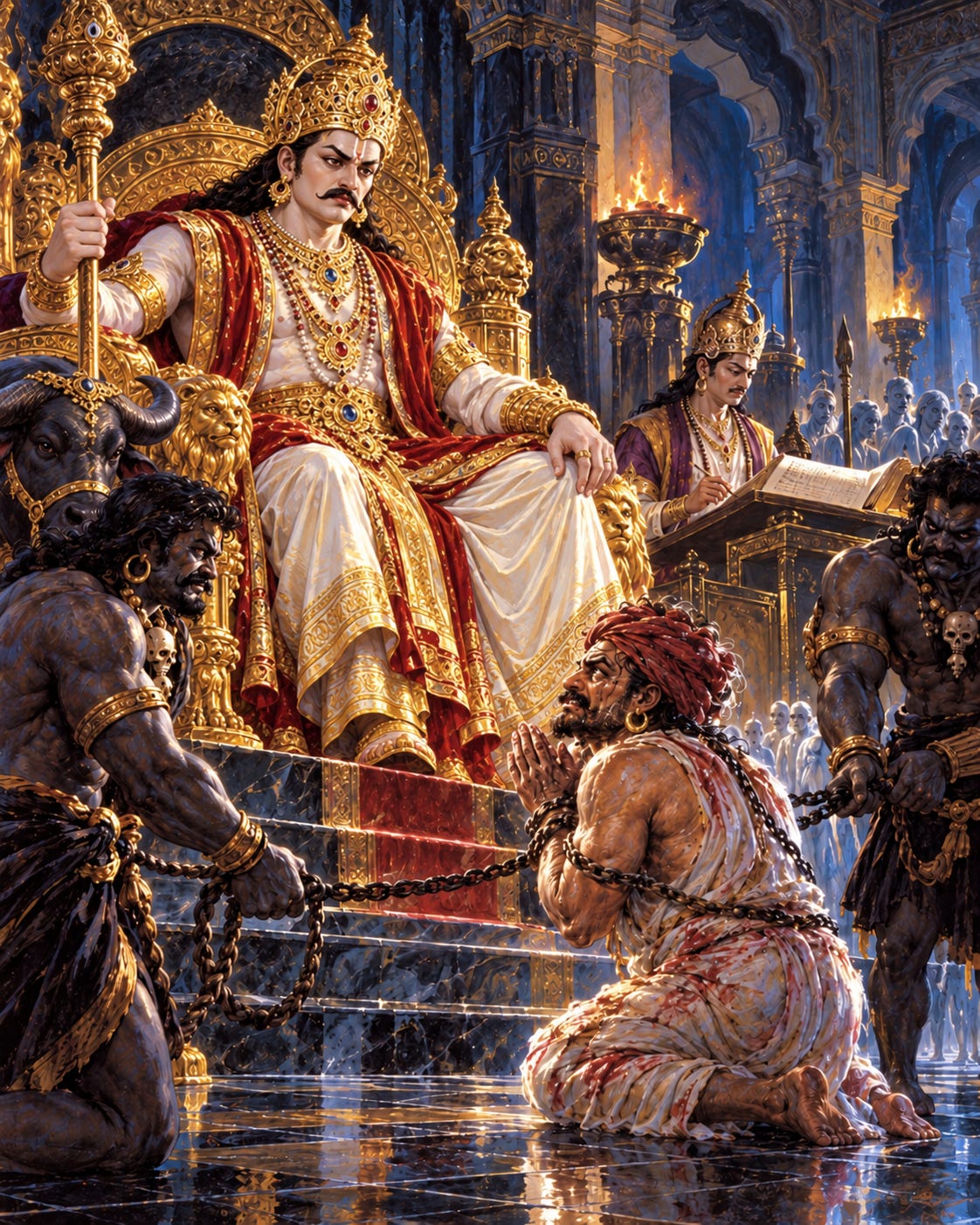
“The King of the pitās is Yamarāja, the very powerful son of the sun-god. He resides in Pitṛloka with his personal assistants and, while abiding by the rules and regulations set down by the Supreme Lord, has his agents, the Yamadūtas, bring all the sinful men to him immediately upon their death. After bringing them within his jurisdiction, he properly judges them according to their specific sinful activities and sends them to one of the many hellish planets for suitable punishments.
Some authorities say that there is a total of twenty-one hellish planets, and some say twenty-eight. My dear King, I shall outline all of them according to their names, forms and symptoms. The names of the different hells are as follows: Tāmisra, Andhatāmisra, Raurava, Mahāraurava, Kumbhīpāka, Kālasūtra, Asipatravana, Sūkaramukha, Andhakūpa, Kṛmibhojana, Sandaṁśa, Taptasūrmi, Vajrakaṇṭaka-śālmalī, Vaitaraṇī, Pūyoda, Prāṇarodha, Viśasana, Lālābhakṣa, Sārameyādana, Avīci, Ayaḥpāna, Kṣārakardama, Rakṣogaṇa-bhojana, Śūlaprota, Dandaśūka, Avaṭa-nirodhana, Paryāvartana and Sūcīmukha. All these planets are meant for punishing the living entities.” (SB 5.26.6-7)
Yamarāja is an empowered living entity who receives the power of observing all activities of all human beings to reward or punish them according to their actions. Not all living beings are judged by him. As Prabhupāda explains in his purport to 6.3.12,
“Yamarāja is in charge of some of the moving living entities, namely the human beings, but the animals, who also move, are not under his control. Only human beings have consciousness of right and wrong, and among them only those who perform sinful activities come under the control of Yamarāja. Therefore although Yamarāja is a controller, he is only a departmental controller of a few living entities. There are other demigods who control many other departments, but above them all is one supreme controller, Kṛṣṇa.”
Even though so powerful, Yamarāja does not work alone. He is in charge of a large police force, composed of millions of Yamadūtas. They are very strong and ruthless, and in general can’t be challenged even by demigods. In the Ramayana, it is described that once Rāvana attacked hell and fought with the Yamadūtas with the intention of challenging Yamarāja to a fight. He took a beating and could defeat them only by invoking the pāśupata-astra he had previously received from Lord Śiva.
Who are they? In the Garuḍa Purāṇa (2.18.34), it is mentioned that “Those who have passed several years in the dreadful hell and have no descendants (to offer gifts) in their favor become messengers of Yama.”
In his purport to Bg 1.14, Prabhupāda mentions that,
“According to the rules and regulations of fruitive activities, there is a need to offer periodical food and water to the forefathers of the family. This offering is performed by worship of Viṣṇu, because eating the remnants of food offered to Viṣṇu can deliver one from all kinds of sinful reactions. Sometimes the forefathers may be suffering from various types of sinful reactions, and sometimes some of them cannot even acquire a gross material body and are forced to remain in subtle bodies as ghosts. Thus, when remnants of prasādam food are offered to forefathers by descendants, the forefathers are released from ghostly or other kinds of miserable life. Such help rendered to forefathers is a family tradition, and those who are not in devotional life are required to perform such rituals. One who is engaged in the devotional life is not required to perform such actions. Simply by performing devotional service, one can deliver hundreds and thousands of forefathers from all kinds of misery.”
We can see thus that a person who falls into hell under a heavy load of sins can still be saved if he has living descendants who can offer him prasādam or save him by becoming devotees. If, however, one has no living descendants, one falls into a very dangerous position, having a very long sentence ahead, without any hope of being saved. In such cases, Yamarāja can show compassion and convert their sentences into work as Yamadūtas, just as sometimes prisoners are engaged in guarding and punishing other prisoners.
Yamadūtas act carefully under the orders of Yamarāja and are very devoted to him. We can see that the Yamadūtas who went to take Ajāmila in the Sixth Canto saw Yamarāja as the Supreme Lord and became deeply surprised in seeing that there was someone above him.
“My dear King, a person who appropriates another’s legitimate wife, children or money is arrested at the time of death by the fierce Yamadūtas, who bind him with the rope of time and forcibly throw him into the hellish planet known as Tāmisra. On this very dark planet, the sinful man is chastised by the Yamadūtas, who beat and rebuke him. He is starved, and he is given no water to drink. Thus the wrathful assistants of Yamarāja cause him severe suffering, and sometimes he faints from their chastisement.
The destination of a person who slyly cheats another man and enjoys his wife and children is the hell known as Andhatāmisra. There his condition is exactly like that of a tree being chopped at its roots. Even before reaching Andhatāmisra, the sinful living being is subjected to various extreme miseries. These afflictions are so severe that he loses his intelligence and sight. It is for this reason that learned sages call this hell Andhatāmisra.” (SB 5.26.8-9)
Family life is considered very sacred in Vedic culture. Not only is one’s family very central to his duties and place in society, but it is also the place where one can perform the service of educating his children in God consciousness. Having one’s wife or children taken away is certainly a very painful experience, and it is also very damaging for society at large. If one treacherously commits such a sin, one becomes entitled to be punished on this particular planet.
“A person who accepts his body as his self works very hard day and night for money to maintain his own body and the bodies of his wife and children. While working to maintain himself and his family, he may commit violence against other living entities. Such a person is forced to give up his body and his family at the time of death, when he suffers the reaction for his envy of other creatures by being thrown into the hell called Raurava.
In this life, an envious person commits violent acts against many living entities. Therefore after his death, when he is taken to hell by Yamarāja, those living entities who were hurt by him appear as animals called rurus to inflict very severe pain upon him. Learned scholars call this hell Raurava. Not generally seen in this world, the ruru is more envious than a snake.
Punishment in the hell called Mahāraurava is compulsory for a person who maintains his own body by hurting others. In this hell, ruru animals known as kravyāda torment him and eat his flesh.
For the maintenance of their bodies and the satisfaction of their tongues, cruel persons cook poor animals and birds alive. Such persons are condemned even by man-eaters. In their next lives they are carried by the Yamadūtas to the hell known as Kumbhīpāka, where they are cooked in boiling oil.” (SB 5.26.10-13)
The rurus are not regular animals. They are very angry and have very strong bodies, and are thus capable of causing great suffering. From where do they come? The very animals and other creatures that a person tortured in his life have the opportunity to take such forms to avenge their suffering.
In the Fourth Canto, it is described that Nārada Muni showed these rurus to King Prācīnabarhi in a visual display of what was awaiting him after death due to his indiscriminate killing of animals in unnecessary fruitive sacrifices:
“The great saint Nārada said: O ruler of the citizens, my dear King, please see in the sky those animals which you have sacrificed without compassion and without mercy in the sacrificial arena. All these animals are awaiting your death so that they can avenge the injuries you have inflicted upon them. After you die, they will angrily pierce your body with iron horns.” (SB 4.25.7-8)
This is, however, not something imposed. The animals are not forced to take such forms, but if they keep a grudge against their tormentor, they have this opportunity of waiting for him or her at the doors of the hellish planets to get their revenge. After that, they continue their evolutionary path.
In his purport to text 10, Prabhupāda explains, “If one simply considers his body to be his self, as do the animals, he is not very sinful. However, if one needlessly commits sins to maintain his body, he is put into the hell known as Raurava. This is the opinion of Śrīla Viśvanātha Cakravartī Ṭhākura. Although animals are certainly in the bodily concept of life, they do not commit any sins to maintain their bodies, mates or offspring. Therefore animals do not go to hell. However, when a human being acts enviously and cheats others to maintain his body, he is put into a hellish condition.”
Meat eating is sanctioned in the scriptures in certain cases and for certain types of persons, but never with unnecessary cruelty. When Nārada Muni saw Mṛgāri torturing the animals before killing them, intentionally shooting them at non-vital points so they would bleed to death, he asked him to at least kill the animals immediately, so they would not suffer in that way. At that occasion, he also showed him the punishment that was awaiting him in hell. This led Mṛgāri to have a change of heart and stop killing animals altogether, becoming a pure Vaiṣnava instead.
“The killer of a brāhmaṇa is put into the hell known as Kālasūtra, which has a circumference of eighty thousand miles and which is made entirely of copper. Heated from below by fire and from above by the scorching sun, the copper surface of this planet is extremely hot. Thus the murderer of a brāhmaṇa suffers from being burned both internally and externally. Internally he is burning with hunger and thirst, and externally he is burning from the scorching heat of the sun and the fire beneath the copper surface. Therefore he sometimes lies down, sometimes sits, sometimes stands up and sometimes runs here and there. He must suffer in this way for as many thousands of years as there are hairs on the body of an animal.” (SB 5.26.14)
In Vedic societies, brāhmanas and cows have special importance, for the brāhmanas take care of the society spiritually, while cows and bulls maintain it materially, with milk, labor, and fertilizer for agriculture. Brāhmanas and cows are thus considered most beneficial for any civilized society. Due to their importance, and also for the fact that they are basically defenseless, it is considered a great sin to kill them. If, despite this strong warning from the scriptures, one so does, he becomes eligible for being tormented in this particular type of hell.
“If a person deviates from the path of the Vedas in the absence of an emergency, the servants of Yamarāja put him into the hell called Asi-patravana, where they beat him with whips. When he runs hither and thither, fleeing from the extreme pain, on all sides he runs into palm trees with leaves like sharpened swords. Thus injured all over his body and fainting at every step, he cries out, “Oh, what shall I do now! How shall I be saved!” This is how one suffers who deviates from the accepted religious principles.” (SB 5.26.15)
People who were born in Vedic societies would be trained from birth to follow the path of the Vedas and worship the Supreme Lord. This was a great privilege that would allow them to follow the path of piety since early life, instead of being born in degraded families and having the opportunity to come in contact with Kṛṣṇa Consciousness only later on, as most of us nowadays. However, this would also come with a great responsibility, since they were expected to continue following these principles. An innocent person who was never educated in the Vedas, and because of this would commit different sinful activities, would not be punished in the same way as someone who was born in an advanced society and received proper training since birth, but still chose to live a life of sin, even though having all opportunities and understanding that these activities are wrong.
There is also the question of emergencies. Sometimes there would be great famines, and people would be forced to eat animals or other types of food that would normally not be acceptable. This would generally not be considered very sinful if performed under certain limits. However, if one were to kill an animal without necessity, just to enjoy the meat, there would be serious punishment.
What about us? Even though we may not be expected to follow rules and regulations to the same extent as people born in Vedic societies, we still need to accept the laws of God. Prabhupāda explains how this applies to our reality in his purport.
Dharmaṁ tu sākṣād bhagavat-praṇītam: The only religious principle is to follow the orders of the Supreme Personality of Godhead. The dharma for this age is to adopt the process of saṅkīrtana, chanting the holy names of the Lord. When we do that, not only do we automatically advance in spiritual realization, but we are also excused for past sinful activities. There are also other systems of religion that offer other forms of God worship. Everyone should follow one of these systems and abide by the rules and regulations prescribed, thus following the laws of God at least to some level. If one intentionally rejects the path of religion and becomes an atheist, living a life of sin, disregarding all regulations from the scriptures, one becomes eligible to be punished in this particular hell.
In this context, it’s important to note that both the Bible and the Quran contain passages that condemn the killing of animals, such as “Thou shalt not kill”. This is not unique to Vaiṣṇava literature. The difficulty is that people opt to overlook these rules. Other forms of animal cruelty are also punishable. As described in texts 32 to 34.
“In his next life, a sinful king or governmental representative who punishes an innocent person, or who inflicts corporal punishment upon a brāhmaṇa, is taken by the Yamadūtas to the hell named Sūkaramukha, where the most powerful assistants of Yamarāja crush him exactly as one crushes sugarcane to squeeze out the juice. The sinful living entity cries very pitiably and faints, just like an innocent man undergoing punishments. This is the result of punishing a faultless person.” (SB 5.26.16)
Kings, ministers, and other government officials concentrate a great deal of power, but this power is supposed to be used to protect the innocent. If instead one becomes cruel or corrupt and uses this power to oppress, punishing innocent people, he becomes eligible to be punished on this particular planet.
Brāhmanas are generally considered out of the jurisdiction of common law. Even if a brāhmana commits some mistake, he is supposed to be corrected by other brāhmanas or realize the mistake himself and atone for it. If a brāhmana commits serious sins and doesn’t atone for them, he is eligible to be punished by Yamarāja. However, a brāhmana is never supposed to be imprisoned, whipped, or hanged like an ordinary criminal. If a government officer were to do that, he would also become eligible to be punished in this way.
“By the arrangement of the Supreme Lord, low-grade living beings like bugs and mosquitoes suck the blood of human beings and other animals. Such insignificant creatures are unaware that their bites are painful to the human being. However, first-class human beings — brāhmaṇas, kṣatriyas and vaiśyas — are developed in consciousness, and therefore they know how painful it is to be killed. A human being endowed with knowledge certainly commits sin if he kills or torments insignificant creatures, who have no discrimination. The Supreme Lord punishes such a man by putting him into the hell known as Andhakūpa, where he is attacked by all the birds and beasts, reptiles, mosquitoes, lice, worms, flies, and any other creatures he tormented during his life. They attack him from all sides, robbing him of the pleasure of sleep. Unable to rest, he constantly wanders about in the darkness. Thus in Andhakūpa his suffering is just like that of a creature in the lower species.” (SB 5.26.17)
The most fundamental religious principle is non-violence. We can see that Lord Buddha was forced to reject the Vedas because people at the time were misusing the authority of the scriptures and indiscriminately killing animals. He thus centered his message on the idea of non-violence, bringing people back to the path of piety and creating the basis for the work of the following ācāryas.
Even insects that bite, such as mosquitoes, should not be killed, for they lack the understanding that their bites create pain to others and are thus considered to be innocent. Animals may kill each other, like a tiger hunting a deer, or a spider capturing another insect, but as human beings we are gifted with superior intelligence and should use it to find peaceful ways to deal with disturbing insects and other creatures. As Prabhupāda explains in his purport, “Although a tiger is not sinful if he attacks another animal and eats its flesh, if a man with developed consciousness does so, he must be punished.”
Even if one argues that this is too difficult for general people to follow, the scriptures prescribe that at least brāhmaṇas, kṣatriyas, and vaiśyas, who would receive higher education, should follow this principle. If a member of these higher classes indiscriminately kills these animals, he or she becomes eligible to be punished in this particular place.
This is a publication for thoughtful readers who want to go deeper into Kṛṣṇa consciousness. I publish daily, trying to offer high-quality spiritual content, and all posts are available to free subscribers. If you wish, you can support this work with a monthly contribution. When you subscribe, you can choose between a free subscription and a monthly contribution, and you can switch from a free subscriber to a supporter at any time.
If you would like to contribute further, you can find the donation links here.