

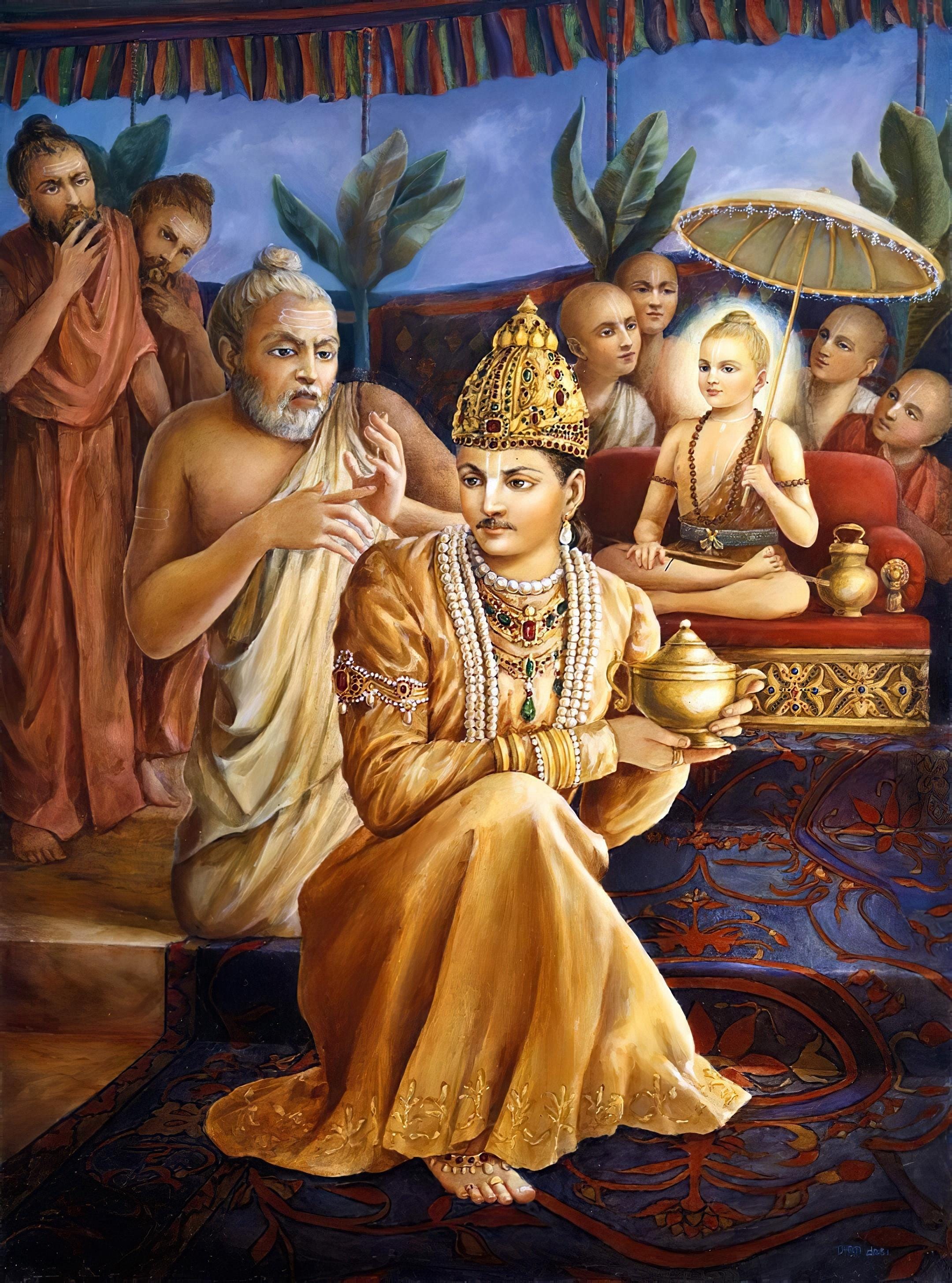
The pastime of Bali Maharaja donating the three planetary systems to Vāmanadeva is described in the eighth canto of the Śrīmad-Bhāgavatam. The Lord appeared in the form of a dwarf brāhmana and begged a donation of three steps of land, on the measurement of his steps, which was immediately granted by Bali. However, the Lord expanded his size, and thus when He took His first step, He covered the entire surface of the earth. Expanding even more, He not only covered the three planetary systems with His second step but in fact kicked the coverings of the universe, creating a crack from which the waters of the Causal Ocean started dripping inside the universe, creating the river Ganges that flows through the numerous planetary systems of the universe.
In the Fifth Canto, chapter 24, there is another, more detailed description of the pastime of Bali Maharaja that focuses on his devotional attitude. This is the passage that reveals the depth of his devotional sentiments.
First of all, what happened with Bali after the Lord, as Vamanadeva, took away all his possessions? Sukadeva Gosvami answers:
“Below the planet Vitala is another planet, known as Sutala, where the great son of Mahārāja Virocana, Bali Mahārāja, who is celebrated as the most pious king, resides even now. For the welfare of Indra, the King of heaven, Lord Viṣṇu appeared in the form of a dwarf Brahmācārī as the son of Aditi and tricked Bali Mahārāja by begging for only three paces of land but taking all the three worlds. Being very pleased with Bali Mahārāja for giving all his possessions, the Lord returned his kingdom and made him richer than the opulent King Indra. Even now, Bali Mahārāja engages in devotional service by worshiping the Supreme Personality of Godhead in the planet of Sutala.” (SB 5.24.18)
Prahlāda Maharaja became the king of Sutala after Lord Nṛsiṁhadeva killed Hiraṇyakaśipu. Later, the throne was passed to Virocana and then to Bali, who eventually became the king of the three worlds after defeating the demigods. After donating the three planetary systems to Vāmanadeva, Bali Maharaja was reinstalled as the king of Sutala, where he continues to worship the Lord while living in great material opulence. Since he desired to control the celestial planetary system, he was blessed by the Lord to become the next Indra (in the 8th Manvantara), reigning over the celestial sphere without opposition for an entire Manvantara before going back to Godhead. Meanwhile, the Lord stays continuously with him, serving him as his doorman.
Prabhupāda describes it beautifully in his purport:
“Bali Mahārāja offered everything to the Lord — his wealth, his kingdom and even his own body (sarvātma-nivedane baliḥ). The Lord appeared before Bali Mahārāja as a brāhmaṇa beggar, and Bali Mahārāja gave Him everything he had. However, Bali Mahārāja did not become poor; by donating all his possessions to the Supreme Personality of Godhead, he became a successful devotee and got everything back again with the blessings of the Lord. Similarly, those who give contributions to expand the activities of the Kṛṣṇa consciousness movement and to accomplish its objectives will never be losers; they will get their wealth back with the blessings of Lord Kṛṣṇa.”
Bali Maharaja was a disciple of Śukrācārya, the seminal guru of the demons. Śukrācārya certainly instructed him in politics, fruitive activities, and so on. However, Bali Maharaja understood that everything should be offered to Lord Viṣnu. When the Lord appeared before him as Vāmanadeva, Śukrācārya revealed his true face, telling Bali to withdraw his promise of giving Him three steps of land and justify it politically. Bali, however, was determined to surrender everything to the Lord and rejected the so-called guru. Bali Maharaja became thus a perfect devotee, accepted as one of the twelve Mahājanas.
Being reinstalled as the ruler of Sutala and being scheduled to become the next Indra are not results of Bali having surrendered his possessions. These are just token blessings from the Lord because of his previous material desires, just as in the case of Dhruva Maharaja becoming king after his father. The real result is his pure love of Godhead. This pure love, in turn, makes the Lord never desire to leave his company.
Material opulence that comes as a result of ordinary karma is often an obstacle to the practice of devotional service, because it tends to make us forget Kṛṣṇa. Therefore, when a devotee is especially sincere, the Lord often takes such material opulence away, so the devotee can advance swiftly. As Prabhupāda mentions, when a neophyte devotee is materially opulent, he forgets the service of the Lord.
There is, however, another type of opulence that is directly given by the Lord for pure devotees who are ready to engage it in His service. By engaging these material facilities, these pure devotees can then expand their devotional service to the Lord. Prabhupāda thus concludes that the material opulences offered to Bali Maharaja, who became even more opulent than the demigods as the ruler of the Sutala planetary system, are not material.
These opulences were not given as a result of his charity, as in ordinary karma. They were given because of his love and devotion to facilitate his devotional service and are free from material inebriety. In other words, this opulence given to Bali Maharaja does not manifest from the illusory potency; it manifests from yoga-maya, the spiritual potency that connects us with Kṛṣṇa.
However, even this spiritual opulence is not the real gift. The real result is pure devotional service. The opulence is just to facilitate that.
One point that could be contested in this pastime is why did the Lord appear as a brāhmana and beg from Bali? Why didn’t He appear in a powerful form and just take everything by force? This is also described by Sukadeva Gosvami:
“When the Supreme Personality of Godhead could see no other means of taking everything away from Bali Mahārāja, He adopted the trick of begging from him and took away all the three worlds. Thus only his body was left, but the Lord was still not satisfied. He arrested Bali Mahārāja, bound him with the ropes of Varuṇa and threw him in a cave in a mountain. Nevertheless, although all his property was taken and he was thrown into a cave, Bali Mahārāja was such a great devotee that he spoke as follows.
Alas, how pitiable it is for Indra, the King of heaven, that although he is very learned and powerful and although he chose Bṛhaspati as his prime minister to instruct him, he is completely ignorant concerning spiritual advancement. Bṛhaspati is also unintelligent because he did not properly instruct his disciple Indra. Lord Vāmanadeva was standing at Indra’s door, but King Indra, instead of begging Him for an opportunity to render transcendental loving service, engaged Him in asking me for alms to gain the three worlds for his sense gratification. Sovereignty over the three worlds is very insignificant because whatever material opulence one may possess lasts only for an age of Manu, which is but a tiny fraction of endless time.” (SB 5.24.23-24)
The traditional process for testing the purity of gold is to rub it against a testing stone. When gold is pure, it is quite soft, and when rubbed, it would leave a golden mark on the stone. Kṛṣṇa is sometimes compared to a testing stone because He sometimes tests His devotees to show their devotion. Why does He do that? For two purposes: to show the extent of the devotion of His pure devotees, giving the example to others, and to glorify His devotees, making their fame well known all over the universe. We can see that we still draw inspiration from the stories of the Pandavas, Prahlāda Maharaja, and so on, devotees who went through this rubbing treatment and demonstrated the depth of their devotion.
Because Vāmanadeva wanted Bali to show the real extent of his devotion, He didn’t become satisfied when Bali surrendered his possessions and even his own body. To show the extent of Bali’s devotional sentiments, he bound him with ropes and threw him inside a mountain cave, just as an ordinary prisoner. Bali, however, didn’t protest. He felt fortunate for receiving the reciprocation of the Lord and instead felt pity for Indra, who, instead of asking the Lord for pure devotional service, engaged Him in getting the three planetary systems back.
The first verse mentions that Kṛṣṇa could see no other means of taking everything away from Bali Mahārāja. What does it mean? When Hiraṇyakaśipu took heaven away from the demigods and threatened Prahlāda, Kṛṣṇa appeared as Nṛsiṁhadeva to kill him. However, Bali is a pure devotee; therefore, Kṛṣṇa can’t fight him, due to affection. The only way left to give back the three planetary systems to the demigods was to appear in the form of a brāhmana and beg it from him.
As Vāmanadeva, the Lord appeared as the son of Aditi, the brother of Indra. Instead of asking for pure devotional service, however, the demigods engaged him in getting the three words back from Bali Maharaja. Even Bṛhaspati, their spiritual master, did not protest. Bali Mahārāja thus pities both, considering them unintelligent and unaware of the true goal of life. Even bound in ropes inside the cave, he is satisfied, being situated in his pure devotional sentiments.
In His Śikṣāṣṭakam, Śrī Caitanya Mahāprabhu prays, “I know no one but Kṛṣṇa as my Lord, and He shall remain so even if He handles me roughly by His embrace or makes me brokenhearted by not being present before me. He is completely free to do anything and everything, for He is always my worshipful Lord, unconditionally.”
These prayers reveal the platform of ātma-nivedana, of surrendering everything to the Lord, unconditionally. Bali Maharaja is situated on this platform, and the Lord appeared to act roughly with him by binding him with ropes, etc., to demonstrate it. Rubbed against the testing stone, Bali Maharaja showed his true value, and purchased the Lord by his devotion. Indra got back his temporary material possessions, as he desired, but Bali Maharaja gained the eternal company of the Lord.
This is a publication for thoughtful readers who want to go deeper into Kṛṣṇa consciousness. I publish daily, trying to offer high-quality spiritual content, and all posts are available to free subscribers. If you wish, you can also choose a paid subscription to support this work.
You can also receive the updates on WhatsApp or Telegram.
If you would like to contribute further, you can find the donation links here.