


You can receive new articles directly in your inbox. Subscription is free; donations are welcome.
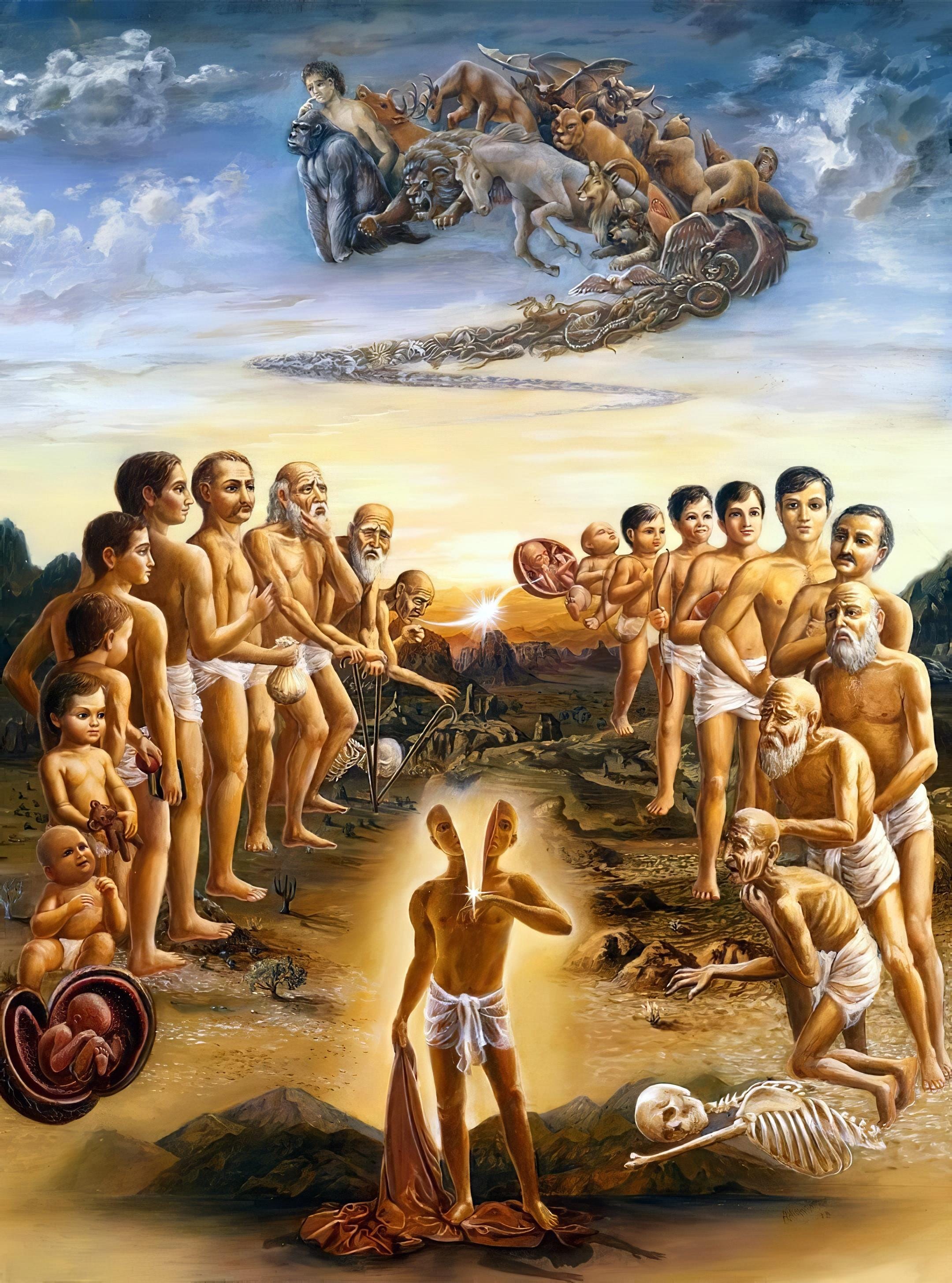
We hear we are the soul and not the body. This is the foundation of the philosophy of the Bhagavad-gītā. Once we get a material body, we identify with it, and thus we transmigrate from one body to another, birth after birth. However, did you ever stop to think how the transcendental soul acquires a material body in the first place? Is it by accident or by some cause?
Parīkṣit Maharaja asked exactly the same question to Śukadeva Goswami:
“O learned brāhmaṇa, the transcendental spirit soul is different from the material body. Does he acquire the body accidentally or by some cause? Will you kindly explain this, for it is known to you.” (SB 2.8.7)
We can practically see that attachment to the body and to things connected with the body can be very strong. Unfortunately, the material body is temporary, and so are all the material things that are connected with it. This creates an undesirable situation: the soul is originally eternal and blissful, but because of this attachment to matter, we come in contact with suffering and death. In his pure state, the soul can travel everywhere, like Nārada Muni, but in the conditioned state, we become restricted. Our consciousness becomes very narrow and our world very small.
Why does this happen? Here is Śukadeva Gosvāmī’s answer:
“Śrī Śukadeva Gosvāmī said: O King, unless one is influenced by the energy of the Supreme Personality of Godhead, there is no meaning to the relationship of the pure soul in pure consciousness with the material body. That relationship is just like a dreamer’s seeing his own body working. The illusioned living entity appears in so many forms offered by the external energy of the Lord. While enjoying in the modes of material nature, the encaged living entity misconceives, thinking in terms of “I” and “mine.”
As soon as the living entity becomes situated in his constitutional glory and begins to enjoy the transcendence beyond time and material energy, he at once gives up the two misconceptions of life [I and mine] and thus becomes fully manifested as the pure self.” (SB 2.9.1-3)
The soul and the body are two different entities, and they have no factual relationship. It’s like the difference between a human being and a phone. What does a man have in common with a phone? Practically nothing; they are two objects of entirely different natures. We are not phones, and we can’t develop relationships with phones. We don’t even look like phones. Although very complex, a phone is just a machine. However, people become absorbed in phones, to the point of forgetting their real lives.
What about the soul? Śukadeva Gosvāmī mentions that it is only because of the influence of the illusory energy that the soul can identify with the body and share the pain and pleasures enjoyed by it.
And what is this illusory energy? Is it some rival force that challenges God, like the devil in Christianity? No, Māyā is also an energy of Kṛṣṇa. When Vyāsadeva was meditating in order to compile the Śrīmad-Bhāgavatam, he saw that Māyā remains under the full control of the Lord.
If Kṛṣṇa controls Māyā, why does he allow us to remain under her grip? Prabhupāda explains it as due to the minute independence of the soul. As parts and parcels of Kṛṣṇa, we have a minute freedom, which Kṛṣṇa respects. A father may not agree with all the life choices made by his sons, but he has to respect their decisions.
What we do with our minute freedom is up to us. We can use this freedom to choose to serve Kṛṣṇa or not. When we decide we don’t want to serve Kṛṣṇa, we are captured by His illusory potency.
This principle is mentioned in the Prema-vivarta:
kṛṣṇa-bahirmukha hañā bhoga-vāñchā kare
nikaṭa-stha māyā tāre jāpaṭiyā dhareWhen the soul turns away from Kṛṣṇa and desires material enjoyment, māyā, who is nearby, captures him.
Prabhupāda explains this point in His purport to SB 2.9.1:
“The answer is that the Lord clearly wishes that every living entity be in his pure consciousness as a part and parcel of the Lord and thus be engaged in the loving service of the Lord as he is constitutionally made; but because the living entity is partially independent also, he may not be willing to serve the Lord, but may try to become as independent as the Lord is. All the nondevotee living entities are desirous of becoming equally as powerful as the Lord, although they are not fit to become so. The living entities are illusioned by the will of the Lord because they wanted to become like Him. Like a person who thinks of becoming a king without possessing the necessary qualification, when the living entity desires to become the Lord Himself, he is put in a condition of dreaming that he is a king. Therefore the first sinful will of the living entity is to become the Lord, and the consequent will of the Lord is that the living entity forget his factual life and thus dream of the land of utopia where he may become one like the Lord. The child cries to have the moon from the mother, and the mother gives the child a mirror to satisfy the crying and disturbing child with the reflection of the moon. Similarly, the crying child of the Lord is given over to the reflection, the material world, to lord it over as karmī and to give this up in frustration to become one with the Lord.”
Both life in the material world and in the impersonal Brahmajyoti are fallen positions. In the material world we identify with the body and mind, and in the Brahmajyoti we identify with the mistaken concept of being one with the Lord. Until we can finally realize our eternal constitutional position of service to Kṛṣṇa, we continue to travel up and down without finding a permanent position, going from one body to the other, up to the Brahmajyoti and back.
One example that could be given is a game on the phone. One may identify with the knight inside the game and be happy when it kills an orc, and unhappy when it dies, but there is no factual relationship between the human being and the character in the game. It is simply a matter of identification, the “I” and “mine” applied to the wrong object.
As long as one identifies with the game, he or she may continue playing, but as soon as this identification is broken, one puts the phone down and returns to his life. How can we break our identification with the body? By reviving our original nature through the process of Kṛṣṇa consciousness. As we realize there is a life outside the confinement we are in, we become progressively less interested in the material illusion.
Read more:


This is a publication for thoughtful readers who want to go deeper into Kṛṣṇa consciousness. I publish daily, trying to offer high-quality spiritual content, and all posts are available to free subscribers. If you wish, you can support this work with a monthly contribution. When you subscribe, you can choose between a free subscription and a monthly contribution, and you can switch from a free subscriber to a supporter at any time.
You can also receive updates on WhatsApp or Telegram.
If you would like to contribute further, you can find the donation links here.