

You can receive new articles directly in your inbox. Subscription is free; donations are welcome.
In the introduction of the Bhagavad-gītā, Prabhupāda mentions:
“Therefore Bhagavad-gītā should be taken up in a spirit of devotion. One should not think that he is equal to Kṛṣṇa, nor should he think that Kṛṣṇa is an ordinary personality or even a very great personality. Lord Śrī Kṛṣṇa is the Supreme Personality of Godhead. So according to the statements of Bhagavad-gītā or the statements of Arjuna, the person who is trying to understand the Bhagavad-gītā, we should at least theoretically accept Śrī Kṛṣṇa as the Supreme Personality of Godhead, and with that submissive spirit we can understand the Bhagavad-gītā. Unless one reads the Bhagavad-gītā in a submissive spirit, it is very difficult to understand Bhagavad-gītā, because it is a great mystery.”
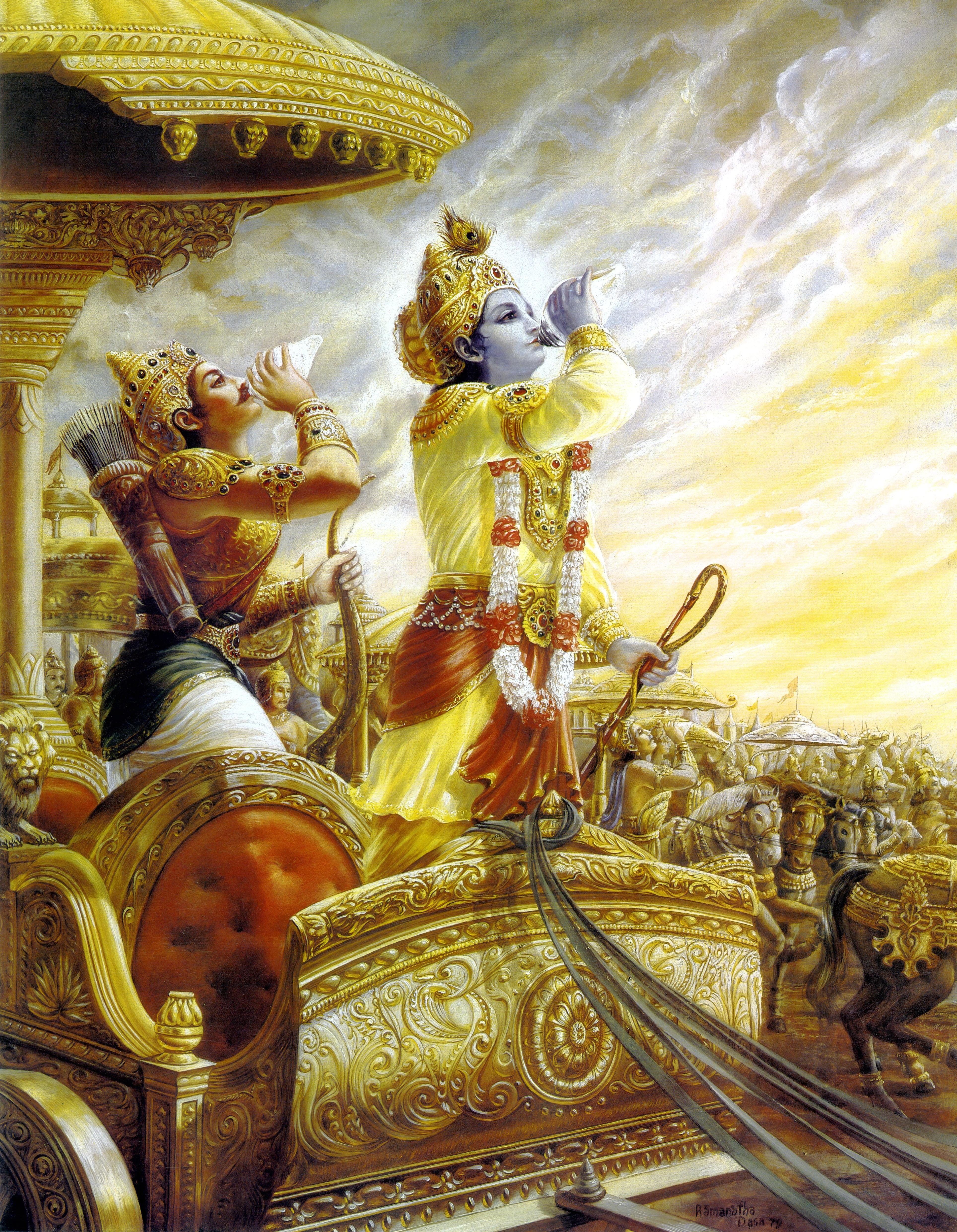
One could argue that at this stage of the book, there is no formal proof given that Kṛṣṇa is indeed the Supreme Personality of Godhead, or even that a Supreme Personality of Godhead really exists. Even if one agrees that there should be a God, how can one know that God is a person and that Kṛṣṇa is that person? To an ordinary person, Kṛṣṇa at this stage may appear like an ordinary man. He is depicted on the cover itself with two hands, driving a chariot. Prabhupāda then tells the reader that Kṛṣṇa should be accepted as God, supporting it only by a verse spoken by Arjuna, where he accepted Him as such. Is Prabhupāda asking the reader to accept it blindly?
The point is that in practically any body of knowledge, the proof comes only after we master the subject. For example, a scientist may prove through an experiment that an atom is not a solid ball of matter but is instead composed of smaller particles, protons, neutrons, etc. His research is then accepted as proof. However, no ordinary person can replicate the experiment to confirm it. Indeed, an ordinary person will probably not even comprehend it. The conclusion is accepted based on trust. The scientist is accepted as a respected person; his conclusion is accepted by other respected people; therefore, it must be correct. Even if one desires to become a scientist to confirm the findings, he or she will have to accept these conclusions as part of their study, and only many years later may be able to see the proof by repeating the experiment. Without following this process, one can’t see proof of anything.
We can also see that this process is often abused. Sometimes experiments are forged, papers are written based on incorrect assumptions, and the whole scientific community may be convinced of things that are not factual at all, and the truth may emerge only years later. Still, for a common person, there is no other way to obtain scientific knowledge. One has to accept the process and study under them.
When it comes to spiritual knowledge, it works similarly. The only way to have “proof” that Kṛṣṇa is indeed the Supreme Personality of Godhead is to directly see or perceive Him. However, this can happen only in a relatively advanced stage of practice. God can be seen, but that’s not easy. Even to see an ordinary man elected as president, we have to follow a long protocol. What to say about seeing the creator and maintainer of all presidents? We have to follow someone who we believe is connected to Him, learn the process from him, and then apply it to our lives.
The process is usually that we receive some small proof by observing the saintliness, knowledge, or some other quality of a devotee and start believing in him or her, at least enough to continue hearing or to continue observing. By staying close, we may receive more small proofs, which may gradually convince us enough to start practicing, and from this practice, we may get progressively more proof. As they say, the proof of the pudding is in eating it. We can’t have definitive proof of anything without first accepting it to a degree and from there experiencing it.
When it comes to the Bhagavad-gītā specifically, the question is that it is not possible to enter into the mysteries of the book without first accepting Kṛṣṇa as God, because without at least some preliminary faith, we will not take what He speaks seriously, and this knowledge will not enter our hearts. Therefore, Prabhupāda urges the reader right at the beginning to accept this point, that at least theoretically Kṛṣṇa should be accepted as God if one wants to benefit from the reading. As initial proof, he offers that Arjuna accepted it, other great Vedic sages accepted it, and he himself accepted it, and then proceeds to elaborate on it in the rest of the introduction. This is not a capricious or unreasonable demand; it is just as the Gītā works. Prabhupāda is just being honest and declaring from the beginning what the process to understand the book is.
Later in the Gītā (4.3), Kṛṣṇa confirms this point by declaring that the qualification of Arjuna to receive this knowledge is that he is His devotee and His friend. Then, on 9.1, He adds that He is speaking to Arjuna because he is never envious of Him. These are thus defined as basic preliminary qualifications.
This faith, however, should not be blind but connected with faith in the current link, in the devotee who is explaining the knowledge, or, in other words, us.
That’s the mistake we usually make. We expect Prabhupāda to do the heavy lifting and forget about the importance of our contribution. If we ourselves are not exemplary and show the practical qualities that are supposed to be developed through the practice of Kṛṣṇa Consciousness, we can’t expect people to accept. Spiritual knowledge is always accepted based on faith; the proof can come only later, when one practices and sees for himself. This preliminary faith is based on seeing someone who is ahead on the path and observing his or her qualities.
Often, we ourselves have not eaten the pudding yet. Frequently, we have accepted Kṛṣṇa Consciousness only on a superficial level, adopting the culture but not the internal practice. When this happens, we may externally accept Kṛṣṇa as part of the identity we accepted as a devotee, as part of the group, without, however, having any real confirmation of it. In this case, we ourselves will not fully believe it and will become disturbed when we meet other people who question.
What is the solution? It is two-fold. One side is that we should go deep into our practice. When we go deep, we get proof, and when proof is received, no one can convince us of the opposite. Once, when I was distributing books, a Christian man came to debate, as sometimes happens. I was not very inclined to waste time, so I went directly to the center of the question. I said to him, “I’m distributing this knowledge because I have seen proof of it. What about you? Have you seen proof of what you are telling me? Have you seen Christ?” That was the end of it. He didn’t want to take a book, but he lost the will to debate.
The second point is indicated by Kṛṣṇa Himself on 18.67, where he mentions that this confidential knowledge should not be explained to one who is envious of Him. That’s another point we often overlook. There are many sincere people around who are searching for something higher. They may question things, but they are not envious. These are the real candidates to receive this knowledge. Openly atheistic people, who resent or envy God, are in a different evolutionary stage. We may approach them indirectly by engaging them in welfare activities or giving them some preliminary or superficial practice, which may help them to gradually become purified, but not direct transcendental knowledge. Without this preliminary purification, the change of heart will never come, and they will never give it a chance.
This is a publication for thoughtful readers who want to go deeper into Kṛṣṇa consciousness. I publish daily, trying to offer high-quality spiritual content, and all posts are available to free subscribers. If you wish, you can also choose a paid subscription to support this work.
You can also receive the updates on WhatsApp or Telegram.
If you would like to contribute further, you can find the donation links here.
Wonderful articles
I remember one very senior European devotee. He is now the temple president of one of the biggest temple in EU.
He shared in his class that he was a very strong atheist and fully engaged in sense gratification and has no faith in God....but when he first time got BG as it is and read the below sentence in the introduction chapter:
".......the person who is trying to understand the Bhagavad-gītā, we should at least theoretically accept Śrī Kṛṣṇa as the Supreme Personality of Godhead, and with that submissive spirit we can understand the Bhagavad-gītā."
He shared that
"By reading these lines, he just theoretically accepted Krishna as Supreme Personality of Godhead and first time read BG".
It worked so effectively that he joined Iskcon immediately and within one or two years he became Sankirtana leader of the whole country or a group of small countries.
This is the power of Srila Prabhupada words in the introduction of BG.
@ respected Chaitanya Chandra Prabhu: thank you so much for writing this wonderr article on this very specific but important subject.
Hare Krishna
Your Servant
Omkaresvara das
Thank you so much prabhuji for this wonderful reply!
So this means its a 3 step process -
1. Have some preliminary faith that God exists, has a form, and Krsna is SPOG
2. Start practicing the things mentioned in BG
3. By the practice, we experience transformation, we get deeper understanding, we get realizations, we get proof, and we become more and more convinced.
I was just wondering -
1. Is a personal spiritual transformation good enough proof to convince a person and take up this path? I am asking this because this type of personal proof comes into the category of Anecdotal proof, which some people may just blatantly deny.
2. Sometimes, if I am unable to preach or convince a person, I think that I am not strong in my practice and philosophy itself, otherwise I would have defeated him, and this thought gives me a sense of inferiority complex. Is there any solution to this?
3. Can you please elaborate on the circular logic part a bit more?
a) Accept Krsna as SPOG
b) in this book, krsna said that he is supreme (some people even ask that who knows this book may be fabricated or not)
c) Thus he is supreme
How can we defend against this argument, because I am defeated many times.
I am sorry prabhuji, if you don't mind, can I keep asking you questions? I have many doubts which aren't resolved yet...
Thank you once again prabhuji, for these wonderful explanations, I am very grateful to you!
ys