

You can receive new articles directly in your inbox. Subscription is free; donations are welcome.
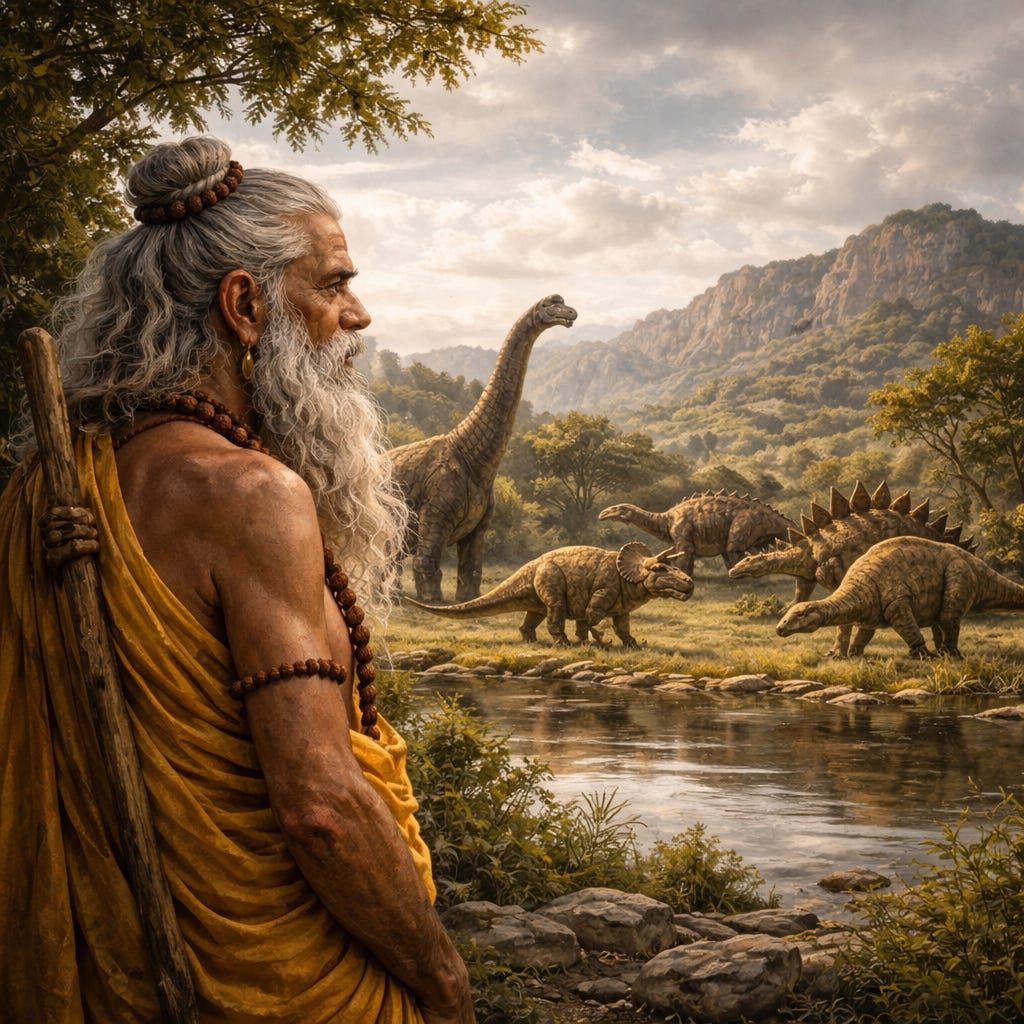
Taking into consideration the historical view of the world that we receive from the Vedas, and more specifically from the Puranas, how could we explain the existence of dinosaurs, as well as Neanderthals and other less-evolved species of human beings that are studied based on paleontological evidence?
Often, we may think that the universe was created the exact way it is now and that it hasn’t changed since, that the way things are now is the way they were since the beginning, with all animals looking the same, and so on. This idea, however, is incorrect and is not at all supported in the Vedic scriptures. This misunderstanding can make it quite hard for us to understand the world around us. The scriptures themselves speak about sequences of ages, cycles of creation and destruction, mass extinctions, and so on. This shows how the history of our planet and of our universe at large is much more complex and turbulent than we can imagine. There is Daksa leaving his body prematurely after offending Lord Śiva, disturbing the whole process of populating the universe; there is Brahmā falling asleep during his day and triggering a process of partial annihilation; there is Hiranyākṣa extensively mining gold from earth and making the whole thing fall out of its orbit; and so on.
So, what do the Vedas say?
The Vedas explain that the universe is populated from the most advanced to the least advanced. Life is not created by chance. There is no evolution in the sense proposed by Darwin:
a) Garbhodakaśāyī Vishnu creates Brahma.
b) Brahma, in turn, creates his mental sons, including Daksa and Svāyambhuva Manu, who populate the universe with different species.
c) Once created, each species continues to reproduce by sexual union, and the population grows over time.
d) Instead of evolving, the species tend to devolve over time, gradually changing and becoming degraded. Nothing better is ever produced. A demigod can produce a man or an ant, but an ant never produces a demigod.
e) Eventually, there is a cycle of destruction, and they are repopulated starting from higher beings. Great sages living in the higher planetary systems of Janaloka, Tapoloka, and Satyaloka are essentially deathless, surviving until the end of the universe. They thus don’t change and are capable of assuming the position of Prajāpatis to repopulate the different species as needed, based on their original forms.
In this way, creation starts with the Lord Himself, the most advanced being, passing through the creation of Brahma and then the Prajāpatis, who are lesser than Him, and culminates with the creation of the other species, down to plants and beasts.
The Vedas describe a total of 8,400,000 species of life in this universe, including 400,000 species of intelligent life. That’s a lot. The way species are counted in the Vedas is also different from the way they are counted in modern biology. In modern taxonomy, species are counted according to their capacity to generate viable descendants. According to this definition, there are about 14,580 species of ants, for example. The Vedic definition, however, is based on levels of consciousness and includes species all over the universe. What the Vedas call “dog,” for example, is a certain state of consciousness that may apply to animals with different forms of bodies and even from different planets. Dogs may also change their forms over time in response to changes in the environment, but they are still classified as the same species.
The Vedas also explain that the maintenance of the universe is far from being automatic. Different types of cycles of destruction happen successively, and the universe has to be constantly repopulated. The physical forms of different species change over time; human beings and other animals degrade, becoming smaller and lower in consciousness as the cycles of four ages (Satya, Treta, Dvāpara, Kali) progress, and so on. Eventually, however, everything is recreated as it was originally.
When we speak about human beings, the Vedas explain that the earth has been populated with human beings since the reign of Svāyambhuva Manu, billions of years ago. How can we reconcile these ideas with modern studies that conclude that evolved human beings appeared about 360,000 years ago or so? And what about dinosaurs, the different geological ages our planet went through, the theory of the snowball earth, and so on?
The first point is that when we hear the description of creation in the Puranas, we must avoid the conclusion that everything exists in the same way it has now since the beginning. This is an idea that can be easily disproved since it is very easy to observe that different species of plants and animals change their forms over time according to different changes in the environment. One of the easiest examples to grasp is dogs: all modern dogs came from a single species that was domesticated a few thousand years ago. However, due to breeding and selection, this single species was subdivided into the thousands of different races of dogs we have nowadays. Darwin noticed this phenomenon and composed his theory of evolution, concluding that life came from matter. His conclusion is incorrect, but the basis of his theory is just the observation of this natural phenomenon.
It is not difficult to understand how, during the billion years of the existence of our planet, the environment changed many times, and the forms of different species changed accordingly. Dinosaurs are nothing more than birds and reptiles adapted to live in the environment that existed at the time, with higher temperatures, higher oxygen content in the atmosphere, and so on.
The Vedas explain that life in the universe is not something easy to maintain. There are frequent cycles of destruction (at the end of each Kali-yuga, at the end of each Manvantara, etc.), as well as other cosmic cataclysms. Different planets need to be constantly repopulated by the different Manus and their descendants. Whole species are frequently wiped out and later reestablished in ways we don’t fully understand. In this way, it is not only in modern science that it is believed that our planet has a convoluted history; the Vedas give a similar view.
Another point is that the universe described in the Vedas is multidimensional, and events described in the Puranas, such as the devastation that happens at the end of the reigns of the Manu, may thus affect different dimensions and species in different ways. In certain dimensions, the devastation may be more complete than in others. There is no indication that life ever stopped completely on our planet, for example. When we check the dates, we can see that there is a strong correlation between cycles of extinction detected by modern studies and the dates given in the Vedas, but it appears that these cycles of extinction impact different dimensions to different degrees.
What about human beings? Why is there no evidence of evolved human beings living on our planet in the past? Actually, this is a myth. Drutakarma Prabhu (Michael Cremo) wrote several books calling our attention to the fact that there are many artifacts that suggest that human beings were living on our planet much earlier than believed in modern paleontology (up to two billion years ago!). The problem is that artifacts that don’t fit in the dominating theory tend to be forgotten or labeled as fraud.
Another point is that Vedic societies that existed in the past would not leave much behind to begin with, even if we consider inhabitants of previous Kali-yugas, who lived in the same gross dimension as us. By descriptions from the scriptures, we understand that all bodies were cremated (leaving only bone fragments that would decompose), practically all tools were made from valuable metals like gold, silver, and copper, and would thus be recycled indefinitely. Most houses and other constructions would be made from wood and stone, and most of the material would also be reutilized in new constructions over time. In this way, conditions necessary for the preservation of bodies and tools (like burial grounds) would not be available. Conversely, aboriginal tribes that used stone tools and would not treat the dead with such care would leave more behind, and that’s what modern paleontologists find.
It is not difficult to imagine that highly evolved human beings could live simultaneously with Neanderthals and cavemen, just like we have modern cities and aboriginal tribes existing simultaneously today. The Vedas offer evidence of this in the race of monkeys described as helping Lord Rama millions of years ago, as well as other stories.
Another point is that there are strong indications that our planet exists simultaneously in several dimensions at once, and thus human beings from different eras live in different levels of reality. Do you really think that people in Satya-yuga could live for 100,000 years and beget children with demigods with bodies like the ones we have now? Quite improbable. It makes much more sense if we acknowledge that they should have more refined (subtle) bodies that matched their level of consciousness. Such refined bodies would also allow them to live in a more refined level of reality, or, in other words, in a different dimension.
In this way, people from Treta-yuga had less refined bodies and thus lived on a lower level. People in Dvāpara-yuga had still less refined bodies and thus lived on a progressively lower level, and we, inhabitants of Kali-yuga, having the lowest level of consciousness of all, live in the grossest dimension and have the grossest type of body. Because we don’t have access to higher dimensions, everything we find when we dig in the ground is bones and stone artifacts left by other similarly lower human beings.
These different dimensions exist simultaneously, but due to our state of consciousness, we can’t access levels of reality higher than our own. There are descriptions that Vyāsadeva, as well as Nara-Narāyana Ṛṣi and other great sages, are still living in Badarīkāśrama, but only certain elevated people can contact them, like in the case of Madhvācārya. They live in a higher reality that is inaccessible to regular people. As expected, it appears that people from higher levels have access to all lower levels, but people from the lower levels can’t access what is higher, just like we can understand ants, but ants can’t understand us.
Another important point to understand is that different animals and plants are constantly fighting for survival, adapting their behavior and the forms of their bodies according to the environment. As the environment changes, following the different periods our planet goes through, so do the forms of different animals and human beings who live in it.
When the Puranas explain that human beings have been living on our planet practically since the beginning, this doesn’t mean they had the same forms or that they were living in the same dimension we live in. It appears that during the course of the ages, most of humanity shifts between dimensions, going progressively down in the grossest levels and later being elevated back when the planet is repopulated by higher beings at the start of the next Satya-yuga.
In this way, the human beings in each Satya-yuga always have a very high level of consciousness (and thus live in a refined dimension), and gradually humanity collectively degrades down to the lower dimensions. There is also the possibility that aboriginal human beings may constantly live in the gross dimension we live in, while advanced humans live in higher dimensions.
This is a publication for thoughtful readers who want to go deeper into Kṛṣṇa consciousness. I publish daily, trying to offer high-quality spiritual content, and all posts are available to free subscribers. If you wish, you can also choose a paid subscription to support this work.
You can also receive the updates on WhatsApp or Telegram.
If you would like to contribute further, you can find the donation links here.
Hare Kṛṣṇa prabhu, Jaii Śrīla Prabhupāda
We find some interesting description in SB 10.64.3 -
kṛkalāsaṁ giri-nibhaṁ
vīkṣya vismita-mānasāḥ
tasya coddharaṇe yatnaṁ
cakrus te kṛpayānvitāḥ
The boys were astonished to behold this creature, a lizard who looked like a hill. They felt sorry for it and tried to lift it out of the well.
Here "giri" word is used which means a hill or mountain. So a lizard shaped as mountain has to be a dinasour ??
In Kṛṣṇa book vol 2, ch 9, Śrīla Prabhupāda says,
"When they approached a well, they found that there was no water in it, but on the contrary, within the well was a wonderful living entity. It was a large lizard, and all of them became astonished to see such a wonderful animal. They could understand that the animal was trapped and could not escape by its own effort, so out of compassion they tried to take the large lizard out of the well. Unfortunately, they could not get the lizard out, even though they tried to do so in many ways.
When the princes returned home, their story was narrated before Lord Kṛṣṇa. Lord Kṛṣṇa is the friend of all living entities. Therefore, after hearing the appeal from His sons, He personally went to the well and easily got the great lizard out simply by extending His left hand. Immediately upon being touched by the hand of Lord Kṛṣṇa, that great lizard gave up its former shape and appeared as a beautiful demigod, an inhabitant of the heavenly planets."
Here also we find Śrīla Prabhupāda describing the creature as "large lizard" and "great lizard" two times each. Literally 4 times Śrīla Prabhupāda says it as large in shape, or hill shape as per the Sanskrit translation, so maybe it's pointing out to the dinasour.
What do you think prabhu??
Hare Krishna Prabhu, please accept my humble obeisances.
What have you meant by the ending sentence?
"constantly living"— Please could you explain that?
Jai Srila Prabhupada!