

You can receive new articles directly in your inbox. Subscription is free; donations are welcome.
“In the Bhāgavatam and related texts, Gaṅgā is described as descending from the spiritual realm, touching the Lord’s lotus feet, flowing downward, being carried by Lord Śiva, and then coming to the earthly plane. At the same time, in our ordinary geographical observation, the Gaṅgā appears to originate from Gaumukh in the Himalayas, like other rivers fed by glaciers. How to reconcile these two descriptions, the scriptural and the observable, especially when speaking to students coming from a pious background but also well familiar with scientific knowledge?”
Yes, the description of the descent of the river Ganges from the coverings of the universe all the way to the Himalayas can be challenging to say the least, since we do not see a river flowing through space, coming to the moon, and from there coming to our planet. It starts, however, to make more sense when we keep in mind that the universe described in the Vedas is multidimensional.
Often, we tend to think that we live in a Euclidean universe where the dimensions are the same everywhere, matter is the same everywhere, and so on. This is also the general scientific interpretation. However, the universe described in the Vedas goes beyond this view, describing different levels of reality. This understanding is essential to reconciling descriptions of the universe found in the Purāṇas with the modern understanding of cosmology and physical reality.
This becomes easier to understand when we consider the topic of the existence of the soul. We accept that the soul exists and that the soul travels from one body to another. Most pious people will agree with that principle. However, what leaves the body is not just the soul, but the subtle body, composed of vital airs, mind, intelligence, ego, etc. In this way, the self that leaves the body and goes to another body is not purely spiritual. There is a soul there, surrounded by all of these material coverings that form the subtle body. That’s also a body composed of material elements. Why then can’t we see it? Why can’t we see the subtle body going out of the body and entering a new body? Why can’t we develop instruments that can register this movement?
The point is that although material, the subtle body is, by definition, subtle. It is matter, but matter of a refined type we can’t perceive with our senses or measure with our instruments. We have a similar situation when we speak about demigods, different planetary systems, hell, asuras, and so on. It’s there, but we cannot see them.
The Polestar is described as the planet of Dhruva and the abode of Kṣīrodakaśāyī Viṣnu. However, even though it is a very bright star, we can’t expect to point a telescope and see Lord Viṣnu lying down there, just as we don’t see apasaras when we go to the moon.
In this way, we have the spiritual platform, the subtle platform, and the gross platform of reality where we live. In the gross platform, the universe appears to be a vast cosmic desert, without many signs of life outside our planet. On the subtle level, we have the demigods and most of the other populations described in the Vedas, Bhū-mandala, and so on, while on the spiritual platform, we have the spiritual planets.
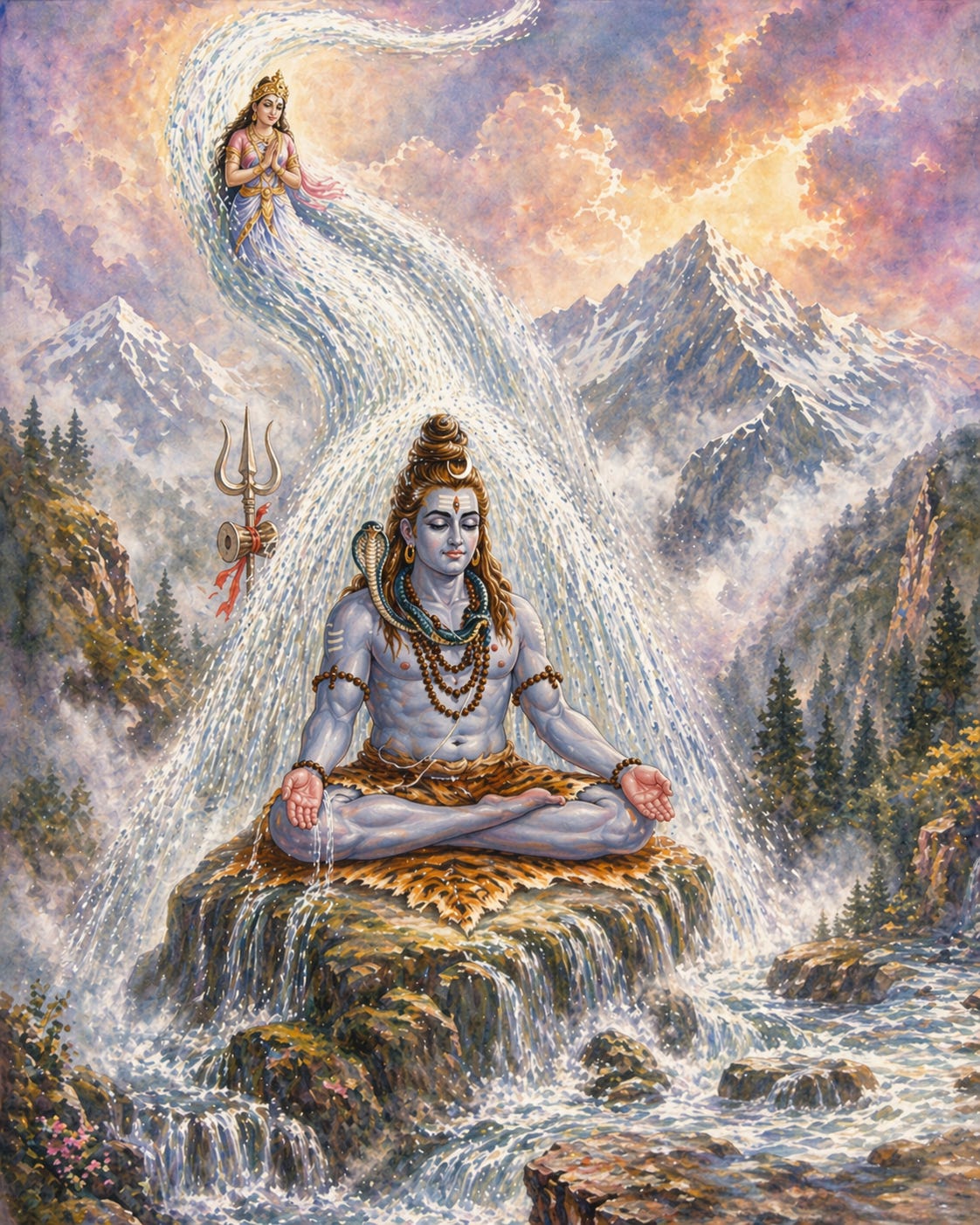
The river Ganges starts from the Causal Ocean as a spiritual river. As it enters the universe, it manifests as a flow in the subtle platform, subtle water that the demigods can see, and transport in their vimānas all the way to the celestial moon. From there, this subtle river flows to the intermediate planetary system of Bhū-mandala, falling on the head of Lord Śiva, and eventually reaching our planet. This spiritual river is not only composed of spiritual water but also has a predominating deity, Gaṅgā. Just as there is a demigod who controls the rain, Indra, and another who controls the sun, Surya, the river Ganges also has a personification. Gaṅgā is thus simultaneously a river and a goddess who married Śāntanu and became the mother of Bhīṣma.
All of this, however, happens in the subtle platform of the demigods. It’s not something we can see with our senses. This spiritual river then combines with the gross water that comes from the glacier, producing the Ganges that is visible to us, which is a combination of both. There is gross water, which we can bathe in, and that quenches our thirst, but at the same time, there is a spiritual quality that purifies us. When we study it with our instruments, however, we can detect and measure only the gross water. The spiritual quality can only be felt by those who are spiritually advanced.
The same is valid for most other aspects of the Vedic universe. There is a spiritual dimension that includes the soul, God, the incarnations of Viṣnu, the spiritually nourishing aspect of prasāda, and so on. There is a subtle dimension that includes the demigods, the different planetary systems described in the Puranas, the celestial moon, and so on, and there is the gross physical aspect, the atoms we can touch and measure. When these three levels are understood, it all makes sense.
When we speak with pious people, it is generally not difficult to agree on this point because they generally already accept the existence of a spiritual plane we can’t directly see by believing in the soul, reincarnation, and so on. We just have to connect this with the subtle plane, and from there with the explanations from the Puranas, which describe reality as being composed of 14 levels, represented by 14 different planetary systems.
When we speak with skeptics in general, it becomes much more difficult because they are usually limited only to the gross aspects of the cosmos. The path in this case would be to first come to the point about ghosts and other evidence of a subtle plane around us, and if this can be established, expand it to a description of levels of reality that we can’t detect with our senses, culminating with the spiritual level. Only when this is agreed upon does it become possible to enter into other descriptions, like the descent of Gaṅgā.
This is a publication for thoughtful readers who want to go deeper into Kṛṣṇa consciousness. I publish daily, trying to offer high-quality spiritual content, and all posts are available to free subscribers. If you wish, you can also choose a paid subscription to support this work.
You can also receive the updates on WhatsApp or Telegram.
If you would like to contribute further, you can find the donation links here.
“In this way, the self that leaves the body and goes to another body is not purely spiritual. There is a soul there, surrounded by all of these material coverings that form the subtle body.”
I recognize the difference between the Dvait and Adwait takes on whether the soul is individualized. The following video explains the transfer of subtle body and says that it is not the soul itself that moves. Just curious if this can be reconciled or just treated as the age-long difference between the two paths. 🙏
https://youtu.be/Zb1mLzRL3wc?si=gLqxKmYF3rBUWe3l
“The path in this case would be to first come to the point about ghosts and other evidence of a subtle plane around us, and if this can be established, expand it to a description of levels of reality that we can’t detect with our senses, culminating with the spiritual level. Only when this is agreed upon does it become possible to enter into other descriptions, like the descent of Gaṅgā.”
Happy to read this part. This is usually the trick that comes to me when I try to convince myself or others of there being a subtler plane beyond the usual physical. Because that is so important to first establish before we go too far trying to understand the details explained in the Puranas.
🙏