

Subscribe to receive new articles by e-mail. It’s free, but if you like, you can pledge a donation:
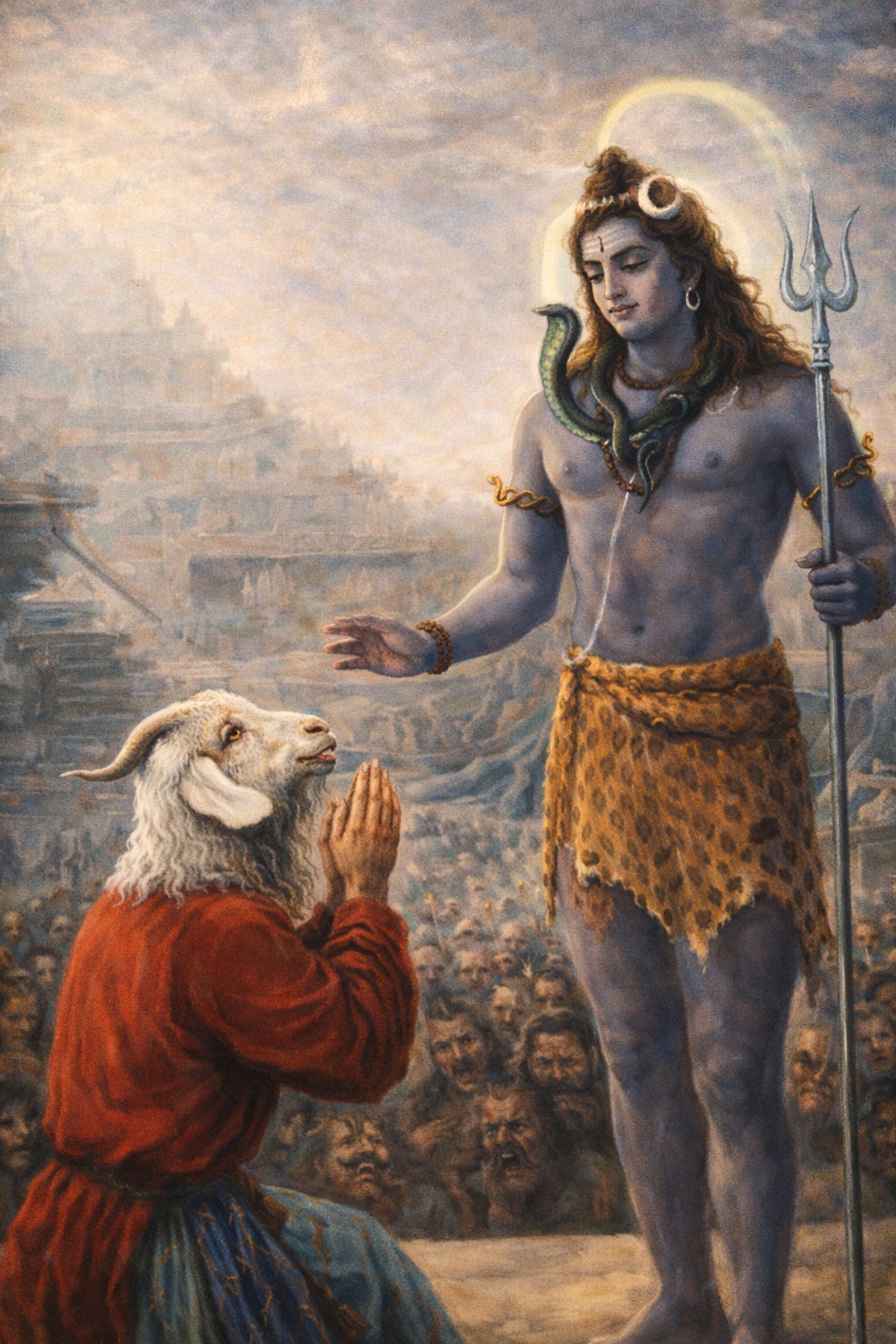
One passage of the Śrīmad Bhāgavatam that may sound quite bewildering is the story of Daksa being killed by Lord Śiva and then revived with the head of a goat. If we accept the Bhāgavatam as an account of real events, this may sound quite difficult to believe, even if we consider the standard of life in higher planets. Even if we accept that it could be physically possible to attach the head of a goat to his body, how to explain that he was revived after it, and that his personality didn’t change?
The point is that everyone has a certain life expectancy that is defined by karma, and no one can remain in his or her body even one second after it. However, there are many situations when a person dies before his time, being killed in a battle, or for some other reason. It’s described that in these cases the soul is forced to remain in his subtle body until the prescribed time for his life ends and the next body is prepared.
Demigods, however, have the power of reviving people and other demigods who died untimely by restoring their bodies and inviting the soul back to it. As long as the soul has not yet transmigrated to another body and the body can be repaired, one can be revived, it doesn’t matter how much time has passed since his death.
In Christianity, the resurrection of Christ is accepted as a great miracle, but according to the Vedas, this is quite a trivial event. Demigods such as the Aśvinī Kumāras, as well as great yogis, can revive people easily, both here and in the celestial planets. Thus, demigods are routinely revived after being killed in battle against demons, and sometimes human beings and others can also be revived. Śrī Caitanya Mahāprabhu revived Śrīvatsa Ṭhākura’s son, Nārada Muni revived the son of King Citraketu, and so on.
The case of Daksa is special, however. Because his head had been destroyed, it was not possible to restore his body. Because he had to be revived to complete the jñana, Lord Śiva instructed the demigods to restore his body using the head of a goat. This is testimony to another point made in the Vedas: consciousness doesn’t come from the brain, but from the combination of the soul and the subtle body, which are situated in the heart. The personality and abilities of a person are thus not situated in the brain, which works more as an interface between the gross body and the subtle body. In the case of Daksa, it must have been disconcerting to wake up with the head of a goat, but being such a great personality, he appears to have been able to quickly adapt to it.
Daksa was thus brought back to life and immediately regretted his mistakes. He also remembered the death of his daughter, Satī, which caused him great pain. Daksa thus choked up and couldn’t speak. With great endeavor, he was able to finally pacify his mind and offer heartfelt prayers to Lord Śiva.
Having prayed to Lord Śiva, Daksa was pardoned by him and blessed to again perform the sacrifice. First of all, the sacrificial arena had to be purified from all the blood and desecration from the followers of Lord Śiva. The brāhmaṇas cleaned the arena, but this in itself was not sufficient to remove the contamination. The true purification comes from invoking the name of Lord Viṣnu. for this end, the sages arranged to offer into the fire the oblations known as puroḍāśa. Before, Lord Viṣnu refused to be present in his sacrifice, due to his offenses to Lord Śiva, but now, as soon as Daksa offered oblations into the fire after chanting the mantras, Lord Viṣnu appeared personally as Nārāyaṇa.
Prabhupada connects these verses to deity worship by explaining that the worship of the deity of the Lord is also a form of yajña, and the priests who worship the deity, as well as all the offerings and the temples, must be very clean, since to offer anything in an unclean state is called a sevāparādha. On the one hand, all the principles of cleanliness must be followed, but on the other hand, it is not possible to have anything clean in this material world, and therefore, the name of the Lord must always be chanted to make anything clean. In this way, the chanting of the holy names must be performed side by side with all the rules and regulations.
After the prayers, Daksa, now in purified consciousness, arranged for the resumption of the sacrifice. Satisfied, the Lord instructed him.
Everyone is part and parcel of the Lord, and He is present in all bodies as the Supersoul. The Lord thus instructed Daksa to abandon his envious attitude towards Lord Śiva and all other living beings, and instead see everyone as being on the same transcendental platform, mentioning that only one who attains this platform attains peace. All others live in anxiety and face all kinds of material difficulties, just as Daksa had recently experienced.
After being thus instructed by the Lord, Daksa resumed the sacrifice, and this time, without offenses, it was successful. However, he did not return to his duties afterwards. Having now the head of a goat, he decided to abandon his body and was later reborn as the only son of the Pracetas and Marisa, a descendant of Maharaja Uttānapāda. All of this happened in the first Manvantara.
After being reborn, however, Daksa didn’t immediately resume his duties. In his first birth, Daksa was born as an exalted personality, the direct son of Brahma, but in this second birth, he was born as a human child, born from Kṣatriyas. To regain his powers, he performed austerities for five Manvantaras to accumulate pious merits, and was finally reinstated in his former position as a Prajāpati in the sixth Manvantara (the Cākṣuṣa Manvantara, the one preceding the current).
After Daksa was again appointed as a Prajāpati in the sixth Manvantara, he first created different types of living beings, such as demigods, humans, etc., out of his mind, just as Brahma does.
However, he was not able to generate sufficient population through this process and thus decided to again practice austerities to satisfy the Supreme Lord and be blessed to perform his service. He went to the mountains to practice austerities, and in this process, he offered the Haṁsa-guhya prayers to the Lord (described in SB 6.4), who became satisfied and appeared to him, blessing him to marry Asiknī, the daughter of Prajāpati Pañcajana.
Daksa then begot ten thousand very qualified sons in the womb of his wife. He instructed them to practice austerities and prepare to enter family life and assist him in the work of populating the universe. However, seeing these very qualified boys, Nārada Muni became compassionate and decided to free them from the clutches of material energy. Purified with transcendental knowledge, the boys decided to enter renounced life.
Sad with the loss of his sons, Daksa begot one thousand more sons. However, when Nārada Muni also delivered them, Daksa again lost his temper and proceeded to offend and curse him, as described in the 5th chapter of the 6th canto.
Daksa then proceeded to beget 60 daughters, whom, being girls, Daksa was sure Nārada would not try to instruct. These daughters were given in marriage to great personalities, and through them, Daksa was finally able to fulfill his ambition of populating the universe.
These daughters of Daksa generated all kinds of living beings, rapidly increasing the population of the universe. Although the universe was never empty, it appears that the population had become much smaller during the first five Manvantaras, to the point that when the Pracetas came out of the lake where they were meditating, the Earth was practically uninhabited and had been covered by trees.
This also provides some explanation for why there is no geological evidence for advanced species of life on our planet until about 800 million years ago. According to the chronology offered in the Śrīmad Bhāgavatam (taking into consideration Sridhara Swami’s factor of two), this coincides with the daughters of Daksa filling the universe with all species of life.
You can also donate using Buy Me a Coffee, PayPal, Wise, Revolut, or bank transfers. There is a separate page with all the links. This helps me enormously to have time to write instead of doing other things to make a living. Thanks!