

Subscribe to receive new articles by e-mail. It’s free, but if you like, you can pledge a donation:
There are a few passages of the Srimad Bhagavatam that may challenge our concept of reality. In the Fifth Canto, for example, it is described how Priyavrata created a second sun and divided Bhu-mandala into seven islands, separated by seven oceans, using the wheels of his chariot.
This description comes in text 5.1.30:
“While so excellently ruling the universe, King Priyavrata once became dissatisfied with the circumambulation of the most powerful sun-god. Encircling Sumeru Hill on his chariot, the sun-god illuminates all the surrounding planetary systems. However, when the sun is on the northern side of the hill, the south receives less light, and when the sun is in the south, the north receives less. King Priyavrata disliked this situation and therefore decided to make daylight in the part of the universe where there was night. He followed the orbit of the sun-god on a brilliant chariot and thus fulfilled his desire. He could perform such wonderful activities because of the power he had achieved by worshiping the Supreme Personality of Godhead.” (SB 5.1.30)
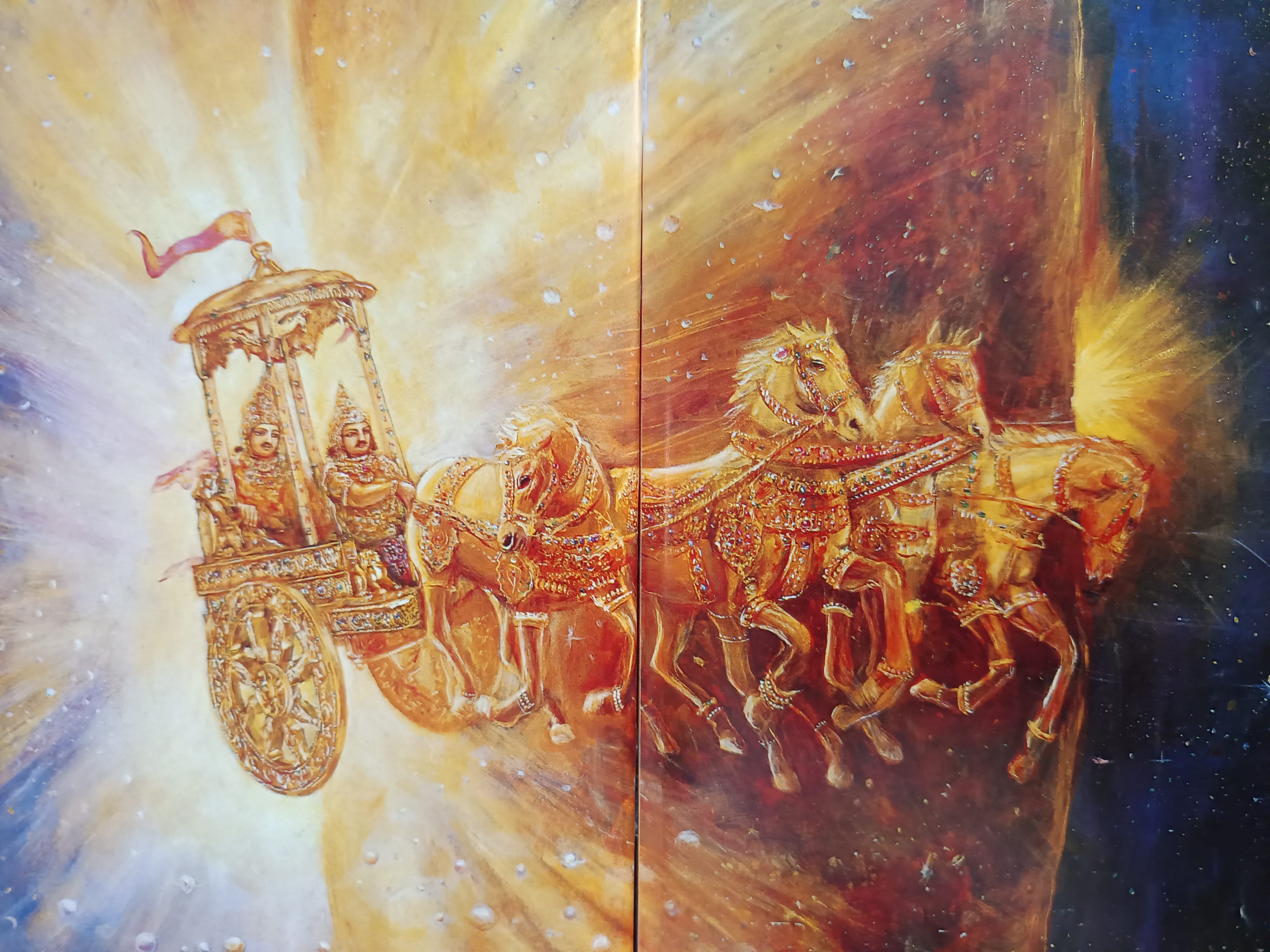
The second sun created by Priyavrata had the form of a chariot. Not only that, but he could sit on it, despite all the light and heat it emitted. Not only that, but this chariot could travel around the universe, like a spaceship, and was used to divide the whole planetary system. How could this be even remotely possible?
The first point is that we must admit that there are many things we don’t know about the universe we live in. Even the most skeptical scientist will be forced to agree on this point.
The second point to understand is the description of the orbit of the Sun in Vedic cosmology. In school, we study that the Earth circles around the Sun. The reason is simple: the sun is much more massive than our planet, and therefore gravity assures that our planet moves around this massive astral body.
The Fifth Canto of Srimad Bhāgavatam, however, gives a different explanation. It describes that the sun travels around Bhu-Mandala in a circular orbit that takes a whole year to complete. This orbit results in the cycles of days and nights for the demigods, for whom a day corresponds to a whole year for us.
This idea that the Sun circles the Earth instead of the opposite is based on another concept brought by Vedic cosmology.
In modern astronomy, it is believed that the sun is much larger than our planet, and therefore, the sun is fixed, and Earth orbits around it. In Vedic cosmology, however, it is described that our planet is part of Bhu-mandala, a much larger, fixed structure. Although also described as very massive, the sun is much smaller than this gigantic structure, and has its fixed orbit circling above it, spending six months on the southern side and six months on the northern side.
How does such a gigantic structure exist right around our planet if we can’t see it? The concept of the universe described in the Vedas is based on different levels of existence, or, using a modern term, different dimensions. Even modern science has the concept of dark matter and dark energy, forms of matter and energy that are simply undetectable to us. Bhu-mandala exists in a higher dimension and is thus observable for the demigods but not to us.
Back to the orbit of the sun, there is a great mountain in the center of Bhu-mandala called Sumeru, and it is described that the sun circumambulates it in this annual rotation. This annual rotation of the sun results in the passage of the seasons on our planet. It goes simultaneously with the daily rotation of the sun around Dhruvaloka that results in the passage of days and nights. This is another delicate detail that you can study in more detail in my book The Intriguing Vedic Universe.
Bhu-Mandala is a planetary system. Our planet is part of this gigantic structure. However, the Earth we walk on is not even remotely equivalent to the whole Bhu-mandala, which is much larger.
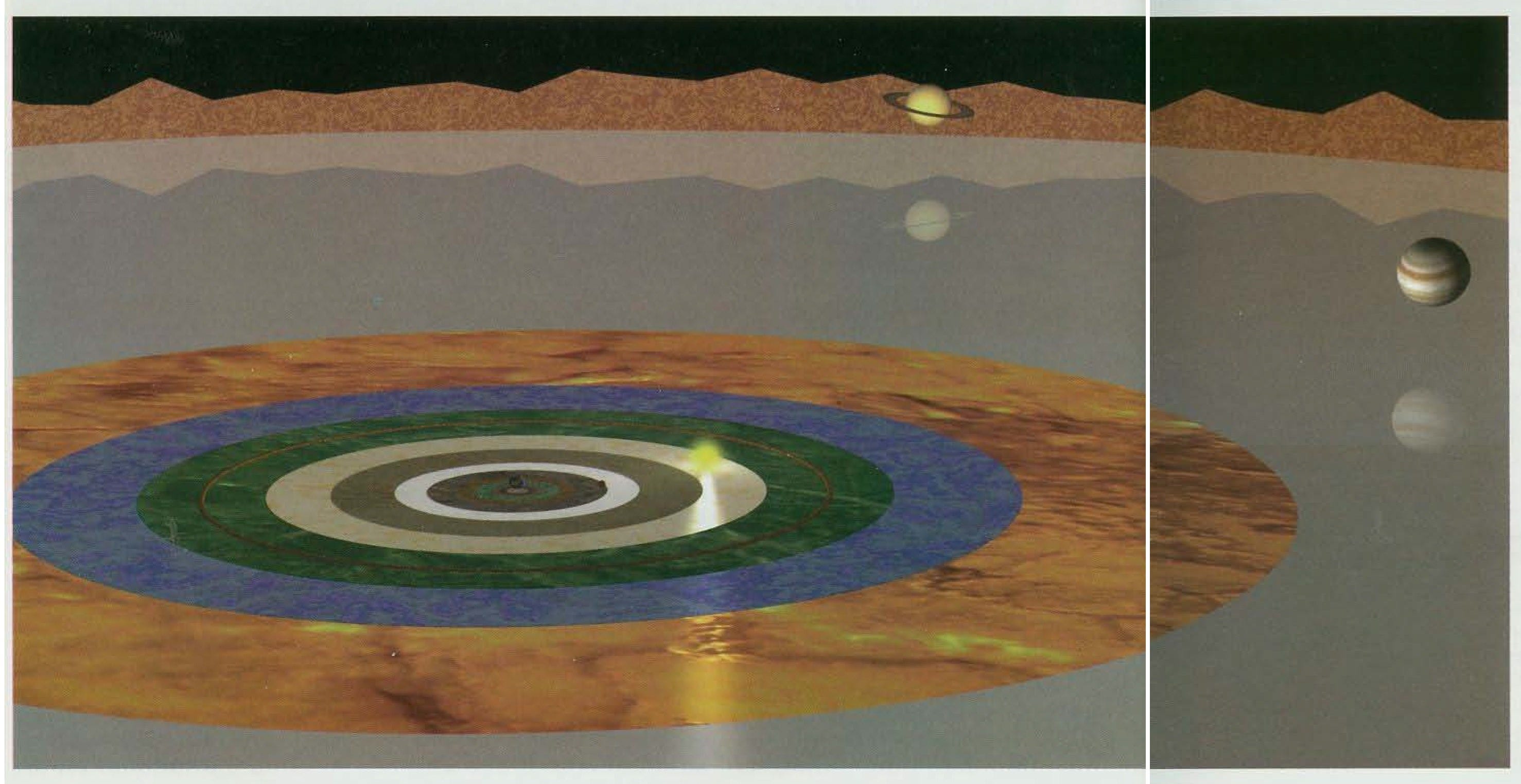
From the perspective of the inhabitants of the different islands of Bhu-Mandala, there is always light, because the sun circles overhead (similar to what we can observe on our planet at the north pole). However, there is less light when the sun orbits the other side of the island. The inhabitants of Bhu-Mandala have thus sometimes more light, and sometimes less light. Priyavrata became dissatisfied with this and decided to fix the situation by creating a second sun.
For this, he created a special chariot that was as brilliant as the sun. This may sound mythical to us, but again, we must consider that there are many things we don’t know. In the Third Canto, we studied how Kardama Muni built a flying castle, as big as a city, that could travel all over the universe, and now we hear that Priyavrata created a chariot that not only could travel around the cosmos, but was as brilliant as the sun. Just as we may build a plane or a computer, these great personalities can build interplanetary castles and chariots that are so powerful. The verse gives the key for understanding that with the words “bhagavad-upāsanopacitāti-puruṣa-prabhāvas”: Priyavrata became so powerful due to being empowered by the Supreme Lord, who was fully satisfied with His service. Since the Lord can create countless universes out of His breath, it is not difficult to imagine that He can empower his devotees to create such wonders.
How did Priyavrata use his chariot? He drove it around Bhu-Mandala on the opposite side of the sun, illuminating the whole planetary system. In the hot months of the year, the chariot provided a form of cooling light, similar to the rays of the moon, and in the winter months, it provided extra heat, increasing the comfort of all inhabitants.
As Prabhupāda mentions in his purport:
“Although Mahārāja Priyavrata devised a very powerful chariot as brilliant as the sun, he had no desire to compete with the sun-god, for a Vaiṣṇava never wants to supersede another Vaiṣṇava. His purpose was to give abundant benefits in material existence. Śrīla Viśvanātha Cakravartī Ṭhākura remarks that in the months of April and May the rays of Mahārāja Priyavrata’s brilliant sun were as pleasing as the rays of the moon, and in October and November, both morning and evening, that sun provided more warmth than the sunshine. In short, Mahārāja Priyavrata was extremely powerful, and his actions extended his power in all directions.”
Verse 31 continues the description:
“When Priyavrata drove his chariot behind the sun, the rims of his chariot wheels created impressions that later became seven oceans, dividing the planetary system known as Bhū-maṇḍala into seven islands.” (SB 5.1.31)
Not only was his chariot capable of illuminating the whole planetary system, but it also changed its structure. By circumambulating Bhu-mandala repeatedly, the wheels created impressions that later became seven great oceans, dividing Bhū-mandala into seven islands.
Again, a chariot that can move around outer space, changing the structure of a planetary system, may sound mythological, but we don’t know all the details. If the chariot was so powerful that it could produce heat and light rivaling the sun, it is not such a stretch of imagination to imagine it could rearrange the whole planetary system by using gravity or other forces unknown to us. In modern astronomy, there is a similar concept, the idea that the planets of the solar system were formed from the combination of smaller particles due to the action of gravity. According to this theory, the solar system was initially a mass of gas and dust that was gradually divided into planets, separated by vast lengths of space.
The description of Priyavrata is different because it describes the evolution of Bhu-mandala, which is the whole intermediate planetary system, which appears to be different from our solar system. The other planets of the solar system, including the Sun and the Moon, are described as celestial planets that are higher than Bhu-mandala in the cosmic hierarchy and have their separate orbits. However, the parallel between Priyavrata dividing Bhu-mandala into separate islands and oceans, and the modern theory of the formation of the planets out of a cloud of dust and gas can help us to understand the description offered in the Śrīmad Bhāgavatam.
In his purport to text 31, Prabhupāda explains:
“Sometimes the planets in outer space are called islands. We have experience of various types of islands in the ocean, and similarly the various planets, divided into fourteen lokas, are islands in the ocean of space. As Priyavrata drove his chariot behind the sun, he created seven different types of oceans and planetary systems, which altogether are known as Bhū-maṇḍala, or Bhūloka. In the Gāyatrī mantra, we chant, om bhūr bhuvaḥ svaḥ tat savitur vareṇyam. Above the Bhūloka planetary system is Bhuvarloka, and above that is Svargaloka, the heavenly planetary system. All these planetary systems are controlled by Savitā, the sun-god. By chanting the Gāyatrī mantra just after rising early in the morning, one worships the sun-god.”
We tend to imagine Bhu-mandala as a series of solid concentric islands surrounded by oceans, just like the islands of our planet, but we can observe that Prabhupāda describes it as a planetary system, explaining how planets are called “islands” (dvīpas) in Vedic literature. This makes the point that there are more details about Bhu-mandala than the simplified model of solid islands and oceans may suggest.
You can also donate using Buy Me a Coffee, PayPal, Wise, Revolut, or bank transfers. There is a separate page with all the links. This helps me enormously to have time to write instead of doing other things to make a living. Thanks!