

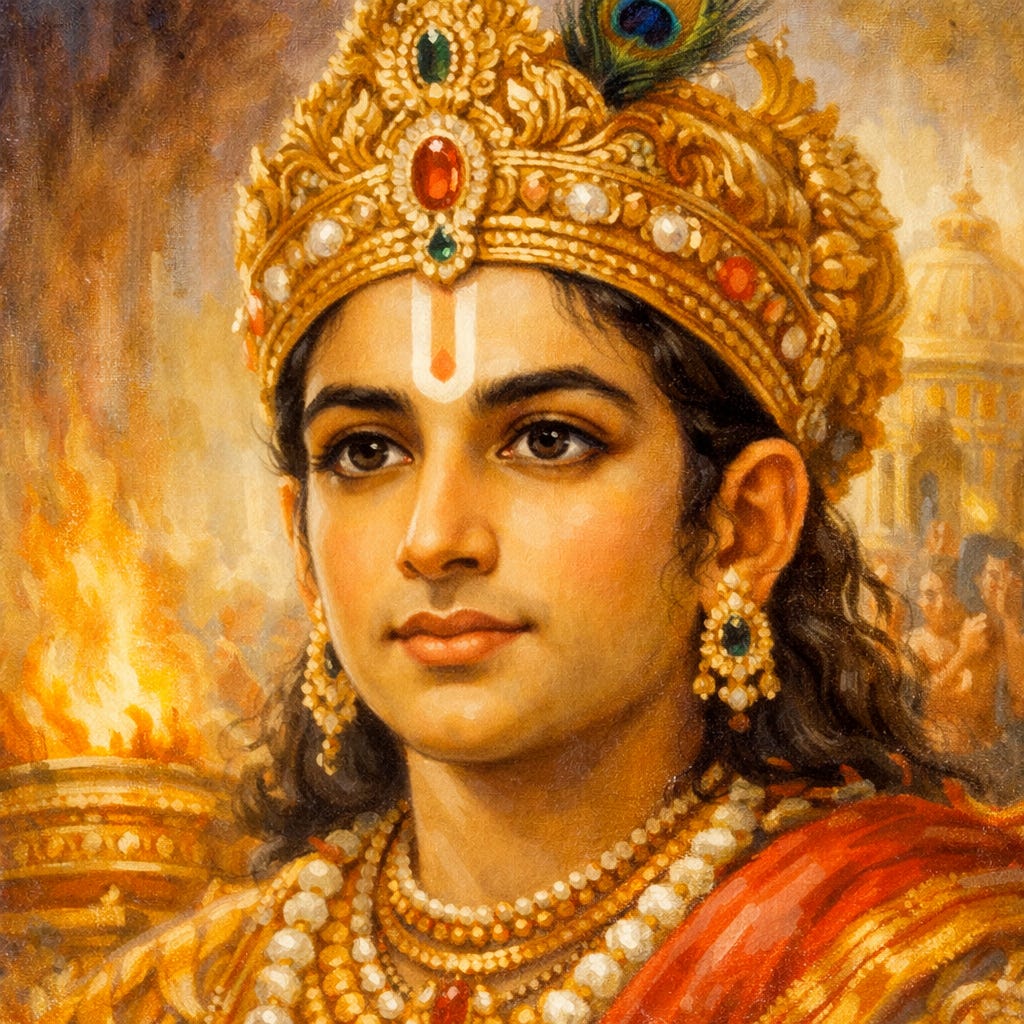
After practicing his legendary meditation, where he stopped the breath of the whole universe, Dhruva was blessed by the Lord to rule as the king for 36,000 years. How did Dhruva rule his kingdom?
This is described on SB 4.12.10:
“As long as he remained at home, Dhruva Mahārāja performed many great ceremonial sacrifices in order to please the enjoyer of all sacrifices, the Supreme Personality of Godhead. Prescribed ceremonial sacrifices are especially meant to please Lord Viṣṇu, who is the objective of all such sacrifices and who awards the resultant benedictions.”
As a pure devotee, the main purpose of Dhruva was to glorify the Lord and increase his service to Him. Dhruva Maharaja ruled over the whole of Bhū-mandala, succeeding his grandfather Svāyambhuva Manu and his father Uttānapāda. As the king, he had a duty to perform sacrifices to teach the path of Dharma to his subjects and distribute charity, and so he did.
Married life always demands a certain compromise between the performance of material duties and the performance of devotional service to the Lord, while sense gratification should be reduced as far as possible. In the Bhagavad-gītā, Krsna explains how material duties can be connected with devotional service through the practice of karma-yoga, and He also explains the importance of restraining ourselves from unlawful sense gratification. Dhruva Maharaja performed this process perfectly, not spending even a farting for his sense gratification, and performed all kinds of sacrifices as an offering to the supreme Lord, without expecting material results. Above all that, he rendered devotional service with unrelenting force, giving the perfect example to all of us.
Apart from maintaining his devotional service to the Lord even while performing his duties as a king, Dhruva Maharaja showed all the good qualities of a pure Vaishnava:
“Dhruva Mahārāja was endowed with all godly qualities; he was very respectful to the devotees of the Supreme Lord and very kind to the poor and innocent, and he protected religious principles. With all these qualifications, he was considered to be the direct father of all the citizens.” (SB 4.12.12)
In this way, Dhruva reigned for 36,000 years as an exemplary king. At the end of this period, an airplane came from Vaikuṇṭha to bring him back to Godhead, in his own Vaikuṇṭha planet, Dhruvaloka.
“Dhruva was seated in the transcendental airplane, which was just about to start, when he remembered his poor mother, Sunīti. He thought to himself, “How shall I go alone to the Vaikuṇṭha planet and leave behind my poor mother?” (SB 4.12.32)
Prabhupāda’s purport to this verse is significant for several reasons. The first is the incredible humility he shows:
“This incident proves that the śikṣā- or dīkṣā-guru who has a disciple who strongly executes devotional service like Dhruva Mahārāja can be carried by the disciple even though the instructor is not as advanced. Although Sunīti was an instructor to Dhruva Mahārāja, she could not go to the forest because she was a woman, nor could she execute austerities and penances as Dhruva Mahārāja did. Still, Dhruva Mahārāja was able to take his mother with him. Similarly, Prahlāda Mahārāja also delivered his atheistic father, Hiraṇyakaśipu. The conclusion is that a disciple or an offspring who is a very strong devotee can carry with him to Vaikuṇṭhaloka either his father, mother or śikṣā- or dīkṣā-guru. Śrīla Bhaktisiddhānta Sarasvatī Ṭhākura used to say, “If I could perfectly deliver even one soul back home, back to Godhead, I would think my mission — propagating Kṛṣṇa consciousness — to be successful.” The Kṛṣṇa consciousness movement is spreading now all over the world, and sometimes I think that even though I am crippled in many ways, if one of my disciples becomes as strong as Dhruva Mahārāja, then he will be able to carry me with him to Vaikuṇṭhaloka.”
Another reason is that of all the controversy caused by a short sentence included later in the same purport:
“Sunīti, however, being a woman, and specifically his mother, could not become Dhruva Mahārāja’s dīkṣā-guru. Still, he was not less obliged to Sunīti.”
Some use this passage to sustain that no woman can become a spiritual master, regardless of qualification, but this is a misinterpretation.
Suniti was in a family relationship with Dhruva, his mother. She was also a woman, and therefore could not become the diksa guru of Dhruva Maharaja. Not only is it uncommon for a father or mother to become the diksa guru for their children, but at the time, people were following the Vaidika system of initiation, instead of the Pañcarātrika system that is current. The Vaidika system is much more strict (appropriate for the time), barring ladies from even being initiated, what to say about giving initiation. The Pañcarātrika system is much more liberal (more appropriate for our time), allowing people of lower birth or who had done sinful things in the past to accept initiation, or even become spiritual masters later on, provided they become first qualified by following the appropriate process. If we consider all these factors, it becomes clear what Śrīla Prabhupāda is explaining: Suniti, being Dhruva Maharaja’s mother, being a woman, subject to the rules of the Vaidika system in use at the time, having not been initiated or received spiritual education, could not become the diksa guru of Dhruva Maharaja.
What about the journey of Dhruva? While Dhruva Mahārāja was passing through space, he gradually saw all the planets of the solar system, and on the path, he saw all the demigods in their airplanes showering flowers upon him like rain. He surpassed the saptarṣi constellation and achieved permanent life in the polestar, the planet where Lord Viṣṇu lives, and which is the central pivot for all luminaries.
As part of the intermediate planetary system, the Earth rests on the plane of Bhū-mandala. In our gross dimension, there is apparently nothing else visible of the structure of Bhū-mandala, but in the refined dimension, where other inhabitants live, there are many different tracts of land and oceans. Higher than the plane of Bhū-mandala are the other planets of our solar system, which are described as celestial abodes that exert astrological influence over us.
The numerous other planets and stars that form the higher planetary system form the Śiśumāra, which can be seen in the sky as the Milky Way. The format of Śiśumāra is sometimes compared with a snake and sometimes with a dolphin. In both analogies, the Polestar resides on the tail (the very top), surrounded by the Saptarṣi, the seven stars, abode of the great sages. All the planets and stars rotate around the Polestar in a circular motion once per day, including the sun.
Simultaneously, the sun and the other planets and stars have their independent motions in the opposite direction. The sun, for example, moves once per day around the Polestar, and once per year in its own orbit, which is responsible for the movement of the sun going to the north and south of the equator, which in turn leads to the passage of the seasons.
Dhruva was thus carried by the airplane to the Polestar, passing through the planetary systems of Bhū-loka, Bhuvarloka, and Svargaloka, and he could see everything, but being his mind fixed in the Lord, He was not interested in anything available there. Just as in the case of Dhruva, when a devotee goes to Vaikuṇṭha, he passes through all the planetary systems and the coverings of the universe and can see all the wonderful material manifestations available there. One is free to stop at any point, but devotees who are fixed in their service to the Lord are not interested in anything temporary, remaining fixed in the ultimate destination.
Devotees who are elevated to Goloka Vṛndāvana, however, go back to Godhead through a different process, which is described by Srila Prabhupada in his purport to 10.1.23:
“In Bhagavad-gītā (BG 4.9) the Lord says, tyaktvā dehaṁ punar janma naiti mām eti: after giving up the material body, the devotee of the Lord returns home, back to Godhead. This means that the devotee is first transferred to the particular universe where the Lord is at that time staying to exhibit His pastimes. There are innumerable universes, and the Lord is appearing in one of these universes at every moment. Therefore His pastimes are called nitya-līlā, eternal pastimes. The Lord’s appearance as a child in the house of Devakī takes place continuously in one universe after another. Therefore, the devotee is first transferred to that particular universe where the pastimes of the Lord are current.”
To be able to join the pastimes of the Lord in the Supreme abode and attain a service there, one has to first learn through the association of the eternal associates of the Lord. This birth to join the pastimes of the Lord is not considered a material birth.
Devotees who practice devotional service in this life, but are not able to attain perfection, take birth in pious families (śucīnāṁ śrīmatāṁ gehe yoga-bhraṣṭo ‘bhijāyate), be on Earth or in the celestial planets, and from there have the opportunity of continuing their devotional service. Although a birth on Earth is considered more favorable, there is no barrier to performing devotional service on the celestial planets. Many devotees join the Lord’s eternal pastimes from there, such as the daughters of the demigods, who were promoted to the position of Gopis.
In any of the three cases, devotees are transported to their next destination by the Viṣṇudutas, who are always ready to assist devotees and protect them from any type of danger, according to the desire of the Lord. The Yamadūtas appear only for materialistic persons, both pious and impious, who are either punished or rewarded for their actions.
This is a publication for thoughtful readers who want to go deeper into Kṛṣṇa consciousness. I publish daily, and all posts are available to free subscribers. If you wish, you can also choose a paid subscription to support this work.
If you would like to contribute further, you can find the donation links here.
Similar to the Anunnaki kings with reigns of tens of thousands of years before kingship was transferred to earth.