

Subscribe to receive new articles by e-mail. It’s free, but if you like, you can pledge a donation:
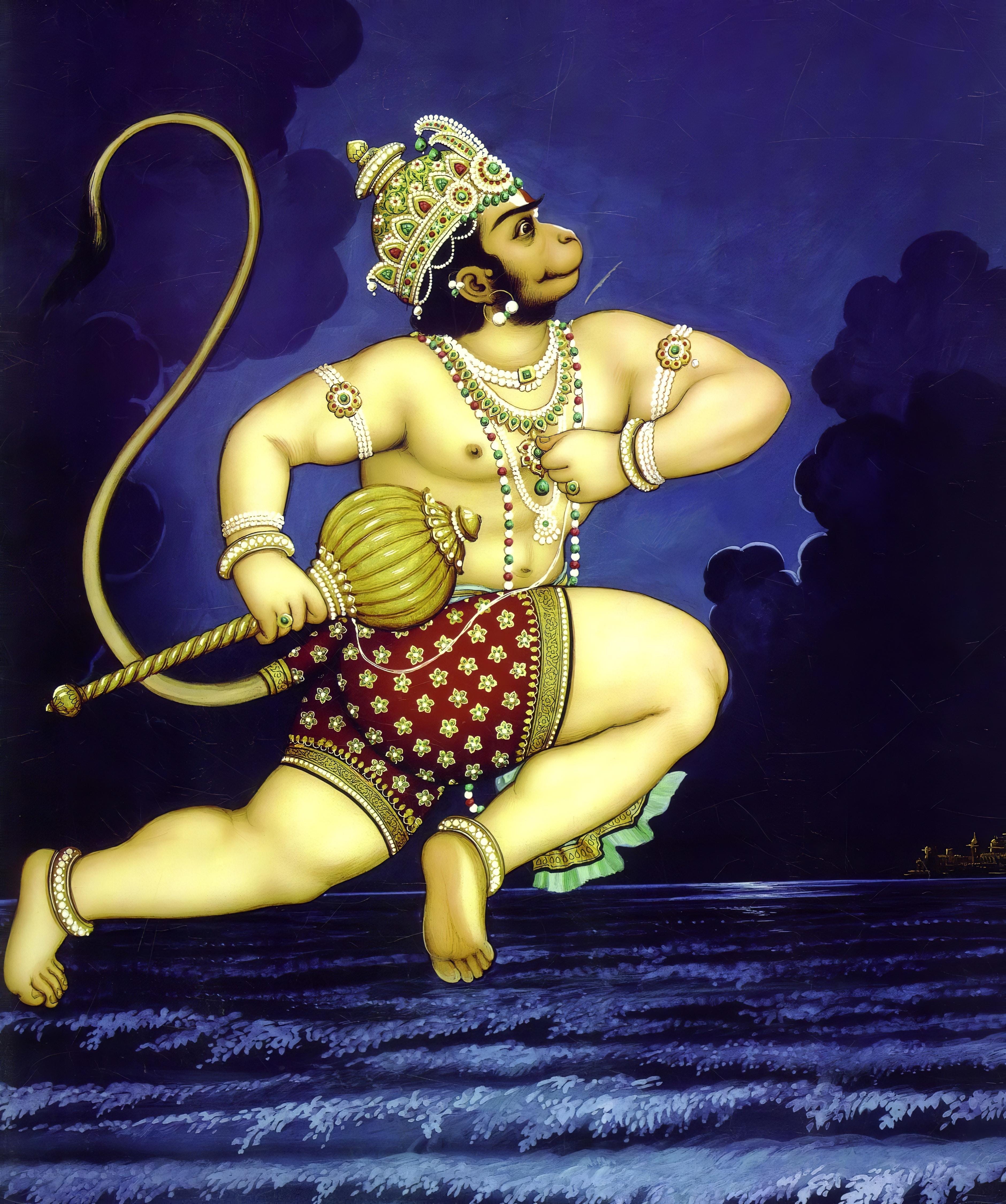
Just as Prahlāda Maharaja, Dhruva, and others, Hanumān still lives among us, giving association to conditioned souls and helping them to come closer to the Lord. It is described that he was blessed to remain in this world as long as Rama’s glories continue to be sung. In this way, he continues to serve the Lord.
The Bhāgavatam describes that he now lives in Kimpuruṣa-varṣa, where he is always engaged in devotional service to Lord Rāmacandra, followed by the local inhabitants. His prayers to the Lord are described in the 5th canto of Śrīmad Bhāgavatam.
As Rāmacandra, the Lord plays many dramatic, human-like pastimes, having His wife kidnapped, making political alliances, fighting in a war, and so on. However, different from ordinary human activities, these pastimes are wonderful and fully transcendental. The Lord has no need for a wife or kingdom, and certainly has no need to fear any enemy. However, as Rāma, the Lord teaches by His own example how to follow the path of virtue and thus attain success in human life, alerting us about the difficulties we have to face when we try to obtain happiness in family life. He also gave the perfect example of a moral life, and thus Hanumān refers to Him as the reservoir of all the good qualities of Āryans. Even today in India, people are inspired by the example of Lord Rama, and this pushes them in the direction of a moral life, conducive to spiritual advancement.
In his commentary, Śrila Viśvanātha Cakravartī Ṭhākura mentions that people are praised for having good qualities, such as truthfulness, compassion, etc. However, all these good qualities reach their perfection in the character of Lord Rāmacandra. He is the nikaṣaṇa, or testing stone, against which the extent of one’s good qualities can be tested.
One could argue, however, that Rama should be accepted as simply a great personality, and not as the Supreme Personality of Godhead. Hanumān, however, dismisses that by explaining that Lord Rāma has a pure form, uncontaminated by the modes of material nature, which can be perceived only by one endowed with pure consciousness. He has no material activities and no material form, meaning He is fully transcendental.
Being so, why did the Lord appear in the form of a human being?
Rāvana received a boon from Brahma that he could not be killed by any Gandharva, Yakṣa, Deva, Dānava or Rākṣa. With this, he was undefeatable by any of the powerful species of the universe. Once he invaded the hellish worlds and fought with Yamarāja himself, who (being a demigod) had to retreat because of this boom. Similarly, Rāvana fought with many other powerful beings all around the universe.
The Supreme Lord can do anything and is not restricted by boons granted by anyone. However, He usually respects the blessings given by the demigods, who are His devotees. Rāvana didn’t include human beings and animals in his request, considering them insignificant, and therefore the Lord appeared in the form of a human being, leading an army of monkeys and bears to kill him.
These adventurous aspects of the Rāma-lila are extremely attractive, but killing Rāvana was actually secondary. The purpose of the appearance of the Lord was to perform sweet pastimes with His devotees and teach the principles of dharma.
If everyone would just stop all material activities to serve the Lord without distraction and go back to Godhead, this would be the best. The Lord wants us to go back; He can make other plans for the continuity of the material creation. However, because we are not ready for this, he makes arrangements for us to get into family life and live with a spouse and children. However, there is no way we can find a perfectly peaceful situation in this material world, and therefore, family life is always full of tribulations. By His personal example, however, the Lord teaches us how to be dutiful in our family life, acting in ways we can progress in the spiritual path.
Another point is the bond between the Lord and His devotees. The Lord and His associates are eternally connected and can’t be separated in any circumstances. Externally, it may appear they are separated, but in this so-called separation, their connection becomes even stronger. All the lilas of the Lord operate thus under this dynamic of meeting and separation, which causes the loving reciprocation to increase unlimitedly. Because the spiritual reality is so intrinsically different from material existence, and the relationship of the Lord with His intimate associates is so inconceivable, the only way to properly understand all these points is to learn them from a self-realized soul.
Being the Lord so exalted, we may think we need a long list of material qualities and accomplishments to be able to become close to him, but in reality, nothing of that is necessary. The only thing we need is devotion. Lord Rāma gave the example by associating with monkeys and bears in the forest, who lacked any high qualification by material standards.
A person attains a good material position and qualities because of past pious activities, and the natural next step is to become a devotee. When one starts worshiping the Supreme Lord, then these assets are properly utilized. If, however, one simply becomes proud, then these material assets become actually an impediment. Anyone can approach the Lord; the only factor needed is eagerness and devotion. Sometimes, asuras perform great austerities, like Hiraṇyakaśipu, who meditated by standing upright for so long that all the flesh in his body was consumed by ants and parasites. A devotee, however, can approach the Lord simply by his or her attitude of service. Because of His wonderful pastimes and personal qualities, Lord Rāma inspires this attitude of service and is thus extremely potent in liberating practically all living entities who come in contact with Him.
Another point is that Lord Rāmacandra and Śrī Caitanya Mahāprabhu are one and the same. Lord Caitanya is represented in the six-armed form of ṣaḍ-bhūja-mūrti, showing that He is simultaneously Rāma and Kṛṣṇa. All the prayers of Hanumān, therefore, directly apply to all three of them. By worshiping these three forms, we can easily attain the goal of life.
You can also donate using Buy Me a Coffee, PayPal, Wise, Revolut, or bank transfers. There is a separate page with all the links. This helps me enormously to have time to write instead of doing other things to make a living. Thanks! You can also receive the updates on Telegram.