


You can receive new articles directly in your inbox. Subscription is free; donations are welcome.
In Abrahamic religions, God is usually seen as the deliverer of punishment. He is the one to be obeyed, or even feared, and punishment by God is not seen as a positive thing. No one wants to become the victim of a flood or a plague, losing one’s children or becoming a statue of salt.
When we study the Vedas, however, we get another view of God, not as the deliverer of punishment, but as the deliverer of salvation. When Kṛṣṇa kills the demons, He may superficially appear to punish them, but this view is very limited. What He does is to free the soul from this abominable position as a demon, sending one back to a position of eternity, bliss, and knowledge in the transcendental platform.
To understand how this can be possible, we need to first understand the nature of Kṛṣṇa and how He manifests in this material world.
Katha Upaniṣad (2.2.13) it is mentioned:
nityo nityānām cetanaś cetanānām
eko bahūnām yo vidadhāti kāmān
tam ātma-stham ye ’nupaśyanti dhīrās
teṣām śāntiḥ śāśvatī netareṣām
If we try to preserve the poetic nature of the language, this verse can be translated as:
“There is one eternal who is supreme among many eternals, the supreme conscious among all conscious beings. This one supreme eternal provides for all the subordinate eternals. He enters the body together with the soul and witnesses his activities. When one becomes sober and wise, he can notice the Lord inside his heart and again be connected with his original, spiritual nature, attaining the eternal peace that is unavailable for the ones who fail to do so.”
As Kṛṣṇa explains in the Gītā, not only He, but also Arjuna and all of us, took birth many times in the past. There is, however, a difference: He can remember all His previous births, but we can’t. How is it possible? This is answered in text 4.6: Kṛṣṇa appears in His original, transcendental body, while we accept different material bodies. There is no difference between Kṛṣṇa and His body; He simply makes His transcendental form visible in this world to perform His pastimes. We, on the other hand, accept a material body that is different from our self, and forget the activities we perform in this life when we go to another body. Even a liberated soul like Arjuna forgets the activities of his previous births. Arjuna was present when Kṛṣṇa spoke the Gītā to Vivasvān, but he forgot. Kṛṣṇa, however, never forgets. There is thus an essential, intrinsic difference between Kṛṣṇa and the infinitesimal soul.
That’s why Kṛṣṇa is called “unborn,” because He always appears in His transcendental form. Kṛṣṇa appearing to take birth from Devakī is just like a theatrical performance. Because Vasudeva and Devakī desired to have Him as their son, Kṛṣṇa appeared to them in His form of Viṣnu, with four arms, and after receiving their prayers, assumed the form of a human baby. His form as a baby is non-different from His form as Viṣṇu; it is just like an actor changing his dress during a performance.
The appearance and disappearance of Kṛṣṇa are compared to dawn and dusk. The sun is always around, but it becomes visible to us under certain circumstances. Similarly, Kṛṣṇa is always present, but sometimes He is visible in His transcendental form, and sometimes not. As soon as He concludes His pastimes in one universe, He immediately starts a new set of pastimes in a different universe. He appears thus sequentially in all material universes every day of Brahmā, without ever changing His body, and without ever forgetting any of His previous appearances.
Apart from His own free will, is there any reason for the appearance of the Lord? Yes, there are three, as He reveals in texts 4.7 and 4.8:
yadā yadā hi dharmasya, glānir bhavati bhārata
abhyutthānam adharmasya, tadātmānaṁ sṛjāmy aham
paritrāṇāya sādhūnāṁ, vināśāya ca duṣkṛtām
dharma-saṁsthāpanārthāya, sambhavāmi yuge yuge“Whenever and wherever there is a decline in religious practice, O descendant of Bharata, and a predominant rise of irreligion – at that time I descend Myself. To deliver the pious and to annihilate the miscreants, as well as to reestablish the principles of religion, I Myself appear, millennium after millennium.”
One could insist that when Kṛṣṇa says tadātmānaṁ sṛjāmy aham (at that time I manifest Myself), it means that Kṛṣṇa is born, like an ordinary man, but this is an incorrect interpretation. The previous verse already established that Kṛṣṇa is unborn and His body is eternal. The word “sṛjāmy” must thus be interpreted as Kṛṣṇa revealing Himself personally in His transcendental form.
Why does He appear? Paritrāṇāya sādhūnāṁ, vināśāya ca duṣkṛtām, dharma-saṁsthāpanārthāya: To deliver the pious and to annihilate the miscreants, as well as to reestablish the principles of religion. When Kṛṣṇa comes, He always fights with many demons, killing them and thus removing the burden of the earth (and, in fact, the whole universe). Simultaneously, He protects His devotees, such as the Pandavas, and reestablishes the principles of dharma, transmitting the Bhagavad-gītā and other scriptures, and teaching by His personal example. He does that not only when He comes as Kṛṣṇa but also in all His incarnations.
What exactly does it mean to annihilate the miscreants? Kṛṣṇa already explained that we are not the body; therefore, what is the point of killing? What does it change if they can just take birth again and continue their activities? That’s precisely the point. When Kṛṣṇa kills a demon, He doesn’t just kill a body. What He does is to completely destroy all the layers of illusion that cover that particular soul, including the gross body, the subtle body, and the material ego.
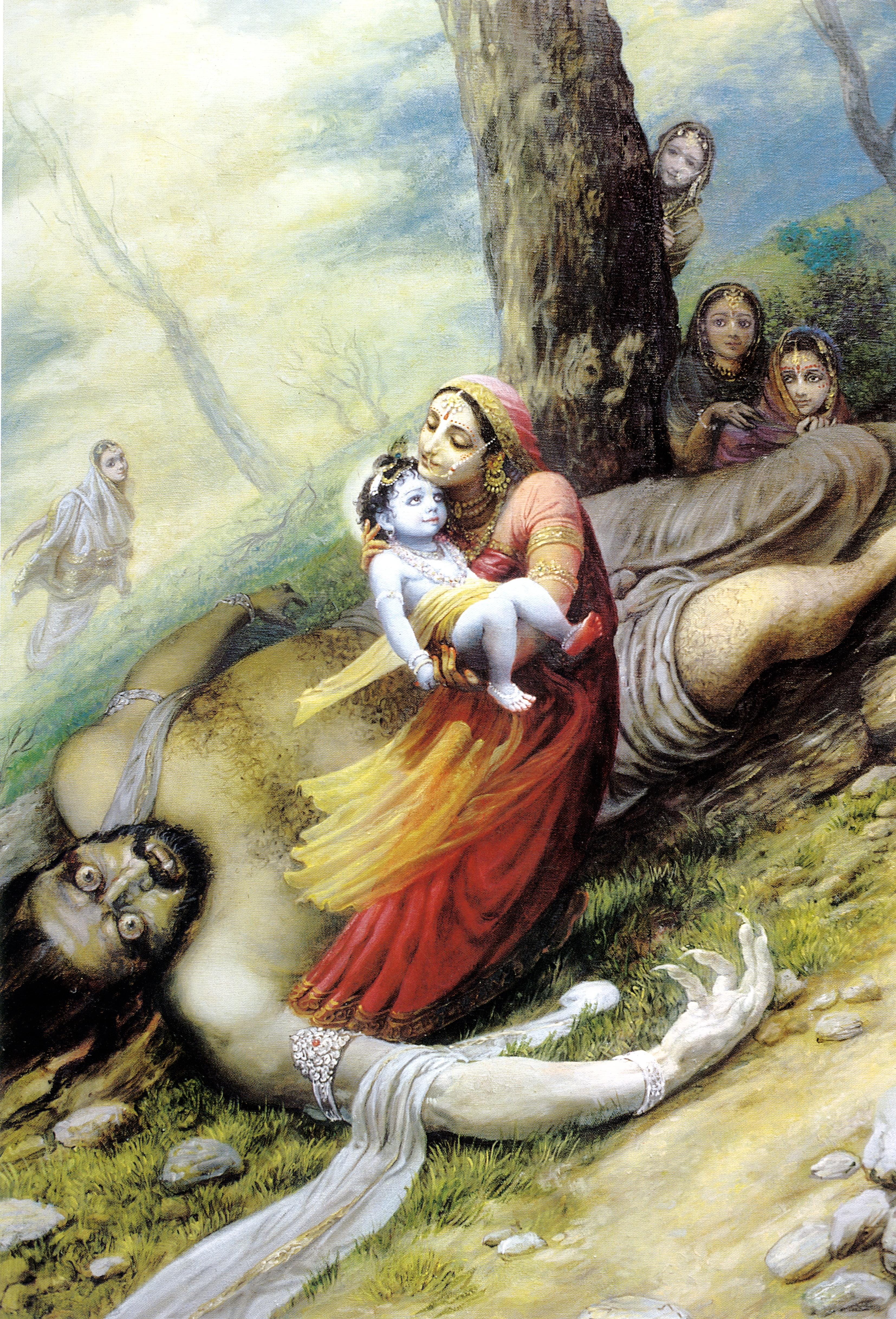
The soul is always pure. What we call a “demon” is just a particular material identity that covers that particular soul. When Kṛṣṇa kills a demon, He destroys that particular material identity, freeing the soul, who thus returns back home, back to Godhead.
All the demons killed by Kṛṣṇa attain liberation. Kṛṣṇa is the supreme pure. Just like the sun can sterilize all kinds of unclean places, when demons come in contact with Kṛṣṇa and are killed by Him, they are purified of all contamination and return to their proper position as pure souls. Usually, they go to the impersonal brahmajyoti, but in a few cases, demons may be elevated to the spiritual planets, like in the case of Pūtanā. This happens in the case of demons who somehow or other develop an attitude of service. Pūtanā, for example, had fed Kṛṣṇa with her breast milk, even though intending to kill Him. Kṛṣṇa accepted this part of her and purified the rest. As a result, she attained the position of one of the assistants of Mother Yaśodā in Goloka Vṛndāvana.
Does Kṛṣṇa save only the demons? Of course not. The devotees are also saved through their contact with Kṛṣṇa, but through a loving relationship. One can speculate about Kṛṣṇa and create many theories about Him, but one who simply accepts the truth and focuses instead on learning about Kṛṣṇa and focusing his or her mind on Him can easily attain spiritual perfection. Normally, liberation from material bondage is very difficult, but when a devotee understands the truth about the personal form of the Lord, he becomes attracted to him, and this spontaneous attraction makes him liberated even before leaving the material body. This simple fact, however, is incomprehensible to mundane scholars and philosophers.
There is, however, something that goes beyond liberation. Kṛṣṇa describes it in text ten, when He mentions that after becoming free from attachment, fear, and anger by transcendental knowledge and taking shelter of Him, many in the past attained transcendental love for Him.
The keyword is bhāva, transcendental love. Attachment, fear, and anger are the three coverings of the soul. When transcendental knowledge is properly realized, it can free us from these coverings, and when we become free, we can become fully absorbed in Kṛṣṇa consciousness. By always thinking of Kṛṣṇa, we gradually attain the stage of transcendental love.
Read also:

This is a publication for thoughtful readers who want to go deeper into Kṛṣṇa consciousness. I publish daily, trying to offer high-quality spiritual content, and all posts are available to free subscribers. If you wish, you can also choose a paid subscription to support this work.
You can also receive the updates on WhatsApp or Telegram.
If you would like to contribute further, you can find the donation links here.