

Subscribe to receive new articles by e-mail. It’s free, but if you like, you can pledge a donation:
In the Fifth Canto of Srimad Bhagavatam, we hear that Priyavrata practiced great austerities, both in his life as a brahmacārī and at the end of life for achieving perfection, and at the end went back to Godhead. His son Āgnīdhra also performed great austerities, but his purpose was quite different. He wanted to marry an apsara and be promoted to Pṛtloka.
As Krsna explains in the Gītā, whatever is our state of consciousness at the time of death, that’s the situation we attain. Āgnīdhra desired to be promoted to Pitṛloka, and his attachment to Pūrvacitti just increased that. Instead of becoming attached to the beautiful form of the Lord, he became attached to a form of this material world, and thus assumed a new material body to continue pursuing his material desires.
No one can live in this material world without performing some kind of austerity. We may perform voluntary austerity, according to the prescription of the scriptures, or we may practice forced austerity, in the form of disease and different forms of material difficulties, but austerity will always be present, even in the life of the wealthiest materialist. The difference, of course, is that by performing voluntary austerity we advance, while forced austerity just brings senseless suffering.
Voluntary austerity can be performed with or without material desire. Austerity performed with material desire can bring us the material results we desire, while austerity performed for the satisfaction of the Lord brings us perfection in devotional service.
Āgnīdhra desired a celestial wife and promotion to Pitṛloka, but still, his desire was not completely outside the realm of devotional service, because he desired to have a perfect son, and he performed all his activities following the precepts of the scriptures. Although he was not situated in a platform of pure devotion like his father, Āgnīdhra was a greatly pious king, and as a result, his eldest son, Nābhi, was a great devotee.
It’s interesting to note that all the injunctions present in the Vedas are the orders of the Supreme Lord, and therefore, a person who performs fruitive activities following the scriptures indirectly worships the Lord, and thus, indirectly practices devotional service. Our ācāryas frequently criticize demigod worship in their commentaries to make it clear that devotional service is the highest perfection, but demigod worship can still serve as a stepping stone for ordinary people who are not capable of directly worshiping the Lord.
Because of his piety, Āgnīdhra was blessed with a son who was a great Vaiṣnava, Nābhi, and through this son, the Lord worked out his transcendental plan of appearing as an incarnation in the bloodline of Priyavrata.
How did it happen?
As in the case of other great exalted couples, Mahārāja Nābhi and his wife practiced austerities and worshiped the Lord for a long time before trying to conceive a son. This is the process for begetting a pure devotee or an incarnation of the Lord, a Ray of Viṣṇu, as described by Śrīla Bhaktivinoda Thākura.
Nābhi performed sacrifices in the pravargya line, which is a line of ritual devotional sacrifices. Rituals have no power for attracting the supreme Lord, but they can serve as conduits for a devotee’s devotion, like in the case of Nābhi. This point was already explained by Lord Kapila in the third canto. Just as a yogi uses āsanas and prāṇāyāma to focus his mind, or a brāhmana focuses his attention by doing elaborate sacrifices, a devotee can use these and other activities performed using his body and mind to express his devotion to the Supreme Lord. The activity or ritual in itself is not important; the devotion is, but if the ritual is used to express one’s devotion, it also becomes perfect.
What was the result? The Lord personally appeared to Nābhi in His Viṣṇu form, displaying all His opulences:
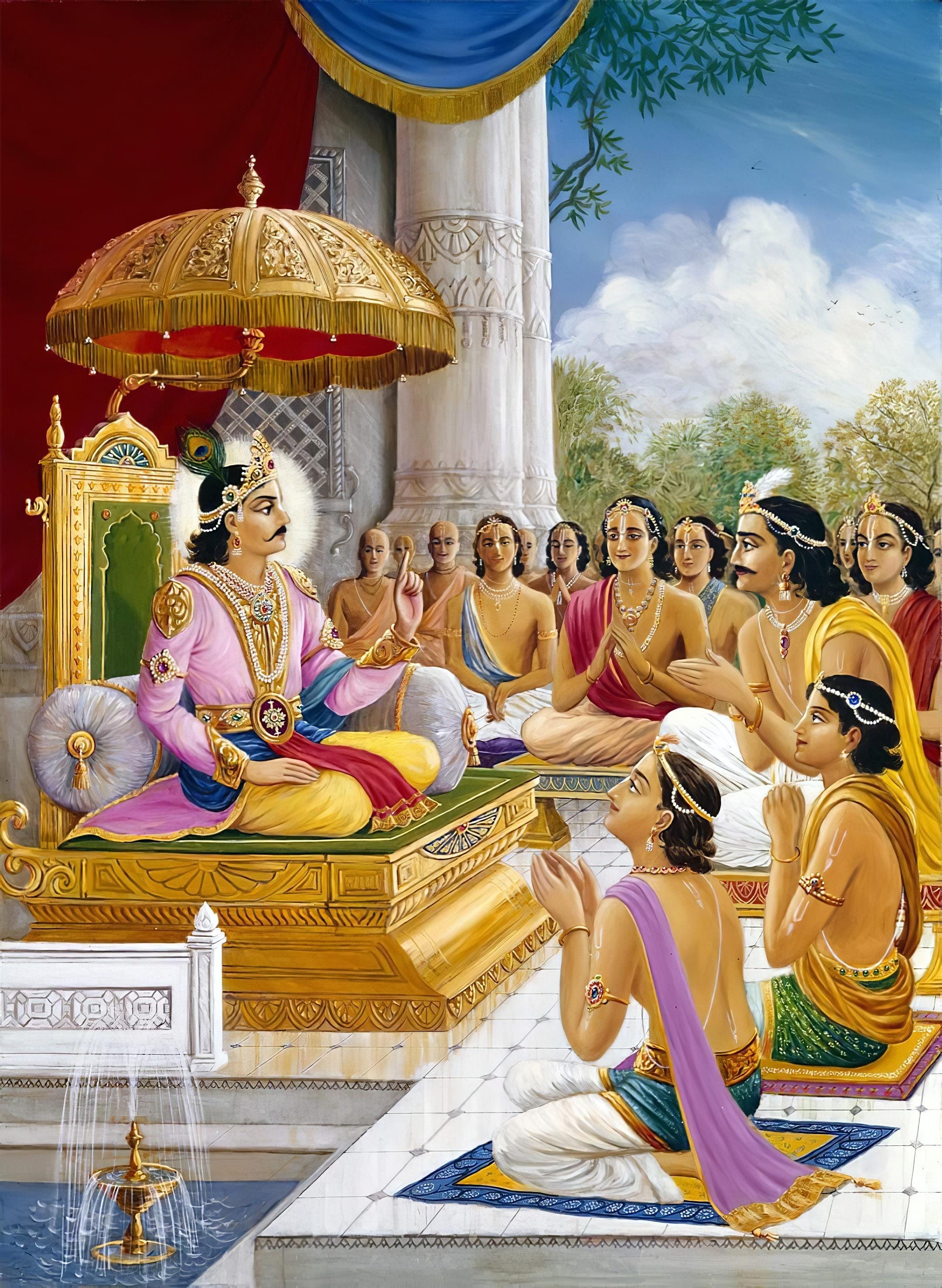
“Lord Viṣṇu appeared before King Nābhi with four arms. He was very bright, and He appeared to be the best of all personalities. Around the lower portion of His body, He wore a yellow silken garment. On His chest was the mark of Śrīvatsa, which always displays beauty. He carried a conchshell, lotus flower, disc and club, and He wore a garland of forest flowers and the Kaustubha gem. He was beautifully decorated with a helmet, earrings, bangles, belt, pearl necklace, armlets, ankle bells and other bodily ornaments bedecked with radiant jewels. Seeing the Lord present before them, King Nābhi and his priests and associates felt just like poor people who have suddenly attained great riches. They received the Lord and respectfully bent their heads and offered Him things in worship.” (SB 5.3.3)
Many verses in the Śrīmad Bhāgavatam describe the form of the Supreme Lord. We should not take these different verses as being repetitive, but rather as an opportunity to remember the Lord and gradually imprint His transcendental form within our minds. The ultimate goal of life is to always remember Krsna and never forget Him. Meditation on the Lord requires us to remember His form, and by such repeated descriptions, Śrīmad Bhāgavatam teaches us how to achieve that.
King Nābhi had the idea of obtaining a son just like the Supreme Lord. For this purpose, he engaged a number of priests in performing the sacrifice. These were no ordinary Brāhmanas, but great devotees who were qualified on the same level as demigods. There is no one like the Supreme Lord; He is the One without a second. He thus used the desire of the king as an excuse to appear as an incarnation, as He Himself desired. Thus he answered:
“O great sages, I am certainly very pleased with your prayers. You are all truthful. You have prayed for the benediction of a son like Me for King Nābhi, but this is very difficult to obtain. Since I am the Supreme Person without a second and since no one is equal to Me, another personality like Me is not possible to find. In any case, because you are all qualified brāhmaṇas, your vibrations should not prove untrue. I consider the brāhmaṇas who are well qualified with brāhminical qualities to be as good as My own mouth. Since I cannot find anyone equal to Me, I shall personally expand Myself into a plenary portion and thus advent Myself in the womb of Merudevī, the wife of Mahārāja Nābhi, the son of Āgnīdhra.” (SB 5.3.17-18)
Queen Merudevī was seated right beside her husband in the sacrificial arena. According to the regulations, one should perform Vedic sacrifices always in the company of his wife. Even in Maharloka, where sages are greatly pure, they perform sacrifices together with their consorts. This gave Merudevī the opportunity to also see the transcendental form of the Lord, and understand that He was going to soon appear from her womb.
It is described that the Lord appeared as Ṛṣabhadeva, the son of Merudevī, in His original spiritual form. This means Ṛṣabhadeva is a direct incarnation of the Lord, with a completely transcendental body. He is not a jīva who was empowered.
You can also donate using Buy Me a Coffee, PayPal, Wise, Revolut, or bank transfers. There is a separate page with all the links. This helps me enormously to have time to write instead of doing other things to make a living. Thanks!