

Subscribe to receive all new articles directly by e-mail. It’s free, but if you like, you can pledge a monthly or annual donation to support my work:
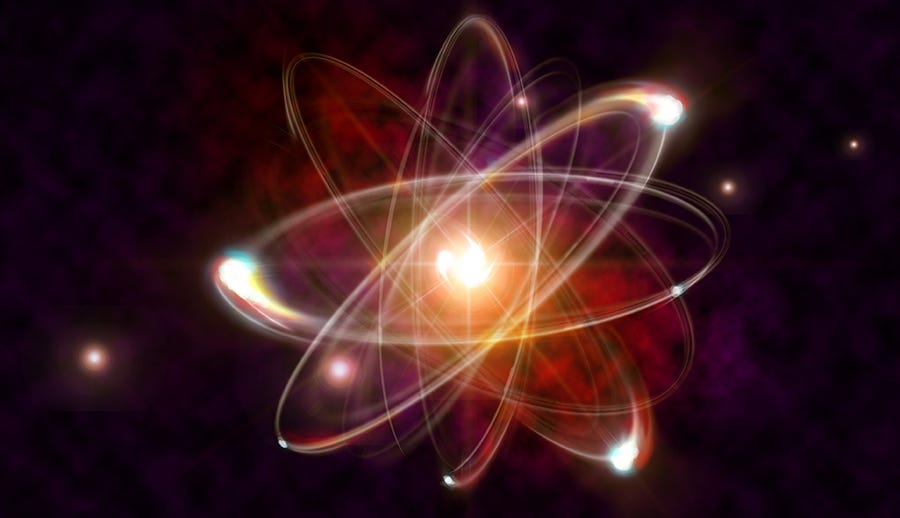
We learn in school that atoms are actually mostly empty space, electrons circling a nucleus like a mini-solar system. However, this picture is outdated. According to more up-to-date scientific studies, the nucleus is not a solid core, and the electrons are not really particles circling it. The current view is that electrons are not like tiny balls, but more like waves of electric charge (quantum objects that appear in certain regions around the nucleus), and the nucleus itself is also not solid matter, but also composed of smaller components held together by powerful interactions. In other words, an atom is not a little mechanical solar system, but mostly empty space structured by fields and interactions. It feels solid when we touch things, but in reality that solidity is mostly the result of electromagnetic forces and quantum effects acting within atoms that are almost entirely empty space.
When I hold a metal ball in my hand, it feels solid, but it feels that way because my hand is made of matter with the same basic atomic structure. The atoms in the ball resist being compressed by the atoms in my hand. If my hand were made of the same ultra-dense matter that physicists believe exists inside black holes, the ball of metal would not feel solid at all. It would simply collapse and almost disappear before I would even touch it, like a ball of styrofoam in contact with fire. If my hand were made of neutrinos or gamma rays, it would pass through the ball without affecting it much, just like the hand of a ghost.
Modern physics also explains that a vacuum is also not simply nothing. That’s another idea we learn in school that is outdated. What we call a vacuum may contain no ordinary matter, but the underlying fields of nature are still present. Even in their lowest state, these fields can fluctuate and produce measurable effects. So, what appears as empty space can still have physical properties: it is not a solid substance, but it is not mere nothingness either. It is the structured background in which particles, forces, and interactions appear, like a stage with no actors currently standing on it. The stage may be empty, but it still has structure, rules, and possibilities, and can influence how the actors move and interact.
So, modern physics explains that matter is not really solid, and space is not really empty. That sounds quite similar to what we study in Vedic metaphysics, as explained by Lord Kapila in the third canto of Śrīmad Bhagavatam.
But it gets better. Imagine a second kind of matter that does not use the same forces that ordinary atoms use to resist contact. It’s not like antimatter, which destroys ordinary matter, but something neutral that would just not directly interact with it. This type of matter would not push back against the atoms in a wall because there would be almost no interaction between them. As a result, it would pass through ordinary matter like a ghost. Still, it would not be unreal: its particles could still interact strongly with one another through a different set of forces, allowing it to form solid objects of its own kind. People living in a world composed of this different type of matter would touch things and interact with other people; their reality would feel solid to them, just as our reality feels solid to us, but we would not be able to see them at all.
Now, imagine several other kinds of matter, some that do not interact at all with matter in our plane, others that interact weakly, some that interact with others but not with us, and so on. It starts getting quite close to the concept of the different planetary systems as different levels of reality, which is described in the Vedas.
When we study the Śrīmad Bhāgavatam, we learn that the world we live in is not unreal, but it is illusory. We hear that there are 14 different planetary systems, composed of what we may call different types of matter. We can’t see demigods, unless they assume forms that are visible to us. Demigods, in turn, can’t see sages from the higher planetary systems, like the Kumaras, unless they intentionally become visible to them. Demons can interact and fight with demigods, but they don’t live on the same level of existence. Matter can be manipulated using subtle, mystical forces that are unknown in modern science, and so on.
All of this may sound very mythical and hard to believe at first, but when we get in contact with ideas that are currently studied in modern physics, the Vedic model suddenly sounds a lot more plausible.
You can also donate using Buy Me a Coffee, PayPal, Wise, Revolut, or bank transfers. There is a separate page with all the links.
If you prefer, you can also receive the updates on Telegram.
Great information. Thank you, prabhuji!