


You can receive new articles directly in your inbox. Subscription is free; donations are welcome.
It may not be very pleasant to hear, but most of our existence in this material world is lived in the animal species, where we simply fight for survival, trying to satisfy the basic needs of the body. There are also demigods and demons who enjoy elevated standards of material enjoyment, but if we calculate statistically, including all forms of life, we can see that souls living in animal, plant, and microbial species are the crushing majority. Only very rarely do we have the opportunity of taking a human birth.
Every human body offers the same basic choice: sense gratification or self-realization. In the Fourth Canto of Śrīmad-Bhāgavatam, we have the allegory of Purañjana, who, although living as a relatively pious king, used only the facilities for sense gratification and fruitive activities. Thus, as time passed, he became more and more illusioned, forgetting his real self. The more we surrender ourselves to sense gratification, the more we become entangled in illusion, material suffering, and agitation, and the more our opportunity for self-realization closes.
As we become old, our consciousness gradually narrows to whatever thoughts and activities we prioritize in life. When we are young, we are very flexible, we are willing to try new things, accept new ideas, and even completely change the direction of our lives. As we become older, however, we become very resistant to any change. A materialist will thus become a progressively more stubborn materialist, and a devotee will gradually become more focused on his or her practice, becoming progressively less interested in other things.
In the allegory, Purañjana is the soul, and the queen is an amalgamation of the material mind and intelligence. Śrīmad-Bhāgavatam mentions that, engaged in material thoughts and fruitive action, he came completely under the control of the mind and was thus cheated, simply working to satisfy its whims.
What can we get from there? The material intelligence can work properly only when purified by spiritual knowledge. Otherwise, it just creates unlimited plans for enjoying matter, and we end up becoming helplessly entangled in them, just like Purañjana.
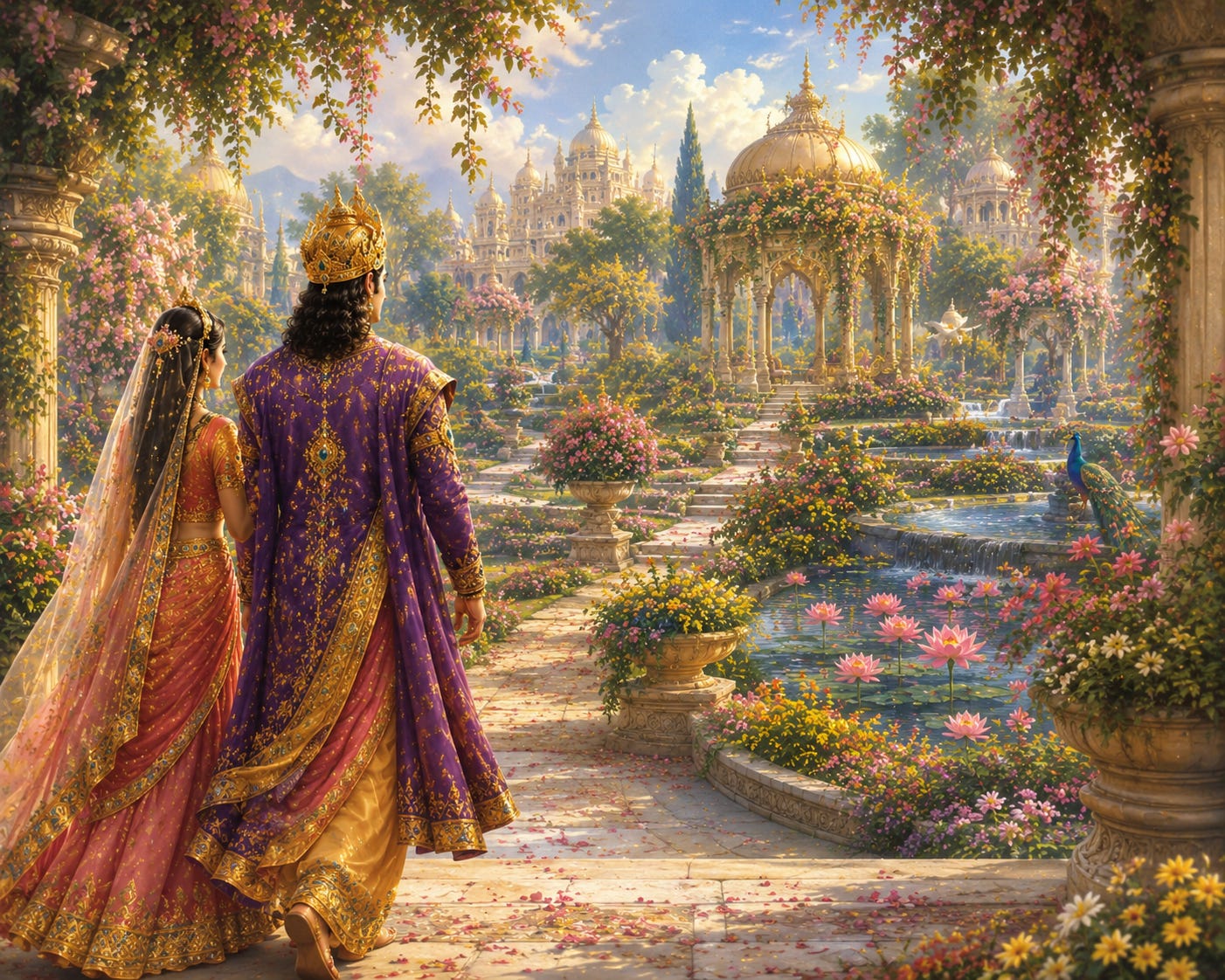
It all starts with association with devotees who are mature in their spiritual practice. From them, we get spiritual knowledge, which we can apply to our practical lives. One part of it is to properly engage ourselves, so the mind and intelligence are moved from matter to Kṛṣṇa. The next step is to engage the people around us, so they don’t keep pulling us back to materialistic life.
Taking to spiritual intelligence means following the precepts of the scriptures and the instructions of the spiritual master. By doing so, we become gradually purified, awakening our original spiritual nature.
This process was followed perfectly by Ambarīṣa Mahārāja, as Prabhupāda describes:
“In the life of Mahārāja Ambarīṣa, we find that the great Mahārāja first engaged his mind on the lotus feet of Kṛṣṇa. In this way his intelligence became purified. Mahārāja Ambarīṣa also used his other senses in the service of the Lord. He engaged his eyes in seeing the Deity in the temple nicely decorated with flowers. He engaged his sense of smell by smelling the flowers, and he engaged his legs by walking to the temple. His hands were engaged in cleansing the temple, and his ears were engaged in hearing about Kṛṣṇa. His tongue was engaged in two ways: in speaking about Kṛṣṇa and in tasting prasāda offered to the Deity.”
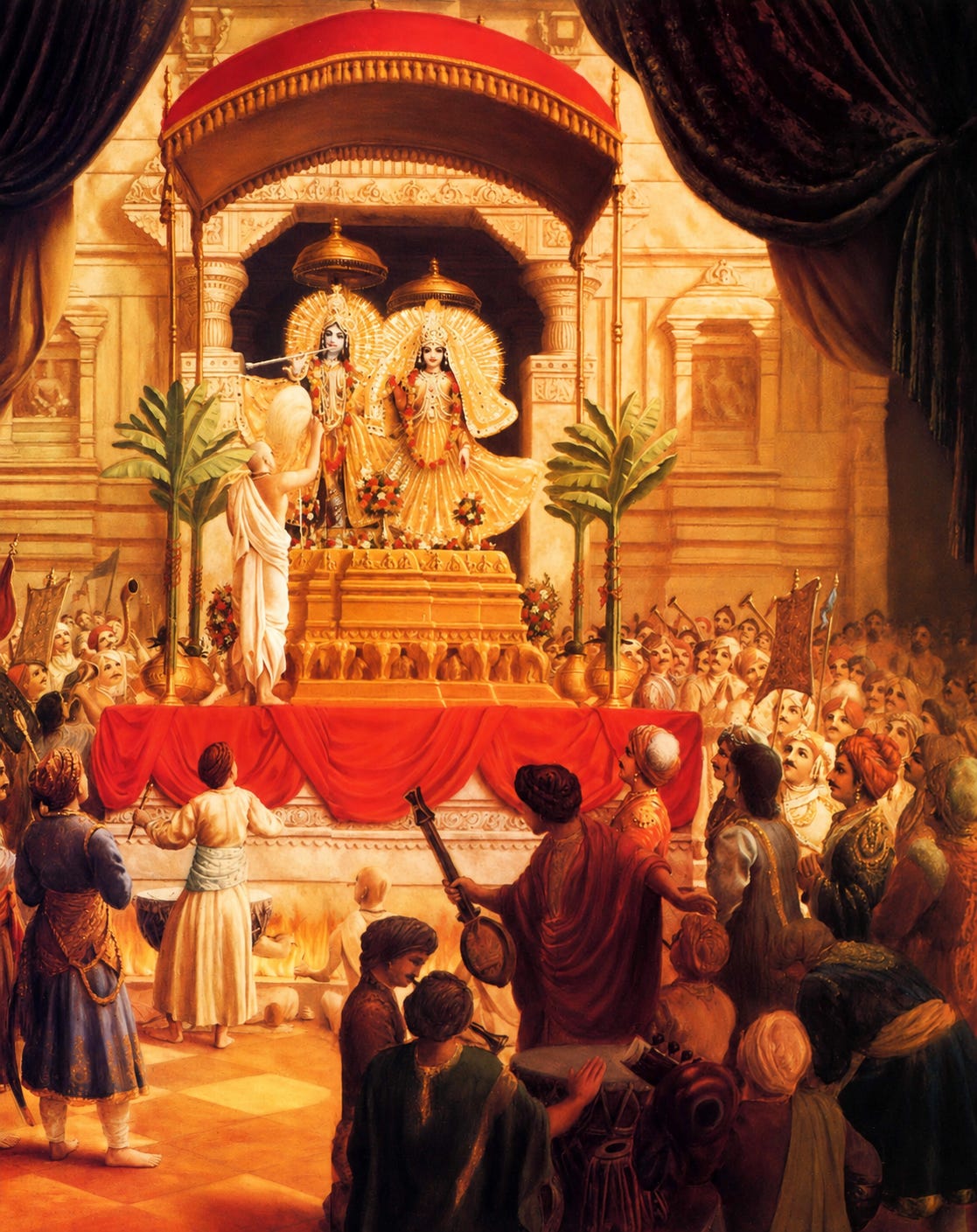
In his purport to SB 4.25.25, Prabhupāda makes another important point: every living entity has the freedom to be attracted by material nature or to stand as a hero and resist that attraction. Purañjana surrendered to the first option, becoming attracted to an easy life of sense gratification. In this way, he lost the opportunity of human life and was cheated in all his endeavors.
That’s the existential choice we are offered in the human form of life. We can use our intelligence to try to enjoy life, working to shape the environment around us in ways that fit our ambitions, or we may choose to purify our intelligence by hearing spiritual knowledge and using it to solve the real problems of life, finding a solution to our material captivity. These two paths lead us in opposite directions, but both start with apparently small daily choices.
The Vedas call our attention to the difference between śreyas and preyas. Śreyas refers to truly beneficial activities that bring us ultimate benefit, while preyas refer to activities that bring some immediate gratification, but undermine our progress in the long run.
Imagine you have 30 minutes free. You may use this break to study a few verses of the Bhagavad-gītā, for example, or you may spend the time watching reels. Watching a few funny videos may sound more pleasing at first (preyas), but if we repeat this same choice many times, we may end up wasting a huge chunk of our lives on an activity that is contrary to our real interests.
Purañjana thought he was exercising his freedom, but by repeatedly following the mind and material intelligence, he gradually lost it. He became unable to act independently, following the movements of his agitated mind and intelligence like a pet animal. This is the final result of material illusion: one who desires to become the master of the world ends up becoming the helpless servant of his selfish desires.
Ambarīṣa Mahārāja followed the opposite path. He did not leave his mind and senses without engagement. He fixed his mind on the thought of Kṛṣṇa and engaged all his senses in devotional activities. Because the mind was given a higher object of meditation, the intelligence became purified, and the senses stopped being enemies. The same instruments that bind us to material life can therefore become instruments of liberation.
Our future consciousness is being formed now. Every activity, conversation, etc., strengthens a particular direction within us. As the years pass, that direction becomes more deeply established, and at death we naturally remember what we have spent our lives meditating upon.
Kṛṣṇa explains in the Bhagavad-gītā that whatever state of being one remembers when leaving the body, that state one attains. Our final remembrance is, therefore, not generally accidental; it is shaped by the thoughts, desires, and attachments we have cultivated throughout life.
The question is, therefore, what kind of consciousness we are practicing every day. Are we training the mind and intelligence to remember Kṛṣṇa, or are we allowing them to train us to serve the senses? Purañjana and Ambarīṣa show the two alternatives. One path gradually takes away our freedom, while the other gradually revives our original spiritual nature.
The takeaway from today is that our destiny is not formed only by a few dramatic decisions at specific points in our lives. It is mainly formed by the apparently insignificant choices we repeat every day.
Read also:

This is a publication for thoughtful readers who want to go deeper into Kṛṣṇa consciousness. I publish daily, trying to offer high-quality spiritual content, and all posts are available to free subscribers. If you wish, you can also choose a paid subscription to support this work.
You can also receive the updates on WhatsApp or Telegram.
If you would like to contribute further, you can find the donation links here.
Is Consciousness only lives inside every human being! Or is the universe itself a concious model and active within us and aware of the concept of Lord's plan about creating a space of Maya.. Is reality something like different form to everyone living in the universe?