

Subscribe to receive new articles by e-mail. It’s free, but if you like, you can pledge a donation:
Can a pure devotee speak something that is incorrect? In the absolute platform, no, because everything they speak passes through the filter of their devotion to the Lord, and is directly and indirectly corrected with Kṛṣṇa. Because everything they speak is grounded in their vision of everything being connected with Kṛṣṇa, everything they speak is correct in the absolute platform.
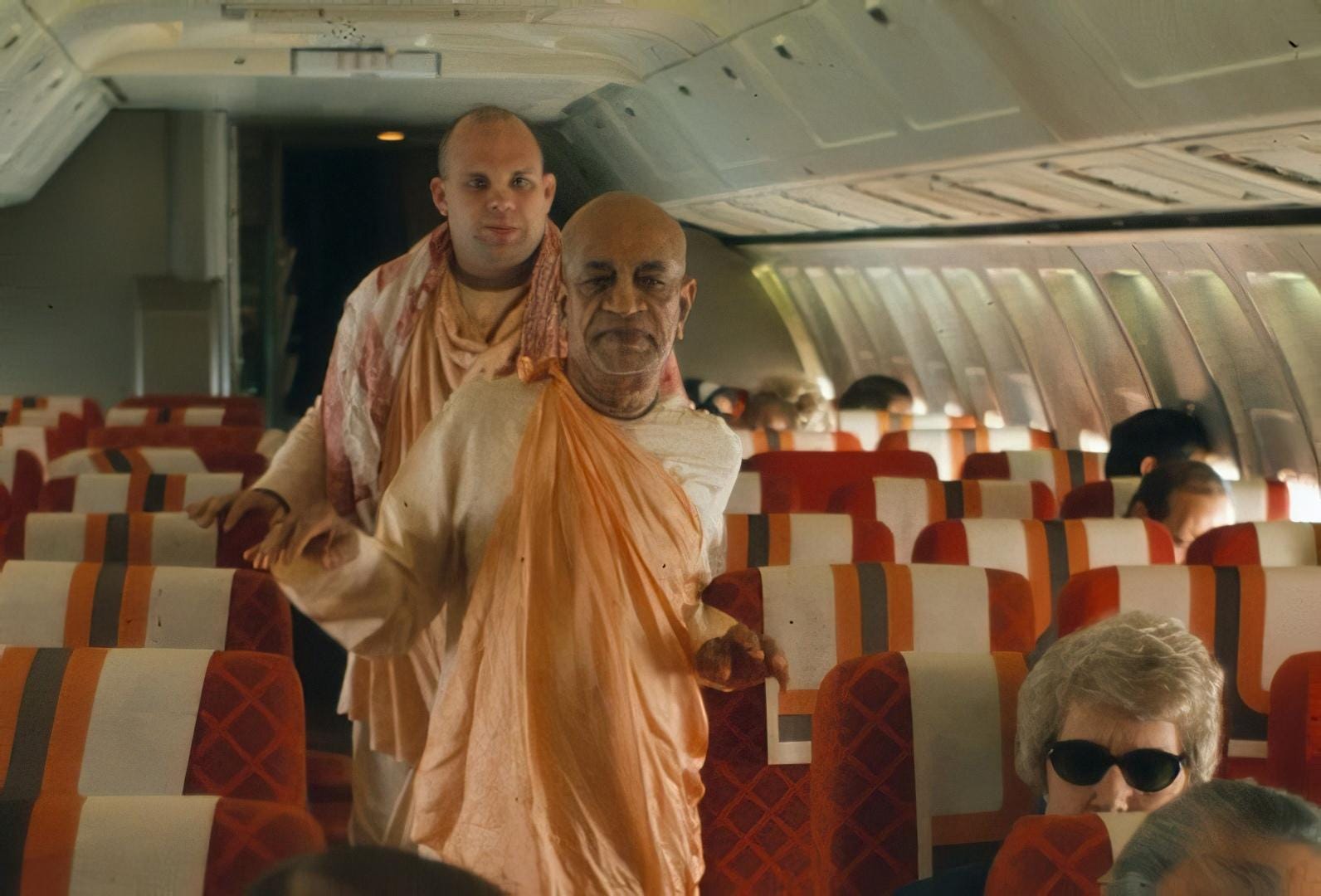
Once, for example, Prabhupāda was in the plane when a silent movie of Charles Chaplin was exhibited. To the surprise of the servants, he liked the movie and mentioned that his humor is very original and Kṛṣṇa is the origin of all original things. One may like or not like the humor of Charles Chaplin and have different opinions about him as a person, but the remark that Kṛṣṇa is the origin of all original things and the ability to put the movie in this context and be able to appreciate it based on its connection with Kṛṣṇa is unique.
Indradyumna Swami tells the story:
“Then the plane took off, some time passed, and we were asked to close the window blinds because a movie was starting. I thought, “A movie is maya. I’m going to show Prabhupāda that I’m not going to watch this movie.” It was dark, the movie started and I picked up my Bhagavad-gita and read different verses, “... dehino ‘smin yatha dehe... dhirastatranamuhyati... sarva-d harinan parityajya ... I’m not watching this movie.” I heard Prabhupāda chuckle. And then he started to laugh. I looked over and Prabhupāda was watching the movie! I put the book down, looked up, and saw it was one of Charlie Chaplin’s humorous movies. Prabhupāda liked the movie. He was laughing, Pradyumna was laughing, and I was also laughing. When the movie ended and the lights came on, I thought, “We aren’t supposed to watch movies. What’s going on here? Prabhupāda must have some explanation.” I leaned over to Pradyumna who was on the other side of Prabhupāda, and said, “Pradyumna, can I speak to you?” He said, “I’m busy now.” I said, “I need to speak to you, I have an important question. I’ll meet you by the bathroom.” I got up and went toward the bathroom. Pradyumna got up, went past Prabhupāda and joined me in the aisle. I said, “Pradyumna, we’re not supposed to watch movies, so what am I supposed to think?” He said, “I don’t know.” I said, “Maybe we should ask Śrīla Prabhupāda.” He said, “Okay. Go ask Śrīla Prabhupāda.” I said, “No, you ask Śrīla Prabhupāda.” He said, “No, you ask Śrīla Prabhupāda.” We went back and forth like this and finally he agreed to ask Śrīla Prabhupāda. He sat down next to Prabhupāda, they spoke and eventually a big smile came on Pradyumna’s face. I was in the aisle waiting. Pradyumna walked over, still smiling. I said, “What did Śrīla Prabhupāda say?” Pradyumna said, “Prabhupāda said, we don’t generally watch movies, but Charlie Chaplin’s humor is very original and Krishna is the origin of all original things.” Even as a young boy, Prabhupāda liked the innocent humor of Charlie Chaplin.” (Memories Anecdotes of a Modern Day Saint - Volume 3 by Siddhanta Dasa)
In this sense, even if a pure devotee gets some material information that is not correct and comments on it, somehow propagating this incorrect fact, it will still be useful, because even though the fact may not be accurate, he will somehow connect it with Kṛṣṇa, and that’s the part we should pay attention to. In a time where facts are often fabricated, conspiracy theories are rampant, and each one creates his or her own version of reality, this becomes an essential point to keep in mind.
Getting news or accurate historical facts should not be the main reason for us to approach a pure devotee, nor should hearing some piece of material information we consider incorrect be the basis for losing our faith in them. We can get information about material events in the news. The difficulty is how to connect them with Kṛṣṇa.
What I find striking, however, is that the vast majority of Prabhupāda’s statements, even a few that sound really far out at first, are proven accurate when we research a little.
For example, in a few of his purports, Śrīla Prabhupāda mentions people implanting the testicles of monkeys into human beings as a way to cure impotence in old men. On 5.14.30, for example, he mentions:
“Monkeys are very expert in sexual enjoyment, and sometimes sex glands are taken from monkeys and placed in the human body so that a human being can enjoy sex in old age. In this way, modern civilization has advanced. Many monkeys in India were caught and sent to Europe so that their sex glands could serve as replacements for those of old people.”
One may think that this may be some kind of mistake, but it’s not. Bizarre as it may seem, such operations were indeed quite popular during the first half of the last century. A Russian surgeon called Sergei Abrahamovich Voronoff created a “treatment” that consisted of inserting tiny slices of baboons’ and chimpanzees’ testicles into the scrotum of men. These fragments were just a few millimeters in size, and thus they would merge into the human tissue without causing rejection, as a normal transplant would do, but it, of course, could result in the transmission of all kinds of disease, which was not well known at the time.
The first official transplant of a monkey gland on a human body happened on the 12th of June, 1920, and quickly the work of Voronoff gained recognition in scientific circles, attracting many candidates, especially millionaires. By the 1930s, thousands of people had already gone through this strange operation, leading to the widespread import of monkeys from India and other countries that Śrīla Prabhupāda describes. Only by the 1940s were the operations finally branded as bogus, and the procedure was thrown into the dustbin of history.
All of this illustrates how materialistic people can do everything in an attempt to increase their sense gratification and span of life, and how these attempts will all ultimately result in failure. Just like people fell into the quackery of Voronoff in the 1920s and 1930s, many fall today into all kinds of fraudulent or ineffective treatments, with similar results. Eventually, all of them will die, and all their efforts will be ultimately forgotten.
What is not forgotten, however, is the transcendental context that such mundane facts of life gain when mentioned by a pure devotee.
You can also donate using Buy Me a Coffee, PayPal, Wise, Revolut, or bank transfers. There is a separate page with all the links. This helps me enormously to have time to write instead of doing other things to make a living. Thanks!
But what about the fact that Srila prabhupada didn't believe that the Nazis killed around 6 million Jews which is well recorded in history? Why Srila prabhupada showed skepticism about it