

Subscribe to receive new articles by e-mail. It’s free, but if you like, you can pledge a donation:
The pastime of Lord Vāmanadeva is described in detail in the 8th canto of the Śrīmad Bhāgavatam. At a certain point, having secured the blessings of the brāhmanas, Bali Maharaja was able to defeat the demigods and take possession of the celestial planets. Defeated, the demigods appealed to Lord Viṣṇu, who appeared as Vāmanadeva.
Vāmanadeva covered the whole universe with two steps by increasing His size. With the first step, he covered the entire surface of the earth, and when he raised his foot to take his second step, his foot hit the coverings of the universe and opened a crack through which the water of the causal ocean leaked inside. It is described that “a few drops” of the causal ocean entered the universe, but this is from the perspective of someone almost as big as the universe itself.
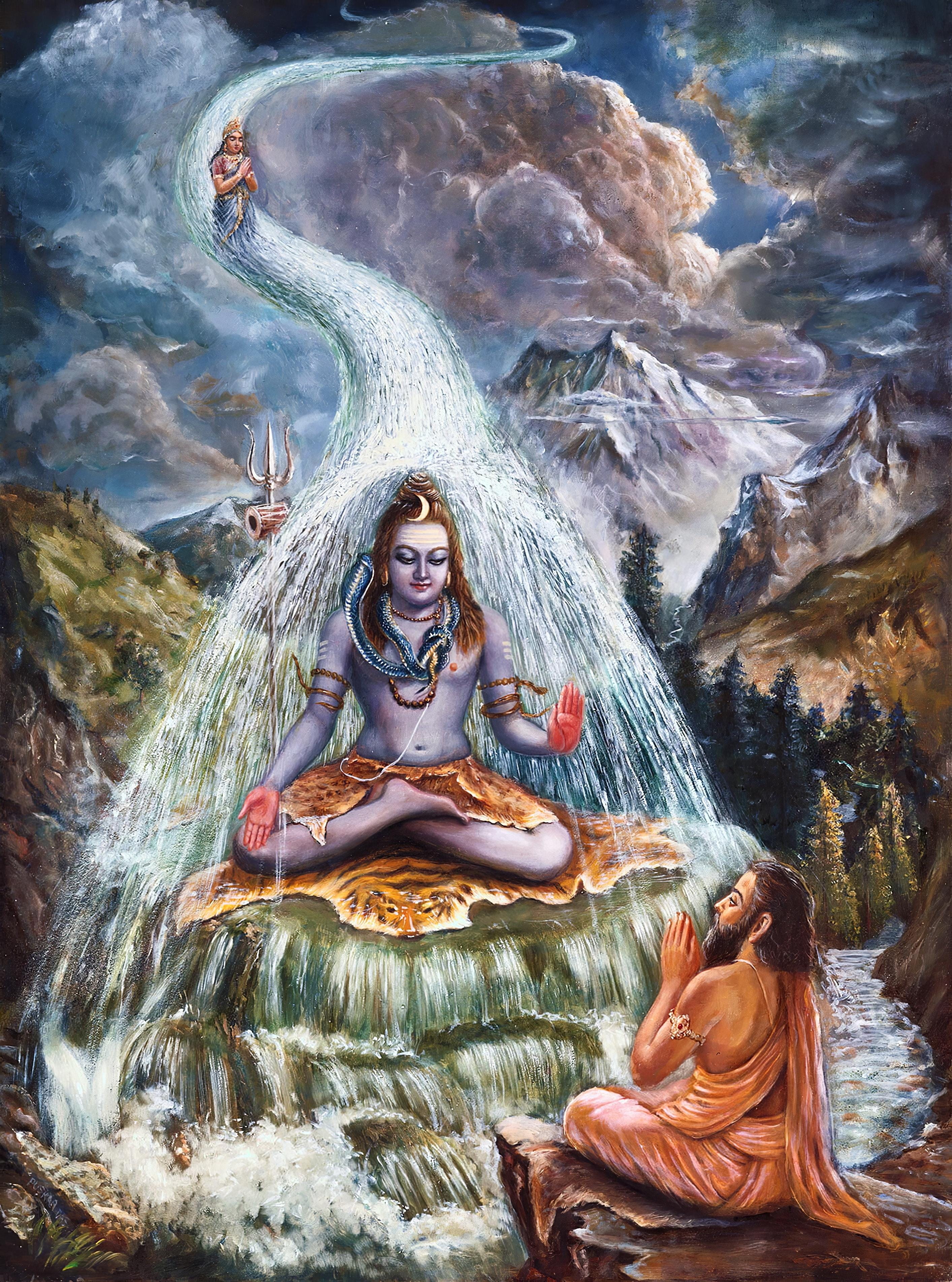
Each material universe is like a coconut, with a hollow central part half-filled with water and surrounded by seven coverings. Outside these coverings are the spiritual waters of the causal ocean, where Lord Mahā-Viṣṇu stays. This water is pure in itself, but it became even more sacred after touching the lotus feet of the Lord, becoming the transcendental river Ganges.
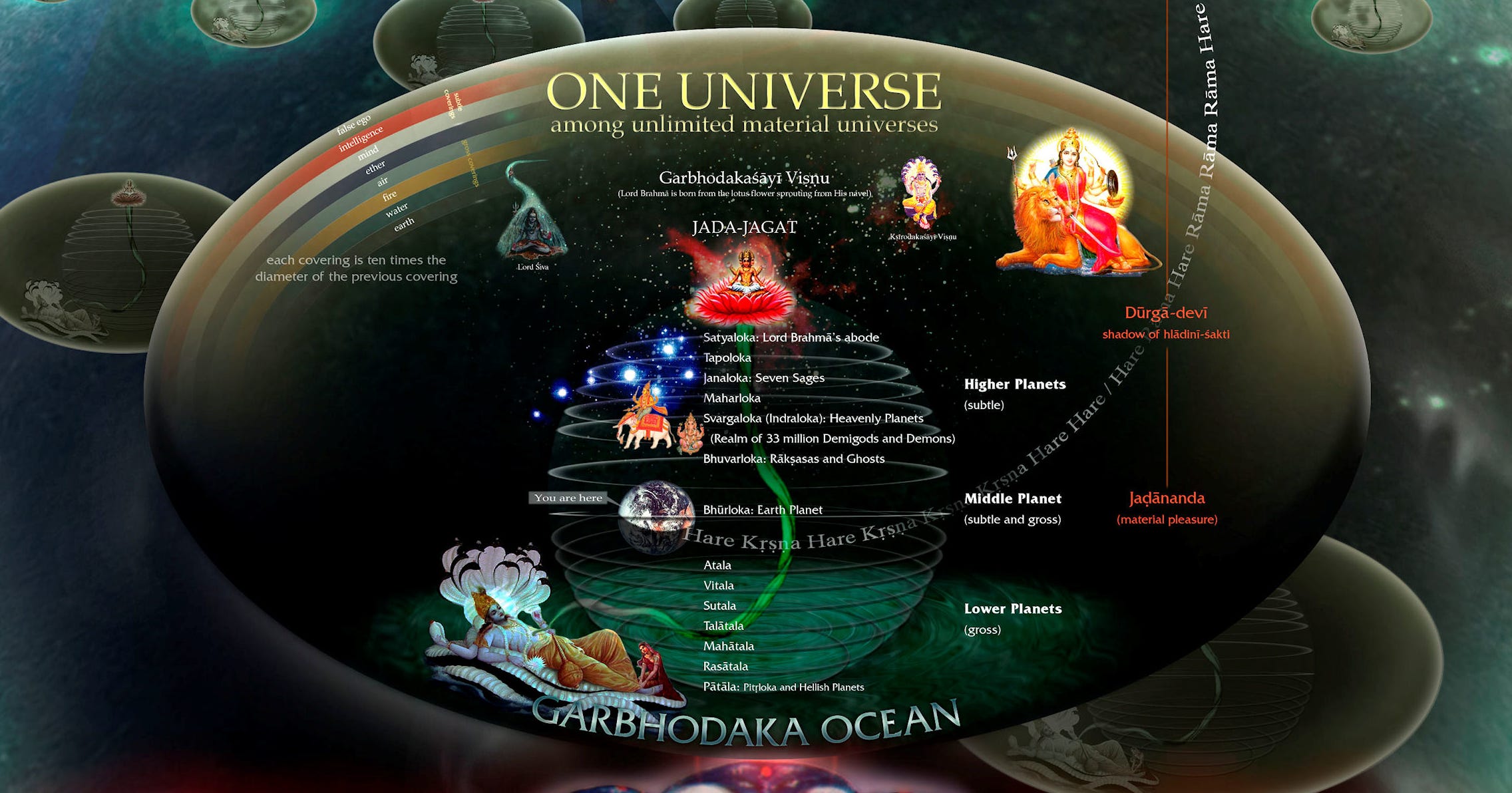
This stream of water then falls through the universe, reaching Svargaloka and then Bhū-Mandala after passing through Dhruvaloka (the Polestar). Dhruvaloka is described in the verse as the topmost planet in this universe, because it is a Vaikuṇṭha planet, and also because it is situated above Svargaloka. Geographically speaking, however, Dhruvaloka is situated below the planetary system Maharloka, and above the Saptarṣi constellation (the seven sages).
“Dhruva Mahārāja, the famous son of Mahārāja Uttānapāda, is known as the most exalted devotee of the Supreme Lord because of his firm determination in executing devotional service. Knowing that the sacred Ganges water washes the lotus feet of Lord Viṣṇu, Dhruva Mahārāja, situated on his own planet, to this very day accepts that water on his head with great devotion. Because he constantly thinks of Kṛṣṇa very devoutly within the core of his heart, he is overcome with ecstatic anxiety. Tears flow from his half-open eyes, and eruptions appear on his entire body. The seven great sages [Marīci, Vasiṣṭha, Atri and so on] reside on planets beneath Dhruvaloka. Well aware of the influence of the water of the Ganges, to this day they keep Ganges water on the tufts of hair on their heads. They have concluded that this is the ultimate wealth, the perfection of all austerities, and the best means of prosecuting transcendental life. Having obtained uninterrupted devotional service to the Supreme Personality of Godhead, they neglect all other beneficial processes like religion, economic development, sense gratification and even merging into the Supreme. Just as jñānīs think that merging into the existence of the Lord is the highest truth, these seven exalted personalities accept devotional service as the perfection of life.” (SB 5.17.2-3)
These two verses describe the spiritual potency of the water of the Ganges, whose waters are accepted by both Dhruva and the sages with great respect. Because these great sages keep the water on the tufts of hair on their heads with such great respect, they obtain uninterrupted devotional service to the Lord, and lose interest in the materialistic process of karma-kanda and economic development, culminating in impersonal liberation.
This shows how the waters are spiritually powerful. If even such great sages derive such great benefit, what to say about us? This also reveals the true benefit of bathing in the Ganges: ultimately, it’s not just about becoming free of sins, but attaining pure devotional service to the Lord.
The next point is the interplanetary flow of Gangā. Dhruvaloka and the abode of the Seven Ṛṣis are far above Svargaloka. How to make a river flow through space over such a great distance? The solution found by the demigods is to carry the waters on their vimānas. The verse mentions that an army of thousands and millions of vimānas (sahasra-koṭi-vimānānīka) is constantly engaged in this service of carrying the waters of the Ganges all the way to Candra-loka (the moon). From there, the water flows into Brahmapurī, the abode of Lord Brahma on top of Mount Sumeru, the central mountain of the high-dimensional Bhū-mandala.
Prabhupāda describes the whole process in his purport:
“We should always remember that the Ganges River comes from the Causal Ocean, beyond the covering of the universe. After the water of the Causal Ocean leaks through the hole created by Lord Vāmanadeva, it flows down to Dhruvaloka (the polestar) and then to the seven planets beneath Dhruvaloka. Then it is carried to the moon by innumerable celestial airplanes, and then it falls to the top of Mount Meru, which is known as Sumeru-parvata. In this way, the water of the Ganges finally reaches the lower planets and the peaks of the Himālayas, and from there it flows through Hardwar and throughout the plains of India, purifying the entire land. How the Ganges water reaches the various planets from the top of the universe is explained herein. Celestial airplanes carry the water from the planets of the sages to other planets.”
In Brahmapurī, on top of Mount Sumeru, the waters of the Ganges divide into four streams, which go into the four directions, flowing through Bhadrāśva-varṣa to the east, Ketumāla-varṣa to the west, Ramyaka, Hiraṇmaya, and Uttarakuru to the north, and Hari-varṣa, Kimpuruṣa, and Bhārata-varṣa to the south. These four principal streams ramify into many, bathing many different tracts of land.
Just as the continents of our planet are surrounded by the ocean, Jambūdvīpa is surrounded by a salt ocean that has the same breadth as the island itself. Therefore, it is said that all these different streams of water flow into the salt ocean.
On our planet, the Ganges appears to originate from melted ice in the Himalaya region, but this is just the apparent cause. Somehow, the subtle waters flow from other regions of Bhū-mandala and mix with this gross water coming from the Himalayas, producing the river we can bathe in to become free from all material contamination.
You can also donate using Buy Me a Coffee, PayPal, Wise, Revolut, or bank transfers. There is a separate page with all the links. This helps me enormously to have time to write instead of doing other things to make a living. Thanks! You can also receive the updates on Telegram.