

Subscribe to receive new articles by e-mail. It’s free, but if you like, you can pledge a donation:
Bharata Maharaja was so successful in his reign that our planet inherited his name, being known as Bhārata-varṣa since then. However, following the footsteps of his ancestors, Bharata Maharaja eventually renounced the kingdom to aim for self-realization. This led him to his famous saga, which took three lives to be completed.
After living as a king, Bharata made a mistake and ended up having to take birth as a deer. However, by remembering his spiritual practice in this life as an animal, he regained the human form in his next life, taking his next birth as the brāhmana Jada Bharata and completing his process of self-realization.
However, how did Bharata Maharaja rule the kingdom in his first life, and how did he become such a great ruler that his name is still remembered even today?
“Mahārāja Bharata was a very learned and experienced king on this earth. He perfectly ruled the citizens, being himself engaged in his own respective duties. Mahārāja Bharata was as affectionate to the citizens as his father and grandfather had been. Keeping them engaged in their occupational duties, he ruled the earth.
With great faith King Bharata performed various kinds of sacrifice. He performed the sacrifices known as agni-hotra, darśa, pūrṇamāsa, cāturmāsya, paśu-yajña [wherein a horse is sacrificed] and soma-yajña [wherein a kind of beverage is offered]. Sometimes these sacrifices were performed completely and sometimes partially. In any case, in all the sacrifices the regulations of cāturhotra were strictly followed. In this way Bharata Mahārāja worshiped the Supreme Personality of Godhead.
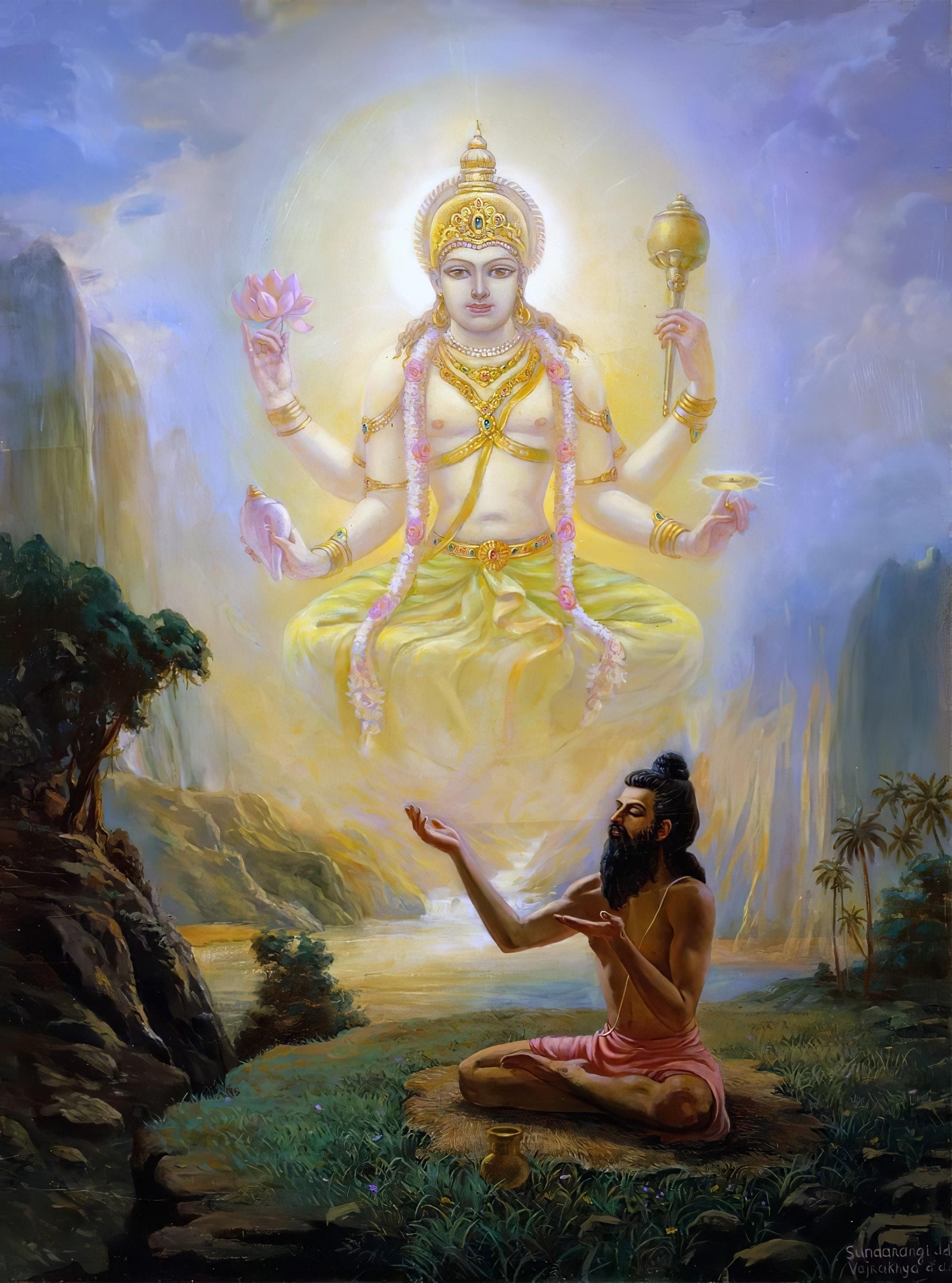
After performing the preliminaries of various sacrifices, Mahārāja Bharata offered the results in the name of religion to the Supreme Personality of Godhead, Vāsudeva. In other words, he performed all the yajñas for the satisfaction of Lord Vāsudeva, Kṛṣṇa. Mahārāja Bharata thought that since the demigods were different parts of Vāsudeva’s body, He controls those who are explained in the Vedic mantras. By thinking in this way, Mahārāja Bharata was freed from all material contamination, such as attachment, lust and greed. When the priests were about to offer the sacrificial ingredients into the fire, Mahārāja Bharata expertly understood how the offering made to different demigods was simply an offering to the different limbs of the Lord. For instance, Indra is the arm of the Supreme Personality of Godhead, and Sūrya [the sun] is His eye. Thus Mahārāja Bharata considered that the oblations offered to different demigods were actually offered unto the different limbs of Lord Vāsudeva.” (SB 5.7.4-6)
The Fourth Canto of Srimad Bhagavatam brings us the example of King Prācīnabarhi, who performed improper fruitive sacrifices and thus got entangled in the reactions of killing numerous animals. He taught that he was achieving the celestial planets by these sacrifices, but Nārada Muni revealed he was actually going to hell for unnecessarily killing so many animals.
Bharata, however, is the example of a King who performed perfect sacrifices for the satisfaction of the Supreme Lord, demonstrating the true purpose of the Vedas.
In the Mundaka Upaniṣad, it’s revealed that the original purpose of the Vedas was understood in Satya-yuga, when different demigods were seen as simply servants of the Lord, and all efforts in self-realization were made simply for understanding Him. The concept of separate worship of demigods was introduced in Treta-yuga, when knowledge diminished, and people started performing sacrifices with fruitive intent, just like Prācīnabarhi.
As urged in the Mundaka Upaniṣad (1.2.1): “Brahman is the Supreme Truth! The original understanding of sacrifice expanded into many forms in Treta-yuga. O great sages anxious to please the Lord, practice sacrifices steadily and regularly, in their original understanding, for the satisfaction of the Lord. This is your path back to Godhead.”
This is the knowledge behind the sacrifices of Bharata Maharaja, as explained by Prabhupāda in his purport to text 5.7.6:
“Because the goddess Durgā satisfies Kṛṣṇa, we should therefore offer respects to Goddess Durgā. Because Lord Śiva is nothing but Kṛṣṇa’s functional body, we should therefore offer respects to Lord Śiva. Similarly, we should offer respects to Brahmā, Agni and Sūrya. There are many offerings to different demigods, and one should always remember that these offerings are usually meant to satisfy the Supreme Personality of Godhead. Bharata Mahārāja did not aspire to receive some benediction from demigods. His aim was to please the Supreme Lord.”
Another frequent misunderstanding is about the purpose of sacrificing animals.
Animals were sacrificed in Vedic sacrifices as a test and also as a visual proof of the potency of the Vedic mantras. The animal would be sacrificed and then resurrected, showing the divine potency of the mantras chanted by the brāhmanas. As Vedic sacrifices would typically attract a large audience, and such a performance would help them acquire faith in the scriptures. However, when the brāhmanas are not able to bring the animals back to life, they, as well as other people involved in the ceremony, become responsible for the killing, as in the case of Prācīnabarhi. Because such brāhmanas are now not available, animal sacrifices are prohibited in our age. Instead of performing complicated rituals, we are urged to focus on the essence of the scriptures by sincerely chanting the holy names. Yajñaiḥ saṅkīrtana-prāyair yajanti hi sumedhasaḥ: this is the process accepted by intelligent persons.
Apart from that, Bharata Maharaja was performing the sacrifices exclusively for the satisfaction of the Lord, and with perfect knowledge of the function of the demigods as different limbs of the Universal form of the Lord. One could question why he worshiped demigods at all, but this is very didactically explained by Prabhupāda. The point is that if we worship the hand of a person, the idea is to satisfy the person himself, not the hand as a separate entity. If we massage a person’s legs, we do not really serve the legs but the person who possesses the legs. Similarly, all the demigods are different parts of the Lord, and if we offer service to them, we actually serve the Lord Himself.
As a King, Bharata Maharaja had the duty of performing sacrifices for the enlightenment of the general public, for this was the appropriate process prescribed in the scriptures for the age he was living in. A pure devotee does not neglect the prescriptions of the scriptures; on the contrary, he gives the example by performing them perfectly.
All of these exalted standards were upheld by Bharata Maharaja, and that’s the reason he became such an exalted king that the planet was renamed in his honor.
Just like his ancestors, Bharata reigned for a very long time. He then divided the kingdom amongst his five sons, Sumati, Rāṣṭrabhṛta, Sudarśana, Āvaraṇa, and Dhūmraketu, and retired to Pulahāśrama, a place where śālagrāma-śilās are naturally found.
This attitude teaches us a number of important lessons. The first is that Bharata perfectly maintained the property he inherited from his ancestors, just as we inherit temples and other facilities from devotees of previous generations, and have the duty of properly maintaining them. Even if we don’t have the potency to create something new, we must at least properly maintain what is there. The second is that he transmitted it to his sons after properly raising and educating them, just as we are supposed to train and nourish the next generation of devotees, who can take up the mission. A third point is that he was not attached; he performed everything out of duty and was ready to relinquish his position as soon as qualified successors were present.
How was he living in his retired life?
“In the gardens of Pulaha-āśrama, Mahārāja Bharata lived alone and collected a variety of flowers, twigs and tulasī leaves. He also collected the water of the Gaṇḍakī River, as well as various roots, fruits and bulbs. With these he offered food to the Supreme Personality of Godhead, Vāsudeva, and, worshiping Him, he remained satisfied. In this way his heart was completely uncontaminated, and he did not have the least desire for material enjoyment. All material desires vanished. In this steady position, he felt full satisfaction and was situated in devotional service.” (SB 5.7.11)
In contrast with the gorgeous sacrifices he performed as a king, Bharata performed a simple process of worship in his retired life, offering water, tulasī leaves, as well as flowers and other natural items. He was situated in devotional service even as a king, but now, free to focus his mind on the Lord without any distractions, his devotional sentiments developed further. This is the characteristic of the spiritual platform: there is no limit on how much one’s love for Krsna can increase. In the spiritual world, the love of all inhabitants continues to increase forever, without limit.
What about us? We may not be able to go to live in Pulaha-āśrama or in another holy place, but we can still continue to advance, even while living at home, by following the same process.
Traditionally, devotees leave home and go to live in holy places to have more facility in serving the Lord, but the main point is not the place, but the consciousness. If one is determined in chanting and practicing the other limbs of the devotional process, one can fix his mind on the Lord and become free from material desires while living anywhere.
You can also donate using Buy Me a Coffee, PayPal, Wise, Revolut, or bank transfers. There is a separate page with all the links. This helps me enormously to have time to write instead of doing other things to make a living. Thanks!
Brilliant explanation and step back in time. Aabhaar, 🙏🏼