


You can receive new articles directly in your inbox. Subscription is free; donations are welcome.
In the Śrīmad-Bhāgavatam, the universe is described as a great machine. The central pivot of this gigantic cosmic machine is Dhruvaloka, which is placed as a central pivot for the rotation of the whole sky. Around this central pivot is śiśumāra, the divine dolphin.
This divine dolphin is described in detail in the Fifth Canto:
This form of the śiśumāra has its head downward and its body coiled. On the end of its tail is the planet of Dhruva, on the body of its tail are the planets of the demigods Prajāpati, Agni, Indra, and Dharma, and at the base of its tail are the planets of the demigods Dhātā and Vidhātā. Where the hips might be on the śiśumāra are the seven saintly sages like Vasiṣṭha and Aṅgirā. The coiled body of the Śiśumāra-cakra turns toward its right side, on which the fourteen constellations from Abhijit to Punarvasu are located. On its left side are the fourteen stars from Puṣyā to Uttarāṣāḍhā. Thus its body is balanced because its sides are occupied by an equal number of stars. On the back of the śiśumāra is the group of stars known as Ajavīthī, and on its abdomen is the Ganges that flows in the sky [the Milky Way].
On the right and left sides of where the loins might be on the Śiśumāra-cakra are the stars named Punarvasu and Puṣyā. Ārdrā and Aśleṣā are on its right and left feet, Abhijit and Uttarāṣāḍhā are on its right and left nostrils, Śravaṇā and Pūrvāṣāḍhā are at its right and left eyes, and Dhaniṣṭhā and Mūlā are on its right and left ears. The eight stars from Maghā to Anurādhā, which mark the southern course, are on the ribs of the left of its body, and the eight stars from Mṛgaśīrṣā to Pūrvabhādra, which mark the northern course, are on the ribs on the right side. Śatabhiṣā and Jyeṣṭhā are on the right and left shoulders.
On the upper chin of the śiśumāra is Agasti; on its lower chin, Yamarāja; on its mouth, Mars; on its genitals, Saturn; on the back of its neck, Jupiter; on its chest, the sun; and within the core of its heart, Nārāyaṇa. Within its mind is the moon; on its navel, Venus; and on its breasts, the Aśvinī-kumāras. Within its life air, which is known as prāṇāpāna, is Mercury, on its neck is Rāhu, all over its body are comets, and in its pores are the numerous stars.” (SB 5.23.4-7)
The śiśumāra is also taken, in a more general sense, as the path of the Milky Way extending through the sky, the millions of stars all the way to the polestar. In the model, the Milky Way is the path of the Ganges flowing in the sky, which forms the abdomen of śiśumāra.
The siśumāra appears in different positions in the sky according to our latitude and the nightly rotation of the sky. It moves following the rotation of the sky around Dhruvaloka, just like a divine dolphin swimming through the sky.
At high northern latitudes, the siśumāra appears upright, with the head downwards and Dhruvaloka on its tail appearing in the northern sky, acting as the central pivot of the rotation of the whole sky.

If we take several photos of the northern sky and make a time-lapse, we will see the whole sky circling around the northern celestial pivot, where Dhruvaloka is situated, exactly as described in the Śrīmad-Bhāgavatam.
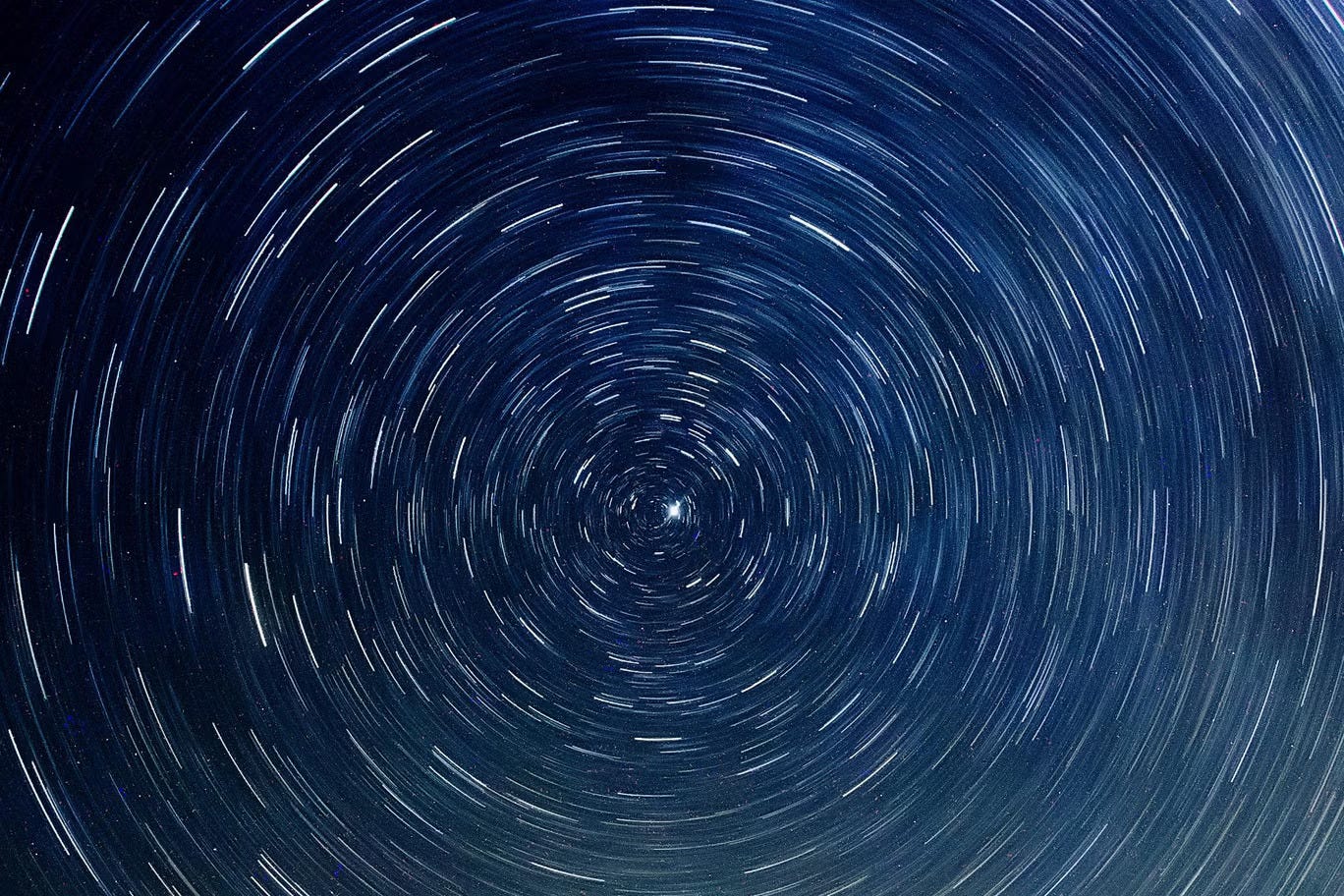
Dhruvaloka itself, however, does not appear to be visible to us, for there is no prominent star there. The closest prominent star is Polaris, which is about ⅔ of a degree from it. It is close enough to serve as a reference point, but if we observe attentively, Polaris also circles the pivot. Its position is also not fixed in the sky: just like other stars, Polaris slowly drifts in position.
This should not, however, be seen as contradictory, for Dhruvaloka is a spiritual planet, and not a physical celestial body that is observable from earth. No one should expect to point a telescope there and see Kṣīrodakaśāyī Viṣnu. Dhruvaloka is thus yet another aspect of the Vedic universe that is not directly observable to us, but that we can ascertain based on its role in the cosmos.
One could also offer that Polaris may be a gross representation of Dhruvaloka, the way it appears in our gross dimension, a visual aid, but not exactly the same high-dimensional object, just in the case of the moon and the sun. This could also be reasonable.
As mentioned, if we stand at higher latitudes, the siśumāra appears upright. As we go south in the globe, however, Dhruvaloka appears lower and lower in the sky, and the siśumāra appears more horizontal. After we cross the equator into the southern hemisphere, Dhruvaloka is not visible. As we go further south, more of the siśumāra itself passes below the horizon.
The description of Dhruvaloka as the central pivot of the sky is yet another evidence that the model described in the Śrīmad-Bhāgavatam is of a spherical earth. If the earth were flat, we would see the northern pivot, with Polaris and Dhruvaloka from any country, and the Milky Way would appear as a fixed band rotating in the sky.
The process of meditation on the śiśumāra, observing the path of stars in the sky as a form of Lord Viṣnu, should not be seen as a form of pantheism, but as a process of personal worship that helps the worshipers to gradually advance to a platform of worship of the spiritual form of the Lord. This again emphasizes the main point of this description: to not just analyze the cosmos, but worship the Lord who is the source and maintainer of the whole cosmic apparatus.
This is the missing link in modern science, and the key to properly understanding the cosmos. Without this understanding, the study of the cosmos becomes fruitless, a mere exercise of speculation that just brings us further away from the goal of human life.
The whole modern cosmological model pushes people in the direction of atheism. By properly understanding the theistic model offered in the Śrīmad-Bhāgavatam, we can offer people an alternative. If people can look at the sky and see the hand of the Lord behind its workings, this will be the first step for them to become full-fledged Vaiṣnavas.
This is a publication for thoughtful readers who want to go deeper into Kṛṣṇa consciousness. I publish daily, trying to offer high-quality spiritual content, and all posts are available to free subscribers. If you wish, you can also choose a paid subscription to support this work.
You can also receive the updates on WhatsApp or Telegram.
If you would like to contribute further, you can find the donation links here.
Well earlier I also used to think that the Sisumara of the Puranas is referring to Milky way but on deeper analysis I discovered that the idea and description of Sisumara matches exactly with that of the the great constellation which ancient Greeks used to call as The Draco, you can check the striking similarities between the two in this research paper by IIT BOMBAY
https://www.researchgate.net/publication/283894340_Sisumara_the_forgotten_Constellation_of_Ancient_Indian_Astronomy_Invited_Conference_Talk
One more small question regarding the location of Dhruvaloka in the Material cosmos:
Do our scriptures give the location of Dhruvaloka in relation to upper planetary systems.
For example: lower than or higher than or near to any of upper planets such as Mahar Loka, Jana Loka , Tapa Loka etc.
Do we get such a reference?
Hare Krishna