

« The ‘Fall’ of the Jīva, as Explained by Śrīla Prabhupāda
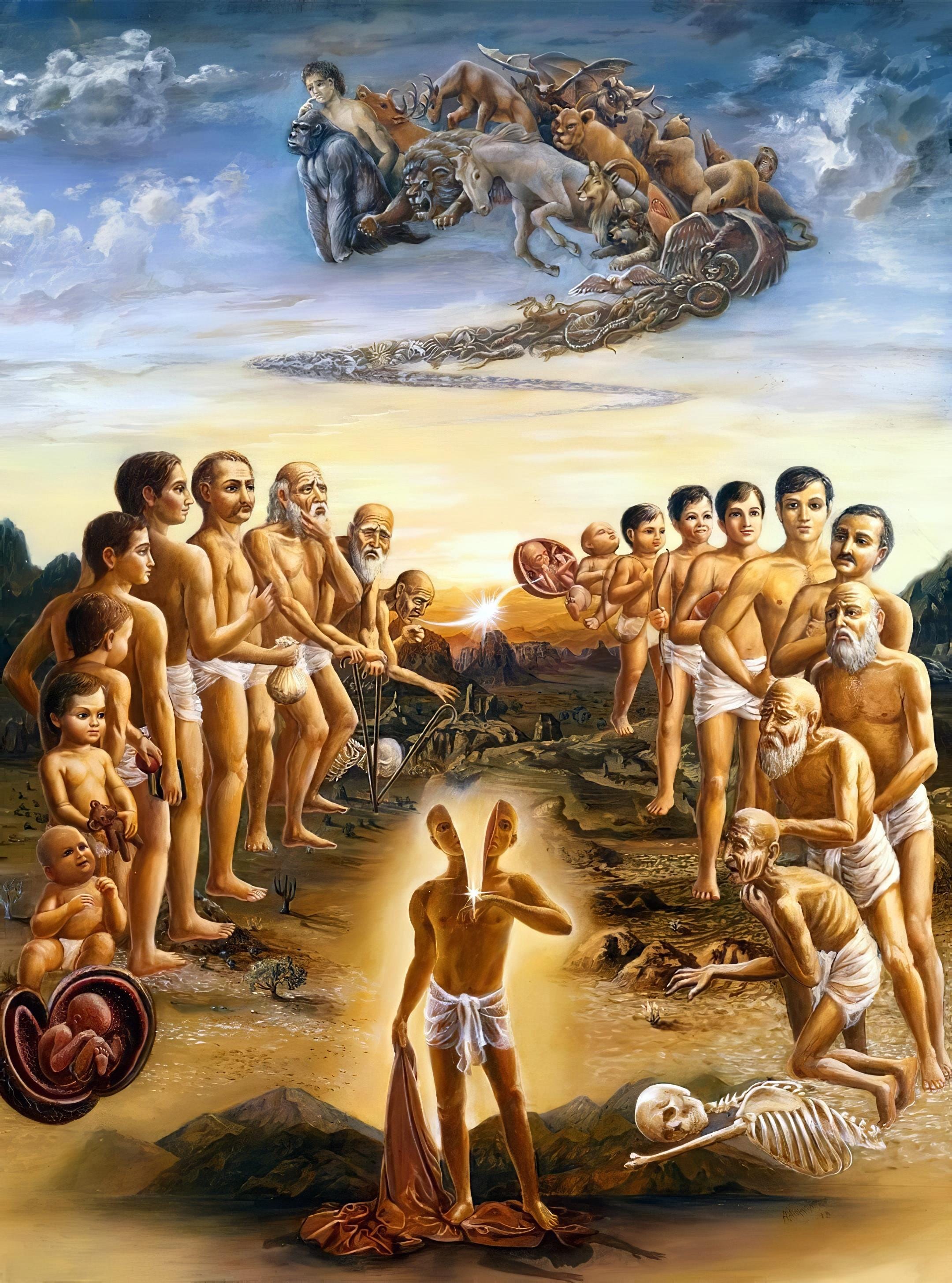
Conditioned life: The reflection in the dark room
Another example given by Lord Kapila to explain our conditioned existence is the reflection of the sun in a dark room. This example is intricate, because it simultaneously explains how the Lord becomes present inside the material creation without touching matter, and also how the individual soul remains transcendental to matter even while identified with a material body and absorbed in material sorrow.
“A liberated soul realizes the Absolute Personality of Godhead, who is transcendental and who is manifest as a reflection even in the false ego. He is the support of the material cause and He enters into everything. He is absolute, one without a second, and He is the eyes of the illusory energy.
The presence of the Supreme Lord can be realized just as the sun is realized first as a reflection on water, and again as a second reflection on the wall of a room, although the sun itself is situated in the sky. The self-realized soul is thus reflected first in the threefold ego and then in the body, senses and mind.” (SB 3.27.11-13)
The Lord is present everywhere in the material creation, even in the false ego, which is the most subtle of all material elements. However, at the same time, it is said that the Lord never touches material nature. How is it that the Lord is present everywhere if He never touches the material creation?
Lord Kapila explains this point by using the example of the sun reflected on a pot of water and then on the walls of a room. The material world is by nature dark, just like a dark room, and the only light comes from the Lord.
Prabhupāda explains this example:
“The example given herewith is perfect. The sun is situated in the sky, far, far away from the surface of the earth, but its reflection can be seen in a pot of water in the corner of a room. The room is dark, and the sun is far away in the sky, but the sun’s reflection on the water illuminates the darkness of the room. A pure devotee can realize the presence of the Supreme Personality of Godhead in everything by the reflection of His energy. In the Viṣṇu Purāṇa it is stated that as the presence of fire is understood by heat and light, so the Supreme Personality of Godhead, although one without a second, is perceived everywhere by the diffusion of His different energies. It is confirmed in the Īśopaniṣad that the presence of the Lord is perceived everywhere by the liberated soul, just as the sunshine and the reflection can be perceived everywhere although the sun is situated far away from the surface of the globe.”
Because the sun is so powerful, even the reflection of the sun in a pot of water in the corner of a dark room is sufficiently luminous to be again reflected in the walls of the room and thus illuminate the whole place. The sun thus enters the room and illuminates it, although it never leaves its position in the sky. Similarly, although the Lord is far, far away, outside the coverings of the universe, He becomes present everywhere by the diffusion of the reflection of His energy.
The Lord is situated in the spiritual sky, and He never comes in contact with the material energy. However, at the same time, He becomes present through the reflection of His energy. In this way, Lord Mahā-Viṣṇu appears as Garbhodakaśāyī-Viṣṇu and then as Kṣīrodakaśāyī Viṣṇu, and from Him, all avatāras are manifested. Even Kṛṣṇa Himself, who never leaves Vṛndāvana, appears in the different universes together with His supreme abode. A pure devotee can thus see Kṛṣṇa present everywhere, although He is eternally situated in the spiritual sky.
This also shows that although present everywhere, Paramātmā is just one. Kṣīrodakaśāyī Viṣṇu is like the reflection of the sun in the pot of water being again reflected on the walls. The light of the reflection illuminates the whole room, although all the light comes from a single source. Just like the light coming from the reflection on the pot of water illuminates the whole room, Paramātmā permeates all parts of the universe, although, at the same time, living in his own abode in Śvetadvīpa. The Lord is thus simultaneously all-pervading (being present everywhere) and localized (being present in one place). This may sound like a contradiction, but it is just another illustration of the transcendental nature of the Lord.
Prabhupāda reinforces this point in his purport: “The word advayam, ‘without a second,’ which is used in this verse, indicates that although the Supreme Personality of Godhead is represented in everything, including the atoms, He is not divided.”
And then: “In the Viṣṇu Purāṇa it is stated that as the presence of fire is understood by heat and light, so the Supreme Personality of Godhead, although one without a second, is perceived everywhere by the diffusion of His different energies. It is confirmed in the Īśopaniṣad that the presence of the Lord is perceived everywhere by the liberated soul, just as the sunshine and the reflection can be perceived everywhere although the sun is situated far away from the surface of the globe.”
What about the soul? The soul is just like the Lord (as indicated in the famous passage from the Chāndogya Upaniṣad, “tat tvam asi”). The Lord is like the sun, and the soul is like a ray of the sun or like a small sun. Sometimes it is also described as the Lord being like the moon and the souls being like stars, conveying the same idea. They are qualitatively one, but quantitatively distinct.
The infinite Lord can simultaneously permeate all material universes, while the infinitesimal soul can permeate a single material body. Just as the Lord does not come in contact with the material energy, the soul also doesn’t, although the consciousness of the soul somehow becomes entrapped here.
Lord Kapila explains this point in text 3.27.13:
evam trivṛd-ahankāro, bhūtendriya-manomayaiḥ
svābhāsair lakṣito ’nena, sad-ābhāsena satya-dṛk
There are two meanings in this verse. One is that the soul is reflected in the false ego, and then in the body, senses, and mind, and the other is that the Supreme Brahman, the Lord, is reflected in the material elements and is thus present everywhere. Prabhupāda translates this verse as “The self-realized soul is thus reflected first in the threefold ego and then in the body, senses and mind.” and then explains also the other meaning in his purport.
A pure devotee can see the Lord present everywhere by His reflection in the material energy, understanding that everything should be used in His service. Prabhupāda gives the example that when a conditioned soul sees a nice flower, he thinks how this flower can be used for his sense gratification, while a liberated soul sees the flower as a reflection of the superior energy of the Lord, and plans how to utilize it in His service. A pure devotee also sees the Lord present in his body, mind, intelligence, and senses, and thus understands that all of these should be used in the service of the Lord.
Just as the Lord is present in the material world as a reflection, the pure devotee can see himself also present as a reflection. The consciousness of the soul is first reflected in the three divisions of the false ego (in goodness, passion, and ignorance) and from there permeates the body, senses, and mind, just like the sun first reflected in the water and then in the walls. In this way, the big sun permeates all material universes, while the small sun permeates just a particular body, but both are eternally situated in the sky.
How the soul enters the body without leaving the spiritual sky
As previously explained, the soul enters into the body in the form of consciousness, and goes from one body to another, even though the soul never factually comes into contact with matter, remaining always in his eternal transcendental position. The material consciousness we have now is manifested by Lord Vāsudeva as a reflection of the original consciousness of the soul, and this reflected consciousness is then covered by the false ego, manifested by Lord Sankarṣaṇa, and then the intelligence and the mind, manifested from Lord Pradyumna and Lord Aniruddha. This combination, what we call the subtle body, is the particle of consciousness that is transported by the vital air from one body to another. However, if one looks for the soul inside the subtle body, one will not find it, because, in reality, the soul is not present there. The soul is present in his original position in the spiritual sky, and only his attention is somehow captured in the material elements.
This elusive nature of the soul is indicated in the Svetasvatara Upanisad (5.9):
“When the upper point of a hair is divided into one hundred parts and again each of such parts is further divided into one hundred parts, each such part is the measurement of the dimension of the spirit soul.”
If one takes the smallest particle that he can measure, he will find that the soul is still smaller. If, by the improvement of technology, one becomes able to detect and measure a still smaller particle, like an atom, he will find the soul is still smaller. In this way, one will never be able to measure the soul; it will always escape his comprehension.
As explained by Lord Kapila, we are not factually present in this material world, although our consciousness is focused here. This explains how a soul can achieve liberation simply by focusing his meditation on Kṛṣṇa. When one can do so, he sees himself immediately with Kṛṣṇa, even while still technically living in a material body. Being in the material world is thus not a question of being in a certain geographical space, but a matter of consciousness. As long as our consciousness is focused on the material world, we are here, but as soon as our consciousness is again focused on Kṛṣṇa, we suddenly realize we never left. This is a very subtle point in our philosophy that Prabhupāda explains in his purports.
In the Bhakti-rasāmṛta-sindhu, Śrīla Rūpa Gosvāmī explains that a pure devotee can be liberated even while living in his material body. From this, we can understand that liberation is not about living in a certain geographical space, but about becoming aware of one’s eternal relationship with Kṛṣṇa. This leads us to the question: How can the pure devotee become aware of His eternal relationship with Kṛṣṇa and thus be directly present with Kṛṣṇa even though he is still living in his physical body?
The answer is that the sun still shines in the sky, even though it is reflected in the water. The light of the sun can be manifested in many places simultaneously.
As Prabhupāda explains in his purport to SB 3.27.13:
“The conditioned soul thinks, “I am this body,” but a liberated soul thinks, “I am not this body. I am spirit soul.” This “I am” is called ego, or identification of the self. “I am this body” or “Everything in relationship to the body is mine” is called false ego, but when one is self-realized and thinks that he is an eternal servitor of the Supreme Lord, that identification is real ego. One conception is in the darkness of the threefold qualities of material nature — goodness, passion and ignorance — and the other is in the pure state of goodness, called śuddha-sattva or vāsudeva. When we say that we give up our ego, this means that we give up our false ego, but real ego is always present. When one is reflected through the material contamination of the body and mind in false identification, he is in the conditional state, but when he is reflected in the pure stage he is called liberated. The identification of oneself with one’s material possessions in the conditional stage must be purified, and one must identify himself in relationship with the Supreme Lord. In the conditioned state one accepts everything as an object of sense gratification, and in the liberated state one accepts everything for the service of the Supreme Lord. Kṛṣṇa Consciousness, devotional service, is the actual liberated stage of a living entity. Otherwise, both accepting and rejecting on the material platform or in voidness or impersonalism are imperfect conditions for the pure soul.”
Prabhupāda goes further still by explaining the eternal position of the soul as a servitor of the Lord. This is the explanation for the “origin” of the soul that Prabhupāda consistently gives in his books, and is the only explanation that does not contradict the scriptures.
As he mentions on text 3.27.14:
“Real individuality is to understand oneself to be the eternal servitor of the Supreme Lord. This information is received from the mouth of Lord Caitanya. He said clearly, upon the inquiry of Sanātana Gosvāmī, that a living entity is the servitor of Kṛṣṇa eternally. Kṛṣṇa also confirms in Bhagavad-gītā that the living entity is eternally His part and parcel. The part and parcel is meant to serve the whole. This is individuality. It is so even in this material existence, when the living entity apparently merges in matter. His gross body is made up of five elements, his subtle body is made of mind, intelligence, false ego and contaminated consciousness, and he has five active senses and five knowledge-acquiring senses. In this way he merges in matter. But even while merged in the twenty-four elements of matter, he can keep his individuality as the eternal servitor of the Lord. Either in the spiritual nature or in the material nature, such a servitor is to be considered a liberated soul.”
In the Bhagavad-gītā, Kṛṣṇa explains that “nāsato vidyate bhāvo, nābhāvo vidyate sataḥ“. Everything that is sat (real) is eternal or immutable, and everything that changes or has a beginning is asat (non-existent, or illusory). If the relationship of the soul with Kṛṣṇa had to be established at a certain point in time, this relationship would have a beginning and thus would be asat, illusory, and temporary, existing only under the purview of the material manifestation. The only way the soul can have an eternal relationship with Kṛṣṇa is if that relationship is eternally existing.
As Prabhupāda explains, the soul is eternally connected with Kṛṣṇa in a bond of love. This relationship is eternal and ever existing, and can’t ever be broken, although it can be temporarily forgotten. The soul thus can come to the material world and become focused on the temporary reality, just like the light of the sun can be reflected in the pot of water and from there illuminate a room, although the sun is permanently fixed in the sky. The reflection of the soul thus becomes engaged with the material ego, mind, intelligence, and senses, creating a delirious consciousness from where one believes there is no God, that he is one with Brahman, or that he is eternally part of the material world, that he was never with Kṛṣṇa or that he doesn’t have a relationship with Kṛṣṇa, or that that an eternal relationship with Kṛṣṇa has to be established, and so on. These are all illusory concepts that come from one’s delirious condition.
Lord Caitanya encapsulates this intricate point in his famous instructions to Śrīla Sanātana Gosvāmī (CC Madhya 20.108): jīvera ‘svarūpa’ haya — kṛṣṇera ‘nitya-dāsa’. A living entity is the servitor of Kṛṣṇa eternally.
Later, He clarifies:
nitya-siddha kṛṣṇa-prema ‘sādhya’ kabhu naya
śravaṇādi-śuddha-citte karaye udaya“Pure love for Kṛṣṇa is eternally established in the hearts of the living entities. It is not something to be gained from another source. When the heart is purified by hearing and chanting, this love naturally awakens.” (CC Madhya 22.107)
These two verses encapsulate the following points:
a) The soul is eternal and thus has no origin or creation. It is simply ever existing.
b) The soul is constitutionally a servant of Kṛṣṇa.
c) The soul’s relationship with Kṛṣṇa is eternal (and thus has no beginning).
d) The soul is eternally an individual since a relationship implies two persons. There is no possibility of becoming one with the Lord.
e) Love for Kṛṣṇa is eternally established in the soul. It is thus part of the soul and inseparable from it.
f) Being part of the soul, this love for Kṛṣṇa is not something to be gained from another source.
g) Being eternal, the relationship with Kṛṣṇa can’t be broken. Being part of the soul, love for Him can’t be separated from it. It can only be forgotten.
h) When the heart is purified by hearing and chanting, this love naturally awakens.
Lord Caitanya then elaborates by explaining:
kṛṣṇa bhuli’ sei jīva anādi-bahirmukha
ataeva māyā tāre deya samsāra-duḥkha“Forgetting Kṛṣṇa, the living entity has been attracted by the external feature from time immemorial. Therefore the illusory energy [māyā] gives him all kinds of misery in his material existence.” (CC Madhya 20.117)
bhayam dvitīyābhiniveśataḥ syād, īśād apetasya viparyayo ’smṛtiḥ
tan-māyayāto budha ābhajet tam, bhaktyaikayeśam guru-devatātmā“When the living entity is attracted by the material energy, which is separate from Kṛṣṇa, he is overpowered by fear. Because he is separated from the Supreme Personality of Godhead by the material energy, his conception of life is reversed. In other words, instead of being the eternal servant of Kṛṣṇa, he becomes Kṛṣṇa’s competitor. This is called viparyayo ’smṛtiḥ. To nullify this mistake, one who is actually learned and advanced worships the Supreme Personality of Godhead as his spiritual master, worshipful Deity, and source of life. He thus worships the Lord by the process of unalloyed devotional service.” (CC Madhya 20.119)
veda-śāstra kahe — ‘sambandha’, ‘abhidheya’, ‘prayojana’
‘kṛṣṇa’ — prāpya sambandha, ‘bhakti’ — prāptyera sadhana
“The Vedic literatures give information about the living entity’s eternal relationship with Kṛṣṇa, which is called sambandha. The living entity’s understanding of this relationship and his acting accordingly is called abhidheya. Returning home, back to Godhead, is the ultimate goal of life and is called prayojana.” (CC Madhya 20.124)
In his purport to CC Madhya 20.117, Prabhupāda explains:
“When the living entity forgets his constitutional position as an eternal servant of Kṛṣṇa, he is immediately entrapped by the illusory, external energy. The living entity is originally part and parcel of Kṛṣṇa and is therefore the superior energy of Kṛṣṇa. He is endowed with inconceivable minute energy that works inconceivably within the body. However, the living entity, forgetting his position, is situated in material energy. The living entity is called the marginal energy because by nature he is spiritual but by forgetfulness he is situated in the material energy. Thus he has the power to live either in the material energy or in the spiritual energy, and for this reason he is called marginal energy. Being in the marginal position, he is sometimes attracted by the external, illusory energy, and this is the beginning of his material life. When he enters the material energy, he is subjected to the threefold time measurement — past, present and future. Past, present and future belong only to the material world; they do not exist in the spiritual world. The living entity is eternal, and he existed before the creation of this material world. Unfortunately he has forgotten his relationship with Kṛṣṇa. The living entity’s forgetfulness is described herein as anādi, which indicates that it has existed since time immemorial. One should understand that due to his desire to enjoy himself in competition with Kṛṣṇa, the living entity comes into material existence.”
You can also donate using Buy Me a Coffee, PayPal, Wise, Revolut, or bank transfers. There is a separate page with all the links. This helps me enormously to have time to write instead of doing other things to make a living. Thanks!
Hare Krishna, this is a pure jewel of reliazation.. putting an end to all debates in this topic..very nice..
Hare Krishna