

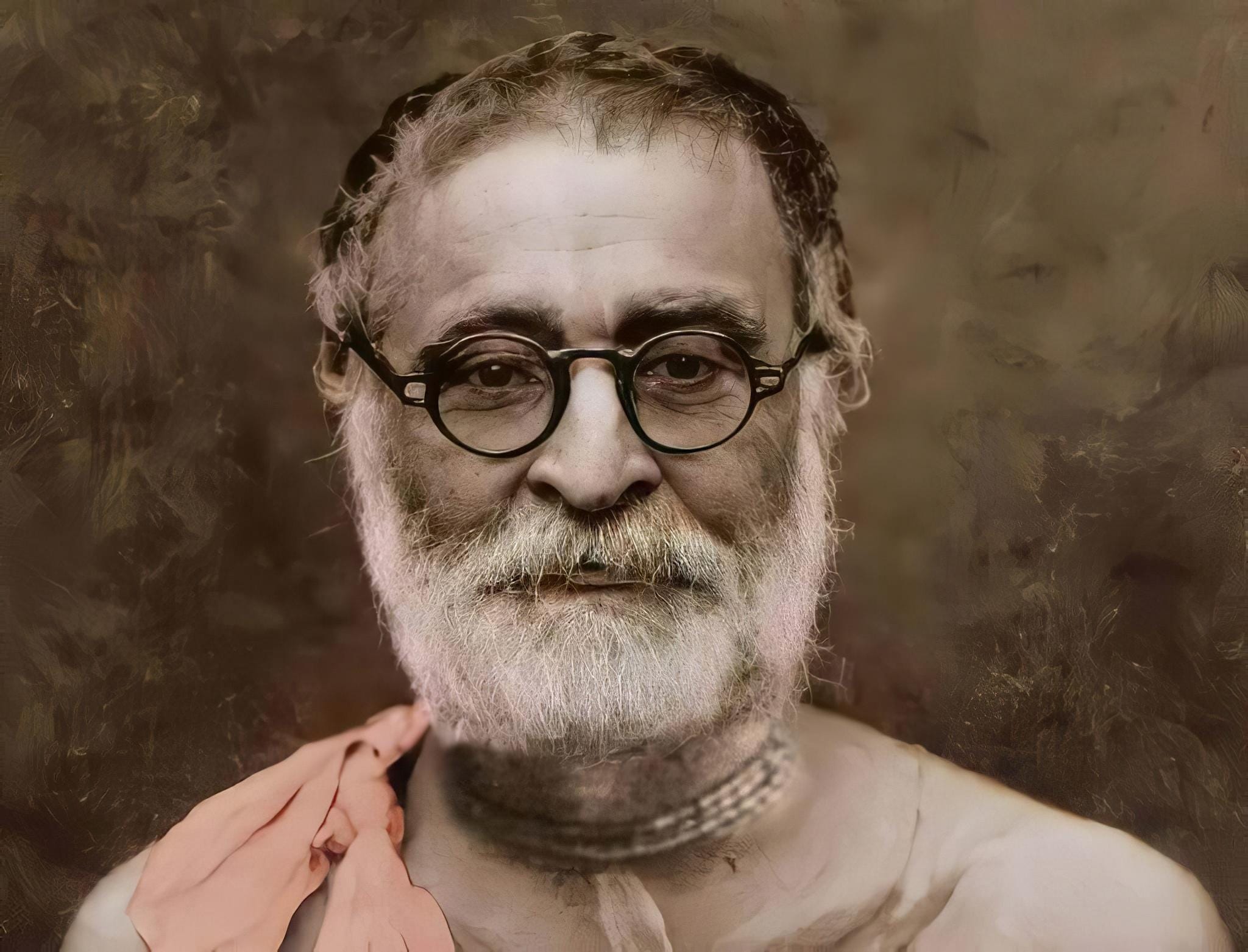
Once, a group of Māyāvādis connected with an important university in India challenged Śrīla Bhaktisiddhānta Sarasvatī Ṭhākura for a debate on the Vedas. Māyāvādis are well known for having an impersonal interpretation of the sastras, defending that the absolute truth is ultimately impersonal, and all forms and variety exist only under the influence of Māyā, or illusion. Even the forms of Lord Viṣnu and His different avatāras are interpreted by them as having material forms and performing their activities under the material mode of goodness. In other words, their understanding is that even when the Supreme Brahman appears in this world, He does it under the influence of Maya. That’s why we call them Māyāvādis because their philosophy incorrectly concludes that Māyā is greater than God. Their philosophy is based on the Śārīraka-bhāṣya, the indirect commentary on the Vedanta-sūtra written by Śankarācārya.
Śrīla Bhaktisiddhānta Sarasvatī Ṭhākura, on the other hand, was famous for teaching the theistic Vaiṣnava interpretation of the sastras, which is based chiefly on the Śrīmad-Bhāgavatam. When challenged by this group, he nonchalantly answered that he was ready to debate with them. They just had to set a date and time.
The Māyāvādis took weeks to answer. Instead of offering a time for the debate, they composed another message, telling him that he could not use verses from the Śrīmad-Bhāgavatam and other Puranas. The Śrīmad-Bhāgavatam is the natural interpretation of the Vedanta-sūtra, written by Śrila Vyāsadeva himself, but Māyāvādis don’t accept it as an authoritative scripture, because it’s very difficult for them to maintain their indirect interpretation when confronted with it. Right in the first verse of the Śrīmad-Bhāgavatam, Śrīla Vyāsadeva completely dismounts the Māyāvāda fallacy by defining Brahman as the Supreme Personality of Godhead Kṛṣṇa, who has not only a personal form but is also full of opulences and performs transcendental activities.
Surprisingly, or unsurprisingly, Śrīla Bhaktisiddhānta Sarasvatī Ṭhākura again nonchalantly answered that he would be ready to debate at any time. If the Māyāvādis objected to the use of the Purāṇas, they could debate based on other books. Apparently, the Māyāvādis were a little concerned about their capacity to defeat him even after imposing these artificial limitations, since they again took a long time to set a date for the debate. Finally, they sent him a third message, saying that after careful deliberation, they concluded that the debate would be conducted exclusively on the aphorisms of the Vedanta-sūtra. No verses from the Upaniṣads, Mahabharata, or any other books could be quoted. Again, Śrīla Bhaktisiddhānta Sarasvatī Ṭhākura answered he was ready to debate with them at any time.
Normally, Vaiṣnavas and other classes of theistic philosophers contest the Māyāvāda philosophy by using verses from different sastras that emphasize the personal aspect of God. Although God also has an impersonal aspect, the personal aspect prevails, and there are many verses directly attesting to this. In the Bhagavad-gītā, for example, Kṛṣṇa directly states that He is the source or basis of the impersonal Brahman (brahmano hi pratisthaham). The Vedanta-sūtra, however, speaks about God in an indirect way, referring to Him as Brahman, which has no material qualities. Māyāvādis can usually hold well to their philosophy when using the Vedanta-sūtra, but Śrila Bhaktisiddhānta was confident that he could defeat them using their own book. How is it even possible?
Śrīla Prabhupāda gives us a few tips on how this can be done in the Teachings of Lord Caitanya. It happens that Lord Caitanya also debated with many great Māyāvādis, including Prakāśānanda Sarasvatī and Sarvabhauma Bhaṭṭācārya, and was able to easily defeat them using his direct interpretation of the Vedanta-sūtra. Lord Caitanya could defeat these great philosophers using nothing more than just logic and the original verses from the Vedanta, without having to quote extensively from other books. In the book, Śrīla Prabhupāda extensively explains this direct interpretation of the text.
For example, the first aphorism of the Vedanta-sūtra is “athāto brahma-jijñāsā”, which can be translated as “Now, therefore, it is time to enquire about Brahman.” We can see that this first aphorism encourages us to seek this Supreme Brahman, without directly defining what it is.
The second aphorism is “janmādy asya yataḥ”, which can be translated as “From Him, everything emanates”. As we can see, this second verse defines Brahman as the source of everything. That’s when the philosophy of the Māyāvādis starts to collapse. If I say “John created this car”, without defining who or what John is, the logical conclusion would be that John is a human being or at least some kind of conscious being; otherwise, it would not be possible for him to create a car. Therefore, even without any further definition, “John created this car” implies that John is a person. If I say that John is a lamp, it stops making any sense, since lamps, rocks, and other unconscious objects don’t create cars. In the Māyāvāda philosophy, Brahman is not considered unconscious, but it is without qualities, attributes or creative intent, and this makes it impossible for it to create something. Māyāvādis explain the existence of the material world by carefully juggling with words, arguing that although the world appear real in our conception, it is ultimately false, just as when we confuse a rope with a snake. I may feel fear, but there is no snake.
By stating “janmādy asya yataḥ”, however, Vyāsadeva breaks these arguments. Although temporary, the material world is not false, and it have been, therefore, created by a conscious creator. Brahman is the creator of everything, and thus Brahman must be a person.
After understanding that Brahman is a person, where can we find more about Him? This is answered in the third sūtra, “śāstra-yonitvāt”. This aphorism can be interpreted as “He is the source of the sastras” or “He can be known through the sastras”. If the first meaning is accepted, it reinforces the personal interpretation, since an impersonal being can’t write books, and if we accept the second meaning it gives us the idea that we can understand Brahman by studying the sastras. If we study carefully the sastras we will eventually reach Śrīmad-Bhāgavatam, which offers the ultimate conclusion of the Vedas, and makes clear that the Supreme Brahman is Kṛṣṇa, the son of Vasudeva, who is the Supreme Personality of Godhead. This progression is indicated in sūtra 4, “tat tu samanvayāt”, “by the harmony of different statements” (from the sastras), which again reinforces the idea that the scriptures led to a logical conclusion and that such conclusion is the Supreme Personality of Godhead.
At this point, a Māyāvādi could try to hold on to the idea that Brahman can’t be expressed in words, and thus any attempt to understand or define Brahman is illusory. However, this is contradicted by the 5th sūtra, “īkṣater nāśabdam”, “Brahman is not inexpressible” (in words), which indicates that Brahman can indeed be explained by words. This is reinforced by the 6th sutra, “gauṇaś cen nātma-śabdāt”. This sūtra has two parts, “gauṇaś cen nā” means that even if described in words, Brahman doesn’t become covered by the material modes, because “ātma-śabdāt”, Brahman is “atma”, he is non-material and existed before the material modes were created. This contradicts the Māyāvādi theory that Brahman becomes covered by Maya when coming to this material world as an avatar. No, Brahman is always transcendental. He is a person, he has spiritual qualities and activities and He never becomes covered by Maya, even if described in words.
In this way, we can see that when the logical and direct interpretation of the verses of the Vedanta-sūtra is accepted, the Māyāvāda philosophy is contradicted in the Vedanta-sūtra itself at every step. Śankarācārya had to go to great lengths in his commentary of the Vedanta-sūtra to sustain his ideas, by using an indirect and contradictory interpretation, up to the point of indirectly accusing Vyāsadeva of making mistakes when writing the Vedanta-sūtra. In this way, the Māyāvāda philosophy is based on a book that directly contradicts it right at the second line, and to counter it, they are forced to argue that the book has mistakes. If the book has mistakes why do they base their philosophy on it in the first place? This is just one of the many contradictions found in their philosophy.
Śrī Caitanya Mahāprabhu was able to easily defeat the greatest logicians of His time by just offering a direct and logical interpretation of the Vedanta-sūtra, and Śrīla Bhaktisiddhānta Sarasvatī Ṭhākura was confident he could do the same. The Māyāvādis however were not so sure of their philosophical strength, since they retracted their invitation, indirectly admitting defeat before the debate even began.
After his debate with Śrī Caitanya Mahāprabhu, Prakāśānanda Sarasvatī, one of the greatest Māyāvādis of his time was forced to admit that:
“Whatever You have said concerning discrepancies in the Māyāvāda philosophy is also known by us. Indeed, we know that all the commentaries on Vedic scriptures by Māyāvādī philosophers are erroneous, especially those of Śaṅkarācārya. Śaṅkarācārya’s interpretations of the Vedānta-sūtra are all figments of his imagination. You have not explained the aphorisms of the Vedānta-sūtra and verses of the Upaniṣads according to Your imagination but have presented them as they are. Thus we are all pleased to have heard Your explanation.”
Later he added:
“We have given up the actual path of spiritual realization. We simply engage in nonsensical talk. Māyāvādī philosophers who are serious about attaining benediction should engage in the devotional service of Kṛṣṇa, but instead they take pleasure in useless argument only. We hereby admit that the explanation of Śaṅkarācārya hides the actual import of Vedic literature. Only the explanation given by Caitanya is acceptable. All other interpretations are useless.”
This is a publication for thoughtful readers who want to go deeper into Kṛṣṇa consciousness. I publish daily, trying to offer high-quality spiritual content, and all posts are available to free subscribers. If you wish, you can also choose a paid subscription to support this work.
You can also receive the updates on WhatsApp or Telegram.
If you would like to contribute further, you can find the donation links here.
Very inspiring 🙏
Thank you for sharing from the verses themselves.