

Subscribe to receive new articles by e-mail. It’s free, but if you like, you can pledge a donation:
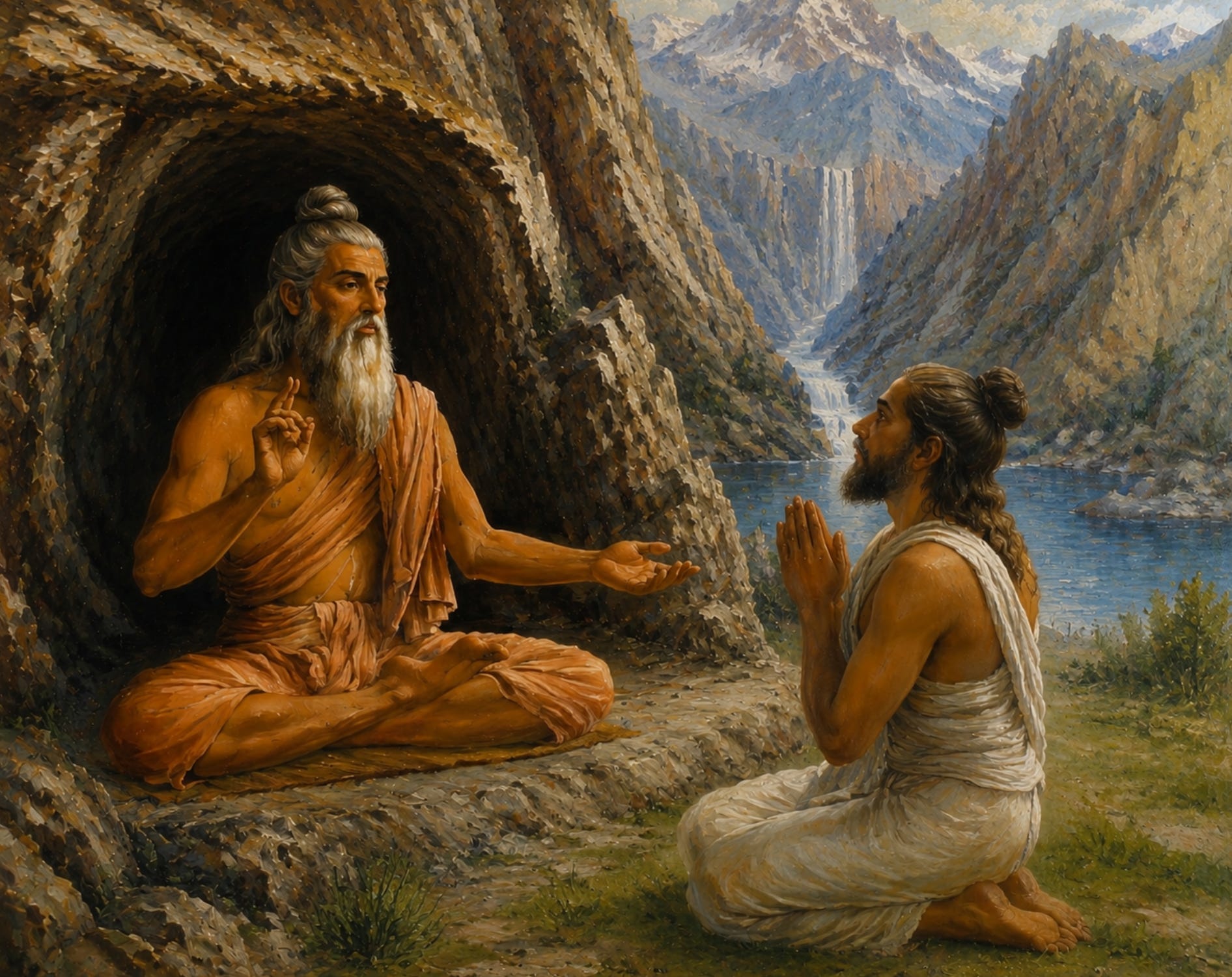
For practically anything we want to learn, we need a teacher. Of course, we can learn many things just by watching videos on YouTube or reading books, but when we want to seriously study a subject, we go to a teacher. If one wants to become a physician, he goes to the university and study from teachers who are experienced physicians. One can learn a lot about health and medicine on YouTube, but to really become a physician himself, he needs to study at a university. Similarly, when we want to learn the spiritual science seriously, we need to find a teacher.
The secret is that we need a teacher who is connected to an authentic school. If one wants to study medicine, he will want to enroll in a respected university, and not just learn from some amateur who teaches from his imagination.
There are different categories of teachers. Some know just a little and can help us to start on the spiritual path. Others know more and can help us to a greater extent, and some are really self-realized and can help us all the way up to the stage of perfection. During life, we learn from many teachers. We start learning from our parents, then from teachers in school, and this process of learning continues all the way up to the end of our lives. The spiritual process is not different; it’s normal that we may have different teachers who can help us in different stages of our spiritual progress.
All the different authentic spiritual schools start from a common source: Kṛṣṇa, the Supreme Personality of Godhead. He is the one whom the Vedas describe as the Supreme Brahman, the immortal and unmanifest. In other words, this knowledge comes all the way from the spiritual side, outside this dark material universe. Being on the spiritual side, Kṛṣṇa knows perfectly how everything works and can share this knowledge with us. Over the centuries, this knowledge has been transmitted generation after generation in a process called paramparā, or disciplic succession. A disciple learns from his spiritual teacher and later shares the same knowledge with his own students, and thus the knowledge is preserved and distributed.
In the last page of his introduction to the Bhagavad-gītā, As It Is, Śrila Prabhupāda shares his own connection. He studied under Śrila Bhaktisiddhānta Sarasvatī Thākura, the great teacher from the Gaudiya Vaiṣnava school. And he, in turn, studied under Śrila Gaurakiśora Dāsa Babaji, and so on.
The disciplic succession that Prabhupāda describes actually comes down since the beginning of the Universe, but the list has only 32 names because only the most prominent links are mentioned. The first name on the list is Kṛṣṇa. He originally taught this spiritual science to Brahmā, the first living being in this universe. Brahmā doesn’t have a material father or mother. He has a divine origin and is empowered with high intelligence and control over matter, so he can execute his arduous task of creating this universe. At the beginning of his life, Brahmā becomes confused after seeing only darkness everywhere, and thus he starts to practice meditation to find answers. When he becomes perfect in his meditation, he is able to see the spiritual side and receive spiritual knowledge from Kṛṣṇa Himself.
Brahmā, in turn, taught this knowledge to Nārada, one of the sons he created from his own mind. Nārada is a very powerful sage who possesses all mystical perfections and can travel all over the universe out of his own will. He does not have a gross physical body like us; therefore, he can travel all over the universe simply out of his desire, without the need for a spaceship. There are many races of higher beings in this universe, and Nārada has students among all of them. He takes the mission of transmitting this spiritual knowledge to representatives of each race, and if a line of succession is broken, he goes there again to repeat the same knowledge to a new teacher, starting a new line of spiritual succession.
Neither Brahmā nor Nārada is from this planet. In other words, if one is looking for extraterrestrial knowledge, this is the right place to look. People are obsessed with gray men in spaceships, but this is the real alien technology.
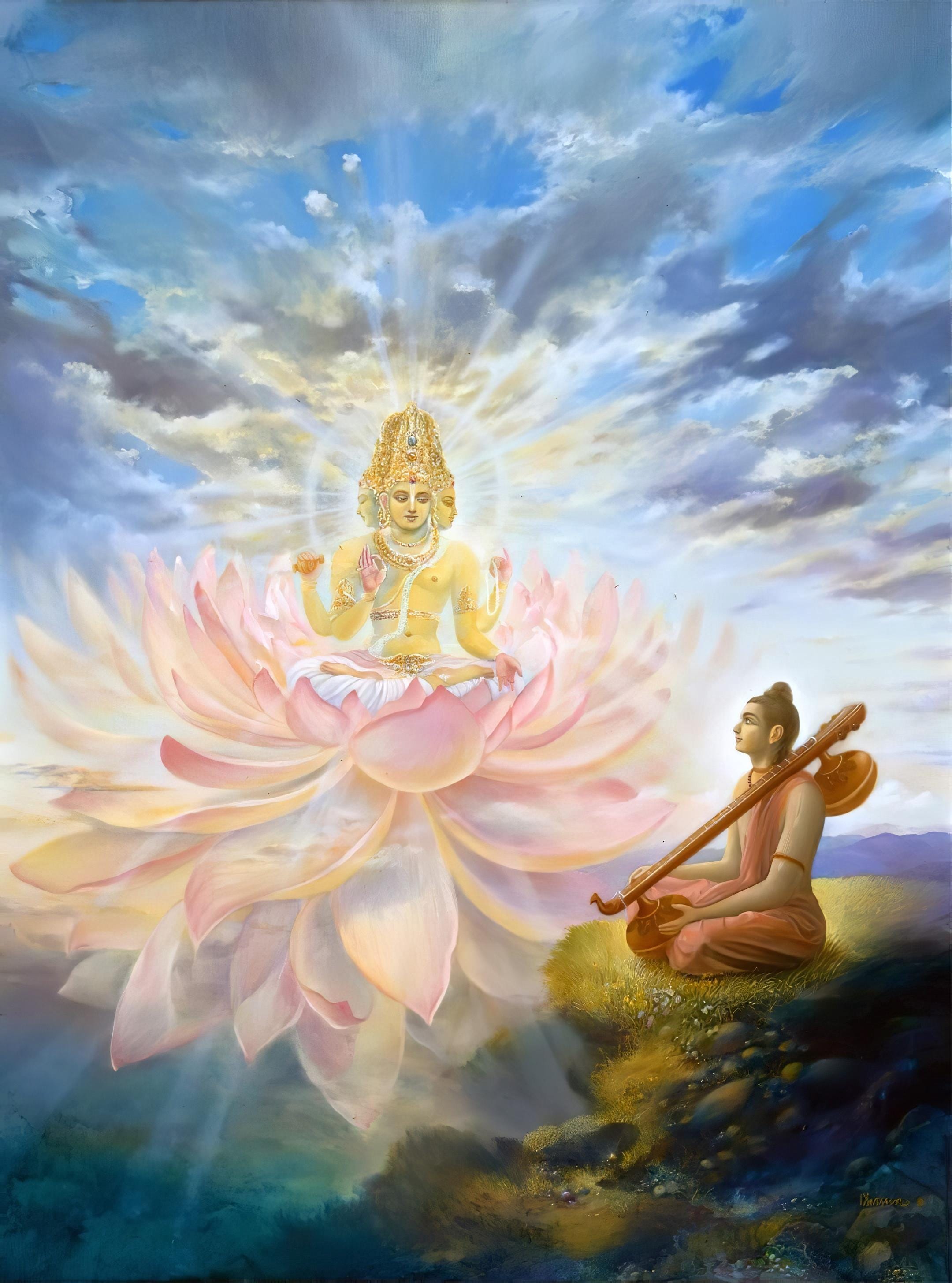
Nārada taught this spiritual science to Vyāsadeva more than 5,000 years ago. He is the first inhabitant of this planet who appears on the list. Vyāsadeva was a great sage who compiled the Vedas based on the knowledge he received from Nārada. Over the centuries, this knowledge was preserved and expanded by a succession of enlightened teachers, like Madhvācārya, Mādhavendra Purī, and Śrī Caitanya Mahāprabhu. Again, just the most prominent names are mentioned, since this succession extends over a period of more than 5.000 years.
Fast-forwarding to the modern age, we have Jagannātha Dāsa Babaji, Bhaktivinoda Thākura, Gaurakiśora Dāsa babaji, Bhaktisiddhānta Sarasvatī Thākura, and finally A. C. Bhaktivedānta Swami Prabhupāda.
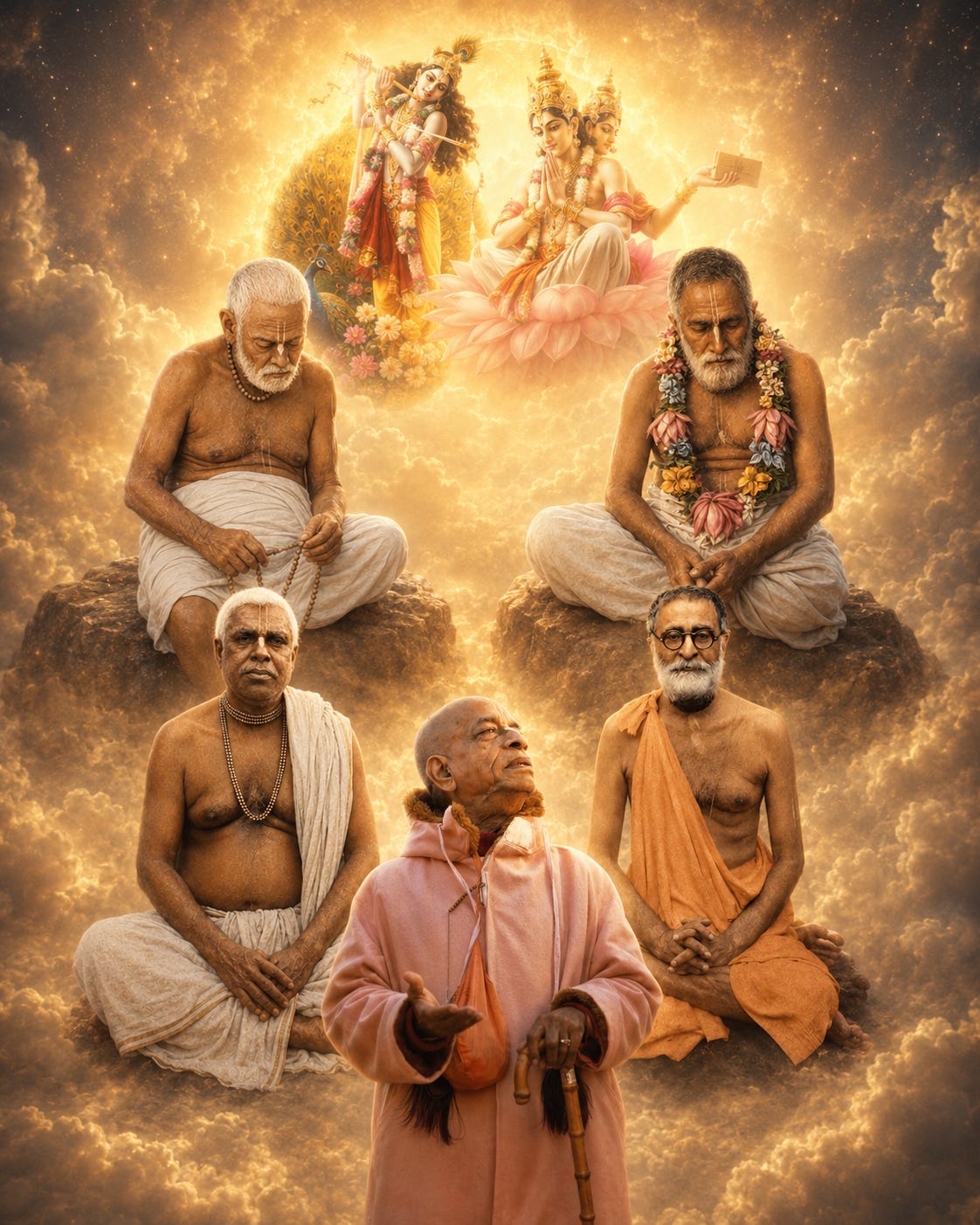
Similarly, Prabhupāda had many students, and many of them also became spiritual teachers. One of them is Śrila Bhakti Thirta Swami, who wrote many books and taught many influential persons, including members of the United Nations. He also had many students, amongst them Śrila Bhakti Dhira Dāmodara Swami, who travels the world explaining this spiritual science. I’m one of his students.
When we think about choosing a spiritual teacher, often we think about who we like to hear, who appears more intelligent, or who fits best whatever stereotype we may have of a guru. The two main points, however, are:
a) Is he or she connected to an authentic spiritual succession coming from Kṛṣṇa Himself?
b) Is he or she faithfully transmitting the knowledge received through it, carefully representing the succession of teachers, or is one teaching from his own mind?
Why is this important? Perfect spiritual knowledge cannot be invented through speculation. It must descend from the spiritual platform. The human mind can create scientific theories or books of fiction, but it has no power to correctly understand the spiritual reality. Transcendental knowledge comes from a perfect reality; therefore, there is nothing to be improved, the point is just to explain it. Changes simply break it, just as a guy with a hammer trying to improve a Ferrari.
As mentioned in the Taittirīya Upaniṣad, the relationship between teacher, student, knowledge, and instruction is the basis of genuine learning. The teacher carries the knowledge, the student receives it, and instruction connects them. A bona fide spiritual teacher does not create a new philosophy or interpret the scriptures according to his imagination. He presents the same essential conclusions that he received from his own spiritual teacher, adapting the explanation to the needs of the student without change.
Śrī Caitanya Mahāprabhu explains that one’s birth, social position, or external status is not important. Whether one is a scholar, a renunciant, a householder, a man or a woman, one can become a spiritual master if one genuinely understands the science of Kṛṣṇa.
Therefore, the main points to consider are:
a) Is he faithful to his own spiritual teacher and to the other ācāryas of the line he or she represents?
b) Is his personal behavior according to the teachings?
c) Does he direct people toward Kṛṣṇa, or toward himself?
d) Can he explain spiritual knowledge clearly and resolve doubts?
e) Is he willing and able to guide the disciple personally?
f) Does association with him increase our desire to chant, hear, serve, and improve our personal character?
Apart from the qualifications of the teacher, there is another side we should be attentive to: building our own qualifications. Even a qualified spiritual master will not be able to help a student who doesn’t have the qualities of a proper disciple. In fact, one is advised not to even accept such a student. As we practice the spiritual process, we work on our own qualifications, and gradually develop the purity for seeing beyond the superficiality and start seeing the purity.
As we associate with different teachers and other devotees whom we respect, we may naturally develop faith in some of them, and by observing which teachers they themselves respect, we gradually move in the right direction.
The right spiritual teacher is not the person who tells us what we want to hear. On the contrary, he is the one who can recognize our conditioning and help us to break free from it. The process is not always easy, but that’s exactly what we are asking for. The idea is that we understand we are not perfect, and we look for a person who can help us to advance.
Books and recorded lectures are always valuable, but they fit into a different niche, for they cannot always make us properly understand our particular situation, expose our blind spots, correct our misunderstandings, or correct us. This is possible only when there is a teacher observing and correcting us.
Go deeper:

You can also donate using Buy Me a Coffee, PayPal, Wise, Revolut, or bank transfers. There is a separate page with all the links. This helps me enormously to have time to write instead of doing other things to make a living. Thanks!
This is an arrogant statement. You risk the danger of listening to your mind and/or concocting spiritual practice which has no basis in parampara.
All the previous acharyas, and even Sri Krishna himself accepted a bonafide living guru whom they took urrendered to and took shelter of. Now you say that you are better than them ?
I got my liberation through Krishna. But that doesn't mean that Krishna is the only. For me Krishna is Supreme and maybe others can see it too but if they don't you have no right to judge them. No one has the right to judge. If some devotee has truly given up to Krishna they will recieve intutions and act as a teacher accordingly. You are assuming too many things. You have a long way to go to understand what Krishna really is.