

« The ‘Fall’ of the Jīva, as Explained by Śrīla Prabhupāda
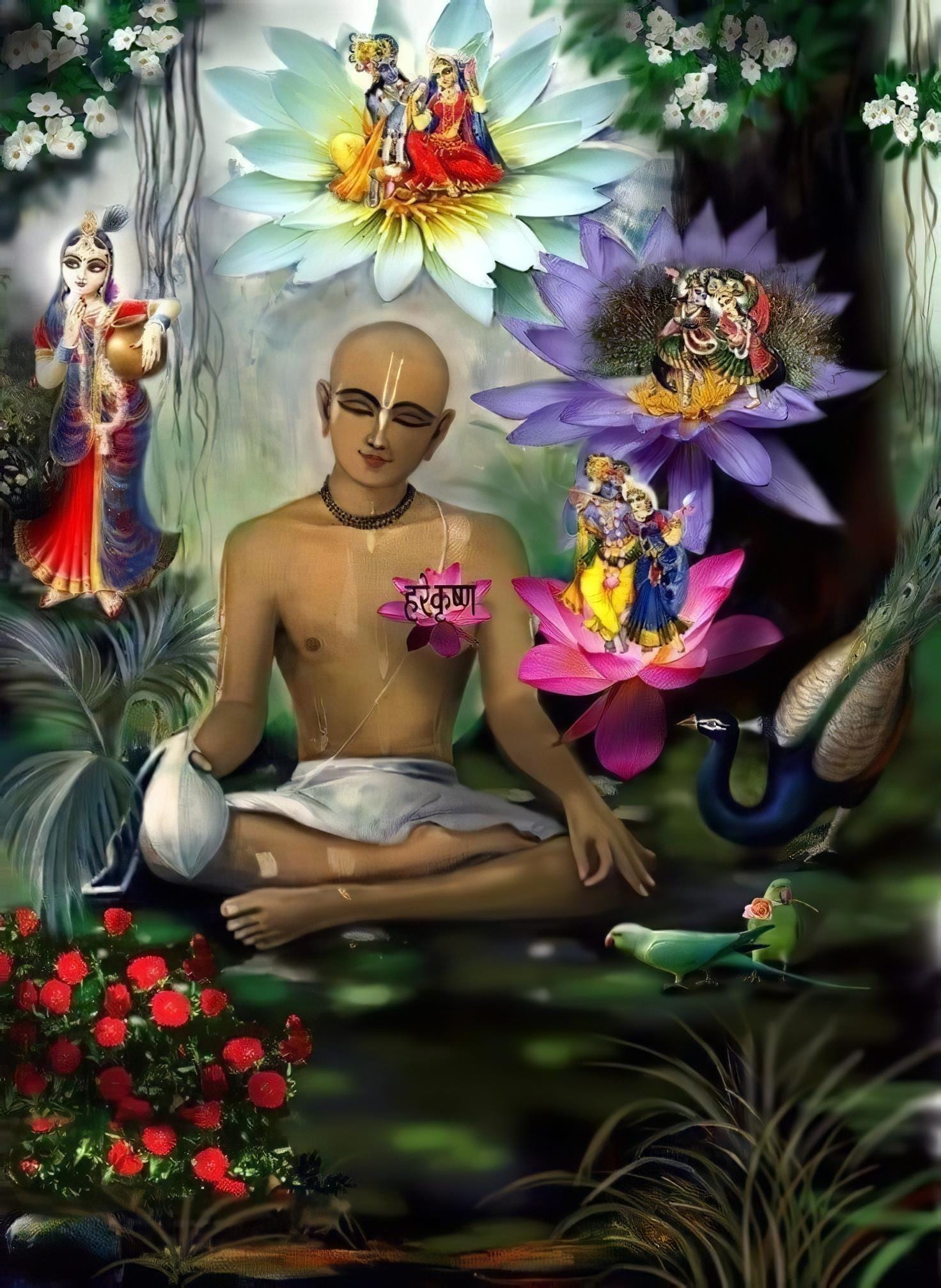
How we become entangled in matter, and how we can become free
In the allegory, Purañjana becoming attracted to the woman representing the material intelligence, illustrates the living entity becoming attracted by the possibilities of sense gratification offered by it. Prabhupāda explains it perfectly in his purport to text 36:
“The living entity comes down into this material world for sense gratification, and his intelligence, represented by the woman, gives him the proper direction by which he can satisfy his senses to their best capacity. In actuality, however, intelligence comes from the Supersoul, or the Supreme Personality of Godhead, and He gives full facility to the living entity who has come down to this material world.”
Often, it is thought that the soul may fall from the spiritual world directly to this material world, but this is an incorrect idea. There is no influence of the material energy in the spiritual world, and thus no possibility of a soul becoming attracted to material enjoyment there. However, if the soul, due to free will, somehow or other becomes averse to the service of Kṛṣṇa, one is removed from this spiritual atmosphere and is eventually placed in a borderline position in the causal ocean. From there, without access to spiritual bliss, one can become attracted to the glitter of the material creation, and thus come here in search of material enjoyment, as described by Prabhupāda.
When this happens, the soul receives the material intelligence as a tool to satisfy his material desires and, hopefully, eventually comes to understand the shortcomings of material enjoyment and search for spiritual knowledge. The intelligence is given to us by the Supersoul, and when we start inquiring about transcendental knowledge, it is also the Supersoul who gives us spiritual realization. In this way, the Supersoul slowly guides us back to our original position.
Purañjana receiving the material intelligence, together with the body and senses, is described in texts 36 and 37. From this point, he is in command of the body and can exert his minute free will, using it to fulfill the mission of the human life, or not:
“O killer of the enemy, you have somehow or other come here. This is certainly great fortune for me. I wish all auspicious things for you. You have a great desire to satisfy your senses, and all my friends and I shall try our best in all respects to fulfill your desires. My dear lord, I have just arranged this city of nine gates for you so that you can have all kinds of sense gratification. You may live here for one hundred years, and everything for your sense gratification will be supplied.” (SB 4.25.36-37)
The intelligence guides the mind, which in turn controls the senses, giving the living entity the possibility of enjoying this world. However, even though the body is put at our disposal, the body is still Kṛṣṇa’s property and should be used in His service. The human body is given to us as an opportunity to develop our Kṛṣṇa Consciousness, or at least lead a pious life according to the prescriptions of the scriptures. If instead we just use it for our own purposes, we have to deal with the karmic reactions, as also illustrated later in the allegory of Purañjana.
Every human body offers the same facilities, both for sense gratification and for self-realization. Purañjana, however, used only the facilities for sense gratification and fruitive activities, and thus, as time passed, he became more and more illusioned, forgetting his real self. The more we surrender ourselves to sense gratification, the more we become entangled in illusion, material suffering, and agitation.
“Being thus entangled in different types of mental concoction and engaged in fruitive activities, King Purañjana came completely under the control of material intelligence and was thus cheated. Indeed, he used to fulfill all the desires of his wife, the Queen.” (SB 4.25.56)
Material intelligence can work properly only when purified by spiritual knowledge. Otherwise, it just creates unlimited plans for enjoying matter, and we end up becoming helplessly entangled in them, just like Purañjana. Similarly, we need to find ways to keep our wives, husbands, and children Kṛṣṇa conscious, since if they become too materialistic, they will also make our practice of Kṛṣṇa Consciousness difficult.
In his purport to this verse, Prabhupāda calls our attention to this point, explaining that if one wants to have a harmonious family life, one has to keep one’s wife or husband satisfied in all aspects, otherwise there is quarrel, divorce, or separation. Maintaining a materialistic wife or husband satisfied, however, requires us to give up our Kṛṣṇa Consciousness, or at least slacken our practice. Therefore, as Prabhupāda explains in other purports, the only solution is to make our family Kṛṣṇa conscious.
In this way, in conditioned life, we are not only controlled externally by other people because of material attachment, but also controlled internally by our material intelligence, teaming up with the mind. We thus completely lose our independence, becoming helpless servants of the dictates of the mind and intelligence. This helpless condition of the conditioned soul is described in verses 57 to 61:
“When the Queen drank liquor, King Purañjana also engaged in drinking. When the Queen dined, he used to dine with her, and when she chewed, King Purañjana used to chew along with her. When the Queen sang, he also sang. Similarly, when the Queen cried, he also cried, and when the Queen laughed, he also laughed. When the Queen talked loosely, he also talked loosely, and when the Queen walked, the King walked behind her. When the Queen would stand still, the King would also stand still, and when the Queen would lie down in bed, he would also follow and lie down with her. When the Queen sat, he would also sit, and when the Queen heard something, he would follow her to hear the same thing. When the Queen saw something, the King would also look at it, and when the Queen smelled something, the King would follow her to smell the same thing. When the Queen touched something, the King would also touch it, and when the dear Queen was lamenting, the poor King also had to follow her in lamentation. In the same way, when the Queen felt enjoyment, he also enjoyed, and when the Queen was satisfied, the King also felt satisfaction.” (SB 4.25.57-61)
In his purport, Prabhupāda explains: “The mind is the place where the self is situated, and the mind is conducted by the intelligence. The living entity, situated within the heart, follows the intelligence. The intelligence is herein depicted as the Queen, and the soul, under mental control, follows the material intelligence just as the King follows his wife. The conclusion is that material intelligence is the cause of bondage for the living entity. The point is that one has to take to spiritual intelligence to come out of this entanglement.”
Taking to spiritual intelligence means following the precepts of the scriptures and the instructions of the spiritual master. By doing so, we become gradually purified, awakening our original spiritual nature.
This process was followed perfectly by Ambarīṣa Mahārāja, as Prabhupāda describes in the same purport: “In the life of Mahārāja Ambarīṣa, we find that the great Mahārāja first engaged his mind on the lotus feet of Kṛṣṇa. In this way his intelligence became purified. Mahārāja Ambarīṣa also used his other senses in the service of the Lord. He engaged his eyes in seeing the Deity in the temple nicely decorated with flowers. He engaged his sense of smell by smelling the flowers, and he engaged his legs by walking to the temple. His hands were engaged in cleansing the temple, and his ears were engaged in hearing about Kṛṣṇa. His tongue was engaged in two ways: in speaking about Kṛṣṇa and in tasting prasāda offered to the Deity.”
As Prabhupāda mentioned in his purport to text 4.25.25, every living entity has the freedom to be attracted by material nature or to stand as a hero and resist that attraction. Purañjana surrendered to the first option, becoming attracted to an easy life of sense gratification. In this way, he lost the opportunity of human life and was cheated in all his endeavors:
“In this way, King Purañjana was captivated by his nice wife and was thus cheated. Indeed, he became cheated in his whole existence in the material world. Even against that poor foolish King’s desire, he remained under the control of his wife, just like a pet animal that dances according to the order of its master.” (SB 4.25.62)
In his purport, Prabhupāda mentions: “Just as a pet monkey dances according to the desires of its master, the King danced according to the desires of the Queen. In Śrīmad-Bhāgavatam (5.5.2) it is said, mahat-sevām dvāram āhur vimukteḥ: if one associates with a saintly person, a devotee, one’s path of liberation becomes clear. But if one associates with a woman or with a person who is too much addicted to a woman, his path of bondage becomes completely clear.”
In this context, the word “woman” is used in the sense of a materialistic person addicted to sense gratification. Once, in India, Prabhupāda received a group of Māyāvādi sannyāsīs, who refused to accept prasāda because it was served by a lady disciple, Yamunā Devi. Prabhupāda chastised them by saying that if they associated with her, they would be purified. This makes the point that a lady who becomes a Vaiṣṇavī, controlling her senses and being engaged in devotional service, is not included in this category. In this way, men who aspire to be serious Vaiṣnavas should be careful not to fall under the control of materialistic women, and similarly, ladies who are serious in spiritual practice need to be careful not to be seduced by materialistic men. Apart from that, both should be careful in associating with materialistic people in general.
Purañjana abandons his intelligence and hunts in the forest
Chapter 4.26 describes the occasion when Purañjana left his queen and went to hunt in the forest. This part of the allegory illustrates the situation of a man who abandons his good sense and performs sinful activities guided only by his senses and the desires of the mind.
In the allegory, the queen represents one’s intelligence, which may be imperfect and prone to materialistic activities, but at least offers a degree of piety, religiosity, and morality to guide these activities. Purañjana was already entangled in material life by following his intelligence, but now, without it, he became busy in simply performing gross sinful activities.
“The great sage Nārada continued: My dear King, once upon a time King Purañjana took up his great bow, and equipped with golden armor and a quiver of unlimited arrows and accompanied by eleven commanders, he sat on his chariot driven by five swift horses and went to the forest named Pañca-prastha. He took with him in that chariot two explosive arrows. The chariot itself was situated on two wheels and one revolving axle. On the chariot were three flags, one rein, one chariot driver, one sitting place, two poles to which the harness was fixed, five weapons and seven coverings. The chariot moved in five different styles, and five obstacles lay before it. All the decorations of the chariot were made of gold.” (SB 4.26.1-3)
In the previous passage, the body was compared to a city, where the soul lives, together with the material intelligence, enjoying the senses and the sense objects. Now the body is compared to a chariot, which allows one to perform different types of activities.
This chariot of the body is moved by five horses, which represent the five sense organs (eyes, ears, nose, skin, and tongue), and using it, Purañjana goes to Pañca-prastha (the forest of the five sense-objects), enjoying gross sense gratification manifested as forms, sounds, tastes, tactile sensations, and smells.
The golden armor, as well as the golden decorations on the chariot, represent the effects of the mode of passion, characterized by pride and restless desire. The king takes with him a quiver of unlimited arrows, which represent his unlimited stock of material desires, leading to a string of sinful activities. The eleven commanders represent the mind and the ten senses, which were already introduced in chapter 4.25 as the servants of the intelligence. Now, however, the King takes them on his excursion without the supervision of his high intelligence, which stays behind in the palace.
Apart from his regular arrows, the king carries two explosive arrows, which are very destructive. These represent the two aspects of the false ego: ahantā (I am this body) and mamatā (everything related to this body is mine). These are especially dangerous and can lead one to cause great harm to others, creating karmic reactions that will keep one perpetually bound to this world.
The two wheels of the chariot represent śubha and aśubha (pious and impious activities), which are supported by the same revolving axle, which represents the material nature. In this way, both types of activities, pious and impious, are just two sides of material action that keep the soul bound to this material world. A person may do either one or the other, or a combination of both, in his pursuit of sense gratification, and in any case, the result is the continuation of birth and death.
All material activities are performed under the three modes of material nature, which are represented by the three flags on the chariot. The chariot runs on pañca-bandhuram, five roads with uneven ground, where the chariot moves, but with difficulty. These are the five vital airs, which on the one hand sustain the body, but on the other hand create all sorts of problems when out of balance, as studied in Vedic medicine. Despite all inconveniences, we have no choice but to travel on these uneven roads as long as we inhabit the body.
The seven coverings of the chariot (sapta varūtham) are the seven ingredients of the body, which serve as coverings for the soul (skin, muscle, fat, blood, marrow, bone, and semen). The rein of the chariot is the mind (an example also given in the Gītā), the driver (damanam) is buddhi, discrimination, and the nīḍa, or sitting place, is the heart, where the soul resides, accompanied by the Supersoul.
The two poles to which the harness was fixed (dvi-kūbara) represent the causes of material bondage (lamentation and illusion), which keep us firmly bound to this material world, and the five weapons (pañca-praharaṇam) are the five functional senses (hands, legs, mouth, genital, and anus), which are used to perform physical actions. Using these five senses, the chariot can perform five classes of activities, and thus it is described as moving in five different styles. The five obstacles are the inconveniences caused by imbalances in the vital airs (anxiety, constipation, dizziness, indigestion, and tremors).
How could Purañjana abandon his intelligence? This is described in the next verse:
“It was almost impossible for King Purañjana to give up the company of his Queen even for a moment. Nonetheless, on that day, being very much inspired by the desire to hunt, he took up his bow and arrow with great pride and went to the forest, not caring for his wife.” (SB 4.26.4)
In his purport, Prabhupāda connects this verse with a man leaving his religious wife to hunt other women. In the previous chapter, the relationship of Purañjana with the material intelligence illustrates the life of a pious materialist who, although attached, conducts his life more or less according to the injunctions of the scriptures. This style of life is condemned in the sense that it doesn’t directly awaken the soul to its original consciousness, but it is, of course, much better than a grossly sinful life. Now, however, Purañjana abandons his piety and, controlled by his unlimited material desires, surrenders himself to gross sinful activities, like animal killing and illicit sex, abandoning both his intelligence and his duly married wife.
When one goes to the forest to hunt indiscriminately, he abandons all sense of compassion for the poor animals. Similarly, when a person abandons one’s good sense and commits sins indiscriminately, he also abandons all sense of empathy and commits the most terrible actions, not caring for the suffering caused to others.
Material life comes from the desire to be an independent enjoyer, an idea that is behind most of what we do in this material world. There is no reason for us to be in this position; we came into it, and we remain here due to choice. Although the soul has no potency to revive its Kṛṣṇa Consciousness independently, Kṛṣṇa leaves us the Vedic literature, so we can revive our original nature in association with devotees. If we don’t take advantage of this facility, we become bound by our whimsical activities and end up lost in material life, without any guide.
As Prabhupāda explains: “Every living entity is part and parcel of God. There is no reason for the living entity’s being put into the miserable threefold condition of material existence but that he voluntarily accepts material existence on the false pretext of becoming an enjoyer. To save him from this horrible condition, the Lord has given all the Vedic literatures in His incarnation of Vyāsadeva.”
In the allegory, Purañjana killed many animals in the forest, just as a materialist performs many different types of sins. Afterwards, he became tired and returned to the palace. This tiredness of the king after committing sinful activities is linked to the intervention of the conscience, which inspires a person to stop sinful activities and return to one’s good sense. In his purport to text 4.26.10, Prabhupāda also raises another reason: the meeting with a saintly person:
“The King became tired after killing so many animals. When a man comes in contact with a saintly person, he becomes aware of the stringent laws of nature and thus becomes a religious person. Irreligious persons are like animals, but in this Kṛṣṇa Consciousness movement such persons can come to a sense of understanding things as they are and abandon the four principles of prohibited activities, namely illicit sex life, meat-eating, gambling and intoxication. This is the beginning of religious life.”
You can also donate using Buy Me a Coffee, PayPal, Wise, Revolut, or bank transfers. There is a separate page with all the links. This helps me enormously to have time to write instead of doing other things to make a living. Thanks!