

You can receive new articles directly in your inbox. Subscription is free; donations are welcome.
Nowadays, when we want to record information, we use our phone or a computer. With a simple click, this information can then be saved in the cloud and, from there, shared with people from all over the world, frequently combined with an image or video. However, the Internet and social networks are relatively new phenomena. Just two decades ago, people used to rely on books and magazines for getting new information.
Books started to be printed in the Middle Ages. Before that, books existed, but they were copied by hand. In the legendary library of Alexandria, sailors had to pay an unusual tax: to allow scholars to copy any books that they would be carrying on their ships, helping to enrich the library.
Before the invention of paper, writings were made using other materials, like papyrus, metal sheets, clay, or even rock. In this way, important information would be preserved for future generations.
The Vedas, however, explain that people from the previous ages didn’t need books. They had a sharp memory and could memorize any amount of information just by hearing it a single time from the spiritual master. They were also more in favor of living simple lives and thus didn’t have much impetus for creating machines that would allow them to print books. Instead, they relied on a system of wandering sages, who would travel from town to town disseminating knowledge. When one of these sages would visit a city or village, people would gather to hear. Apart from that, local teachers know about different branches of knowledge and transmit them to their students according to their inclinations. All teachers were brāhmanas who openly shared their knowledge with any qualified student. There were no monthly fees: each student could remunerate the teacher with any amount comfortable for them. Rich students could give good amounts of grains and other valuable items, while poor students could give just a fruit or a flower, for example.
In fact, this ancient system of free education was still in place by the time the British came to India. Eager to advance their colonial agenda, they quickly dismantled the traditional system and replaced it with schools where they could disseminate their own ideas and culture. That’s how Indians came to reject their own culture and believe that everything Western was better. This was one of the keys to their dominance of the Indian subcontinent.
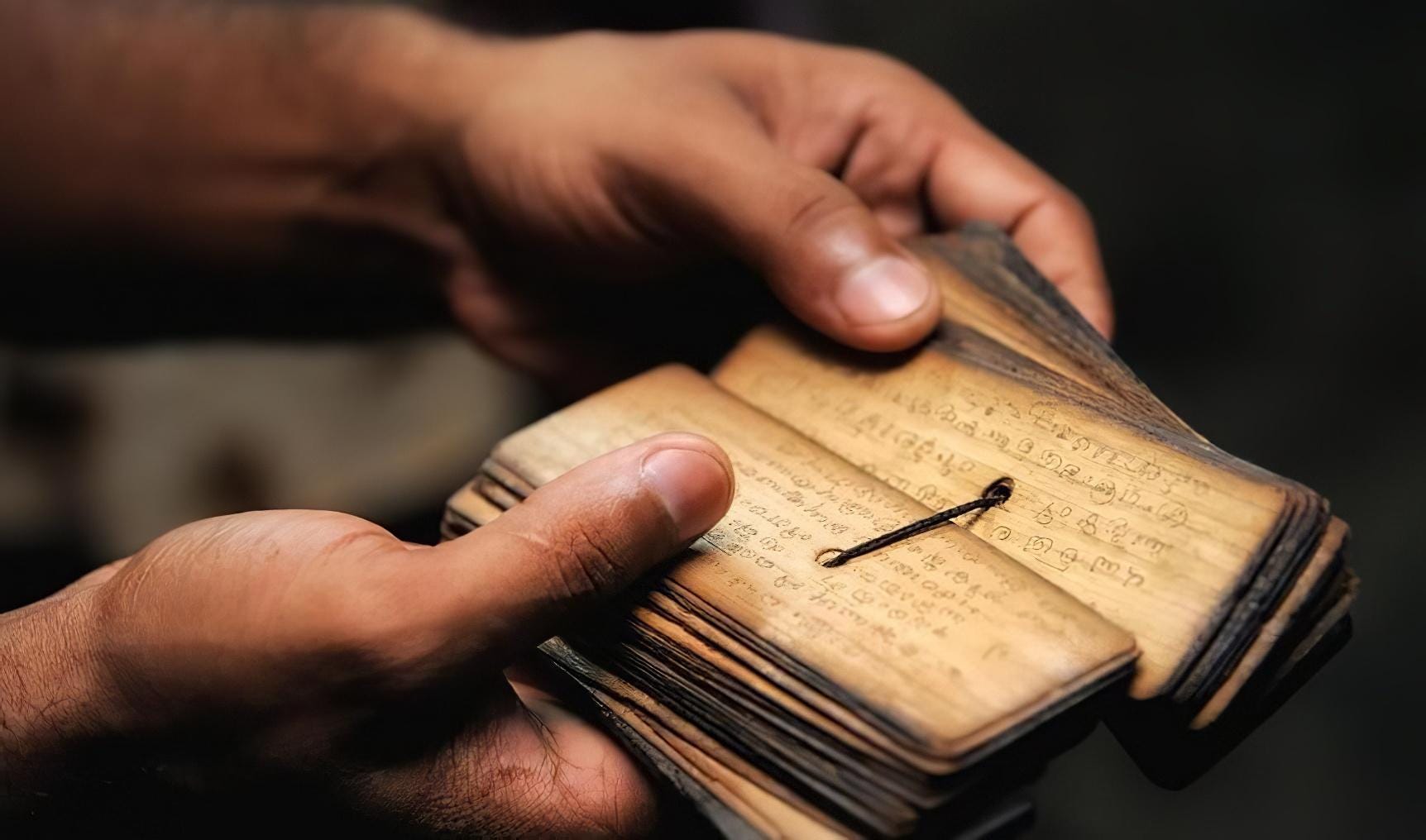
Back to the Vedas, when there was a need to write information down, a simple but ingenious system was used: instead of paper, people wrote on specially prepared palm leaves, which served as the writing medium for generations. According to tradition, Vyāsadeva used this system to record the scriptures, and in this way, they continued to be preserved and transmitted down to the modern age.
Although the word “leaves” may suggest something fragile, palm-leaf manuscripts were actually quite durable when properly prepared and preserved.
The leaves were first selected and prepared so they would not crack or decay easily, dried in the sun, and then cut into standard, rectangular shapes. The text was written using a needle, and then a pigment was rubbed over the leaf, filling the grooves of the letters and making the text clearly visible. The written leaves would then be pierced with small holes and strung together with thread into manuscript bundles. If carefully preserved, such manuscripts could last for centuries. When an old copy began to deteriorate, the text was copied onto a fresh set of leaves, and in this way, the scriptures could be passed down from one generation to the next.
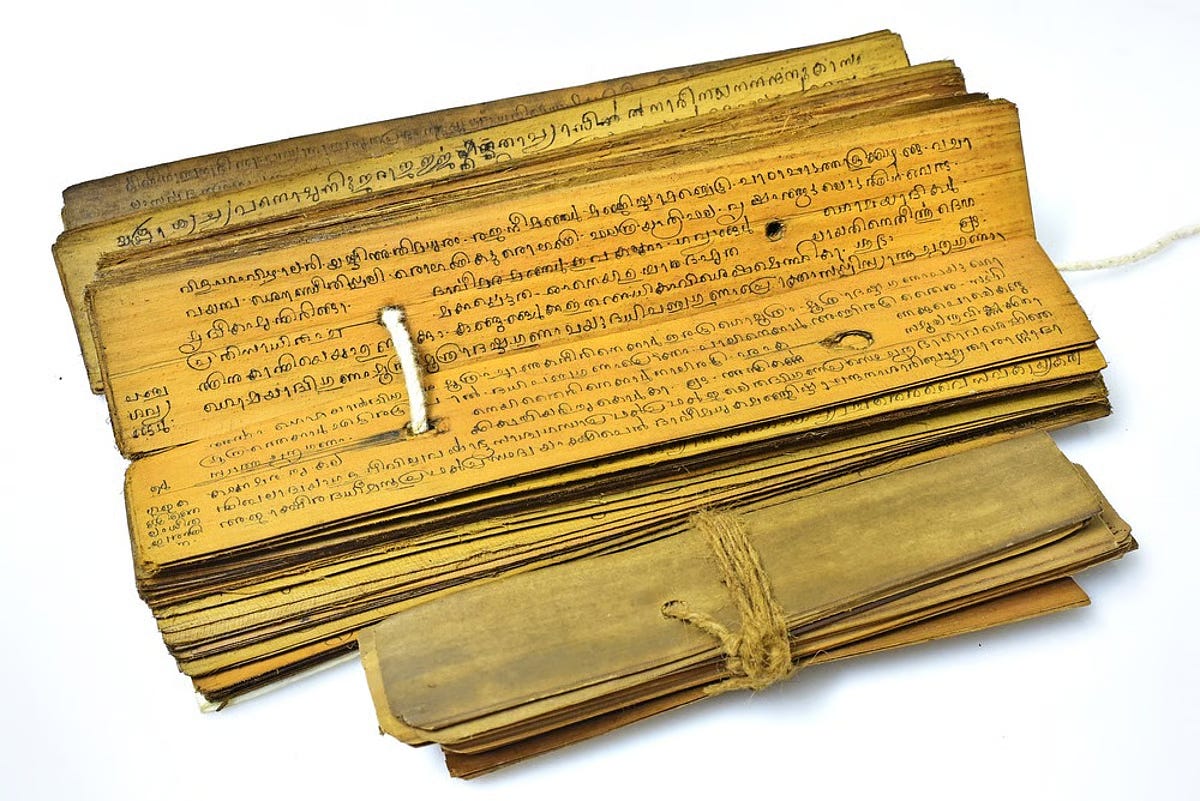
It may sound impractical, but the system fit into the culture predominant at the time. Nowadays, we write some rant and quickly post it without even thinking, and people then reply with whatever first comes to their minds. Ancient sages, however, would be much more thoughtful. They would carefully compose each verse in their minds before writing it down. It was a much more thoughtful and slow process, and only valuable information would usually be written, different from what we have nowadays. Books would also not generally be studied alone but would fit into the system of oral transmission, studied under the spiritual master.
This process of writing on leaves started to become popular a little before the beginning of the current age. At the time Vyasadeva started his work of compiling the Vedas, there were already other sages recording their teachings and conclusions on palm leaves.
On his purport to CC Adi 7.106, Prabhupada mentions, “Śrīla Bhaktisiddhānta Sarasvatī Ṭhākura comments that while Vyāsadeva was compiling the Vedānta-sūtra, seven of his great saintly contemporaries were also engaged in similar work. These saints were Ātreya Ṛṣi, Āśmarathya, Auḍulomi, Kārṣṇājini, Kāśakṛtsna, Jaimini and Bādarī. In addition, it is stated that Pārāśarī and Karmandī-bhikṣu also discussed the Vedānta-sūtra aphorisms before Vyāsadeva.”
We can see that in different passages of the Vedanta-sutra, Vyāsadeva mentions Jaimini or other philosophers, sometimes using their conclusions as support and sometimes disagreeing with them. This shows how Śrila Vyāsadeva was not compiling the Vedanta Sutras in an intellectual vacuum but had contact with other philosophers dedicated to studying Vedic knowledge and distilling its conclusions. All of these great philosophers could understand the Vedas to a certain extent and grasp aspects of the Vedic truth, their interpretations being recorded into their own philosophical systems (such as the Pūrva-mīmāṁsā of Jaimini) and transmitted to their disciples. However, being the incarnation of the Lord, Vyāsadeva was the one able to understand the Vedas in their plenitude.
He divided the original Veda into four and wrote other supplemental books, like the Upaniṣads, Puranas, and the Mahabharata (which includes the Bhagavad-gītā). In conclusion, he wrote the Vedanta-sūtra, which summarizes the higher portions of the Vedas, which deal with spiritual knowledge. Predicting that people from our times could easily misunderstand and misinterpret the elevated knowledge of the Vedanta-sūtra, he wrote the Śrīmad-Bhāgavatam, a commentary that gives the ultimate conclusion.
All the other philosophical systems available at the time failed to describe the ultimate conclusion of the Vedas, devotional service to the Lord, and in fact, even Vyāsadeva’s own works before the Śrīmad-Bhāgavatam failed to properly express it, which led Nārada Muni to appear to him, ordering Vyāsadeva to compile a new book directly glorifying the Supreme Personality of Godhead.
The Śrīmad-Bhāgavatam was then written on palm leaves and preserved over the centuries, all the way to our modern age, allowing us to now share it through books and on the internet, all part of a divine plan to spread this transcendental knowledge.
This is a publication for thoughtful readers who want to go deeper into Kṛṣṇa consciousness. I publish daily, and all posts are available to free subscribers. If you wish, you can also choose a paid subscription to support this work.
If you would like to contribute further, you can find the donation links here.
🙏