

« Things I Wish Someone Had Taught Me When I Started Krishna Consciousness
If I take shelter of you, and you cut my throat, that’s the worst sin
One of the points emphasized in Vedic literature is that we should surrender to superior authorities, culminating with Kṛṣṇa Himself. As one learns to be respectful to seniors, parents, rulers, spiritual teachers, etc., and get valuable instructions from them, he gradually learns to curb his false ego and his rebellious nature and thus learns how to surrender to Kṛṣṇa. In other words, the Vedic idea is that we start by surrendering to Kṛṣṇa’s representatives and gradually learn how to surrender to Kṛṣṇa Himself.
The problem is that if the superiors don’t give a good example, or worse, if they exploit their subordinates, a great scar is created: someone sincerely surrenders to an authority, but the authority betrays him, and now he has difficulties in surrendering to other authorities, which creates a problem for his spiritual advancement, since without surrendering to proper authorities it becomes much harder to surrender to Kṛṣṇa.
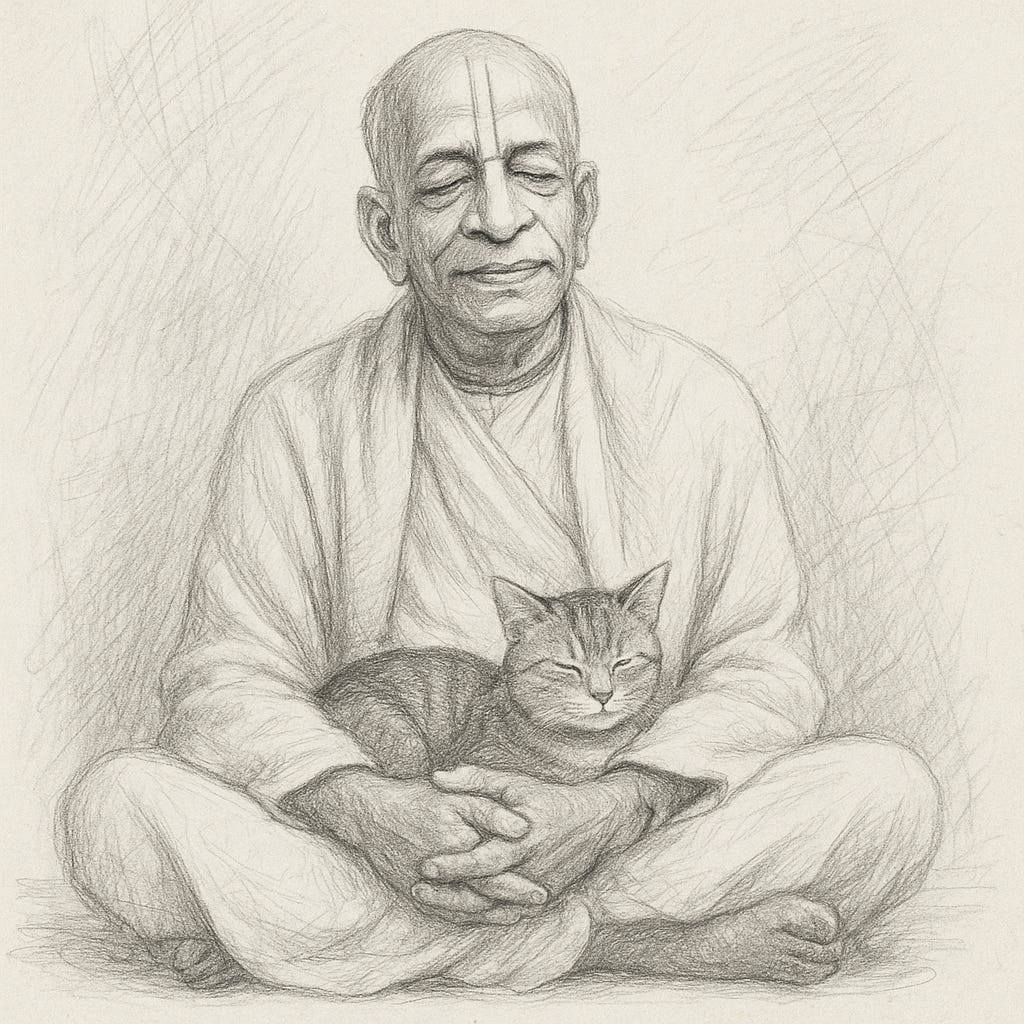
Once, Śrila Prabhupāda was giving a lecture to a small group of disciples in India, when a cat unexpectedly appeared and lay on his lap. Śrila Prabhupāda didn’t seem disturbed by the cat and allowed it to stay there for some time. Later, he used this situation to illustrate the point that betraying someone who takes shelter of us in good faith is an extremely serious sin. He said: “If I take shelter of you, if I put my head on your lap, and you cut my throat, that’s the worst sin.”
We can see that this is behind many problems we have nowadays. For a certain time, we taught people that they should completely surrender and live in the temples. Many would take this advice in good faith and trust the local authorities to the point of sometimes trusting them to choose their spouses. The problem is that in many circumstances, the authorities would not be able to properly take care of devotees, and thus, many would leave, feeling betrayed.
This kind of situation creates two problems: not only does it make it much harder for someone to again trust a spiritual authority, which in turn becomes a stumbling block on one’s path, but it also creates problems for the authority himself, who will surely face problems in his spiritual development, or even fall as a result of it. This is the kind of situation that can erode our movement from the inside, creating scars that are very difficult to heal later.
It’s good to teach people to surrender to Kṛṣṇa, but if we want to play the role of Kṛṣṇa’s representatives, accepting such surrender ourselves, then we have to be sure that we are qualified to play this role, being not only free from any kind of exploitative nature but having the heart, skills and spiritual realization necessary to take care of people’s needs and help them to advance spiritually. Ultimately, it is not possible to satisfy anyone’s needs without also giving them Kṛṣṇa consciousness, because a materialist will never be satisfied with whatever he or she has. A spiritual leader should be capable of giving devotees proper material facilities while simultaneously supporting them in their spiritual practice. We need to sincerely ask ourselves if our purpose is to help people get close to Kṛṣṇa, or if we just want to get followers.
There are several levels of spiritual teachers: some just help people to get into the proper path, others help them to grow on this path, and others are capable of bringing them to the ultimate goal. We should be able to, realistically, understand at which level we belong, and not become spiritual cheaters by pretending to be something we are not.
Devotees who genuinely attain a level of becoming capable of accepting the surrender of others are devotees who are very deeply connected with their own spiritual masters (in the real, spiritual sense, and not just physically) and thus see themselves as just a link in the chain, connecting their disciples to their own spiritual master, who in turn connects them with their own spiritual master, all the way up to Kṛṣṇa. Only by accepting such a humble attitude, as a servant of one’s own spiritual master, can one become free from all kinds of exploitative attitudes. A devotee who sees himself as an object of worship is still just a conditioned soul.
« Things I Wish Someone Had Taught Me When I Started Krishna Consciousness
You can also donate using Buy Me a Coffee, PayPal, Wise, Revolut, or bank transfers. There is a separate page with all the links. This helps me enormously to have time to write instead of doing other things to make a living. Thanks!
Really helpful topic🙏🙏🙏