

You can receive new articles directly in your inbox. Subscription is free; donations are welcome.
During the early 1960s, Śrīla Prabhupāda wrote a series of manuscripts while living in Vṛndāvana. Some of them were published, like the first three volumes of the Śrīmad-Bhāgavatam and Śrī Īśopaniṣad, but some were left behind when he came to the West, apparently forgotten.
Among them, there was an unfinished manuscript of a dissertation on the talks between Śrī Caitanya Mahāprabhu and Rāmānanda Rāya that was later published by Gauḍīya Maṭha devotees as a book called In Search of the Ultimate Goal of Life.
Prabhupāda commented on the same passage again in Teachings of Lord Caitanya, and then again on his commentary on the Śrī Caitanya-caritāmṛta. In other words, this passage is so significant that Prabhupāda wrote three separate commentaries on it!
Why is this conversation so important?
In a sense, this is the most essential discussion of all, for it discusses the goal of life itself. Not only does it describe the supreme goal of love of Godhead, but it also defines all the preliminary steps, offering a map where we can identify where we are, define where we want to go, and understand the path to reach there.
In the Śrī Caitanya-caritāmṛta, these talks are narrated in chapter eight of the Madhya-līlā, and in Teachings of Lord Caitanya, they comprise the whole final part of the book, from chapter 27 onward.
What is it about?
Rāmānanda Rāya is the incarnation of Viśākhā, one of the principal gopis. His mission in Caitanya līlā is to help the Lord, as Mahāprabhu, to understand the ecstatic symptoms experienced by the gopīs, which is the primary process of His mission.
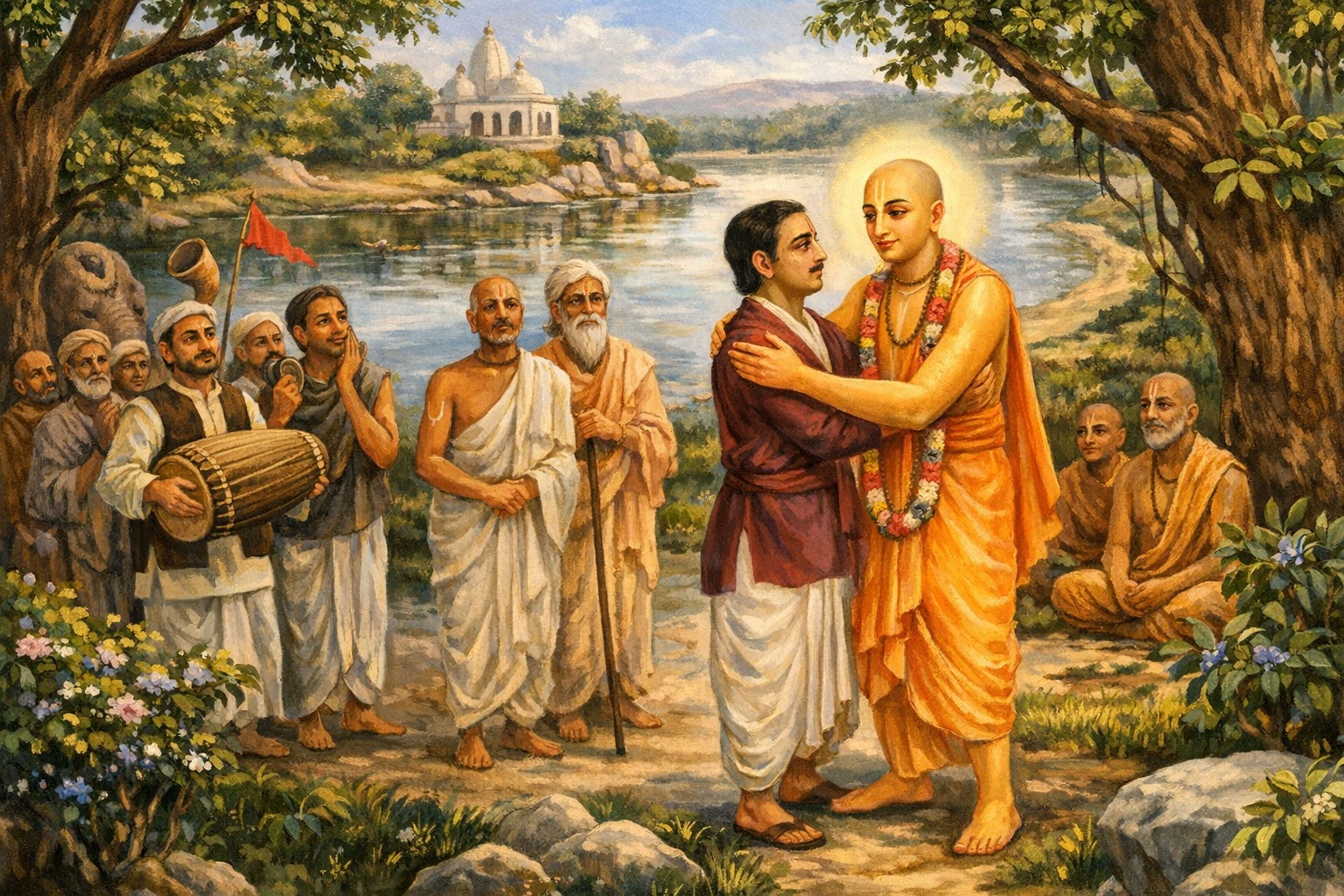
They first met at the banks of the river Godāvarī. At the time, Rāmānanda was accompanied by a few stereotyped caste brāhmanas, and thus the Lord checked his ecstatic feelings, but later, when they met in private, he could relate freely with Him.
Mahāprabhu started their conversation by asking Rāmānanda to recite a verse from the scriptures describing the ultimate goal of life.
His first answer was that by practicing varnāśrama, a person revives his original Kṛṣṇa consciousness, quoting the Viṣṇu Purāṇa (3.8.9). Mahāprabhu, however, didn’t like this answer very much, arguing that simply following varnāśrama is external and cannot be properly practiced in the age of Kali. It cannot thus be accepted as the ultimate goal of life. He thus asked Rāmānanda to speak something higher.
Rāmānanda then quoted Bg 9.27, suggesting that the practice of Karma-yoga, offering all our activities to Kṛṣṇa is the Supreme goal: “My dear son of Kuntī, whatever you do, whatever you eat, whatever you offer in sacrifice, whatever you give in charity, and whatever austerities you perform, all the results of such activities should be offered to Me, Kṛṣṇa, the Supreme Personality of Godhead.”
The practice of Karma-yoga is higher than the mere external practice of rules and regulations connected with the varnāśrama system, but Mahāprabhu was still not satisfied with the answer. Again, He defined it as external. He was not interested in external practices but in a real change of the heart.
He then quoted Bg 18.66: “After giving up all kinds of religious and occupational duties, if you come to Me, the Supreme Personality of Godhead, and take shelter, I will give you protection from all of life’s sinful reactions. Do not worry.”
The practice of religious duties, as explained in the scriptures, brings the promise of material results in the form of prosperity, progression to the celestial planets, etc. Apart from that, these material duties sometimes conflict with one’s service to the Lord. We can see that in the Gītā, Kṛṣṇa was telling Arjuna to fight for Him, but Arjuna was reluctant, based on material duties. Dharma-tyāga, to renounce this stereotyped performance of material duties and instead directly surrender to the pure representative of the Lord, is a much higher platform. However, even that was rejected by Mahāprabhu. He was aiming for something still higher.
Rāmānanda then offered jñāna-miśrā bhakti, philosophical inquiry dovetailed with devotional service as the ultimate goal, quoting Bg 18.54: “One who is thus transcendentally situated at once realizes the Supreme Brahman and becomes fully joyful. He never laments or desires to have anything. He is equally disposed toward every living entity. In that state he attains pure devotional service unto Me.”
Even this, however, Mahāprabhu defined as external. Philosophical inquiry directed to Kṛṣṇa can eventually lead one to devotional service, but it is a path, not the goal itself. Until one attains the final goal of the process, it is still just external. Instead of moving one’s body, one is moving one’s mind, but it is still essentially the same.
Rāmānanda then suggested that jñāna-śūnyā bhakti, devotional service uncontaminated by any tinge of philosophical speculation, is the ultimate goal, quoting SB 10.14.3, a verse originally spoken by Lord Brahmā:
“Those who, even while remaining situated in their established social positions, throw away the process of speculative knowledge and with their body, words and mind offer all respects to descriptions of Your personality and activities, dedicating their lives to these narrations, which are vibrated by You personally and by Your pure devotees, certainly conquer Your Lordship, although You are otherwise unconquerable by anyone within the three worlds.”
Śrī Caitanya Mahāprabhu acknowledged that this suggestion was better than the previous but requested Rāmānanda Rāya to go further. He then suggested that prema-bhakti, ecstatic love for Kṛṣṇa, is the ultimate perfection.
Mahāprabhu finally accepted this suggestion, but He requested Rāmānanda to continue speaking.
Rāya then suggested dāsya-prema, spontaneous loving service in servitude as the ultimate perfection.
To support it, he quoted the conclusion of Yāmunācārya in his Stotra-ratna (43): “By serving You constantly, one is freed from all material desires and is completely pacified. When shall I engage as Your permanent eternal servant and always feel joyful to have such a perfect master?”
Mahāprabhu, however, requested him to go still further. He then suggested sakhya-prema, pure devotional service in fraternity as the highest perfection.
This is the perfection attained by the cowherd boys, that Śukadeva Gosvāmī glorifies on SB 10.12.11: “Those who, even while remaining situated in their established social positions, throw away the process of speculative knowledge and with their body, words and mind offer all respects to descriptions of Your personality and activities, dedicating their lives to these narrations, which are vibrated by You personally and by Your pure devotees, certainly conquer Your Lordship, although You are otherwise unconquerable by anyone within the three worlds.”
Mahāprabhu agreed that this was a good suggestion but requested something still higher.
Rāmānanda then suggested vātsalya-prema as the ultimate perfection. That’s the position attained by mother Yaśodā and Nanda Mahārāja, described on SB 10.9.20:
“Neither Lord Brahmā, nor Lord Śiva, nor even the goddess of fortune, who is always the better half of the Supreme Lord, can obtain from the Supreme Personality of Godhead, the deliverer from this material world, such mercy as received by mother Yaśodā.”
Is it possible that something still higher can exist? Higher than such a perfection that is not attainable even for Brahmā, Śiva, or Lakṣmī herself?
Mahāprabhu acknowledged the excellence of this platform by praising Rāmānanda Raya, but he still wanted to hear of something still higher
The Lord said, “Your statements are certainly getting better and better one after the other, but surpassing all of them is another transcendental mellow, and you can speak of that as the most sublime.”
Rāmānanda then offered kāntā-prema, conjugal attachment for Kṛṣṇa, as practiced by the gopīs, as the topmost position in love of Godhead. This platform was described by Uddhava, Kṛṣṇa’s most intimate servitor, in SB 10.47.60:
“When Lord Śrī Kṛṣṇa was dancing with the gopīs in the rāsa-līlā, the gopīs were embraced around the neck by the Lord’s arms. This transcendental favor was never bestowed upon the goddess of fortune or the other consorts in the spiritual world. Nor was such a thing ever imagined by the most beautiful girls in the heavenly planets, girls whose bodily luster and aroma resemble the beauty and fragrance of lotus flowers. And what to speak of worldly women, who may be very, very beautiful according to material estimation?”
Finally, Śrī Caitanya Mahāprabhu accepted it as the limit of perfection. From this point, the conversation was directed to discussing the ecstatic devotional sentiments of the gopīs and finding their ultimate expression.
Prabhupāda gives us a mysterious purport in this connection on CC Madhya 8.79:
“In general, love of Godhead is devoid of the intimacy of ownership. In the case of love in servitude, there is a want of confidence. There is a want of increased affection in the fraternal relationship, and even when this affection increases in the parental relationship, there is nonetheless a want of complete freedom. However, when one becomes a conjugal lover of Kṛṣṇa, everything lacking in the other relationships is completely manifest. Love of Godhead lacks nothing in the conjugal stage. The summary of this verse is that parental love of Godhead is certainly higher than fraternal love and that conjugal love is higher yet. It was when Śrī Caitanya Mahāprabhu requested Rāmānanda Rāya to go further that he came to the point of the conjugal relationship, which is the highest perfectional stage of transcendental love.”
What does it mean?
This purport is the conclusion of a succession of masterful purports by Prabhupāda starting from 8.68.
Everything starts with sādhana-bhakti, when we practice regulated devotional service under the shelter of the spiritual master. Before that, we are simply doing superficial external practices with our bodies and minds, as previously rejected by Mahāprabhu.
This sādhana-bhakti starts with association with devotees, passes through anartha-nivṛtti, and reaches the stage of niṣṭhā, when we become fixed in the devotional platform. One then becomes attached to the Lord and His devotional service (āsakti) and, by progressing further, eventually reaches prema-bhakti. That’s an extraordinarily elevated goal by itself. What makes this conversation between Śrī Caitanya Mahāprabhu and Rāmānanda Rāya so extraordinary is that prema-bhakti is taken as a baseline. We then have the most precipitous exposition on love of Godhead, going up to text 8.79.
The difference between sādhana-bhakti and prema-bhakti is discussed in 8.70. Sādhana-bhakti means devotional service performed in faith, when we don’t have God of Godhead, but we believe that this is the goal and believe that the process we are instructed to perform leads to it. Prema-bhakti is defined as devotional service in greed, spontaneous devotional service that emerges from the heart without external effort. This is the baseline for their discussion.
There are five platforms of pure love of Godhead: śānta-rasa (neutrality), dāsya-rasa (servitude), sakhya-rasa (friendship), vātsalya-rasa (parental affection), and mādhurya-rasa (conjugal love).
Śānta-rasa is considered still a preliminary platform, for it doesn’t include an active attitude of service. It is thus not included in the discussion.
As discussed in 8.71, spontaneous loving service begins with an attitude of intimate attachment (mamatā). There is service before that; devotional service is the eternal propensity of the soul, and we are performing service even now in the stage we currently are. However, before this intimate attachment is established, the loving affairs between the Lord and His devotee are not actually fixed. This, in turn, starts when a devotee transcends śānta-rasa and enters into dāsya-prema. In that platform, the devotee feels that “the Lord is my master” and serves Him. As Prabhupāda mentions, that’s the level when Kṛṣṇa consciousness is awakened.
This is the meaning of the first part of Prabhupāda’s purport on 8.79: “In general, love of Godhead is devoid of the intimacy of ownership.”
In śānta-rasa, there is no intimate attachment, mamatā. The Lord is there, but there is no feeling that “the Lord is mine”. Love of Godhead is thus not fully awakened. The predominant attitude is still indifference.
The second part of the purport, “In the case of love in servitude, there is a want of confidence”, is explained on 8.74:
“As long as loving service is rendered to the Lord in the master-servant relationship, there is some fear, for the servant is always afraid of the master, despite the intimacy of self-interest. In this stage the servant is always afraid of the master and respectful of Him. When the devotee is further advanced, he has nothing to fear. He considers the Lord and himself on an equal level. At such a time, the devotee is fully convinced that Lord Kṛṣṇa is a friend and cannot at all be dissatisfied if the devotee lives with Him on an equal level. This understanding is called viśrambha, that is, devoid of a respectful attitude. When this attitude is chosen, it becomes sakhya-prema, or love of Godhead in friendship. On this stage there is developed consciousness of equality between the Lord and the devotee.”
In this way, dāsya-rasa is superexcellent, but there is something that can be improved. Prabhupāda is careful in using the word “want” (instead of lacking, missing, etc.) because that’s not a defect, but something that can be added to something that is already perfect. Because there is so much reverence in dāsya-rasa, there is a lack of confidence, and this limits a devotee’s expression of devotional sentiments. When this fear is somehow transcended, one’s devotional service expands, and a devotee enters the realm of sakhya-rasa, where the intimacy increases, and all reverence is put aside. Love can thus be expressed practically without limit. In the Bṛhad-bhāgavatāmṛta, we can study how Gopa-kumāra remained dissatisfied even in Vaikuṇṭha because his love for the Lord couldn’t be fully expressed in the environment of reverence present there.
There is, however, still a “want” in sakhya-rasa. That’s the next part of the purport: “There is a want of increased affection in the fraternal relationship”.
This is explained on 8.76: “The stage of loving service to the Lord in parental affection is an advanced stage of love in fraternity. In the fraternal relationship there is a sense of equality, but when that sense of equality is advanced in affection, one attains the platform of parental love.”
The same lack of reverence present in sakhya-rasa is also present in vātsalya-rasa; however, in parental affection, the attachment is still stronger. This increase in attachment is the part that can still be improved in sakhya-rasa, even though it is already perfect and superexcellent.
There is, however, still something that can be added on top of the maddening affection present in vātsalya-rasa, which is the complete freedom in expressing affection present in mādhurya-rasa. A parent can embrace and kiss the child, but the conjugal relationship brings even greater intimacy.
As Prabhupāda concludes:
“However, when one becomes a conjugal lover of Kṛṣṇa, everything lacking in the other relationships is completely manifest. Love of Godhead lacks nothing in the conjugal stage. The summary of this verse is that parental love of Godhead is certainly higher than fraternal love and that conjugal love is higher yet. It was when Śrī Caitanya Mahāprabhu requested Rāmānanda Rāya to go further that he came to the point of the conjugal relationship, which is the highest perfectional stage of transcendental love.”
The rest of the conversation expands this further still, exploring the topic of conjugal love to the topmost limit.
This is a publication for thoughtful readers who want to go deeper into Kṛṣṇa consciousness. I publish daily, trying to offer high-quality spiritual content, and all posts are available to free subscribers. If you wish, you can also choose a paid subscription to support this work.
You can also receive the updates on WhatsApp or Telegram.
If you would like to contribute further, you can find the donation links here.