


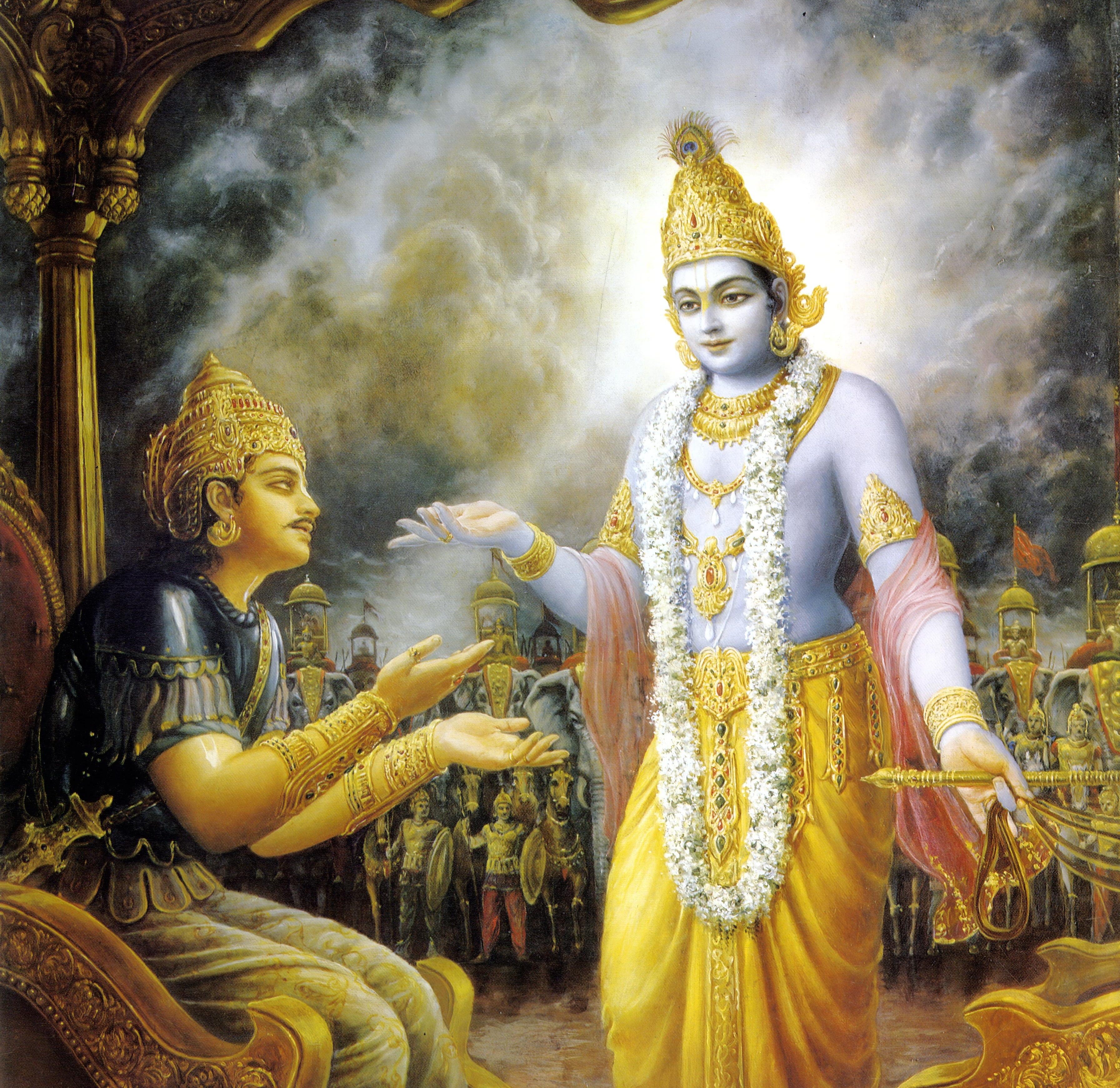
Close to the end of the Bhagavad-gītā, in text 18.54, Kṛṣṇa gives us a mysterious description:
“One who is thus transcendentally situated at once realizes the Supreme Brahman and becomes fully joyful. He never laments or desires to have anything. He is equally disposed toward every living entity. In that state he attains pure devotional service unto Me.”
Is it not that devotional service is supposed to bring us to the stage of perfection where we become happy and see everyone on the spiritual platform? If it is so, why then does Kṛṣṇa describes that first one has to attain perfection before coming to the stage of devotional service? And, conversely, if one has to be perfect to attain devotional service, how can we ever get there?
Prabhupāda dispels the confusion in his purport:
“To the impersonalist, achieving the brahma-bhūta stage, becoming one with the Absolute, is the last word. But for the personalist, or pure devotee, one has to go still further, to become engaged in pure devotional service. This means that one who is engaged in pure devotional service to the Supreme Lord is already in a state of liberation, called brahma-bhūta, oneness with the Absolute. Without being one with the Supreme, the Absolute, one cannot render service unto Him. In the absolute conception, there is no difference between the served and the servitor; yet the distinction is there, in a higher spiritual sense.”
Brahma-bhūta is the stage of liberation, where we become free from the influence of the three modes. That’s the stage where we return to our pure position as souls, beyond matter. This can be attained even during one’s life; there is no need to die first. When one reaches this stage, one develops the symptoms described by Kṛṣṇa in the verse:
a) He becomes fully joyful.
b) He never laments or desires to have anything.
c) He is equally disposed toward every living entity, seeing everyone as the soul and not the body.
However, this platform of liberation is just the middle of the way. It leads to the beginning of another road, which brings us to the real perfection. The first stage brings one to the stage of detachment from the material world, while the second brings one to the eternal position of service to Kṛṣṇa.
Everyone has to first pass through the stage of liberation to reach the ultimate perfection, which is pure devotional service to Kṛṣṇa. In his purport, Prabhupāda connects this with the impersonalists, because they lack knowledge of what is beyond, and think they have reached perfection when they attain the stage of liberation from the three modes. When one leaves his body at this stage, without any knowledge of his eternal relationship with Kṛṣṇa, he is not able to go further than the impersonal brahmajyoti. Because he failed to attain his original position, however, this position is ultimately temporary. Eventually, he falls down again into the material world. The devotee also passes through the stage of liberation, but he does not stop there. The understanding of his eternal relationship with Kṛṣṇa makes he continue engaging in devotional service and advancing further.
There is no need, however, for a devotee to practice a separate process to come to the stage of liberation. Devotional service is the complete path that brings us from the beginning to the end. In the neophyte stage, we practice devotional service and chant the holy names under the influence of the material modes, battling the desires of the mind. The result of this preliminary devotional service is that we gradually come to the stage of liberation. From this stage, our service becomes steady, and we continue advancing all the way to the platform of prema, the ultimate perfection.
The stage of liberation, in the context of a devotee serving Kṛṣṇa without motive, is explained by Prabhupāda further in his purport:
“In the material concept of life, when one works for sense gratification, there is misery, but in the absolute world, when one is engaged in pure devotional service, there is no misery. The devotee in Kṛṣṇa consciousness has nothing for which to lament or desire. Since God is full, a living entity who is engaged in God’s service, in Kṛṣṇa consciousness, becomes also full in himself. He is just like a river cleansed of all dirty water. Because a pure devotee has no thought other than Kṛṣṇa, he is naturally always joyful. He does not lament for any material loss or aspire for gain, because he is full in the service of the Lord. He has no desire for material enjoyment, because he knows that every living entity is a fragmental part and parcel of the Supreme Lord and therefore eternally a servant. He does not see, in the material world, someone as higher and someone as lower; higher and lower positions are ephemeral, and a devotee has nothing to do with ephemeral appearances or disappearances. For him stone and gold are of equal value. This is the brahma-bhūta stage, and this stage is attained very easily by the pure devotee.”
The most interesting part is that just as one can reach the platform of liberation in this very same life, without having to leave one’s body, the stage, the stage of ultimate perfection is also achievable even while we are still technically living in this material world. This is the power of the devotional process. This is also explained by Prabhupāda later in his purport:
“The world is miserable for the materially infected person, but for a devotee the entire world is as good as Vaikuṇṭha, or the spiritual sky. The highest personality in this material universe is no more significant than an ant for a devotee. Such a stage can be achieved by the mercy of Lord Caitanya, who preached pure devotional service in this age.”
The whole point is that this platform of perfection is reachable when we work for Kṛṣṇa, and not through the process of artificial renunciation adopted by jñanis.
The purpose of the whole Bhagavad-gītā is to take us out of the path of fruitive material action and bring us to the platform of devotional service, where we work for Kṛṣṇa, armed with transcendental knowledge of our eternal relationship with Him. When Kṛṣṇa mentions on chapter three that a person who is situated on the platform of knowledge has no duties to perform, this means he stops working on the material, fruitive platform. Work continues, but now on the spiritual platform of service to Kṛṣṇa. When He says that all kinds of sacrificial work culminate in knowledge, this means that sacrifices described in the Vedas have as their ultimate goal to elevate one to the platform of devotional service.
Both work in devotion and inaction in knowledge are explained, because they are two steps on the same stair. The first step is to stop material action through the increase of knowledge. Then, the same knowledge should lead us to the platform of service to Kṛṣṇa. Action does not stop; it is spiritualized following the transformation in our consciousness.
Such a devotee is called a nitya-sannyāsī, one who is always renounced. A devotee becomes a better renunciant than the jñani without ever abandoning his duties. Real renunciation is not in stopping activity, but in renouncing the fruits and the sense of proprietorship. Mechanical renunciation is artificial; real renunciation means to work for Kṛṣṇa.
To stop working is easy, especially when the work is not pleasant, as in the case of Arjuna. To continue working, despite all inconveniences, for a higher purpose, without expecting results, and without considering oneself the doer—that is the real deal.
This is a publication for thoughtful readers who want to go deeper into Kṛṣṇa consciousness. I publish daily, trying to offer high-quality spiritual content, and all posts are available to free subscribers. If you wish, you can also choose a paid subscription to support this work.
You can also receive the updates on WhatsApp or Telegram.
If you would like to contribute further, you can find the donation links here.