

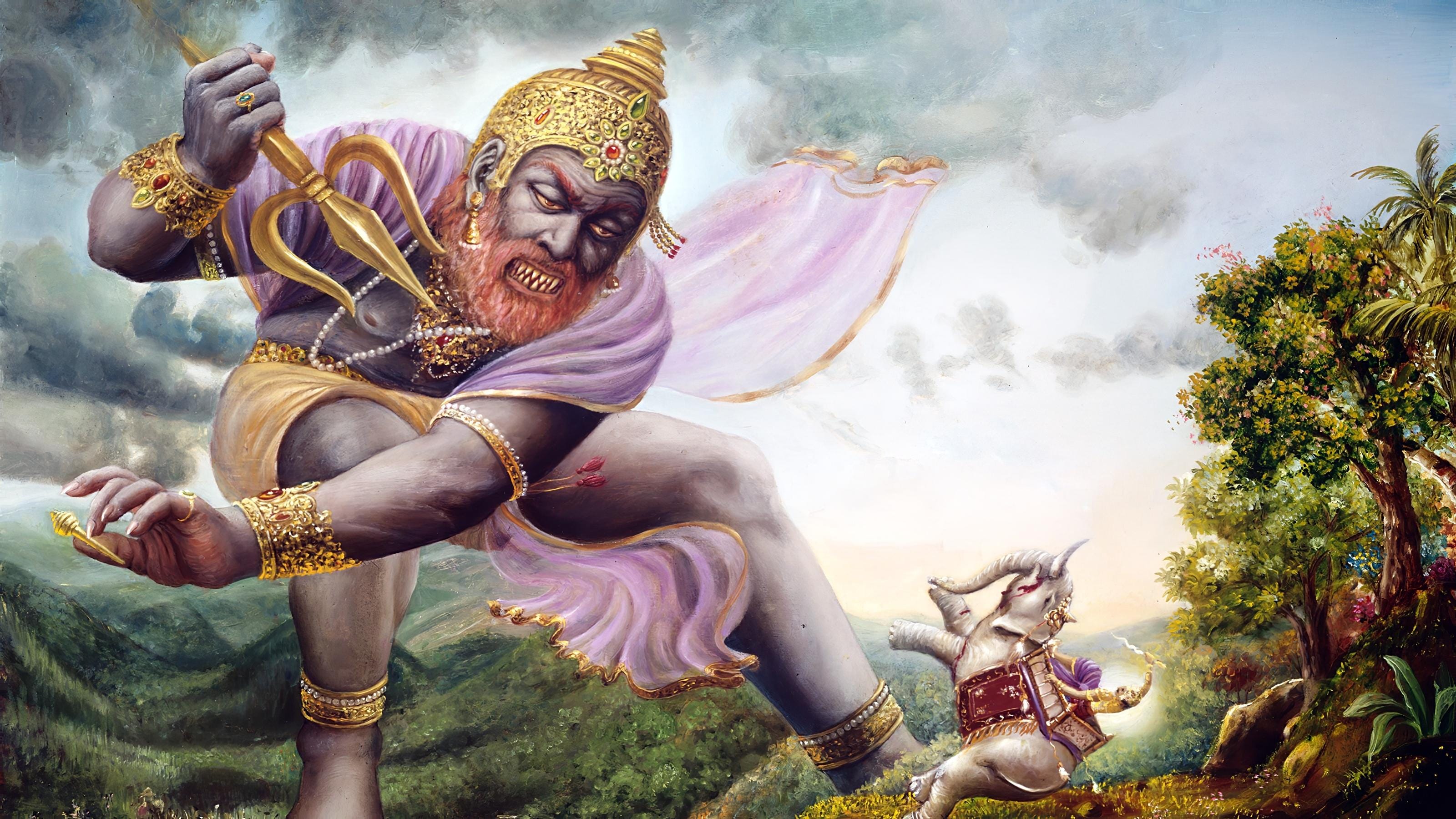
The story of Indra and Vṛtrāsura in the 6th canto of Śrīmad-Bhāgavatam describes the fight between a pure devotee and a demon. Looking at the painting, we immediately jump to the conclusion that the giant Vṛtrāsura is the demon, and Indra is the devotee, but what makes this story interesting is the inversion of the roles. In this case, Vṛtrāsura is playing the part of the pure devotee, while Indra is playing the part of the demon! How can it be so?
When we speak about “demon,” we may think about some creature with horns and a tail, but in the context of the Vedas, asura, or demon, means materialist. Many demons are beautiful, materially pious, and learned in the scriptures, but despite these good qualities, they are materialists who just use religion to achieve their materialistic goals. In the process, they don’t hesitate to fight and kill others.
A pure devotee, on the other hand, is someone who doesn’t want anything from this world. He just wants to serve Kṛṣṇa. A pure devotee may still execute his duties in society, according to his position in life, but internally he remains fixed on this ultimate goal. Because of this, his external actions are not always a reliable way to understand his position. The story of Vṛtrāsura is very revealing in this regard.
After disrespecting Bṛhaspati, his spiritual master, Indra lost his power and was thus defeated by the demons. He went with the other demigods to ask for advice from Lord Brahma and was advised to get the help of Viśvarūpa, who was a qualified brāhmana and could accept the role of the priest of the demigods. With the help of Viśvarūpa, Indra regained his powers and was able to defeat the demons in battle and recover his position.
However, he later noticed that Viśvarūpa was secretly offering oblations to the demons in the sacrifices he was doing in the name of the demigods. The reason was that Viśvarūpa was connected with the family of the demons on the part of the mother, and was secretly offering oblations to them out of affection. Fearing that these oblations could strengthen the demons and make him again lose his post, Indra became alarmed and killed Viśvarūpa on the spot. Because of this, he incurred the heavy sin of killing a brāhmana who was also playing the role of his spiritual master.
This action enraged Tvaṣṭā, the father of Viśvarūpa, who was pained for having his son killed in this way. Out of grief, Tvaṣṭā decided to make a great sacrifice to kill Indra, but because he mispronounced one of the mantras, instead of getting Indra killed, a gigantic black demon appeared from the fire.
This “demon,” Vṛtrāsura, was Citraketu in his past life. The reason he became a demon was that he made a joke with Lord Śiva, which was misunderstood by Pārvatī, who unnecessarily cursed him to become a demon.
Citraketu was a pure devotee who was engaged in chanting the holy names continuously. The curse of Pārvatī was arranged by Kṛṣṇa so he could come back earlier to Godhead, instead of having to wait until the end of a very long life in the celestial planets.
Being born from the sacrifice performed by Tvaṣṭā, Vṛtrāsura was considered his son and thus accepted the duty of fighting with Indra to avenge his brother. Internally, however, he was aloof, being engaged in remembering Kṛṣṇa.
In the first fight with the demigods, Vṛtrāsura found a peaceful way to defeat them by swallowing their weapons. The demigods, led by Indra went to Lord Viṣnu for consultation, but instead of praying for being delivered from the clutches of illusion, Indra asked the Lord to come as an incarnation to kill this powerful demon who defeated them. Disappointed, Lord Viṣnu told him to beg a great ascetic called Dadhīci for his bones, which could be used to make a powerful weapon that would be able to defeat Vṛtrāsura.
Armed with the bones of Dadhīci, fashioned into a powerful weapon that could produce thunderbolts, Indra went again to fight with Vṛtrāsura, who showed great valor by staying to fight with Indra even when all the other demons had fled.
Vṛtrāsura perfectly understood the plan of the Lord. He understood that Indra was armed with a weapon that would kill him, but he was not afraid of death, understanding that that was the arrangement of the Lord to deliver him from the material clutches.
Indra was at first hesitant about killing Vṛtrāsura, understanding that he was actually a brāhmana, but he reasoned with the other demigods that he could kill him and later counteract the reaction by doing a sacrifice. Thus, he also became guilty of the offense of committing sins on the strength of chanting the holy names.
During the battle, Vṛtrāsura was preaching to Indra about religious principles, while Indra was concerned about maintaining his position as the king of the demigods. Indra was showing rather mundane emotions, like fear and hesitation, while Vṛtrāsura was completely fearless.
When Indra finally got the upper hand, Vṛtrāsura became absorbed in meditation and left his body by his own will, attaining the supreme destination. Indra, on the other hand, was busy for one year with the arduous task of beheading the dead body of Vṛtrāsura.
The saint Vṛtrāsura went thus back to Godhead, attaining his eternal position as a servant of Kṛṣṇa, while Indra remained in this material universe to deal with the reactions of killing a pure devotee for material gain.
This story illustrates the difference between materialistic devotees and pure devotees. Indra was also a devotee, but he was a materialistic devotee, whereas, despite his terrifying appearance, Vṛtrāsura was a pure devotee. Anxious for material gains, Indra fought and eventually killed him, and thus became involved in a terrible crime. Vṛtrāsura, on the other hand, saw everything as an arrangement of Kṛṣṇa and was anxious to cooperate with it.
In the end, Vṛtrāsura was able to go back to Godhead as he wanted, and Indra was able to maintain his position in this material world, as he desired.
This is a publication for thoughtful readers who want to go deeper into Kṛṣṇa consciousness. I publish daily, and all posts are available to free subscribers. If you wish, you can also choose a paid subscription to support this work.
If you would like to contribute further, you can find the donation links here.
Hare Krishna prabhuji...
Prabhuji sorry for being off-topic.
Prabhuji what is the answer for the stone paradox or the statement like "Can God kill himself?", "Can God do evil"?...
Many Atheist come up with these arguments. And many Mayavadis also comes up with such arguments to say your Ishwar is badhit.