



You can receive new articles directly in your inbox. Subscription is free; donations are welcome.
A recent study from MIT (Nataliya Kosmyna et al., “Your Brain on ChatGPT: Accumulation of Cognitive Debt when Using an AI Assistant for Essay Writing Task) supports with data something many of us may have already been noticing in practice: excessive use of AI can make us dumber.
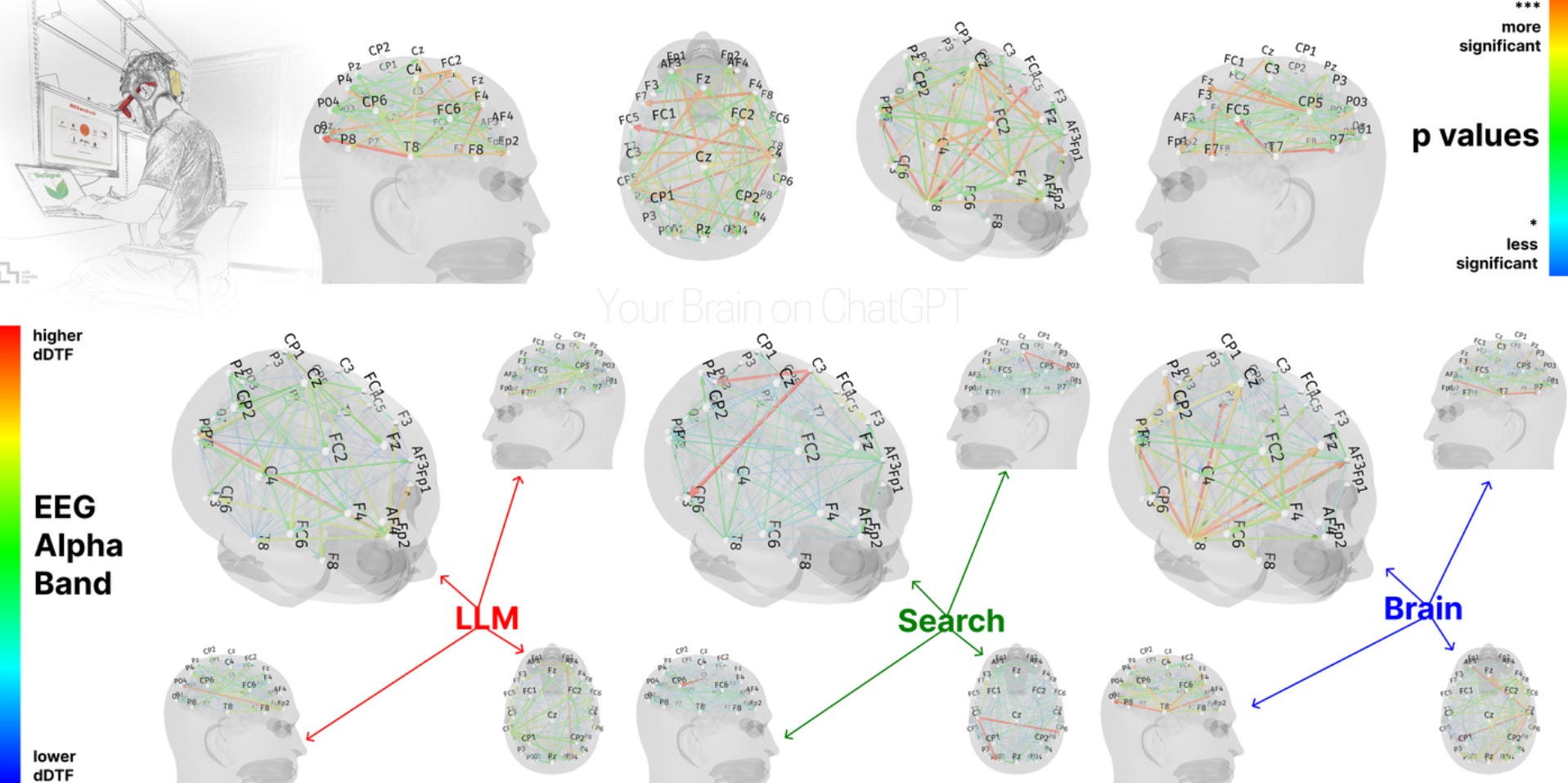
The study found that participants who relied on ChatGPT while writing essays showed much lower neural connectivity during the activity than participants who used conventional web search or wrote from memory. The participants in the AI group also showed weaker recall of their own essays and reported less sense of ownership over them. The researchers then extrapolated these results to describe the possible accumulation of such effects as a “cognitive debt” that may increase with time, creating a form of permanent impairment.
This first image shows the engagement of different parts of the brain during the activity. The EEG of the brain in the participants writing from memory shows intense activity, while in the LLM group the brain remains passive:
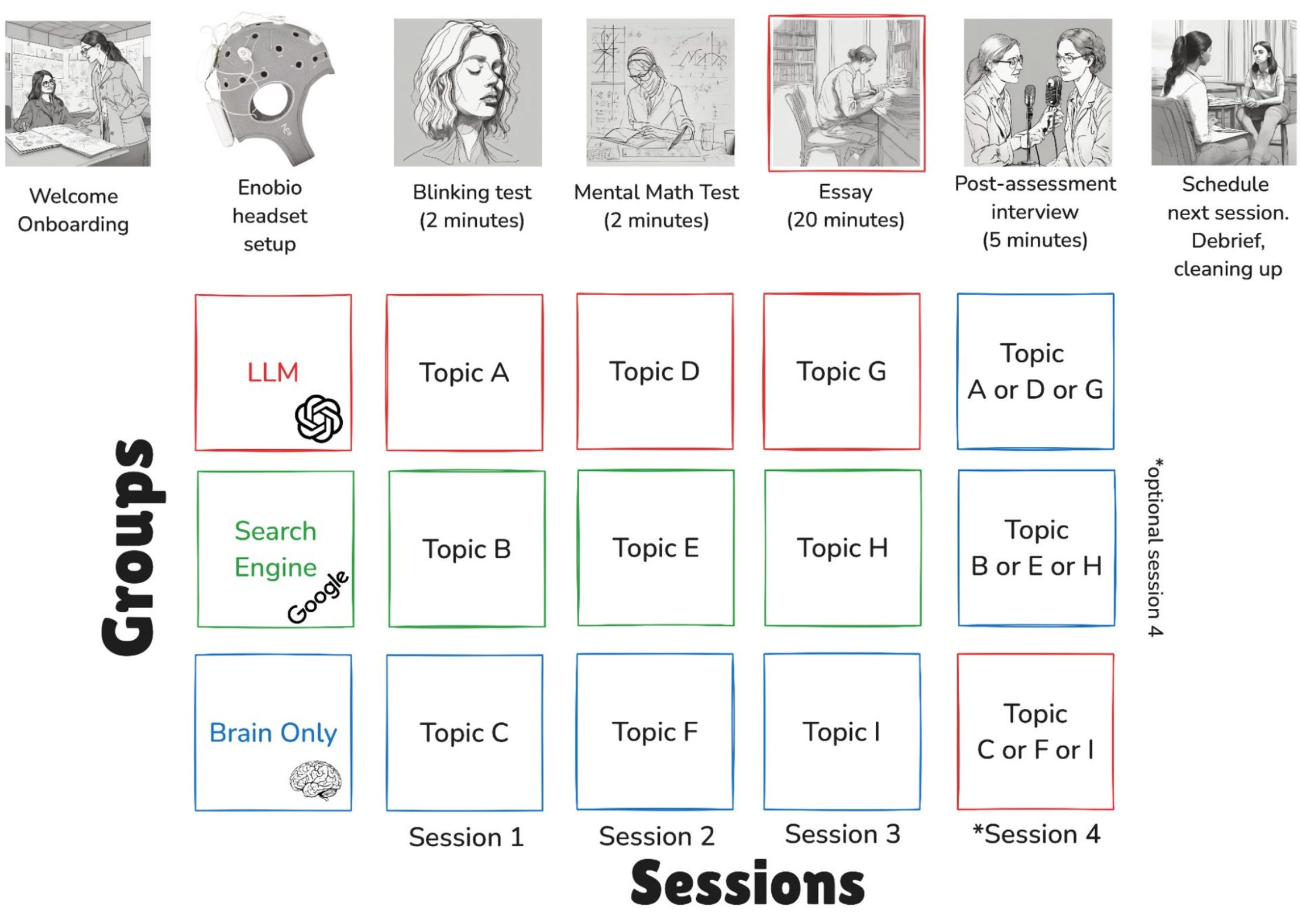
This second image breaks it down by stage. In the LLM group, the brain remains passive during all the stages of the task and then becomes active when they are questioned about what they did. At this stage, they finally woke up and tried to remember, without success, the essay they produced using the AI. For the participants who wrote the essay from memory, the opposite happened. The brain was fully active during the task and, conversely, showed the lowest level of neural connectivity when they were describing what they just did. In other words, they had to work hard to write the essay and then had an easy time while describing what they wrote, remembering it easily. The group using search engines stayed in the middle in all these stages:
This study supports the idea that writing in the old style, using books and memory, is still the most intellectually engaging method of writing. The point of the study is not whether we write using a pen or a keyboard but what kind of assistance we rely on. If we work hard to write each word of an article, the mental activity will be huge. If we do a search and then half-copy it from the results, the effect will be moderate, and if we just write a prompt and copy the result, the effort will be minimal. If we do the same every day, the cumulative effect may be huge. With people starting to rely on the use of Gemini, ChatGPT, DeepSeek, Claude, etc. for the simplest tasks, we can see where we are going. If AI is constantly used to replace thinking, our capacity to think weakens.
The main problem is that many tend to use AI as an oracle. They write a prompt and accept whatever comes back. This is the pattern of usage that weakens thinking, because it allows the AI to think for us. This is an updated version of an old pattern: people receive information from search engines and social networks and repeat it without questioning. It is thus not exactly new, but LLMs certainly amplified it. The way things are going, it may be eventually possible for a person to just rely on AI for all actions and interactions, without ever having to think. At this point, we will have to discuss whether this will be human life at all.
How can we deal with this problem without reducing the discussion to a simple “Should we use AI or not?”
The point is that AI is, in essence, just another tool, just like Google or anything else. The point is not so much the tool but the use we give it. So, how to use AI in a way that doesn’t impair our cognitive ability?
The point is to not use it as an oracle, but as an assistant. There is a huge difference between the two.
When we ask an assistant to help us with a task, we keep the overall planning and offload to him or her parts of the task that we know how to do but can do faster with help. If the idea is to make a fruit salad, we can ask the assistant to go check the prices or help to peel them. The problem starts when we don’t know what a fruit salad is and ask the assistant to make one.
Similarly, when we are studying or writing, we can use the AI to help with the mechanical parts of the work, like research. This is probably the best use for it: to help find information and use this information to improve our thinking, instead of doing the thinking for us. We can also use it as a partner to test ideas and discuss different points, and so on.
As we all know, AI systems can invent facts, misattribute quotations, provide false references, or misunderstand a problem while expressing complete certainty. If we don’t check at each stage, we will end up passively accepting false answers just because they look polished. This will not only lead to mistakes but will also weaken our thinking.
Let’s presume I’m writing an article disagreeing with the Māyāvāda philosophy, for example. I can use the AI to help me find the references. I may remember a verse from the Gītā only vaguely, and the AI can help me find it instead of having to go through the mechanical process of looking for the verse page by page.
After the article has taken form, I can then use a prompt like this:
“You are a follower of the Advaita school, a Māyāvādī. Read my article and try to refute it, paragraph by paragraph, using arguments of your school. Include references, quotes and other details. Make it comprehensive.”
Now, I will have a lot of information and counterarguments that can help me to improve the original article. In this case, the output of the LLM doesn’t need to be accepted as truth; it just gives me something to work with. I will simply analyze the arguments one by one and be sure my article anticipates the ones I consider relevant.
This is very different from asking the AI to write the article for me. I studied, I came to understand what Māyāvāda is, and I have an idea of how to refute particular points, but I’m using the AI to strengthen my work, helping me to notice the dead spots in my thinking. I will probably not have an Advaitin at my side to discuss the points of the article, but I can use the AI to create a digital one to discuss with. It will not be perfect, but it can be good enough for what I need, or at least be better than not having it.
I can also make it more specific. Presume I’m writing an essay about the practical application of the Bhagavad-gītā as It Is in modern life, for example. If I have a digital copy, I can add the file and the draft of my article and prompt:
“Check the source material, and evaluate my article against the teachings of the book. Challenge my perception raising valid points where it deviates from the book. Be brutally honest.”
Again, it can give me a lot of contrary arguments that I can use to go deeper into the book and refine my conclusions. A lot of it will be bogus, but this can also help me to refine my thinking, anticipating misunderstandings readers may have.
When the article is more or less complete, I can use the AI as an editor to refine it:
“Act as my editor. Check my article from the point of view of the Gaudiya Vaiṣnava philosophy for philosophical inconsistencies and grammatical mistakes. Mark what you consider incorrect in bold.”
This is a little more dangerous than the first, because it can invoke the oracle attitude. The point here is not to accept what the AI returns, but to check each point and decide case by case what we can use or not, separating what is factually a mistake and what is just hallucination or misunderstanding from the model. AI can do a relatively good job of pointing out basic inconsistencies, but it usually fails to understand most delicate philosophical points, so it’s up to us to judge what is relevant or not.
The main point is that in both cases we don’t accept what the model gives at face value. It is just like a friend giving opinions, or a post we read on a social network. We don’t accept it as authoritative; we accept it as an opinion that we will compare with authoritative knowledge we have.
We can also use AI to offload repetitive parts of the work, like formatting, sorting out references, making tables, etc. If I can do these in less time, it can actually improve my thinking instead of atrophying it, because I will spend more time thinking and improving the article instead of doing mechanical work.
There are also parts of the work where we understand the result we want, but we don’t have the direct skill to produce it. A good example is images. I may have an idea of an image for an article, but since I’m not a painter, I have no means to produce it. I could use AI to help with that, giving it clear parameters and adjusting the result until it fits what I have in mind. Maybe I need to produce an audio version of the article, but my pronunciation is not good. AI may make a passable audio narration. Perhaps I need to make it into a web page, but I know nothing about web design. AI can also help with that.
Normally, all of these stages would require me to hire different people to do it. One may argue against it from the point of generating jobs, which is a valid point, but from the point of view of thinking, the use of AI in these cases is not negative, because in any case I would not be the one doing the thinking.
In conclusion, AI acts more like an amplifier. It magnifies existing habits. If a person wants to avoid thinking, AI can surely help with that. If the idea is the opposite, to get the other side, get contrary arguments, challenge the way we see things, and force us to go back to the books and study harder to be able to answer different challenges, AI can also help to develop that. What puts us on one side or another is the use or absence of critical thinking.
When we speak about critical thinking, there are four skills that have become essential when dealing with AI tools:
1- Analysis: This one is important in dealing with all types of information, but specifically with AI. We should be able to identify what the AI is missing, detect gaps, assumptions, etc. If it’s something outside my area of expertise, a good way to do that is to always ask it to provide references and check them at every step.
2- Logical thinking: How does A lead to B? Again, that’s an essential skill since the beginning of time, but the importance has increased with the popularization of AI. I have a problem, and an LLM may suggest a solution, but I should be able to analyze the steps that this solution involves, detect mistakes, improve things, and so on. Maybe the solution is completely bogus, and I will decide to just do it myself, or start again. This all depends on personal judgment. Without it, the AI becomes just an oracle, and we go back to the initial problem.
3- Judgment: This brings back to the idea of AI as an assistant. The AI is not the authority in this case; you are. As human beings, we are supposed to learn from superior sources, and then apply this knowledge. AI can feed us with additional information and offer additional challenges, but AIs are not living beings; they have no rational thinking; they just regurgitate information based on patterns and algorithms. You are the one who has to judge the validity and usefulness of it based on knowledge and realization you have acquired.
4- Systematic questioning: That’s an important one. Presume I need to use AI to figure out something I don’t know. How to avoid using it as an oracle? I can treat it as an unreliable source. In this case, I will not accept the first answer. I will keep questioning, ask for references, check them, pose arguments, explore different sides, try to understand what assumptions it’s making, study the canonical texts, etc. By following this process, I can come to know the subject, and the AI again becomes the assistant and not the oracle.
All of this takes energy and time, but that’s precisely the point. Without it, I become just a passive spectator who learns nothing and questions nothing. That’s the mistake many are making.
Read more:


This is a publication for thoughtful readers who want to go deeper into Kṛṣṇa consciousness. I publish daily, trying to offer high-quality spiritual content, and all posts are available to free subscribers. If you wish, you can support this work with a monthly contribution. When you subscribe, you can choose between a free subscription and a monthly contribution, and you can switch from a free subscriber to a supporter at any time.
You can also receive updates on WhatsApp or Telegram.
If you would like to contribute further, you can find the donation links here.
AI stops real skill development.