


You can receive new articles directly in your inbox. Subscription is free; donations are welcome.
Mahāprabhu is the ultimate authority on devotional service. Not only is He Kṛṣṇa Himself, but He is Kṛṣṇa in the role of a perfect devotee. There cannot thus be any mistake in His presentation of devotional service. However, an attentive reader may notice what appears to be a contradiction in His teachings. In his instructions to Śrīla Rūpa Gosvāmī, He mentions:
brahmāṇḍa bhramite kona bhāgyavān jīva
guru-kṛṣṇa-prasāde pāya bhakti-latā-bīja
mālī hañā kare sei bīja āropaṇa
śravaṇa-kīrtana-jale karaye secana“According to their karma, all living entities are wandering throughout the entire universe. Some of them are being elevated to the upper planetary systems, and some are going down into the lower planetary systems. Out of many millions of wandering living entities, one who is very fortunate gets an opportunity to associate with a bona fide spiritual master by the grace of Kṛṣṇa. By the mercy of both Kṛṣṇa and the spiritual master, such a person receives the seed of the creeper of devotional service.”
“When a person receives the seed of devotional service, he should take care of it by becoming a gardener and sowing the seed in his heart. If he waters the seed gradually by the process of śravaṇa and kīrtana [hearing and chanting], the seed will begin to sprout.”(CC Madhya 19.151-152)
These two verses give the idea that devotional service is inherited, or in other words, it is received from the spiritual master when he becomes satisfied with the disciple.
If we go just three chapters ahead, however, in the teachings to Sanātana Gosvāmī, He appears to contradict Himself by stating:
nitya-siddha kṛṣṇa-prema ‘sādhya’ kabhu naya
śravaṇādi-śuddha-citte karaye udaya“Pure love for Kṛṣṇa is eternally established in the hearts of the living entities. It is not something to be gained from another source. When the heart is purified by hearing and chanting, this love naturally awakens.” (CC Madhya 22.107)
This verse gives the idea that devotional service is inherent in the soul. It is already there as part of one’s eternal nature. It has only to be awakened.
As in other points, it appears to be a contradiction only until we understand the underlying principle behind both statements.
Prabhupāda gives us the clue in his purport to text 22.109:
“This love is already there within the heart of everyone (nitya-siddha kṛṣṇa-prema). Spontaneous service is not artificial. One simply has to come to that platform by rendering devotional service according to the regulative principles. Thus one has to practice hearing and chanting and follow the other regulative principles by washing the temple, cleansing oneself, rising early in the morning, attending maṅgala-ārati and so on. If one does not come to the platform of spontaneous service in the beginning, he must adopt regulative service according to the instructions of the spiritual master. This regulative service is called vaidhī bhakti.”
The two verses describe two separate analogies, which describe two essential details about the soul:
a) Love of Godhead is already there within the heart of everyone.
b) It has to be awakened through the process of devotional service, practiced under the guidance of the spiritual master.
The first point describes the eternal constitutional position of the soul of love for Kṛṣṇa. This is the basis for the whole explanation of Kṛṣṇa consciousness by Prabhupāda. This love of Godhead is eternally there, but in contact with material illusion, it can be temporarily covered or forgotten.
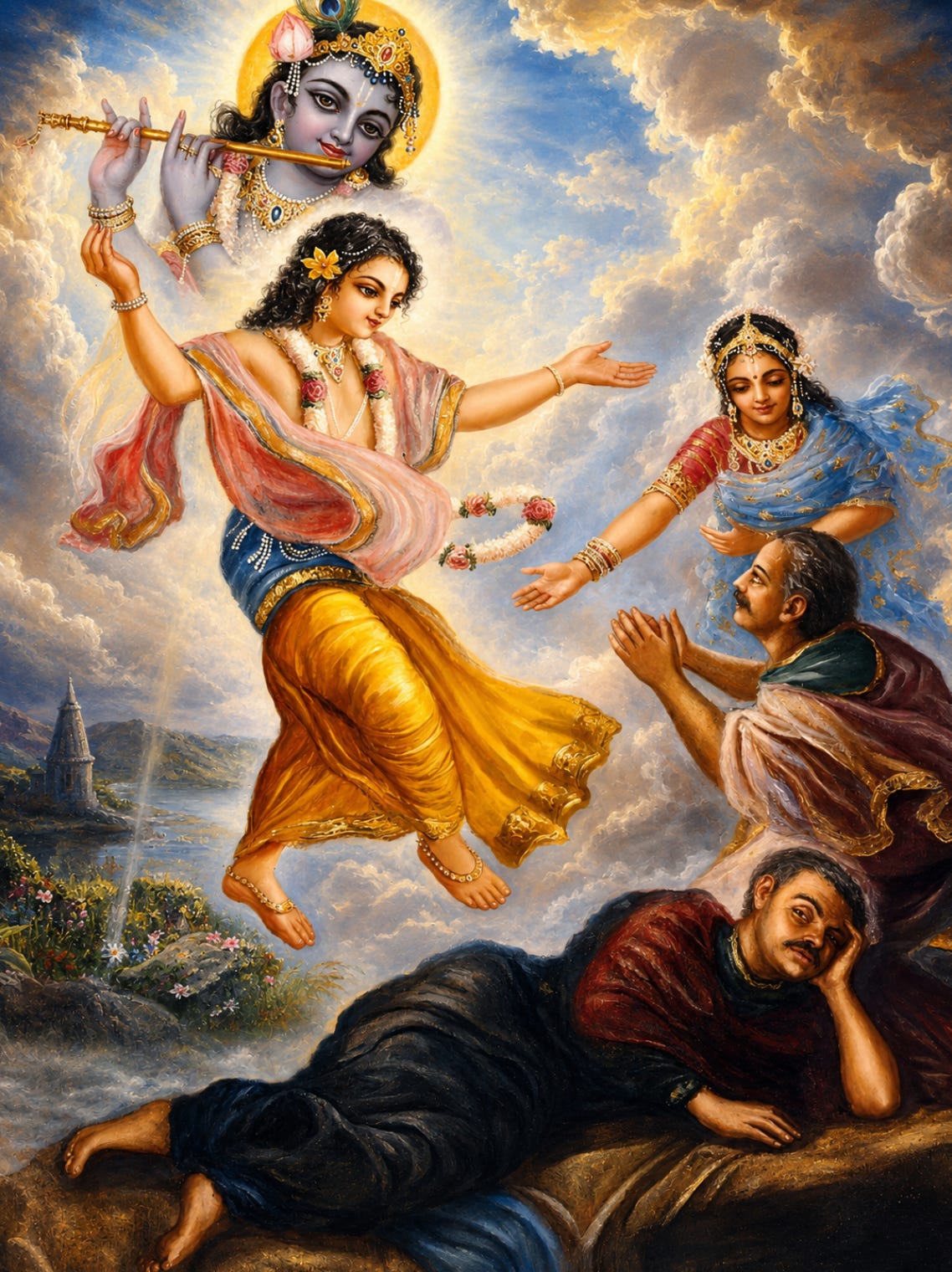
Different analogies are given to explain this point, not only by Prabhupāda, but by other ācāryas. One is someone sleeping, becoming absorbed in the dream and forgetting himself; another is someone losing something and being later reunited with the precious object by the grace of a benefactor. If something is forgotten or even lost, it doesn’t stop being ours, but we need help to remember or find it. This is the point explained in CC Madhya 22.107: Pure love for Kṛṣṇa is eternally established in the hearts of the living entities. It is not something to be gained from another source.
Why then do we need a spiritual master? He is the benefactor that reunites us with the lost treasure. He is the one who awakens us from the depths of ignorance, and he is the one who unties us when we can’t do it by ourselves. This process of reawakening our Kṛṣṇa consciousness is described in CC Madhya 19.151-152, which gives the analogy of a creeper watered by hearing and chanting penetrating the coverings of the universe and resting at the Lotus feet of the Lord.
As in other spiritual topics, the two analogies describe different sides of the same question and have to be understood simultaneously. When we try to flatten it into a single, simplistic explanation, we misunderstand.
This specific verses also clarify a number of points about the practice of devotional service we may have doubts about.
One misconception is that we don’t need anyone to become perfect in Kṛṣṇa consciousness; we just need to chant alone. This is possible only for pure devotees who have already become free from material desires. Not everyone is like Haridāsa Thākura. Prabhupāda makes this point in his purport to text 19.152:
“To live with devotees or to live in a temple means to associate with the śravaṇa-kīrtana process. Sometimes neophyte devotees think that they can continue the śravaṇa-kīrtana process without worshiping the Deity, but the execution of such śravaṇa-kīrtana is meant for highly developed devotees like Haridāsa Ṭhākura, who engaged in the śravaṇa-kīrtana process without worshiping the Deity. However, one should not falsely imitate Haridāsa Ṭhākura and abandon Deity worship just to try to engage in śravaṇa-kīrtana. This is not possible for neophyte devotees.”
The final goal is the same for everyone: always remember Kṛṣṇa and never forget Him. But the recommended way to do that may be different at different stages. A pure devotee may simply sit and chant the whole day, like Haridāsa Ṭhākura, but a neophyte simply can’t. It’s not a matter of willpower. One may be able to chant attentively for one and a half hours, or maybe two hours. The strategy at this stage is thus to combine this chanting with other activities connected with Kṛṣṇa. Deity worship is one of these activities and can be an especially demanding one. If a devotee worships the Deity following all the regulations, he or she will automatically remember Kṛṣṇa constantly. The same can be attained with other services. However, if we reject it prematurely to imitate Haridāsa Ṭhākura, it will probably not work so well. Such imitation usually comes from pride, while regulated devotional service requires humility.
There are other points mentioned in the same purport about the relationship with the spiritual master.
We hear that only by the mercy of the spiritual master can one go back to Godhead and attain pure devotional service. Hearing this, one may think that this is something capricious, that the spiritual master looks at one’s face and decides if he will give us love of Godhead or not. Prabhupāda, however, explains that it is not so:
“Endowed with the mercy of the Supreme Personality of Godhead, the spiritual master distributes the mercy to those who are elevated and pious. Thus the spiritual master trains his disciples to render devotional service unto the Supreme Personality of Godhead. This is called guru-kṛpā.”
The spiritual master wants to give love of Godhead to everyone, but he has to observe eagerness and qualification. He has thus to observe his disciples, guide them, and wait until the disciples become sufficiently qualified to receive the gift. It all starts with one’s eagerness to practice the process and to purify oneself.
Another point is that the devotional seed of the bhakti-latā-bīja is received from the spiritual master. Prabhupāda mentions:
“If one is not fortunate enough to receive the bhakti-latā-bīja from the spiritual master, he instead cultivates such seeds as karma-bīja, jñāna-bīja, or political, social or philanthropic bījas. However, the bhakti-latā-bīja is different from these other bījas. The bhakti-latā-bīja can be received only through the mercy of the spiritual master. Therefore one has to satisfy the spiritual master to get the bhakti-latā-bīja (yasya prasādād bhagavat-prasādaḥ). The bhakti-latā-bīja is the origin of devotional service. Unless one satisfies the spiritual master, he gets the bīja, or root cause, of karma, jñāna and yoga without the benefit of devotional service. But one who is faithful to his spiritual master gets the bhakti-latā-bīja.”
The first point here is that the spiritual master does not give the other seeds that fructify in the form of material activities; they are received from other people we may associate with. Everyone goes in a certain direction in life according to nature and association. One may try to become rich, another may try to do philanthropy, another may become degraded, etc. Just as one becomes a businessman by associating with businessmen, or a drunkard by associating with drunkards, one becomes a pure devotee by associating with pure devotees.
The point made here is that if we are not honest in our dealings with the spiritual master and not sincere in our practice, this duplicitous attitude may not be sufficient to award us the bhakti-plant, and much less nourish it. We thus end up only with the material seeds that gradually sprout and fructify, pulling us back to material life.
This is a point many may misunderstand, thinking that it is something capricious, that the spiritual master gives or does not give the devotional seed based on external worship, donations, etc. Every disciple has the duty of seeing and treating the spiritual master with all honor as a representative of Kṛṣṇa, but what really satisfies the spiritual master is that one is eager to serve Kṛṣṇa. That’s the qualification to receive Kṛṣṇa-prema. When he sees that the disciple is eager to serve Kṛṣṇa, he becomes very happy and gives him the seed of devotional service. Without it, we will receive some other seed from someone else, and we will go in a different direction.
In this way, the seed of devotional service does not bring something originally absent from the soul. Rather, it awakens what has been forgotten and gives it a practical direction. The spiritual master reminds us of our real identity, and guides us so that our original love for Kṛṣṇa can gradually manifest. There is no contradiction between saying that love of Godhead is eternally present in the heart and saying that the seed of devotional service must be received from the spiritual master. One statement describes what the soul eternally is; the other describes how the conditioned soul returns to that eternal position. The treasure is already ours, but without the mercy of Kṛṣṇa and the spiritual master, we may never find it.
Go deeper:

This is a publication for thoughtful readers who want to go deeper into Kṛṣṇa consciousness. I publish daily, trying to offer high-quality spiritual content, and all posts are available to free subscribers. If you wish, you can also choose a paid subscription to support this work.
You can also receive updates on WhatsApp or Telegram.
If you would like to contribute further, you can find the donation links here.