


You can receive new articles directly in your inbox. Subscription is free; donations are welcome.
Here is a very interesting question raised by Mahmoud Etemadi about the relationship with the Deity we discussed in yesterday’s article:
“I was struck by your sentence, “There is thus a moment when we make this switch in our minds. Now it’s not a statue anymore; now it’s the Lord.”
Suppose I have a photograph of my father who has passed away. I may place it somewhere special, speak to him through it, remember him intensely, and feel his presence very deeply. The photograph may become sacred to me because of the relationship and meaning invested in it.
But it would be a very different claim to say that at some particular moment my father actually entered the photograph, so that it was no longer merely a photograph but had objectively become my father.
If Kṛṣṇa is already present everywhere, even within every atom, what exactly changes when a murti becomes a Deity? Is the change primarily in the consciousness, intention, and relationship of the worshiper, or does something objectively change in the form itself? If the latter, what is the basis for knowing that this ontological change has actually taken place?”
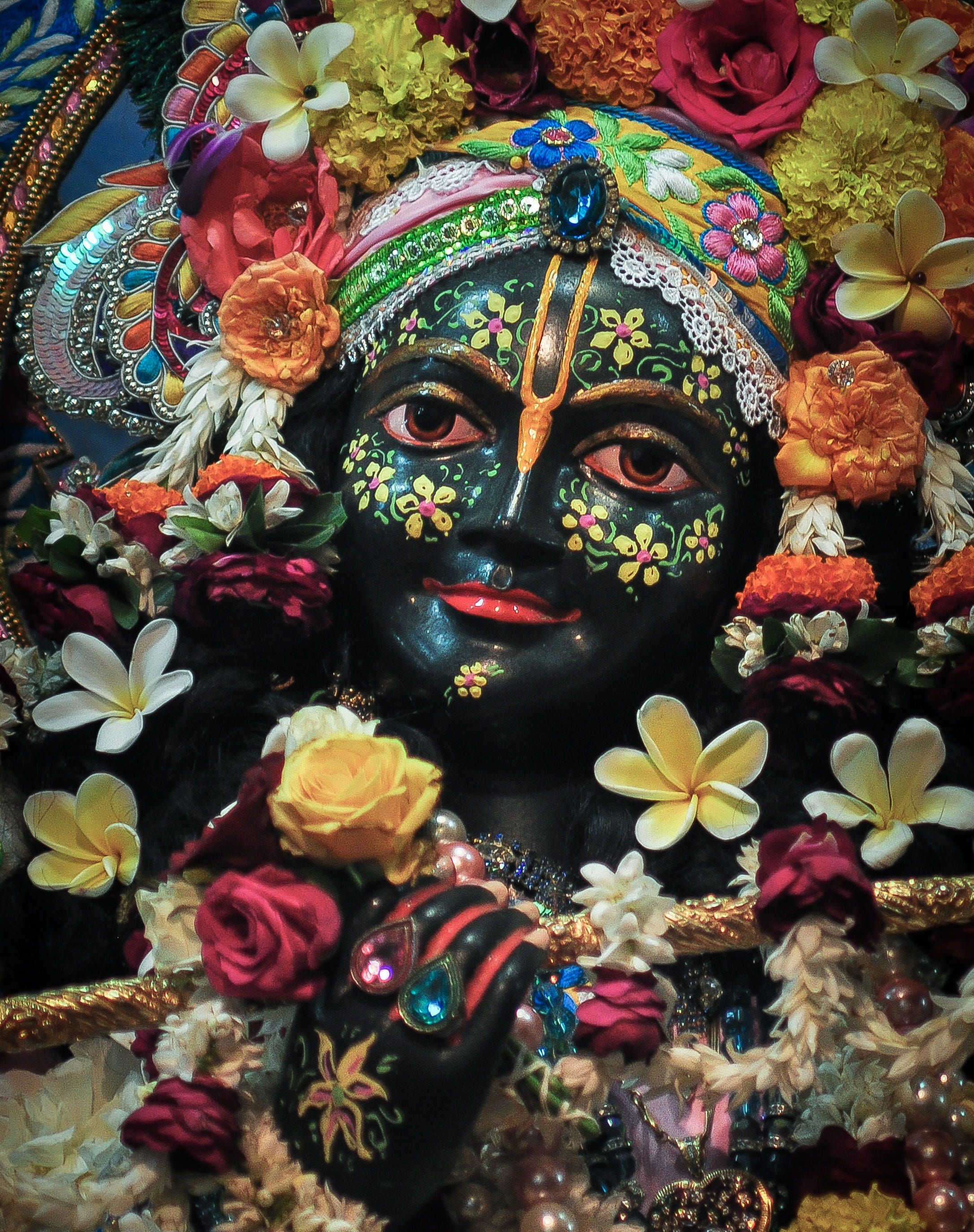
This question touches an important point I should clarify in yesterday’s article. When I spoke about a “switch in our minds,” I did not mean that our consciousness transforms a statue into Kṛṣṇa. The change in our consciousness is our recognition that Kṛṣṇa has manifested in that particular form and is personally receiving our service.
There is a difference between Kṛṣṇa present everywhere and Kṛṣṇa present as the Deity, a form that He has specifically agreed to accept. My father never becomes a photograph; the photo is something that reminds me of my father, but it will never become my father as a person. They always remain different. More importantly, my father has no power to make himself personally present through the photograph. Kṛṣṇa does. That’s the main difference.
In the case of Kṛṣṇa, everything is Kṛṣṇa in a sense, because everything is made of His energy. In this sense, a pure devotee sees Kṛṣṇa everywhere. However, this doesn’t mean a stone is the same as Kṛṣṇa in His personal form, as He explains in the Gītā (9.4-5):
“By Me, in My unmanifested form, this entire universe is pervaded. All beings are in Me, but I am not in them. And yet everything that is created does not rest in Me. Behold My mystic opulence! Although I am the maintainer of all living entities and although I am everywhere, I am not a part of this cosmic manifestation, for My Self is the very source of creation.”
At first, this sentence may appear contradictory, but it just reveals a delicate concept. Everything comes from the energy of Kṛṣṇa, and therefore everything is Kṛṣṇa in a sense, but at the same time, Kṛṣṇa is not reducible to any individual manifestation of His energy. The energy and the energetic are simultaneously one and different. Therefore, although Kṛṣṇa is present everywhere and everything rests on Him, we can’t worship a regular stone or log of wood as Kṛṣṇa; this would be idolatry, or pantheism.
Kṛṣṇa, however, has a very special characteristic that no ordinary person has: He can be present in many different places simultaneously, and accept many different forms. He appears millions of times during the history of the universe in the form of many different incarnations, like puruṣa avatāras, guna avatāras, manvantara avatāras, śaktyāveśa avatāras and so on, and He is simultaneously present in innumerable forms in every other universe, apart from all spiritual planets. Similarly, when He so desires, He can manifest Himself in the form of a particular Deity to accept the service of His devotees.
The example given in this case is that this form becomes like a red-hot bar of metal.
An iron bar placed in fire acquires the qualities of fire and can burn anything it touches. Similarly, although the form of the Deity may originally be made from stone, wood, metal, paint, or other material elements, when Kṛṣṇa manifests Himself in that form, it is no longer ordinary matter. Śrīla Prabhupāda explicitly explains that when the Lord manifests, “it is no longer a physical form.” When a devotee worships the Deity, he or she associates with Kṛṣṇa, and thus becomes infused with Kṛṣṇa consciousness.
How does a stone become the Deity? What is exactly the process? When exactly does the change happen?
A stone is not Kṛṣṇa. A sculptor can shape this stone in the form of Kṛṣṇa, but just shaping it in His image still does not make it Kṛṣṇa. It becomes the arcā-vigraha when Kṛṣṇa accepts that form as His own manifestation in response to the prayers and desire of His devotees. That’s the moment Kṛṣṇa reveals Himself.
This distinction is important. No one can force Kṛṣṇa to appear in a statue, and no one can manufacture Kṛṣṇa by performing a ritual. A devotee simply invites Him to mercifully accept a form through which the devotee can serve Him. Because Kṛṣṇa is omnipotent, He can agree to do so.
In an installation ceremony, the tradition is that the forms remain blindfolded as they are bathed with yogurt and other auspicious substances and other rites are performed.
The forms are ceremonially bathed with auspicious substances, mantras are chanted, a fire yajña may be performed, and the devotees formally invite the Lord to accept the form and their service. When the process is concluded, the eyes of the Deity are opened, and the blindfolds are removed. That’s the moment when Kṛṣṇa is accepted as personally being present there. From this moment, the Deity is worshiped, dressed, offered nice preparations, devotees sing for Him, offer prayers, and so on. Now Kṛṣṇa is there, and He is listening.
However, saying that Kṛṣṇa “enters the statue” can be misleading if taken too literally. Kṛṣṇa was never absent. As Paramātmā, He is already present within every atom. What changes is not His geographical presence, but the way He chooses to manifest Himself there. Before installation, He is present in the same general sense in which He is present everywhere. As the arcā-vigraha, He makes Himself specifically available as the object of personal worship and service: devotees can bathe Him, dress Him, offer Him food, decorate Him, speak to Him, and serve Him personally.
Therefore, the change is objective; it is real, it is not just something in the devotee’s mind, but it is not a material transformation that can be detected by analyzing the stone in a laboratory. It is not about atoms changing into something else. What changes is the personal presence of Kṛṣṇa there, accepting our offerings. Our consciousness does not create this spiritual reality; what happens during the installation ceremony is that our consciousness learns to recognize it.
That’s why a Deity can be installed even without an elaborate ceremony. Śrīla Prabhupāda sometimes installed Deities through very simple ceremonies centered on kīrtana and worship. The power is not in the ritual, but in the sincerity of the devotees involved. That’s what makes Kṛṣṇa inclined to accept a form.
One can press further, questioning what the test is to make sure Kṛṣṇa is present in a Deity. Here we come to the limitations of empiricism in studying what is spiritual. A laboratory can analyze the material composition of the Deity, but it cannot measure Kṛṣṇa manifested there in His spiritual form, much less His spiritual reciprocation with His devotees.
A devotee can see Kṛṣṇa in the Deity, because Kṛṣṇa reveals Himself to the devotee because of his devotion. A devotee will thus develop a personal relationship with the Deity. He will talk with the Deity, offer prayers, and so on, and at each step receive reciprocation. An atheist, however, will see just a statue, because Kṛṣṇa will remain covered to him.
This does not mean that the Deity becomes Kṛṣṇa for the devotee and turns back into stone when an atheist enters the temple. The identity of the Deity does not depend on the consciousness of the observer. What depends on our consciousness is how much of His presence Kṛṣṇa allows us to perceive. As He mentions in the Gītā:
“I am never manifest to the foolish and unintelligent. For them I am covered by My internal potency, and therefore they do not know that I am unborn and infallible.”
This brings us back to the example of the photograph. A photograph becomes special to me because I invest it with meaning. However, it remains only a representation of the person. If my father passed away, a photograph will not bring him back. With the Deity, the direction is reversed. My consciousness does not make Kṛṣṇa present. Kṛṣṇa first agrees to manifest Himself through the arcā-vigraha, and I then gradually learn to recognize and relate to the Person who is present there.
That is the real meaning of the “switch in our minds”: not transforming a statue into God, but ceasing to see the form through which God has chosen to reveal Himself as ordinary matter.
Replacing the Deity
Another interesting question, from Shamdai Sivnanden:
“I was asked if a broken Deity can still be worshiped. I did not believe so, and replied no; it should be replaced. Then I was bombarded with questions: why, if it has been imbued with life, couldn’t it still be worshiped? Why not, as we don’t discard a family member with a broken arm? How to answer these questions, and was I correct in saying no?”
This is another point that may seem confusing and contradictory. If something happens and the form of the Deity is somehow seriously damaged, like an arm being broken, the form is usually replaced. This may sound very contradictory, because it seems that now the Deity is again seen as a statue instead of a person. It, however, again shows the difference between Kṛṣṇa and an ordinary person.
If my brother loses an arm, I can’t give Him a new body. He will continue living in the armless body until the end of his life, and I will continue associating with him in this form. Kṛṣṇa, however, has no such limitation. He can assume a new form. The devotees have thus the responsibility of properly maintaining the form of the Deity, and, if necessary, ask Kṛṣṇa to accept a new form, since it is not proper to ask Kṛṣṇa to stand on the altar without an arm. Properly maintaining the form through which Kṛṣṇa accepts our service is itself part of Deity worship.
One example is the worship of Lord Jagannātha in Puri. Once per year, the Deities are restored during the Anavasara, and every 8 to 19 years, when the lunar calendar contains two months of Āṣāḍha, the complete forms are replaced in the Nabakalebara. Lord Jagannātha, Baladeva and Subadrā receive new bodies, and the old forms are buried in another elaborate ceremony.
This ceremony illustrates an essential point: the physical form does not constitute the identity of the Deity. The Deity is Kṛṣṇa Himself, and His form is fully spiritual. Kṛṣṇa can accept a new form, and it is still the same Deity. It is thus not a “new Kṛṣṇa” or a “new Jagannatha.” Rather, it is the same Kṛṣṇa accepting the service of His devotees through a new form.
It is, however, not a hard and fast rule that the form must be completely replaced. Often it can be simply repaired. One example is the Deities of Śrī Śrī Rādhā-London-Īśvara. Rādhārāṇī had a small chip in Her finger, and Śrīla Prabhupāda specifically arranged to have it repaired before the Deities were installed. You can read the story here.
Read more:


This is a publication for thoughtful readers who want to go deeper into Kṛṣṇa consciousness. I publish daily, trying to offer high-quality spiritual content, and all posts are available to free subscribers. If you wish, you can support this work with a monthly contribution. When you subscribe, you can choose between a free subscription and a monthly contribution, and you can switch from a free subscriber to a supporter at any time.
You can also receive updates on WhatsApp or Telegram.
If you would like to contribute further, you can find the donation links here.