

Subscribe to receive new articles by e-mail. It’s free, but if you like, you can pledge a donation:
🔉 Audio of the lesson »
🎙Podcast (Search for “Mysteries of the Vedas” on Spotify, iTunes, etc. to hear all the lessons
Join the Telegram group if you would like to join the live lessons. This course is maintained with your donations. Click here to donate.
💬 Text of the lesson
Jaḍa Bharata breaks his silence and scolds the king
King Rahūgaṇa considered himself a learned man, but his knowledge was actually very limited. He was in the bodily conception of life, and could not even speak coherently from a philosophical point of view. Śukadeva Goswami describes his words as abaddham (incoherent, illogical, nonsensical). He was speaking, but his ideas were incoherent. This contradiction was noted by Jaḍa Bharata, who decided to deliver his teachings to him. Superficially, Jaḍa Bharata may appear to show a little anger in some of these verses, but this is just a show of mercy. Just as Kṛṣṇa’s killing of a demon is actually meant for his deliverance, when a Vaiṣnava appears to be angry, that’s just a sign of benediction.
As Prabhupāda explains in his purport:
“Being self-realized, Jaḍa Bharata, who was fully situated on the transcendental platform, did not at all become angry; instead, he smiled and began to deliver his teachings to King Rahūgaṇa. A highly advanced Vaiṣṇava devotee is a friend to all living entities, and consequently he is a friend to his enemies also. In fact, he does not consider anyone to be his enemy. Suhṛdaḥ sarva-dehinām. Sometimes a Vaiṣṇava becomes superficially angry at a nondevotee, but this is good for the nondevotee. We have several examples of this in Vedic literature. Once Nārada became angry with the two sons of Kuvera, Nalakūvara and Maṇigrīva, and he chastised them by turning them into trees. The result was that later they were liberated by Lord Śrī Kṛṣṇa. The devotee is situated on the absolute platform, and when he is angry or pleased, there is no difference, for in either case he bestows his benediction.”
In this way, Jaḍa Bharata started his discourse, commenting on the erratic words of the King:
“The great brāhmaṇa Jaḍa Bharata said: My dear King and hero, whatever you have spoken sarcastically is certainly true. Actually these are not simply words of chastisement, for the body is the carrier. The load carried by the body does not belong to me, for I am the spirit soul. There is no contradiction in your statements because I am different from the body. I am not the carrier of the palanquin; the body is the carrier. Certainly, as you have hinted, I have not labored carrying the palanquin, for I am detached from the body. You have said that I am not stout and strong, and these words are befitting a person who does not know the distinction between the body and the soul. The body may be fat or thin, but no learned man would say such things of the spirit soul. As far as the spirit soul is concerned, I am neither fat nor skinny; therefore you are correct when you say that I am not very stout. Also, if the object of this journey and the path leading there were mine, there would be many troubles for me, but because they relate not to me but to my body, there is no trouble at all. (SB 5.10.9)
Rahūgaṇa said: “You certainly appear very fatigued because you have carried this palanquin alone without assistance for a long time and for a long distance.”
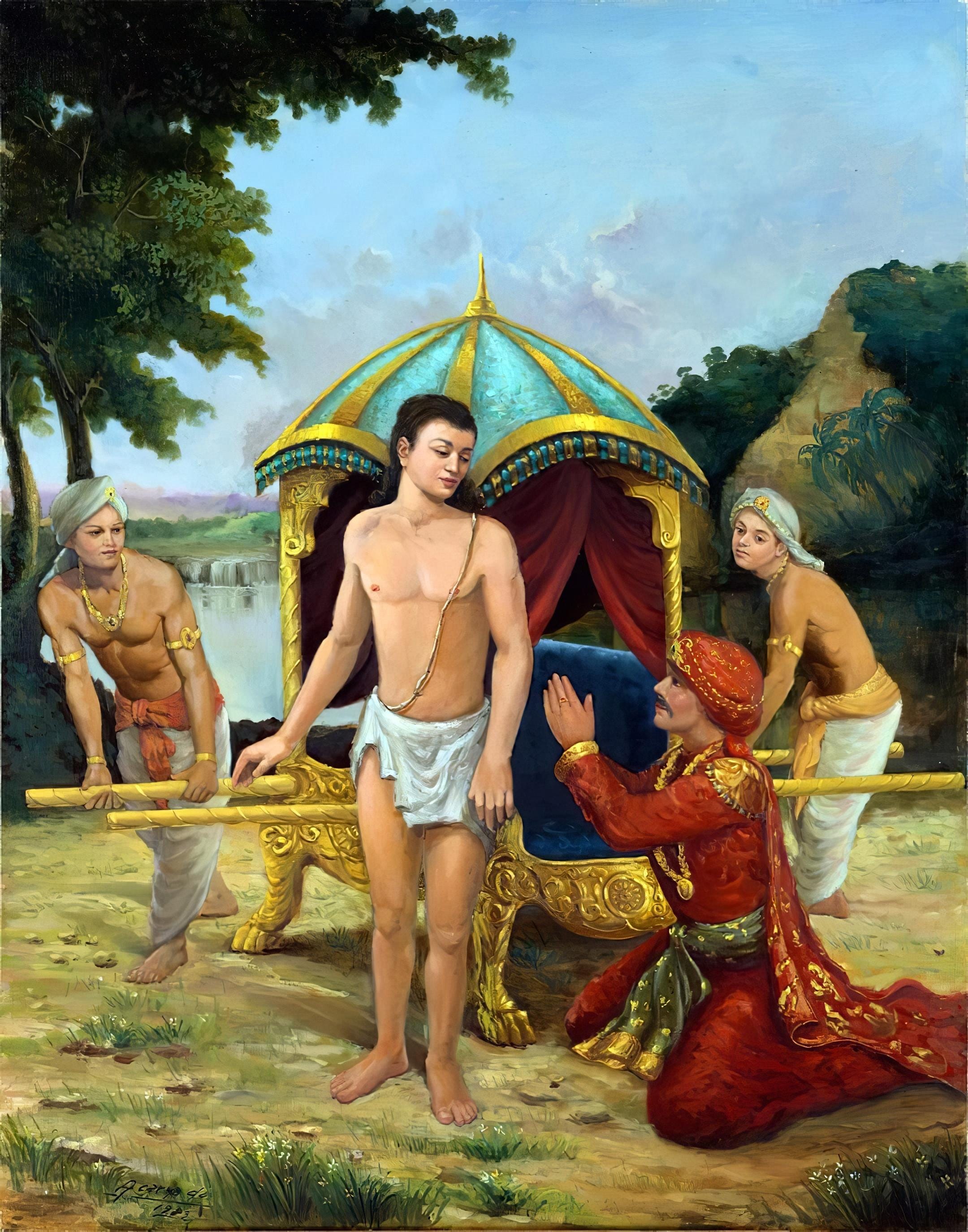
The king was under the bodily concept of life, confusing the body with the self. He saw himself as the king, and Bharata as the palanquin carrier, who was laboring to carry him. Because of his entitlement, he thought Bharata had the duty of carrying him and doing it properly, and addressed him sarcastically, accusing him of not working.
To this, Jaḍa Bharata answered that the body alone is the carrier of the palanquin. He is the soul, different from the body, and because he is detached from the body, he has not labored carrying it. The king is thus, he argues, not incorrect in his statement, since, in fact, he (as the self-realized soul) has not labored carrying the palanquin or doing anything else.
Rahūgaṇa said: “Besides that, due to your old age you have become greatly troubled. My dear friend, I see that you are not very firm, nor very strong and stout.”
Jaḍa Bharata answers that these words befit a person who does not know the difference between the body and the soul. A material body can indeed be stout or thin, strong or weak, but it makes no sense to describe the soul as such. Rahūgaṇa’s speech sounds thus highly contradictory, because he is addressing Bharata with adjectives that can be applied only to the body. Jaḍa Bharata thus sharply corrects him by stating he is neither fat nor skinny, much less old.
What about being troubled? Bharata answers that he is not troubled by the job at all. The job, as well as the goal and the results of the job, relate only to the body. With this, the next statement of the king, “Aren’t your fellow carriers cooperating with you?” also sounds nonsensical. Since there is no problem, why is he bringing up the point of teamwork to solve it?
Jaḍa Bharata thus continues:
“Fatness, thinness, bodily and mental distress, thirst, hunger, fear, disagreement, desires for material happiness, old age, sleep, attachment for material possessions, anger, lamentation, illusion and identification of the body with the self are all transformations of the material covering of the spirit soul. A person absorbed in the material bodily conception is affected by these things, but I am free from all bodily conceptions. Consequently I am neither fat nor skinny nor anything else you have mentioned.” (SB 5.10.10)
With his discourse, Jaḍa Bharata tries to shake Rahūgaṇa’s concept of life and push him out of bodily conception. What is his goal with that? Prabhupāda answers in his purport:
“It is not possible for everyone to become immediately self-realized like Jaḍa Bharata. However, as stated in Śrīmad-Bhāgavatam (1.2.18): naṣṭa-prāyeṣv abhadreṣu nityaṁ bhāgavata-sevayā. By spreading the Bhāgavata principles, we can raise human society to the platform of perfection. When one is not affected by the bodily conceptions, one can advance to the Lord’s devotional service.”
Just as in other passages of Śrīmad Bhāgavatam, the goal is not to just give correct philosophical concepts, but to elevate us to the platform of devotional service. As long as we think we are the body, we will be involved with all the bewilderment connected with that. Only when this misunderstanding is finally clear does the door for elevation to the platform of devotional service, which is connected with the eternal nature of the soul, open.
“My dear King, you have unnecessarily accused me of being dead though alive. In this regard, I can only say that this is the case everywhere because everything material has its beginning and end. As far as your thinking that you are the king and master and are thus trying to order me, this is also incorrect because these positions are temporary. Today you are a king and I am your servant, but tomorrow the position may be changed, and you may be my servant and I your master. These are temporary circumstances created by providence.” (SB 5.10.11)
Rahūgana had questioned, “Are you dead despite the life within your body?” with the idea of making another offensive remark. Jaḍa Bharata, however, argues that the king was again unsuccessful with his choice of words, for this is just a general statement and does not sound like an offense to a self-realized soul. Being dead though alive is the general condition of everything that is material. The body is composed of dead material elements, and simply looks alive because of the presence of the soul. The living appearance of the body is thus not a characteristic of the body per se, nor permanent, since once the soul leaves the body, it becomes again just a lump of matter.
In the Gītā, Krsna questions Arjuna: “how can a person who knows that the soul is indestructible, eternal, unborn and immutable kill anyone or cause anyone to kill?” The soul is never killed, and the body is never alive; therefore, how can any intelligent person claim to kill or be killed by someone?
Another misconception of the king is to see himself as the king, and thus as the master who is entitled to be served by others. However, for how long is he going to be the king? This position is connected with the body and thus temporary. Today, he is in the position of ordering others, but tomorrow he may be the one carrying the palanquin. However, in his illusion, he can’t see this, and considers his position as a king permanent.
As Prabhupāda explains in his purport:
“The spirit soul is in a deep slumber caused by the force of material nature. He is put in one type of condition and again changed into another type. Without self-realization and knowledge, conditional life continues, and one falsely claims himself a king, a servant, a cat or a dog. These are simply different transformations brought about by the supreme arrangement. One should not be misled by such temporary bodily conceptions. Actually no one is master within the material world, for everyone is under the control of material nature, which is under the control of the Supreme Personality of Godhead.”
Rahūgana had also said: “Do you not know that I am your master? You are disregarding me and are not carrying out my order.” and then he threatened: “For this disobedience I shall now punish you just as Yamarāja, the superintendent of death, punishes sinful people. I shall give you proper treatment so that you will come to your senses and do the correct thing.”
To these last two points, Jaḍa Bharata answered:
“My dear King, if you still think that you are the King and that I am your servant, you should order me, and I should follow your order. I can then say that this differentiation is temporary, and it expands only from usage or convention. I do not see any other cause. In that case, who is the master, and who is the servant? Everyone is being forced by the laws of material nature; therefore no one is master, and no one is servant. Nonetheless, if you think that you are the master and that I am the servant, I shall accept this. Please order me. What can I do for you?
My dear King, you have said, “You rascal, you dull, crazy fellow! I am going to chastise you, and then you will come to your senses.” In this regard, let me say that although I live like a dull, deaf and dumb man, I am actually a self-realized person. What will you gain by punishing me? If your calculation is true and I am a madman, then your punishment will be like beating a dead horse. There will be no effect. When a madman is punished, he is not cured of his madness.” (SB 5.10.12-13)
Who is a master in this world? We are all being pushed around by material nature, sometimes being forced to act as a master, and sometimes as a servant. Since the positions are constantly being reshuffled, who is the master and who is the servant?
Jaḍa Bharata is a self-realized soul. He does not have any personal need to speak. He is simply speaking for the benefit of the king. He is also beyond any concept of material honor and pain, and therefore, he did not mind working as a palanquin carrier, just as he didn’t mind working in the fields for his brothers. In fact, he was working without complaining already. The one who started complaining was the king. Therefore, he argues, if Rahūgaṇa wants to insist on his false conception of being the king, then he should just order him whatever he wants him to do.
This point about being the master or servant is a very central point to our material conditioning. Here, everyone wants to be the master, but this contradicts our constitutional position as eternal servants of the Lord. In fact, even in conditioned life, we remain always servants, since the master is material nature. We simply imagine that we have become the masters of someone. We can thus choose to voluntarily accept our constitutional position as loving servants of Krsna, or insist on an imaginary position as masters and be forced to remain as servants of the material energy.
As Prabhupāda explains in his purport to text 12:
“Śrīla Bhaktivinoda Ṭhākura states that all men and women are floating like straws on the waves of material nature. If they come to the understanding that they are the eternal servants of Kṛṣṇa, they will put an end to this floating condition. As stated in Bhagavad-gītā (3.37): kāma eṣa krodha eṣa rajo-guṇa-samudbhavaḥ. Due to the mode of passion, we desire many things, and according to our desire or anxiety and according to the order of the Supreme Lord, material nature gives us a certain type of body. For some time we play as master or servant, as actors play on the stage under someone else’s direction. While we are in the human form, we should put an end to this nonsensical stage performance. We should come to our original constitutional position, known as Kṛṣṇa consciousness. At the present moment, the real master is material nature. Daivī hy eṣā guṇa-mayī mama māyā duratyayā (Bg. 7.14). Under the spell of material nature, we are becoming servants and masters, but if we agree to be controlled by the Supreme Personality of Godhead and His eternal servants, this temporary condition ceases to exist.”
Rahūgaṇa also called Bharata a crazy fool, while at the same time threatening to punish him. This again was contradictory. If he is crazy, punishment will not correct him. It will be just useless labor, like beating a dead horse expecting it to start walking, or beating a bag of flour expecting it to turn back into grains. And if, conversely, Rahūgaṇa were to accept Jaḍa Bharata as a self-realized soul, then again punishment would do no good, because punishment can only be applied to the body, and would do nothing to change his position or behavior. He would still stall every three steps to avoid killing the ants.
The words of Rahūgaṇa were thus again proved nonsensical.
“Śukadeva Gosvāmī said: O Mahārāja Parīkṣit, when King Rahūgaṇa chastised the exalted devotee Jaḍa Bharata with harsh words, that peaceful, saintly person tolerated it all and replied properly. Nescience is due to the bodily conception, and Jaḍa Bharata was not affected by this false conception. Out of his natural humility, he never considered himself a great devotee, and he agreed to suffer the results of his past karma. Like an ordinary man, he thought that by carrying the palanquin he was destroying the reactions of his past misdeeds. Thinking in this way, he began to carry the palanquin as before.” (SB 5.10.14)
A neophyte may become proud and think he is the best devotee, but a pure devotee never thinks like this. In the first part of the Bṛhad-bhāgavatāmṛta, Nārada Muni visits Lord Śiva, Prahlāda Maharaja, Hanumān, the Pandavas, the Yādavas, and finally Uddhava, and none of them claim to be great devotees or recipients of Kṛṣṇa’s mercy. On the contrary, each of them points him to someone else. Similarly, despite instructing the King, Jaḍa Bharata remained humble and accepted the work of carrying the palanquin as a result of his past karma.
When he said, “I am actually a self-realized person,” this was not spoken out of pride. He used the words sva-saṁsthāṁ gatasya me, which means “I am situated in proper understanding of my constitutional position.” In other words, he stated he was situated in his constitutional position as a soul, seeing himself as an eternal servant of Krsna. In this position, there is no false prestige.
Rahūgaṇa becomes astonished and inquires from Jaḍa Bharata
“Śukadeva Gosvāmī continued: O best of the Pāṇḍu dynasty [Mahārāja Parīkṣit], the King of the Sindhu and Sauvīra states [Mahārāja Rahūgaṇa] had great faith in discussions of the Absolute Truth. Being thus qualified, he heard from Jaḍa Bharata that philosophical presentation which is approved by all scriptures on the mystic yoga process and which slackens the knot in the heart. His material conception of himself as a king was thus destroyed. He immediately descended from his palanquin and fell flat on the ground with his head at the lotus feet of Jaḍa Bharata in such a way that he might be excused for his insulting words against the great brāhmaṇa. He then prayed as follows.” (SB 5.10.15)
Despite not being very much enlightened philosophically due to the covering of the mode of passion, Rahūgaṇa had faith in philosophical talks on the absolute truth and was used to hearing from great sages. Hearing these words from Jaḍa Bharata, he could immediately recognize him as one of them. He thus immediately abandoned his position of false prestige, getting down from the palanquin and offering obeisances to the great devotee.
As Prabhupāda mentions in his purport:
“We must know how to conquer the repetition of birth and death. Mahārāja Rahūgaṇa also knew the purpose of life; therefore when Jaḍa Bharata put the philosophy of life before him, he immediately appreciated it. This is the foundation of Vedic society. Learned scholars, brāhmaṇas, saintly persons and sages who were fully aware of the Vedic purpose advised the royal order how to benefit the general masses, and by their cooperation the general masses were benefited. Therefore everything was successful. Mahārāja Rahūgaṇa attained this perfection of understanding the value of human life; therefore he regretted his insulting words to Jaḍa Bharata, and he immediately descended from his palanquin and fell down at the lotus feet of Jaḍa Bharata in order to be excused and to hear from him further about the values of life known as brahma jijñāsā (inquiry into the Absolute Truth).”
Jaḍa Bharata understood this predisposition and thus took the trouble of instructing him. If the king was just a rascal in the mode of ignorance, like the dacoits that previously tried to behead him, he would have just tolerated whatever the king would try to do to him.
“King Rahūgaṇa said: O brāhmaṇa, you appear to be moving in this world very much covered and unknown to others. Who are you? Are you a learned brāhmaṇa and saintly person? I see that you are wearing a sacred thread. Are you one of those exalted, liberated saints such as Dattātreya and other highly advanced, learned scholars? May I ask whose disciple you are? Where do you live? Why have you come to this place? Is your mission in coming here to do good for us? Please let me know who you are.
My dear sir, I am not at all afraid of the thunderbolt of King Indra, nor am I afraid of the serpentine, piercing trident of Lord Śiva. I do not care about the punishment of Yamarāja, the superintendent of death, nor am I afraid of fire, scorching sun, moon, wind, nor the weapons of Kuvera. Yet I am afraid of offending a brāhmaṇa. I am very much afraid of this.” (SB 5.10.16-17)
In his purport, Prabhupāda mentions that it was appropriate for Rahūgaṇa to inquire about Jaḍa Bharata’s disciplic succession or lineage, since he was accepting him as a spiritual master. He could see that he was wearing a thread, and thus he understood he had been initiated as a brāhmana, but it must have been puzzling to him how such a great sage could be living in this condition. He thus inquired if he was a great renounced sage like Dattātreya.
Being part of Vedic society, Rahūgaṇa knew very well the calamitous results of offending a brāhmana or a Vaiṣnava, and he was thus very anxious to be forgiven for his offenses. Before, he thought Jaḍa Bharata was an ordinary worker and was thus ordering and threatening him. Now, however, it was established that Bharata was a brāhmana or great sage, and was thus proper for the king to offer obeisances to him. This is another point that illustrates the beauty of the Vedic culture that Prabhupāda speaks about in his purport to text 15. People would be trained in such a way that they would immediately offer respect to saintly persons and, in this way, would have a very clear path for spiritual advancement. Even a proud king like Rahūgaṇa didn’t hesitate to offer obeisances to his previous palanquin carrier.
“My dear sir, it appears that the influence of your great spiritual knowledge is hidden. Factually you are bereft of all material association and fully absorbed in the thought of the Supreme. Consequently you are unlimitedly advanced in spiritual knowledge. Please tell me why you are wandering around like a dullard. O great saintly person, you have spoken words approved by the yogic process, but it is not possible for us to understand what you have said. Therefore kindly explain it.
I consider your good self the most exalted master of mystic power. You know the spiritual science perfectly well. You are the most exalted of all learned sages, and you have descended for the benefit of all human society. You have come to give spiritual knowledge, and you are a direct representative of Kapiladeva, the incarnation of God and the plenary portion of knowledge. I am therefore asking you, O spiritual master, what is the most secure shelter in this world?
Is it not a fact that your good self is the direct representative of Kapiladeva, the incarnation of the Supreme Personality of Godhead? To examine people and see who is actually a human being and who is not, you have presented yourself to be a deaf and dumb person. Are you not moving this way upon the surface of the world? I am very attached to family life and worldly activities, and I am blind to spiritual knowledge. Nonetheless, I am now present before you and am seeking enlightenment from you. How can I advance in spiritual life? (SB 5.10.18-20)
Rahūgaṇa understood that Jaḍa Bharata is qualified in the spiritual science, even though he was not able to fully understand what he said. He thus frankly admits his lack of knowledge and urges Bharata to elaborate on his explanations and thus teach him. By the words sākṣāt harim jñāna-kalā-avatīrṇam, he addresses Jaḍa Bharata as a bona-fide representative of the Lord, specifically as a representative of Lord Kapila, who had come to enlighten the world on the path of analytical knowledge.
The attitude of Rahūgaṇa is also very significant for us. Once his false concept as a king was shattered, he accepted Jaḍa Bharata as a spiritual master and inquired from him about the goal of life. Similarly, as soon as we become interested in finding the solution for material perplexities, we should approach a spiritual master to learn the spiritual science. Just as Rahūgaṇa will be corrected from all his mistaken philosophical conceptions, the role of the spiritual master is to correct us and situate us in the proper spiritual path. Without a spiritual master, one will tend to continue like King Rahūgaṇa before meeting Jaḍa Bharata, considering oneself learned while still confused about basic philosophical points.
Having found his spiritual master, Rahūgaṇa starts the process of inquiry:
“You have said, “I am not fatigued from labor.” Although the soul is different from the body, there is fatigue because of bodily labor, and it appears to be the fatigue of the soul. When you are carrying the palanquin, there is certainly labor for the soul. This is my conjecture. You have also said that the external behavior exhibited between the master and the servant is not factual, but although in the phenomenal world it is not factual, the products of the phenomenal world can actually affect things. That is visible and experienced. As such, even though material activities are impermanent, they cannot be said to be untrue.” (SB 5.10.21)
Jaḍa Bharata said he was not the body and was thus, as the soul, he was not tired from the work of carrying the palanquin. One could take this explanation as supporting the Māyāvādi idea that the material world is false, and thus all the actions performed and relationships we cultivate here are equally false.
It appears that Rahūgaṇa was not familiar with Vaiṣnava philosophy and thus understood the arguments of Jaḍa Bharata in this light. He thus presents some valid arguments that contradict the Māyāvādi view, protesting against the idea of the material world being false. Prabhupāda’s purport for this verse can be understood in this light:
“This is a discussion on impersonal Māyāvāda philosophy and the practical philosophy of Vaiṣṇavas. The Māyāvāda philosophy explains this phenomenal world to be false, but Vaiṣṇava philosophers do not agree. They know that the phenomenal world is a temporary manifestation but it is not false. A dream that we see at night is certainly false, but a horrible dream certainly affects the person seeing it. The soul’s fatigue is not factual, but as long as one is immersed in the illusory bodily conception, one is affected by such false dreams. When dreaming, it is not possible to avoid the actual facts, and the conditioned soul is forced to suffer due to his dream. A waterpot is made of earth and is temporary. Actually there is no waterpot; there is simply earth. However, as long as the waterpot can contain water, we can use it in that way. It cannot be said to be absolutely false.”
A Māyāvādi could argue that the world is false, and thus there is no fatigue. However, that’s not our experience. Even though we accept we are not the body, it is a fact that we are practically affected by the state of the body. A dream is certainly illusory, but we can’t say it is false, since we indeed experience the dream, and what we see affects our mental state. Similarly, even though one is not the car, if the car is destroyed, he will certainly be mentally affected.
Similarly, even though we are not the body, as long as we are in the body, we are affected by the state of the body. If I don’t eat, I will not have the strength to work and perform my duties. This is what Prabhupāda means by “the practical philosophy of Vaiṣṇavas”. We understand we are not the body, but at the same time, we don’t neglect the practical aspects of material existence. We understand the material world is temporary, but we don’t say it is false.
He gives a series of examples to sustain this point:
1) A dream is not reality, but a nightmare affects the person seeing it.
2) A soul doesn’t get tired, but as long as one is immersed in the bodily concept, one feels tired.
3) Earth is permanent, while a waterpot is a temporary manifestation. Soon, the waterpot is broken and again becomes earth. In reality, what we call “waterpot” is simply earth. However, the practical effect of putting water on the waterpot and throwing it over a lump of earth is different. As long as the waterpot can contain water, we can use it in that way.
There is, however, a difference between this practical level and the absolute level of realization of a paramahaṃsa like Jaḍa Bharata. Although not false, a dream has no effect on reality. A dream affects me only to the extent I believe the dream is real. From the moment I understand it is just a dream, it has no effect on me whatsoever.
In this way, both the positions of Jaḍa Bharata and Rahūgaṇa are correct in a sense. Jaḍa Bharata speaks on the absolute level of realization, seeing himself as factually separated from the body, as the pure soul, unaffected by the pains and pleasures of the body. Rahūgaṇa, on the other hand, speaks from the level of someone who intellectually understands he is not the body, but still identifies with it. This is the same level most of us are, and in the next chapter, Jaḍa Bharata will give us instructions capable of elevating us to the absolute level of realization of a self-realized soul.
“King Rahūgaṇa continued: My dear sir, you have said that designations like bodily fatness and thinness are not characteristics of the soul. That is incorrect because designations like pain and pleasure are certainly felt by the soul. You may put a pot of milk and rice within fire, and the milk and rice are automatically heated one after the other. Similarly, due to bodily pains and pleasures, the senses, mind and soul are affected. The soul cannot be completely detached from this conditioning.” (SB 5.10.22)
Jaḍa Bharata mentioned that fatness, thinness, thirst, hunger, fear, anger, lamentation, etc., are transformations of the material body and mind, not of the soul. Rahūgaṇa, however, still under the impression that this sounds like Māyāvāda philosophy, argues that even if he were to agree that all of these are transformations of the body and mind, the soul is still connected with the body and feels all of that. Being so, how can we say that the soul is untouched?
To illustrate his point, Rahūgaṇa uses the analogy of a pot containing rice and milk put over a fire. Very quickly, the fire heats the pot, and as soon as the pot becomes hot, the heat is transferred to the milk, which in turn starts cooking the rice. As long as the rice is inside the pot, and the pot is over the fire, there is no way to stop this cooking process. Similarly, material pain and pleasures affect the body and senses, and this in turn affects the mind. Being the soul inside the body, as soon as the mind is distressed, the soul also becomes distressed. How can one be completely detached from this?
Again, as Prabhupāda explains in the purport, this argument is correct from a practical point of view, but it is applicable only as long as I identify with the body. Just like a car being hit by a truck provokes pain only to someone identified with this particular car. I can see many cars being destroyed in different ways, and I may become a little amazed, but as long as I don’t see myself as the owner of one of these particular cars, I will not be affected by the scene.
Technically speaking, the connection between the soul and the body is called ahaṅkāra (identification). Because of this identification, centered around the false ego, the soul sees himself as the body and mind, and effectively experiences what the body experiences. In this case, the analogy of Rahūgaṇa of the pot in the fire is applicable. Jaḍa Bharata is also identified, but not with the body. He is identified with his real, eternal form as a soul (svarūpa), which is distinct from the body. A perfect devotee in this level sees the body as something separated from himself and simply observes it, just as someone seeing from the outside. That’s why he was not disturbed when the dacoits were preparing to cut his throat or when the constables of Rahūgaṇa were forcing him to carry the palanquin.
Within his attached mentality as a king, Rahūgaṇa couldn’t conceive that someone could be completely impervious to the situation of the body as Jaḍa Bharata was. He could see practically that he was unattached to the body, and thus he acquired a great respect for him, but how it could be so was completely inconceivable for the king, leading to these inquiries.
“My dear sir, you have said that the relationship between the king and the subject or between the master and the servant are not eternal, but although such relationships are temporary, when a person takes the position of a king his duty is to rule the citizens and punish those who are disobedient to the laws. By punishing them, he teaches the citizens to obey the laws of the state. Again, you have said that punishing a person who is deaf and dumb is like chewing the chewed or grinding the pulp; that is to say, there is no benefit in it. However, if one is engaged in his own occupational duty as ordered by the Supreme Lord, his sinful activities are certainly diminished. Therefore if one is engaged in his occupational duty by force, he benefits because he can vanquish all his sinful activities in that way.” (SB 5.10.23)
Jaḍa Bharata spoke about the roles of master and servant, king and subjects being temporary and illusory, and about the uselessness of punishment. One could use this as an excuse to avoid performing one’s duties. If my position as a father, husband, king, etc. is illusory, and no one is the body anyway, why should I bother performing duties?
This argument would be valid from the point of view of a self-realized soul who really is beyond any sense of material attachment or proprietorship. However, as long as one is attached and identified with the body, one should perform his or her duties, because this helps one to become free from karma and gradually progress. Rahūgaṇa is precisely in this platform, and therefore, he protests the idea that as a king he should not punish and thus correct his subjects.
The argument of Rahūgaṇa is correct from the platform he is on, and is also applicable to us in a practical sense. Prabhupāda further elaborates on that, connecting it with the idea of an authority being responsible for engaging others in Kṛṣṇa-conscious activities:
“This argument offered by Mahārāja Rahūgaṇa is certainly very effective. In his Bhakti-rasāmṛta-sindhu (1.2.4), Śrīla Rūpa Gosvāmī says, tasmāt kenāpy upāyena manaḥ kṛṣṇe niveśayet: somehow or other, one should engage in Kṛṣṇa consciousness. Actually every living being is an eternal servant of Kṛṣṇa, but due to forgetfulness, a living entity engages himself as an eternal servant of māyā. As long as one is engaged in māyā’s service, he cannot be happy. Our Kṛṣṇa consciousness movement aims at engaging people in Lord Kṛṣṇa’s service. That will help them become freed from all material contamination and sinful activity. This is confirmed in Bhagavad-gītā (4.10): vīta-rāga-bhaya-krodhāḥ. By becoming detached from material activities, we will be freed from fear and anger. By austerity, one becomes purified and eligible to return home, back to Godhead. The duty of the king is to rule his citizens in such a way that they can become Kṛṣṇa conscious.”
“In this godless civilization, if a president engages people somehow or other in devotional service or the awakening of Kṛṣṇa consciousness, he renders the very best service to the citizens.”
This commentary from Prabhupāda bridges the two conceptions. Rahūgaṇa sees himself as a king and argues from this perspective. We can see that he was engaging people in carrying his palanquin, seeing himself as their master, without even paying them a salary. Jaḍa Bharata already established that this concept is illusory. In the absolute sense, who is the king and who is the servant? A king should not rule because he thinks he is a king, but rule as a servant of the Lord, punishing, rewarding, teaching, and guiding the citizens in ways that can help them to develop their Kṛṣṇa Consciousness. That’s the point Rahūgaṇa is missing.
Having concluded his arguments, Rahūgaṇa again begs forgiveness for his offense and waits for Jaḍa Bharata’s reply:
“Whatever you have spoken appears to me to be contradictory. O best friend of the distressed, I have committed a great offense by insulting you. I was puffed up with false prestige due to possessing the body of a king. For this I have certainly become an offender. Therefore I pray that you kindly glance at me with your causeless mercy. If you do so, I can be relieved from sinful activities brought about by insulting you.
O my dear lord, you are the friend of the Supreme Personality of Godhead, who is the friend of all living entities. You are therefore equal to everyone, and you are free from the bodily conception. Although I have committed an offense by insulting you, I know that there is no loss or gain for you due to my insult. You are fixed in your determination, but I have committed an offense. Because of this, even though I may be as strong as Lord Śiva, I shall be vanquished without delay due to my offense at the lotus feet of a Vaiṣṇava.” (SB 5.10.24-25)
You can also donate using Buy Me a Coffee, PayPal, Wise, Revolut, or bank transfers. There is a separate page with all the links. This helps me enormously to have time to write instead of doing other things to make a living. Thanks!