

Subscribe to receive new articles by e-mail. It’s free, but if you like, you can pledge a donation:
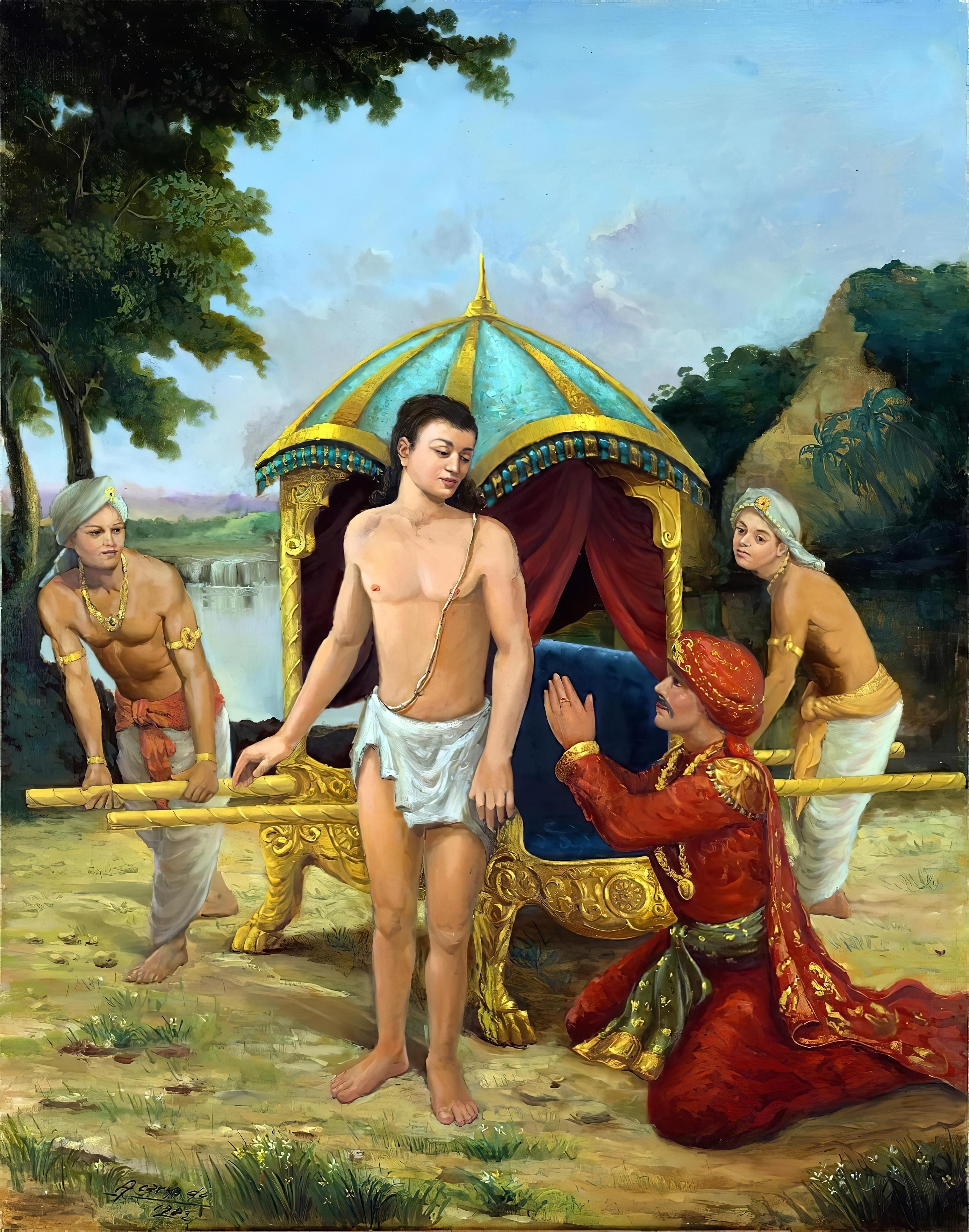
King Rahūgaṇa was a king who ruled two states of India: Sindhu and Sauvīra. He was not a great ruler like Bharata or Priyavrata, but was, in general, a pious person who was a follower of Lord Kapila and was inclined to philosophical inquiry. However, as a king, he was also inclined to act in the mode of passion. He became proud of his position and started to believe he had a duty to exploit the work of others just for being the king. He was thus engaging some men without payment as palanquin carriers while he traveled to Kapilāśrama.
By the time they reached the banks of the river Ikṣumatī, they were short of one carrier in the crew. When they saw Jaḍa Bharata (Bharata Maharaja in his third life, as a brāhmana), they considered him fit for the post, seeing that he was very strong. They thus conscripted him forcefully. Jaḍa Bharata didn’t protest. He just started carrying the palanquin as he was ordered, without any complaint.
However, because of is sense of non-violence, Jaḍa Bharata could not move very swiftly. He would stop every three feet to see if there were ants on the way. This constant moving and stopping made the palanquin move unevenly, angering the king.
Being threatened, the other carriers quickly pointed to Jaḍa Bharata as the source of the disturbance. The king thus became angry and threatened him.
The king considered himself a learned man, but his knowledge was actually very limited. He was in the bodily conception of life, and could not even speak coherently from a philosophical point of view. Śukadeva Goswami describes his words as abaddham (incoherent, illogical, nonsensical). He was speaking, but his ideas were incoherent. This contradiction was noted by Jaḍa Bharata, who decided to deliver his teachings to him, as described in the 5th canto of Śrīmad Bhāgavatam. Superficially, Jaḍa Bharata may appear to show a little anger in some of these verses, but this is just a show of mercy. Just as Kṛṣṇa’s killing of a demon is actually meant for his deliverance, when a Vaiṣnava appears to be angry, that’s just a sign of benediction.
Rahūgaṇa had said: “You certainly appear very fatigued because you have carried this palanquin alone without assistance for a long time and for a long distance.”
The king was under the bodily concept of life, confusing the body with the self. He saw himself as the king, and Bharata as the palanquin carrier, who was laboring to carry him. Because of his entitlement, he thought Bharata had the duty of carrying him and doing it properly, and addressed him sarcastically, accusing him of not working.
To this, Jaḍa Bharata answered that the body alone is the carrier of the palanquin. He is the soul, different from the body, and because he is detached from the body, he has not labored carrying it. The king was thus, he argues, not incorrect in his statement, since, in fact, he (as the self-realized soul) has not labored carrying the palanquin or doing anything else.
Rahūgaṇa said: “Besides that, due to your old age you have become greatly troubled. My dear friend, I see that you are not very firm, nor very strong and stout.”
Jaḍa Bharata answered that these words befit a person who does not know the difference between the body and the soul. A material body can indeed be stout or thin, strong or weak, but it makes no sense to describe the soul as such. Rahūgaṇa’s speech sounds thus highly contradictory, because he is addressing Bharata with adjectives that can be applied only to the body. Jaḍa Bharata thus sharply corrects him by stating he is neither fat nor skinny, much less old.
What about being troubled? Bharata answers that he is not troubled by the job at all. The job, as well as the goal and the results of the job, relate only to the body. With this, the next statement of the king, “Aren’t your fellow carriers cooperating with you?” also sounds nonsensical. Since there is no problem, why is he bringing up the point of teamwork to solve it?
With his discourse, Jaḍa Bharata tried to shake Rahūgaṇa’s concept of life and push him out of bodily conception. Just as in other passages of Śrīmad Bhāgavatam, the goal is not to just give correct philosophical concepts, but to elevate us to the platform of devotional service. As long as we think we are the body, we will be involved with all the bewilderment connected with that. Only when this misunderstanding is finally cleared does the door for elevation to the platform of devotional service, which is connected with the eternal nature of the soul, is opened.
Rahūgaṇa had questioned, “Are you dead despite the life within your body?”
He said that with the idea of making another offensive remark. Jaḍa Bharata, however, argued that the king was again unsuccessful with his choice of words, for this is just a general statement and does not sound like an offense to a self-realized soul. Being dead though alive is the general condition of everything that is material. The body is composed of dead material elements, and simply looks alive because of the presence of the soul. The living appearance of the body is thus not a characteristic of the body per se, nor permanent, since once the soul leaves the body, it becomes again just a lump of matter.
Another misconception of the king is to see himself as the king, and thus as the master who is entitled to be served by others. However, for how long is he going to be the king? This position is connected with the body and thus temporary. Today, he is in the position of ordering others, but tomorrow he may be the one carrying the palanquin. However, in his illusion, he can’t see this, and considers his position as a king permanent.
Rahūgaṇa had also said: “Do you not know that I am your master? You are disregarding me and are not carrying out my order.” and then he threatened: “For this disobedience I shall now punish you just as Yamarāja, the superintendent of death, punishes sinful people. I shall give you proper treatment so that you will come to your senses and do the correct thing.”
To these last two points, Jaḍa Bharata answered: “My dear King, if you still think that you are the King and that I am your servant, you should order me, and I should follow your order. I can then say that this differentiation is temporary, and it expands only from usage or convention. I do not see any other cause. In that case, who is the master, and who is the servant? Everyone is being forced by the laws of material nature; therefore no one is master, and no one is servant. Nonetheless, if you think that you are the master and that I am the servant, I shall accept this. Please order me. What can I do for you?”
Who is a master in this world? We are all being pushed around by material nature, sometimes being forced to act as a master, and sometimes as a servant. Since the positions are constantly being reshuffled, who is the master and who is the servant?
Jaḍa Bharata was a self-realized soul. He does not have any personal need to speak. He is simply speaking for the benefit of the king. He is also beyond any concept of material honor and pain, and therefore, he did not mind working as a palanquin carrier. In fact, he was working without complaining already. The one who started complaining was the king. Therefore, he argues, if Rahūgaṇa wants to insist on his false conception of being the king, then he should just order him whatever he wants him to do.
This point about being the master or servant is a very central point to our material conditioning. Here, everyone wants to be the master, but this contradicts our constitutional position as eternal servants of the Lord. In fact, even in conditioned life, we remain always servants, since the master is material nature. We simply imagine that we have become the masters of someone. We can thus choose to voluntarily accept our constitutional position as loving servants of Krsna, or insist on an imaginary position as masters and be forced to remain as servants of the material energy.
Rahūgaṇa also called Bharata a crazy fool, while at the same time threatening to punish him. This again was contradictory. If he is crazy, punishment will not correct him. It will be just useless labor, like beating a dead horse expecting it to start walking, or beating a bag of flour expecting it to turn back into grains. And if, conversely, Rahūgaṇa were to accept Jaḍa Bharata as a self-realized soul, then again punishment would do no good, because punishment can only be applied to the body, and would do nothing to change his position or behavior. He would still stall every three steps to avoid killing the ants.
The words of Rahūgaṇa were thus again proved nonsensical.
A neophyte may become proud and think he is the best devotee, but a pure devotee never thinks like this. In the first part of the Bṛhad-bhāgavatāmṛta, Nārada Muni visits Lord Śiva, Prahlāda Maharaja, Hanumān, the Pandavas, the Yādavas, and finally Uddhava, and none of them claim to be great devotees or recipients of Kṛṣṇa’s mercy. On the contrary, each of them points him to someone else. Similarly, despite instructing the King, Jaḍa Bharata remained humble and accepted the work of carrying the palanquin as a result of his past karma.
When he said, “I am actually a self-realized person,” this was not spoken out of pride. He used the words sva-saṁsthāṁ gatasya me, which means “I am situated in proper understanding of my constitutional position.” In other words, he stated he was situated in his constitutional position as a soul, seeing himself as an eternal servant of Krsna. In this position, there is no false prestige.
You can also donate using Buy Me a Coffee, PayPal, Wise, Revolut, or bank transfers. There is a separate page with all the links. This helps me enormously to have time to write instead of doing other things to make a living. Thanks!