

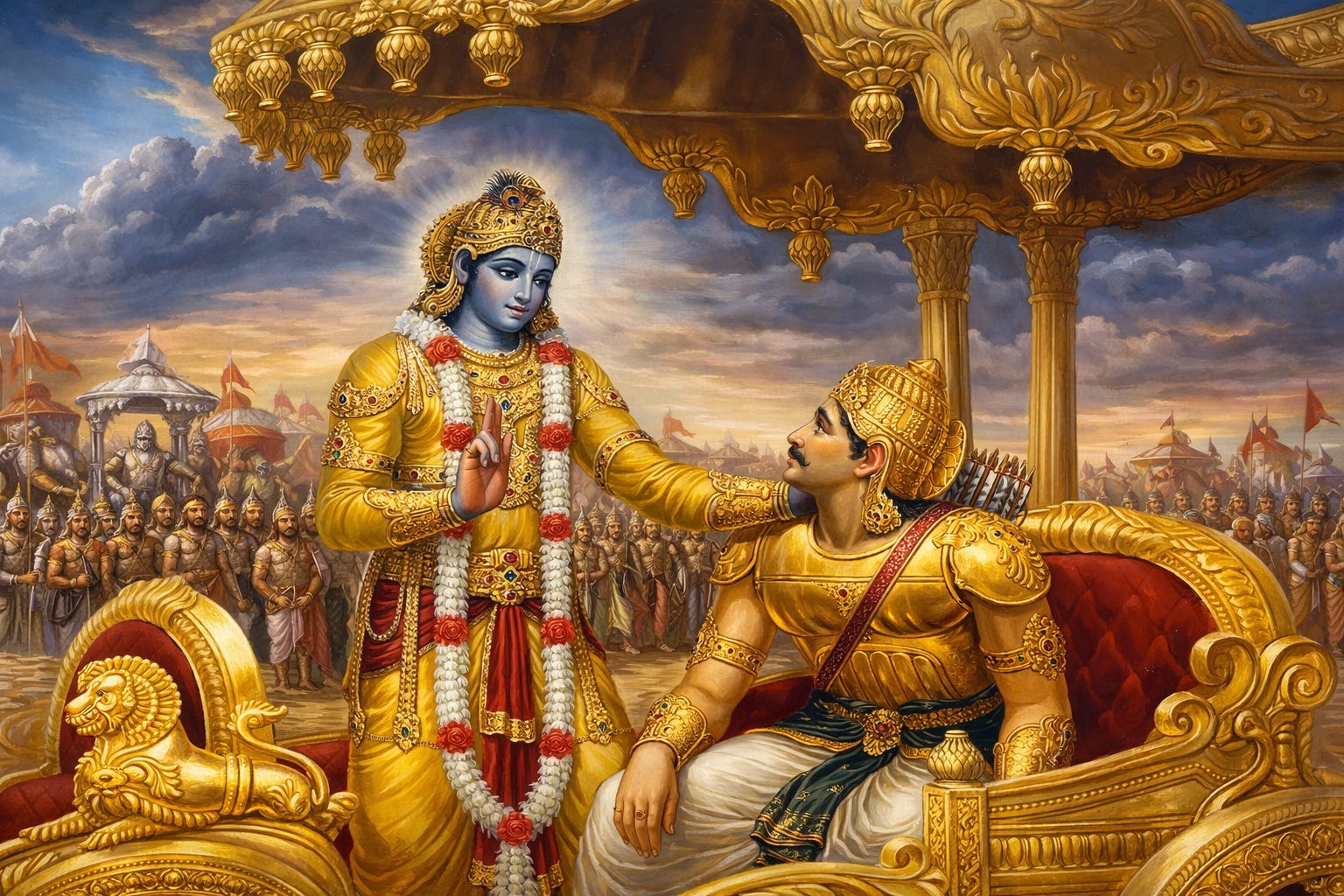
There is a verse in the Gītā that almost everyone knows. That’s usually the verse we remember after reading the book:
sarva-dharmān parityajya, mām ekaṁ śaraṇaṁ vraja
ahaṁ tvāṁ sarva-pāpebhyo, mokṣayiṣyāmi mā śucaḥ“Abandon all varieties of religion and just surrender unto Me. I shall deliver you from all sinful reactions. Do not fear.”
The problem is that when this verse is taken out of context, it can be easily misunderstood, since the idea of surrendering to Kṛṣṇa without the proper context leads our mind to fill in the gap with whatever speculation comes out of it. People then end up doing the most creative things in the name of surrendering unto Kṛṣṇa.
Instead, we should always remember this verse together with the previous one, which gives the proper context:
man-manā bhava mad-bhakto, mad-yājī māṁ namaskuru
mām evaiṣyasi satyaṁ te, pratijāne priyo ’si me“Always think of Me, become My devotee, worship Me and offer your homage unto Me. Thus you will come to Me without fail. I promise you this because you are My very dear friend.”
This verse is a summary of the whole process of Kṛṣṇa Consciousness, which is explained in more detail by Prabhupāda in his purport. Here is a list of points:
a) We should become pure devotees of Kṛṣṇa, always think of Him, and act for Him.
b) We should not become cheaters by abandoning our duties and going to meditate in the forest just to attract cheap adoration from others (this was already rejected in the earlier chapters).
c) We should mold our lives in such a way that we will always have the chance to think of Kṛṣṇa.
d) We should find ways to connect our daily activities with Kṛṣṇa, performing everything as an offering unto Him (as discussed in chapters 3, 4, and 5). In this way, we can live our lives in such a way that we can think of Kṛṣṇa 24 hours per day. When we come to this stage, even sleep can be done as an offering to Him, as a way to prepare us to serve the next day.
e) By following this process, Kṛṣṇa promises, we will certainly return to the spiritual abode, where we will be able to associate with Kṛṣṇa face to face. “Everyone who follows the path of Arjuna can become a dear friend to Kṛṣṇa and obtain the same perfection as Arjuna.”
This path of devotional service is simple and sublime, but one could offer many arguments against adopting it. If I become engaged in serving Kṛṣṇa, what about my mundane duties, my family traditions, my cultural heritage, and so on? Arjuna, especially, is concerned about sinful reactions from serving Kṛṣṇa. Any activity we perform in this world may have negative repercussions and may be considered negative from some point of view. If one decides to build a family, someone will complain about overpopulation. If one decides to distribute books, someone will complain about disturbing unwilling people; if someone decides to cook and distribute prasāda, someone will complain about it not being vegan, or raw-food, gluten-free, or something else. In the case of Arjuna, especially, his service was to fight in the battle, and he was concerned about negative karmic consequences.
In this context, Kṛṣṇa reassures: “Abandon all varieties of religion and just surrender unto Me. I shall deliver you from all sinful reactions. Do not fear.”
Ultimately, dharma means to perform activities that revive our original nature of service to Kṛṣṇa. In other words, real dharma means Kṛṣṇa Consciousness. As long as we are acting under the instructions of Kṛṣṇa, or His representative, as described in the Gītā, there is no question of negative reactions. Even if there is some fault in our activities, because we are acting for Kṛṣṇa, He will take care of any negative repercussions. Śrīla Prabhupāda gives the example that if someone kills whimsically, he will go to prison and be severely punished, but if one kills in battle, defending one’s country, he gets a medal. Similarly, all material activities bring karmic reactions, but when we perform activities for Kṛṣṇa, in devotional service, not only do we not accumulate any karma, but Kṛṣṇa makes sure that even the previous karma is destroyed. In this way, we quickly become free from karma and eligible to be elevated to the spiritual platform. If this applies even to Arjuna, who was going to fight in a battle and kill thousands, this surely applies to any lawful activity performed in devotion.
Kṛṣṇa then adds a purport to these two verses in the next three texts:
“This confidential knowledge may never be explained to those who are not austere, or devoted, or engaged in devotional service, nor to one who is envious of Me.
For one who explains this supreme secret to the devotees, pure devotional service is guaranteed, and at the end he will come back to Me.
There is no servant in this world more dear to Me than he, nor will there ever be one more dear.”
The best occupation for one who has surrendered to Kṛṣṇa through the practice of the process of devotional service, as described in the previous two verses, is to explain this transcendental message that we are applying to our practical lives to others. In this way, not only do we help them to ascend to the same devotional platform, but we also increase our own realization. This process of spreading Kṛṣṇa Consciousness is thus not something extra, but an integral part of the process. From day one, we should be repeating whatever we can understand and thus trying to bring others to the same platform.
This, however, should not be done in a pushy way, as Kṛṣṇa alerts. This knowledge should be explained only to those who are able to accept Kṛṣṇa as the Supreme Personality of Godhead. Although everyone has the potential to become a devotee of Kṛṣṇa (that’s the original nature of the soul, which is simply covered), not all will do so, out of free will. When people have the opportunity of hearing about the soul and other of the preliminary topics of the Gītā, some will become attracted to hear more, and gradually acquire some faith. Others, however, will become envious and inimical. These should not be instructed further. We should not be pushy.
As Kṛṣṇa declares, “he who studies this sacred conversation of ours worships Me by his intelligence.” Simply by hearing this knowledge with a submissive attitude, one gradually becomes free from all karmic obstacles and is gradually elevated to a platform of devotional service, even without separate effort. Kṛṣṇa again confirms the same in the next verse, assuring that “one who listens with faith and without envy becomes free from sinful reactions and attains to the auspicious planets where the pious dwell.”
By broadcasting the message of the Gītā, propagating the sublime practice of devotional service, we can gradually purify people and help them to start on the path of devotional service. Not many will become pure devotees immediately—the devotional process usually takes many lives—but if we can help people to start, that’s already a great achievement.
As people who started in previous lives gradually mature, and others start the process, gradually, devotional service to the Lord can spread all over the world. There is no need to be concerned about people who are inimical or envious. They may also gradually be purified, or, if not, they will probably not take another human birth, which also solves the problem.
This is a publication for thoughtful readers who want to go deeper into Kṛṣṇa consciousness. I publish daily, and all posts are available to free subscribers. If you wish, you can also choose a paid subscription to support this work.
You can also receive the updates on WhatsApp or Telegram.
If you would like to contribute further, you can find the donation links here.