

« The Song of God—Volume 2, chapters 7-12
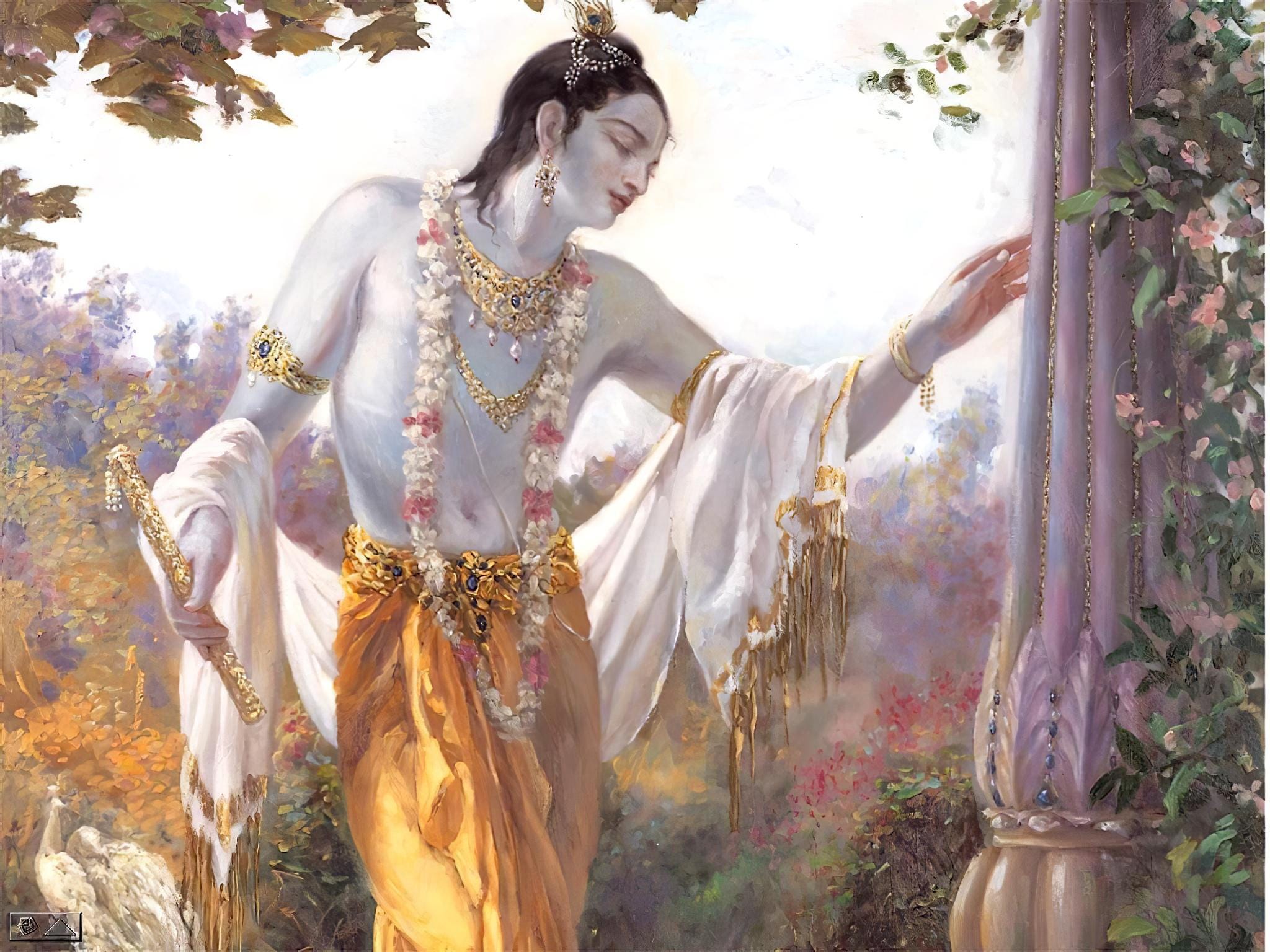
Knowing Kṛṣṇa in full (Bg 7.1 to 7.3)
Kṛṣṇa begins the chapter by establishing the process by which He can be known in truth. We should take shelter of Him by hearing submissively and practicing devotional service. Knowledge of Kṛṣṇa and His potencies is not merely theoretical: when properly received and cultivated through devotional service, it gradually brings us to the stage of seeing Him everywhere. Although many strive for perfection through karma, jñāna, or yoga, hardly anyone knows Kṛṣṇa in truth, because His personal nature can be understood only through bhakti. No one can conquer Kṛṣṇa by force, but when a devotee serves Him with love, Kṛṣṇa reveals Himself to him.
Text 1: śrī-bhagavān uvāca
mayy āsakta-manāḥ pārtha, yogaṁ yuñjan mad-āśrayaḥ
asaṁśayaṁ samagraṁ māṁ, yathā jñāsyasi tac chṛṇu
The Supreme Personality of Godhead said: Now hear, O son of Pṛthā, how by practicing yoga in full consciousness of Me, with mind attached to Me, you can know Me in full, free from doubt.
Text 2: jñānaṁ te ’haṁ sa-vijñānam, idaṁ vakṣyāmy aśeṣataḥ
yaj jñātvā neha bhūyo ’nyaj, jñātavyam avaśiṣyate
I shall now declare unto you in full this knowledge, both phenomenal and numinous. This being known, nothing further shall remain for you to know.
Text 3: manuṣyāṇāṁ sahasreṣu, kaścid yatati siddhaye
yatatām api siddhānāṁ, kaścin māṁ vetti tattvataḥ
Out of many thousands among men, one may endeavor for perfection, and of those who have achieved perfection, hardly one knows Me in truth.
These three verses are a direct continuation of Kṛṣṇa’s conclusion at the end of chapter six. Kṛṣṇa revealed that the pure devotee is the highest yogī, and now He will reveal the process that brings us to this final perfection. This also reinforces the conclusion that the process of aṣṭāṅga-yoga that Kṛṣṇa explained in chapter six is not the final goal, but just a stepping stone leading to the path of bhakti. One may reach the platform of bhakti by gradually advancing through the processes of karma, jñāna, and yoga, or one may reach it directly through association with devotees, but in any case, devotional service is the culmination of all processes of self-realization. As Prabhupāda explains:
“In the first six chapters of Bhagavad-gītā, the living entity has been described as nonmaterial spirit soul capable of elevating himself to self-realization by different types of yogas. At the end of the Sixth Chapter, it has been clearly stated that the steady concentration of the mind upon Kṛṣṇa, or in other words, Kṛṣṇa consciousness, is the highest form of all yoga. By concentrating one’s mind upon Kṛṣṇa, one is able to know the Absolute Truth completely, but not otherwise. Impersonal brahma-jyotir or localized Paramātmā realization is not perfect knowledge of the Absolute Truth, because it is partial. Full and scientific knowledge is Kṛṣṇa, and everything is revealed to the person in Kṛṣṇa consciousness. In complete Kṛṣṇa consciousness one knows that Kṛṣṇa is ultimate knowledge beyond any doubts. Different types of yoga are only steppingstones on the path of Kṛṣṇa consciousness.”
As Kṛṣṇa has explained, the perfect devotee always thinks of Kṛṣṇa with great faith. How can this faith be developed? It all starts with hearing. That’s why Kṛṣṇa says to Arjuna: tac chṛṇu, “just try to hear the knowledge I will explain.” By hearing about Him, we can come to practice the process of bhakti-yoga in full Kṛṣṇa consciousness and with our mind fully attached to Him. To facilitate that, Kṛṣṇa will describe many details about Himself in this and the following chapters.
Hearing about Kṛṣṇa, however, is not a whimsical activity. We should hear from the perfect source: Kṛṣṇa or His bona fide representative. The words used are yogaṁ yuñjan mad-āśrayaḥ: We should practice self-realization by taking shelter of Kṛṣṇa, or, in other words, practicing in consciousness of Kṛṣṇa. Taking shelter of Him means practicing the process He Himself describes, hearing about Him from His genuine representative. Hearing about Kṛṣṇa is thus not just an isolated intellectual activity, but part of the broader process of Kṛṣṇa consciousness.
What about the spiritual knowledge itself? Kṛṣṇa already explained the process for the transmission of transcendental knowledge in chapter four. The qualifications of a speaker of transcendental knowledge are not based on eloquence or academic credentials, but simply on how faithful one is to the bona fide spiritual master connected to the disciplic succession. Transcendental knowledge is already perfect; there is nothing to be improved. We just need to keep our ego outside the process, and explain it the way it was received, preserving all the correct conclusions received from the paramparā. As soon as we try to replace this perfect knowledge with our speculations, we come down to the level of ordinary jñānīs.
Previously, in chapter four, Kṛṣṇa also spoke about the importance of hearing with faith. As He mentioned, for the doubting soul, there is happiness neither in this world nor in the next. When we hear with firm faith from the bona fide representative, the path fully opens for us. Hearing with faith leads to spiritual practice, and this practice fixes our mind upon Kṛṣṇa, which leads to Him becoming satisfied and deciding to reveal Himself to us. That’s exactly the process that Kṛṣṇa mentions here.
Knowledge about everything that exists
Kṛṣṇa says: jñānaṁ te ’haṁ sa-vijñānam. Ordinarily, the word “jñāna” means knowledge about the difference between matter and spirit, and “vijñāna” means realized knowledge. Here, however, jñānam means knowledge about the material manifestation (knowledge of the Lord’s potencies), and vijñānam means direct spiritual knowledge about Kṛṣṇa, including all His potencies. The material manifestation is phenomenal, because it is temporary and perceptible through material experience. This is the observable or empirical reality we can perceive using our material senses. Kṛṣṇa and the spiritual manifestation, on the other hand, are numinous: the ultimate transcendental reality, beyond the reach of our senses.
The knowledge Kṛṣṇa is about to reveal is thus both phenomenal and numinous, because it allows us to understand everything that exists: both the temporary material manifestation and the eternal, transcendental manifestation, as well as Kṛṣṇa Himself, who is the source of both. This being known, there is nothing else left to know.
Prabhupāda uses these two terms in many other passages. In SB 5.12.8, for example, he wrote, “The phenomenal world depends on the noumenal existence; similarly, everything exists by virtue of the potency of the Supreme Lord, although due to our ignorance the Supreme Lord is not perceived in everything.”
Why is this knowledge important? This is the basis for understanding the wonderful opulences Kṛṣṇa will describe in the next chapters, which are, in turn, essential for developing the stage of constant meditation Kṛṣṇa describes. Without following the proper progression, we can easily misunderstand, coming to conclude that Kṛṣṇa has a material form, like the Māyāvādīs, or that His pastimes are performed in a sensual platform, like the sahajiyās.
In his purport, Prabhupāda relates the second verse with text 1.1.3 of the Mundaka Upaniṣad. This is one of the most emblematic texts of the Upaniṣads, describing precisely the goal of knowledge as perfect understanding about Kṛṣṇa and His potencies.
śaunako ha vai mahāśālo ’ngirasam
vidhivad upasannaḥ papraccha
kasmin nu bhagavo vijñāte
sarvam idam vijñātam bhavatītiŚaunaka, the respected householder, approached Aṅgiras following proper etiquette and inquired: “O great sage who knows everything! By knowing what does everything become known?” (Muṇḍaka Upaniṣad, 1.1.3)
There are several details hidden in this sentence. The word “kasmin” in this context indicates a specific inquiry about the absolute truth, which acts as both the efficient cause (nimitta) and the material cause (upādāna). In other words, the Lord is both the cause and the effect of everything, because everything comes from the Lord and is composed of His energy.
“Efficient cause” means the active agent that initiates creation (in other words, God in His personal aspect), while “material cause” indicates the material energy (the external potency of the Lord) from which all material manifestations are created.
When we say that the Lord is both the efficient cause (nimitta) and the material cause (upādāna) of everything, we indicate that He is everything, both the energy and the manipulator of the energy, or in other words, both the energy and the energetic. There is nothing apart from Kṛṣṇa. Everything is Kṛṣṇa’s energy; nothing is independent or separated from Him, but at the same time, there is differentiation among His different energies. This is the essence of the acintya-bhedābheda-tattva philosophy of Mahāprabhu. We are one with God, being part of His energy, but at the same time we are separate individuals. In other words, we are one in quality, but different in quantity, eternally separated parts and parcels of Him.
An analogy used in many passages of the Upaniṣads is that just as by understanding the properties of clay one can understand the properties of all objects made from clay, by understanding the foundation of all knowledge, the Supreme Brahman, one can fully understand everything else that exists. There is nothing separate from Kṛṣṇa; therefore, Kṛṣṇa is the basis of all knowledge. One who understands Kṛṣṇa knows everything.
One among thousands
It is, however, not so easy to find someone who knows Kṛṣṇa in truth. Most people live on the animal platform, just eating, sleeping, mating, and defending. Even among followers of the Vedas, most are interested only in materialistic performances, karma-kāṇḍa, with the goal of attaining material prosperity and elevation to the celestial planets. Among many such ritualistic performers, one may inquire about the soul, and start on the path of jñāna-kāṇḍa, and maybe later be promoted to the path of aṣṭāṅga-yoga. Among many of these transcendentalists, one may attain the platform of liberation, but even among thousands of such liberated souls, hardly any know Kṛṣṇa in truth. Why is that? They strive to know Kṛṣṇa through the wrong process. Kṛṣṇa can be known only through devotional service. As Prabhupāda explains:
“It is not possible for the Brahman-realized impersonalist or the Paramātmā-realized yogī to understand Kṛṣṇa the Supreme Personality of Godhead as the son of mother Yaśodā or the charioteer of Arjuna. Even the great demigods are sometimes confused about Kṛṣṇa (muhyanti yat sūrayaḥ). Māṁ tu veda na kaścana: “No one knows Me as I am,” the Lord says. And if one does know Him, then sa mahātmā su-durlabhaḥ: “Such a great soul is very rare.” Therefore unless one practices devotional service to the Lord, one cannot know Kṛṣṇa as He is (tattvataḥ), even though one is a great scholar or philosopher. Only the pure devotees can know something of the inconceivable transcendental qualities in Kṛṣṇa—His being the cause of all causes, His omnipotence and opulence, and His wealth, fame, strength, beauty, knowledge and renunciation—because Kṛṣṇa is benevolently inclined to His devotees.”
Jñānīs try to understand the absolute truth through their intellectual power, while yogīs try to realize Him through a mechanical process. However, Kṛṣṇa can’t be conquered by one’s own strength; He can be conquered only through love. No jñānī or yogī can force Kṛṣṇa to reveal Himself, but a devotee, by his devotion, can please Kṛṣṇa to such an extent that He decides to reveal Himself.
As Śrīla Prabhupāda quotes from the Bhakti-rasāmṛta-sindhu 1.2.234: “No one can understand Kṛṣṇa as He is by the blunt material senses. But He reveals Himself to the devotees, being pleased with them for their transcendental loving service unto Him.”
Therefore, when Kṛṣṇa mentions that “Out of many thousands among men, one may endeavor for perfection, and of those who have achieved perfection, hardly one knows Me in truth,” this should not be taken as a discouragement. On the contrary, it shows how the process of devotional service He will describe in the following chapters is valuable, allowing us to attain what even great jñānīs and yogīs cannot obtain even after many lives.
The process of bhakti is easy in one sense, but in another it is the most difficult path, because it demands that we give up our material ego and surrender to Kṛṣṇa through His representative. It is easy for the simple, who are ready to simply love Kṛṣṇa and surrender unto Him, but complicated for the complicated, who want liberation while at the same time remaining independent. An impersonalistic jñānī may abstain from material activities, and a nondevotional ascetic may perform great penances, but they keep their ego, imagining that they have become one with the Absolute Truth. A devotee, however, has to abandon all claim and situate himself in his original position of service to Kṛṣṇa.
This is another point emphasized by Śrīla Prabhupāda in his purport. Devotional service demands that one follow the rules and regulations of the process. Surrendering to Kṛṣṇa means following the process given by Him. Sahajiyās and mental speculators can create easy processes, but these are just superficial imitations. If we desire to attain the ultimate perfection, we need to follow the process and work to control the mind and senses and curb the material ego through the process of regulated devotional service. This process is natural for a devotee, but it is impossible for one who refuses to surrender his false ego.
“Kṛṣṇa is the Supreme Personality of Godhead, the cause of all causes, the primeval Lord Govinda. Īśvaraḥ paramaḥ kṛṣṇaḥ sac-cid-ānanda-vigrahaḥ/ anādir ādir govindaḥ sarva-kāraṇa-kāraṇam. It is very difficult for the nondevotees to know Him. Although nondevotees declare that the path of bhakti, or devotional service, is very easy, they cannot practice it. If the path of bhakti is so easy, as the nondevotee class of men proclaim, then why do they take up the difficult path? Actually the path of bhakti is not easy. The so-called path of bhakti practiced by unauthorized persons without knowledge of bhakti may be easy, but when it is practiced factually according to the rules and regulations, the speculative scholars and philosophers fall away from the path.”
Main points in the purports of Śrīla Prabhupāda:
“The Supreme Personality of Godhead said: Now hear, O son of Pṛthā, how by practicing yoga in full consciousness of Me, with mind attached to Me, you can know Me in full, free from doubt.”
a) The first six chapters of the Gītā describe us as transcendental spirit souls, and explain that we can elevate ourselves to the stage of self-realization by the practice of different processes of yoga. At the end of chapter six, it is stated that Kṛṣṇa consciousness is the highest form of yoga, and the only process that allows us to understand the Absolute Truth perfectly. Realization of the impersonal Brahman, or the localized Paramātmā, is merely partial, and different processes of yoga are only steppingstones on the path. Therefore, one who comes directly to Kṛṣṇa consciousness automatically understands the partial aspects and can know everything perfectly.
b) Chapter seven describes the nature of Kṛṣṇa consciousness. It describes Kṛṣṇa’s opulences and how He manifests His opulences, and also the four kinds of people who come to Him, and the four classes who never approach Him.
c) One who constantly thinks about Kṛṣṇa is the highest yogī, but how can we attain this concentration? It is possible by practicing the nine forms of devotional service, of which śravaṇam (hearing) is the most important. We should hear directly from Kṛṣṇa or from a pure devotee of Kṛṣṇa, not from a puffed-up nondevotee with just academic erudition.
d) From inside the heart, Kṛṣṇa purifies the devotee who constantly hears about Him. In this way, we advance in transcendental knowledge and become fixed in devotional service. As our devotional service develops, we become free from passion and ignorance, and as a consequence, we become free from lust and greed. When this process is complete, we come to pure goodness and understand the science of God perfectly.
“I shall now declare unto you in full this knowledge, both phenomenal and numinous. This being known, nothing further shall remain for you to know.”
a) Complete knowledge includes knowledge of the phenomenal world, the spirit behind it, and the source of both, Kṛṣṇa. When the cause becomes known, everything becomes known. As mentioned in the fourth chapter, this knowledge can be obtained only by devotees in the disciplic succession.
“Out of many thousands among men, one may endeavor for perfection, and of those who have achieved perfection, hardly one knows Me in truth.”
a) Most people are simply interested in materialistic activities. Out of many thousands of such ordinary men, one may come to transcendental realization. The Gītā explains the processes of jñāna-yoga, dhyāna-yoga, Sāṅkhya, etc. However, Kṛṣṇa can be known only through Kṛṣṇa consciousness. Without it, yogīs and jñānīs may attain Brahman realization, but they remain confused in their attempts to understand Kṛṣṇa.
b) Even though Śaṅkarācārya admitted that Kṛṣṇa is the Supreme Personality of Godhead, his Māyāvādī followers cannot accept Him as such. Why? It is very difficult for non-devotees to know Him. Even though they say that the path of bhakti is easy, they cannot take to it.
c) In reality, bhakti is not easy. Unauthorized persons may invent some easy practice, but this is just a disturbance in society. When it comes to the true process, one has to follow the rules and regulations. Devotees can do it, but scholars and philosophers without devotion to Kṛṣṇa fall away.
d) Impersonalists who are stuck in Brahman realization, and yogīs stuck in Paramātmā realization cannot understand Kṛṣṇa. Even great demigods are sometimes confused about Him. Only rare mahātmās come to know Him in truth. Unless one practices devotional service, one cannot know Kṛṣṇa as He is, despite being a scholar or philosopher.
e) Pure devotees are a different category. Only they can realize Kṛṣṇa as He is. Why? Because Kṛṣṇa reveals Himself to the devotees, being pleased with their transcendental loving service unto Him.
Next: The components of everything that exists (Bg 7.4 to 7.7)
Read the entire book:
« The Song of God—Volume 2, chapters 7-12

This is a publication for thoughtful readers who want to go deeper into Kṛṣṇa consciousness. I publish daily, trying to offer high-quality spiritual content, and all posts are available to free subscribers. If you wish, you can also choose a paid subscription to support this work.
You can also receive the updates on WhatsApp or Telegram.
If you would like to contribute further, you can find the donation links here.