


Prefer listening? There is my narration of the article. ⤴️
You can receive new articles directly in your inbox. Subscription is free; donations are welcome.
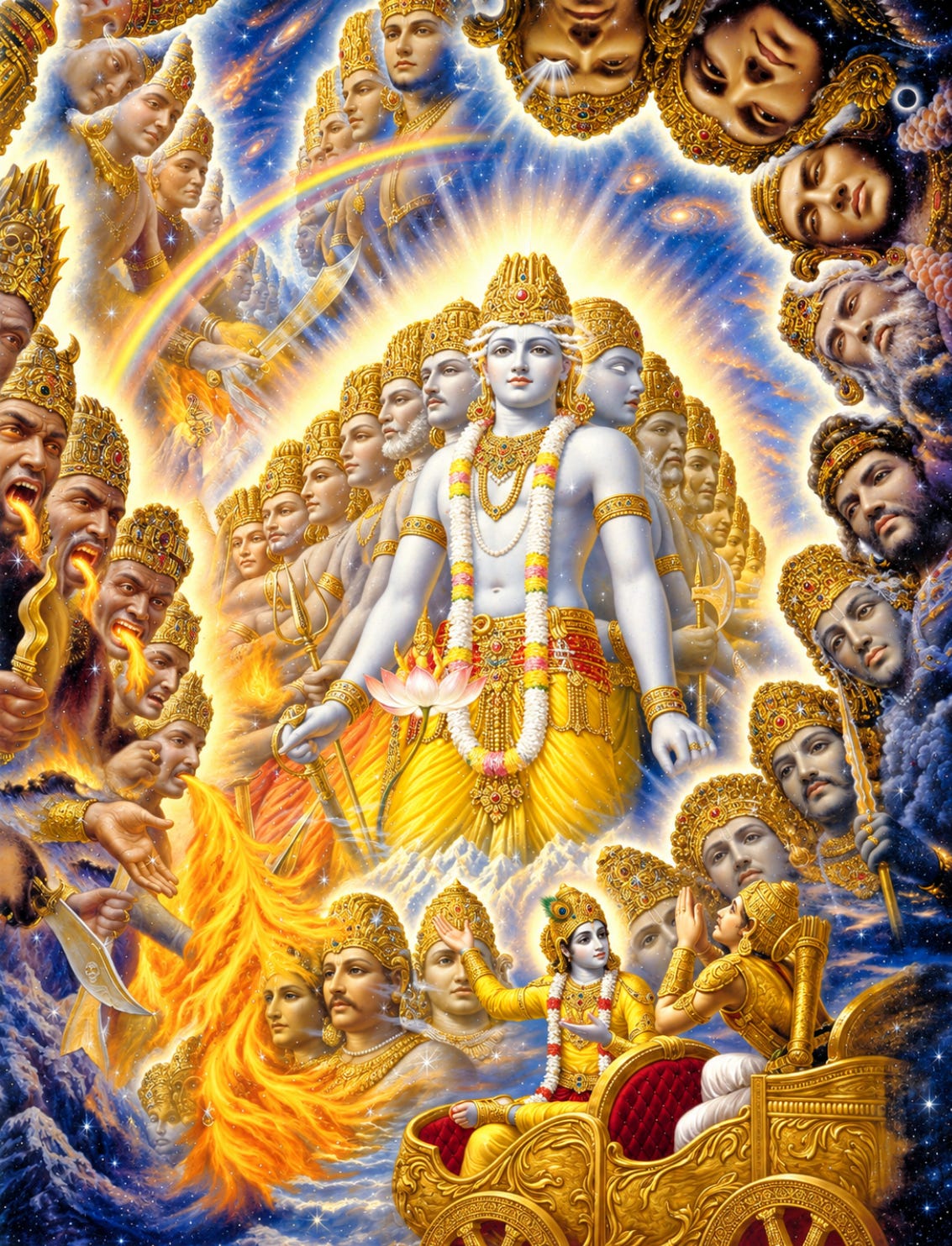
Kṛṣṇa showing His universal form to Arjuna is one of the most intriguing passages of the Bhagavad-gītā. We normally think of Kṛṣṇa as the beautiful Supreme Personality of Godhead, the enchanting youth who plays the flute and performs so many wonderful pastimes. In the Gītā, however, He shows an aspect so terrifying that even Arjuna, His intimate friend, became disturbed.
“Arjuna saw in that universal form unlimited mouths, unlimited eyes, unlimited wonderful visions. The form was decorated with many celestial ornaments and bore many divine upraised weapons. He wore celestial garlands and garments, and many divine scents were smeared over His body. All was wondrous, brilliant, unlimited, all-expanding. If hundreds of thousands of suns were to rise at once into the sky, their radiance might resemble the effulgence of the Supreme Person in that universal form.”
Soon, he started offering prayers:
“O Lord of lords, O refuge of the worlds, please be gracious to me. I cannot keep my balance seeing thus Your blazing deathlike faces and awful teeth. In all directions I am bewildered. All the sons of Dhṛtarāṣṭra, along with their allied kings, and Bhīṣma, Droṇa, Karṇa – and our chief soldiers also – are rushing into Your fearful mouths. And some I see trapped with heads smashed between Your teeth. As the many waves of the rivers flow into the ocean, so do all these great warriors enter blazing into Your mouths. I see all people rushing full speed into Your mouths, as moths dash to destruction in a blazing fire. O Viṣṇu, I see You devouring all people from all sides with Your flaming mouths. Covering all the universe with Your effulgence, You are manifest with terrible, scorching rays. O Lord of lords, so fierce of form, please tell me who You are. I offer my obeisances unto You; please be gracious to me. You are the primal Lord. I want to know about You, for I do not know what Your mission is.”
How to understand such a terrifying aspect of Kṛṣṇa?
The universal form shown to Arjuna is not just a vision of the physical universe; it includes Kṛṣṇa’s presence inside of it, and the action of all His different potencies involved in the cosmic affairs. One of these potencies is kāla, time. Kāla is the main force behind the cosmic creation; it is counted by Lord Kapila as one of the material elements, even though it has no physical form.
Material time is divided into past, present, and future, and the universal form revealed all. Arjuna could thus see not only the present arrangement of the universe, but also future events. He could thus see the terrible battle that was coming, and how most soldiers on both sides would fall in battle. An ordinary person could see a warrior being killed by an arrow, or by the blunt strike of a mace, but Arjuna could see the underlying cause, the influence of time itself. He thus saw these warriors being devoured by the numberless mouths of the universal form, some of them crushed between their teeth. This vision was terrifying, even for a great warrior like him, who was used to facing danger and seeing the horrors of battle.
One could put forward the question of free will. If the future is already fixed, does it mean we don’t have a choice? That’s not the case. Duryodhana had choices at many points. He could have stopped the cheating in the gambling match at any step, or avoided trapping the Pāṇḍavas in it in the first place. He could have stopped Duḥśāsana from grabbing Draupadī by the hair; he could have intervened when Karṇa offended her. He could have given back the kingdom to Yudhiṣṭhira at any point during their exile and begged forgiveness; he could have accepted the many peace proposals before the battle, or even surrendered his forces on the battlefield. On all of these occasions, he remained resolute in his inimical attitude against Kṛṣṇa’s pure devotees, and this sealed his destiny. All the other Kauravas who were involved would also share the same destiny. Not even Bhīṣma and Droṇa, the two most experienced commanders, could save him.
Similarly, every human being has many choices during his life. Many aspects of our lives are fixed, such as our position of birth, general nature, and many events we are supposed to face during our lives due to karmic results, but many others can be changed or avoided according to the path we take. Time affects everyone, and everyone has to eventually face death, but the relationship of a pure devotee with death is very different from that of a materialist. Prabhupāda gives an example: a cat carries both her kittens and mice in her mouth. For the mouse, the cat’s grasp is terrifying, while for the kittens it is simply Mom moving them to a new place. More than that, any person, at any stage of his life, can choose to surrender to Kṛṣṇa and put an end to his material existence. Material life is not Kṛṣṇa’s idea; it is our own determination that keeps us entrapped in it. We can choose between remaining obstinate like Duryodhana and being crushed by the influence of time, or surrendering to Kṛṣṇa like Arjuna and regaining our original eternal and blissful nature, away from the material bewilderment.
The example used by Arjuna of moths entering into a fire is very instructive. Moths have a predisposition to go in the direction of light, and thus when they see a fire burning at night, they are attracted by it and rush into it without understanding that this brings death. Similarly, we have an inclination to seek pleasure, but when ignorance makes us seek pleasure in irreligion, we are attracted to the fire of material energy, which consumes us in the form of time. Our life passes in a moment, and by the time we realize it, we are already in the jaws of death.
There is nothing apart from Kṛṣṇa, and therefore no one can live independently from Him. As He mentions, “There is no truth superior to Me. Everything rests upon Me, as pearls are strung on a thread.” We are always connected to Kṛṣṇa through His different aspects. A devotee chooses to interact with Kṛṣṇa in His beautiful aspect as Govinda, playing blissful pastimes with His devotees in Vṛndāvana, while a materialist chooses the path of material illusion, which brings him to Kṛṣṇa’s terrifying aspect as time and death.
Time I am
After Arjuna offered his prayers, Kṛṣṇa, as the universal form, answers:
“Time I am, the great destroyer of the worlds, and I have come here to destroy all people. With the exception of you [the Pāṇḍavas], all the soldiers here on both sides will be slain. Therefore get up. Prepare to fight and win glory. Conquer your enemies and enjoy a flourishing kingdom. They are already put to death by My arrangement, and you, O Savyasācī, can be but an instrument in the fight.”
When Kṛṣṇa personally comes, all the different forms of Viṣṇu and His different potencies all merge into His body. In some passages of the Bhagavad-gītā, Kṛṣṇa speaks as Paramātmā, or another particular form. Here He speaks as Kāla, the all-devouring time. What is His purpose? Lokān samāhartum iha pravṛttaḥ – “I have come here to destroy all people.”
Everything that is material changes. The process of change starts with birth, and the final change is death. As long as we are not prepared to accept our original nature as pure souls, we are forced to accept one temporary material identity after another. As soon as we accept a material body, death is certain. Time is just the potency that coordinates this process.
This is ultimately His mercy, allowing us to start again multiple times, until we finally can get it right and re-attain our original spiritual consciousness. Through this process of birth and death in different forms of life, the Lord gradually coaches us into returning to our original consciousness.
One could argue that Kṛṣṇa could simply kill all the opposing soldiers using His inconceivable potency, just as He killed so many demons. That would not be a problem. Why then did He organize such a complex arrangement for Arjuna to fight? Because He wanted Arjuna to take the credit. That’s Kṛṣṇa’s nature: although He is so powerful, and the maintainer of everything, He likes to give the credit to His devotee.
This also illustrates our own situation. When Mahāprabhu appeared 500 years ago, He spread Kṛṣṇa consciousness all over India. He could have taken the whole world; He is all-powerful, but He left this part for us, so we can have the opportunity of serving Him. Just as many books were written mentioning devotees who took part in Caitanya Mahāprabhu’s movement at that time, and their accomplishments, in the future books will be written about the achievements of devotees of our times. In the same way that devotees who took part in the original pastimes were accepted as His associates and joined His eternal līlā, we also have the same opportunity, through the same arrangement offered to Arjuna. We simply have to become instruments in the fight.
Kṛṣṇa already has an arrangement for bringing us back to Godhead, and for using us as instruments for bringing other people to Him. Our mission is to stop fighting against His arrangement, and instead take part in it.
Kṛṣṇa addressing Arjuna as Savya-sācī (one who can shoot arrows very expertly) is also significant. Arjuna is an expert warrior, but this empowerment comes from Kṛṣṇa. He thus received a difficult mission from Kṛṣṇa, fighting Bhiṣma, Drona, and all the powerful Kuru warriors, but also received a great power to do so. Similarly, any devotee who surrenders to Kṛṣṇa and agrees to act according to His plan can be similarly empowered.
The spiritual path, however, is not free from challenges. Here you can find information about the traps most of us face:

This is a publication for thoughtful readers who want to go deeper into Kṛṣṇa consciousness. I publish daily, trying to offer high-quality spiritual content, and all posts are available to free subscribers. If you wish, you can support this work with a monthly contribution. When you subscribe, you can choose between a free subscription and a monthly contribution, and you can switch from a free subscriber to a supporter at any time.
You can also receive updates on WhatsApp or Telegram.
If you would like to contribute further, you can find the donation links here.