


You can receive new articles directly in your inbox. Subscription is free; donations are welcome.
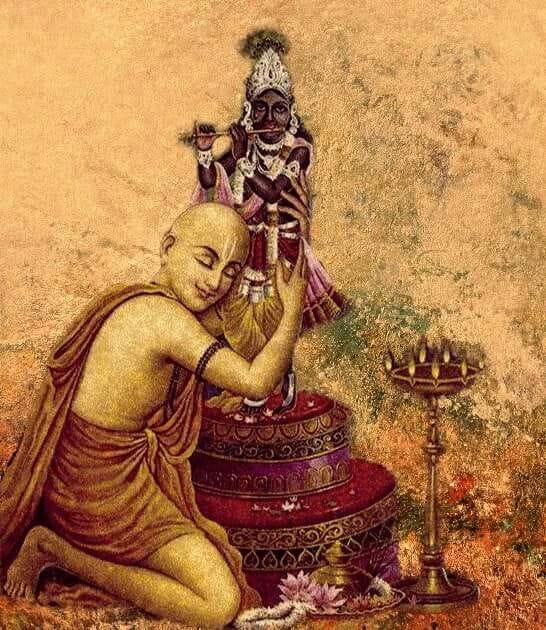
When Śrī Caitanya Mahāprabhu started for Mathurā from Vārāṇasī, a group of devotees wanted to accompany Him. Mahāprabhu, however, did not want to come to Vṛndāvana with an entourage and thus asked all of them to return home.
Their response is very instructive. In the absence of the Lord, they served Him in separation:
prabhura virahe tine ekatra miliyā
prabhu-guṇa gāna kare preme matta hañā“Feeling separation from the Lord, the three used to meet and glorify the holy qualities of the Lord. Thus they were absorbed in ecstatic love.”
This is an important principle of true devotional life: We cannot obtain Kṛṣṇa or His pure devotees by imagination or imitation. We have to follow the proper devotional process.
As Mahāprabhu Himself teaches in His Siksastakam:
yugayitam nimeshena, chakshusha pravrishayitam
shunyayitam jagat sarvam, govinda-virahena meO Govinda! Feeling Your separations I am considering a moment to be like twelve years or more. Tears are flowing from my eyes like torrents of rain, and I am feeling all vacant in the world in Your absence.
ashlishya va pada-ratam pinashtu mam
adarshanan marma-hatam karotu va
yatha tatha va vidadhatu lampato
mat-prana-nathas tu sa eva naparahI know no one but Krsna as my Lord, and He shall remain so even if He handles me roughly by His embrace or makes me brokenhearted by not being present before me. He is completely free to do anything and everything, for He is always my worshipful Lord, unconditionally.
This same devotional mood can be seen in the gopīs of Vṛndāvana. When Kṛṣṇa left for Mathurā, they passed their time remembering Him. In this way, their connection with Kṛṣṇa became even stronger than when He was directly present.
This is the mood Śrī Caitanya Mahāprabhu Himself teaches in the final verse of Śikṣāṣṭaka. Kṛṣṇa may embrace His devotee, neglect, or even break one’s heart by remaining absent; still, He remains the devotee’s worshipable Lord unconditionally. This is real love: “Kṛṣṇa is completely free to do anything He wants; I love Him without imposing conditions.”
We come then to the sahajiyā mentality, which goes in the opposite direction. It does not accept Kṛṣṇa’s freedom. It wants intimacy with Him without the necessary humility and purification. A pure devotee constantly strives to purify himself and still considers himself unworthy of being in the presence of Kṛṣṇa, accepting any reciprocation from the Lord as the greatest treasure. A sahajiyā, on the other hand, wants to bring the lila down to his mundane mentality.
Externally, such a person may speak about kṛṣṇa-līlā, gopī-bhāva, prema, or confidential service. Internally, however, the mood is not surrender but possession: “Kṛṣṇa is mine. I control Kṛṣṇa. I control access to Kṛṣṇa. I can give prema.” This is just another form of material illusion; it has nothing of transcendental.
Of course, a pure devotee also thinks, “Kṛṣṇa is mine.” But this is not the possessiveness of the enjoyer. It is the possessiveness of love. The pure devotee thinks, “Kṛṣṇa is my Lord, my life, my shelter,” while the sahajiyā thinks, “Kṛṣṇa is my object of enjoyment, and I am qualified to enter His most intimate pastimes.”
Here we are speaking of diametric opposites. The gopīs’ love is not based on the idea that they dominate Kṛṣṇa. It is based on complete abnegation. They are ready to suffer for Kṛṣṇa’s happiness. They are ready to remain in separation if that is His desire. Their love is not a demand placed upon Kṛṣṇa; it is their very life offered to Him.
In this way, separation shows what is actually in our hearts. When Kṛṣṇa is not visibly present, what do we do? Do we glorify Him, serve Him, and wait for His mercy, following the path of the Six Gosvāmīs? Or do we manufacture a cheap substitute?
Sahajiyās create an imaginary process of siddha-praṇālī, where one simply imagines that one has entered the lila, without first developing the necessary qualification. They thus often live immersed in immoral habits, often meeting women at night, while at the same time considering themselves givers of prema.
This is described by Prabhupāda in the Nectar of Devotion, chapter 16:
“In this connection, we should be careful about the so-called siddha-praṇālī. The siddha-praṇālī process is followed by a class of men who are not very authorized and who have manufactured their own way of devotional service. They imagine that they have become associates of the Lord simply by thinking of themselves like that. This external behavior is not at all according to the regulative principles. The so-called siddha-praṇālī process is followed by the prākṛta-sahajiyā, a pseudosect of so-called Vaiṣṇavas. In the opinion of Rūpa Gosvāmī, such activities are simply disturbances to the standard way of devotional service.”
A second danger is false humility. Real humility means recognizing one’s dependence on Kṛṣṇa, guru, Vaiṣṇavas, and the process of devotional service itself. False humility means to play a role, act humble in order to be seen as advanced. One may touch others’ feet, take food from their plates, call oneself fallen, and make a public display of humility, while internally cultivating the desire to be honored as a great devotee.
There is a difference between being humble and looking humble, and this distinction often determines the future of our devotional life.
A sincere beginner may be proud, conditioned, and full of anarthas, but if he or she accepts the proper process, hears submissively, follows a regular sādhana, etc., one can gradually be purified. The process works. However, if one fakes humility and tries to bring his ambitions to spiritual life, becoming known as a famous devotee with thousands of followers, then the further one goes, the harder the disease becomes to cure.
This is why sahajiyā practice is so dangerous. It does not just fail to remove our anarthas; it can reinforce them. One then becomes older in devotional life but not genuinely advanced. One becomes more proud instead of humbler. One speaks of intimate service, but becomes less able to correct himself or even follow basic principles. Instead of becoming a servant of the servant, he becomes a self-appointed distributor of so-called prema.
Once, a group of devotees went to visit a certain babaji in Vṛndāvana. He received them well and spoke something about love of Kṛṣṇa, gave them some prasādam, etc. Most of the group was charmed by him, but one of the ladies became disturbed after the visit. Later, when they discussed the plans for the next day, she said she didn’t want to visit that babaji again. When asked why, she said that when they were leaving, he approached her and said to her to come at night, and he would give her prema...
For hundreds of years, Vaiṣṇavism has been plagued by examples like this. People who have some sentiment go to Vrindāvana and try to pose as renounced people without the necessary purification of heart, often becoming pretenders who maintain illicit desires even after many years of practice and often act on them when the chance appears. This is like a cancer that continues to spread in our movement.
Here, the example of Mādhavendra Purī is very important. When Mahāprabhu met the Sanodiyā brāhmaṇa in Mathurā, the brāhmaṇa recognized Mahāprabhu’s ecstatic love and concluded that He must have some relationship with Mādhavendra Purī. Mahāprabhu then said that this kind of ecstatic love can be experienced only by one who has a relationship with Mādhavendra Purī; without him, there is no possibility of such love.
This teaches that ecstatic love is not something we can produce at home. It descends through spiritual connection with the disciplic succession. It cannot be produced by sentiment, theatrical behavior, ambition, or imagination. It comes through sambandha, proper spiritual understanding, combined with the genuine current of devotion.
Mahāprabhu also honored that brāhmaṇa, even though he belonged to a lower caste. Śrīla Prabhupāda explains that Mahāprabhu accepted food from him because he belonged to Mādhavendra Purī’s community, and thus “a spiritual relationship is established on the spiritual platform, without consideration of material inferiority or superiority.”
Real spiritual life is not judged by external prestige. One person may have high birth, reputation, institutional position, or many followers, yet lack humility. Another may be socially insignificant, yet deeply connected to the current of pure devotion. Mahāprabhu saw the real devotion.
The sahajiyā tendency is to do the opposite. One may reject ordinary social hierarchy, but then create another hierarchy based on imagined intimacy: “We are higher. We know the confidential truth. Others know only the ABCD. Come to us if you want the real thing.” This is not freedom from pride. It is just pride in a more subtle form.
A genuine Vaiṣnava behaves differently. One honors the spiritual relationship of others and tries to reinforce it, without exploiting them. A senior devotee should strengthen a junior devotee’s faith in his guru, the sādhana he follows, the śāstras he studies, and the disciplic succession to which he surrendered. He should not use another’s respect as an opportunity to draw him away, weaken his faith, or make himself the center.
A real servant of Kṛṣṇa does not think, “How can I get more followers?” He thinks, “How can I help this person remain connected to Kṛṣṇa and his spiritual master?”
The same danger appears when we speak about karma and purification. Sometimes we may prematurely think that we are above karma, but if material difficulties still disturb our service and chanting, we should not pretend to be transcendental. We may be theoretically under Kṛṣṇa’s protection, but in practical life we still need to perform our sādhana, practice austerity, follow ekādaśīs, pray, associate with advanced devotees, study, etc.
Here also, the sahajiyā mistake is to want the fruit without the process. One wants prema without anartha-nivṛtti, intimacy without surrender, and spontaneous devotion without first becoming purified by regulated devotion. However, real prema is not cheap. It can manifest only in a purified heart.
In the end, the test comes back to humility. Do we become more dependent on Kṛṣṇa, or more convinced of our own greatness? Do we glorify the previous ācāryas, or try to replace them? Do we strengthen others’ faith in guru and śāstra, or do we try to bring people to our orbit? Do we accept Kṛṣṇa’s freedom, or claim to control access to Him?
Read also:


This is a publication for thoughtful readers who want to go deeper into Kṛṣṇa consciousness. I publish daily, trying to offer high-quality spiritual content, and all posts are available to free subscribers. If you wish, you can also choose a paid subscription to support this work.
You can also receive the updates on WhatsApp or Telegram.
If you would like to contribute further, you can find the donation links here.
Great analysis prabhu ! Dandavat pranam
Please accept my respectful obeisances unto your lotus feet. This guidance is so very important for me. I saw it exactly when needed.