

« The Song of God—Volume 2, chapters 7-12
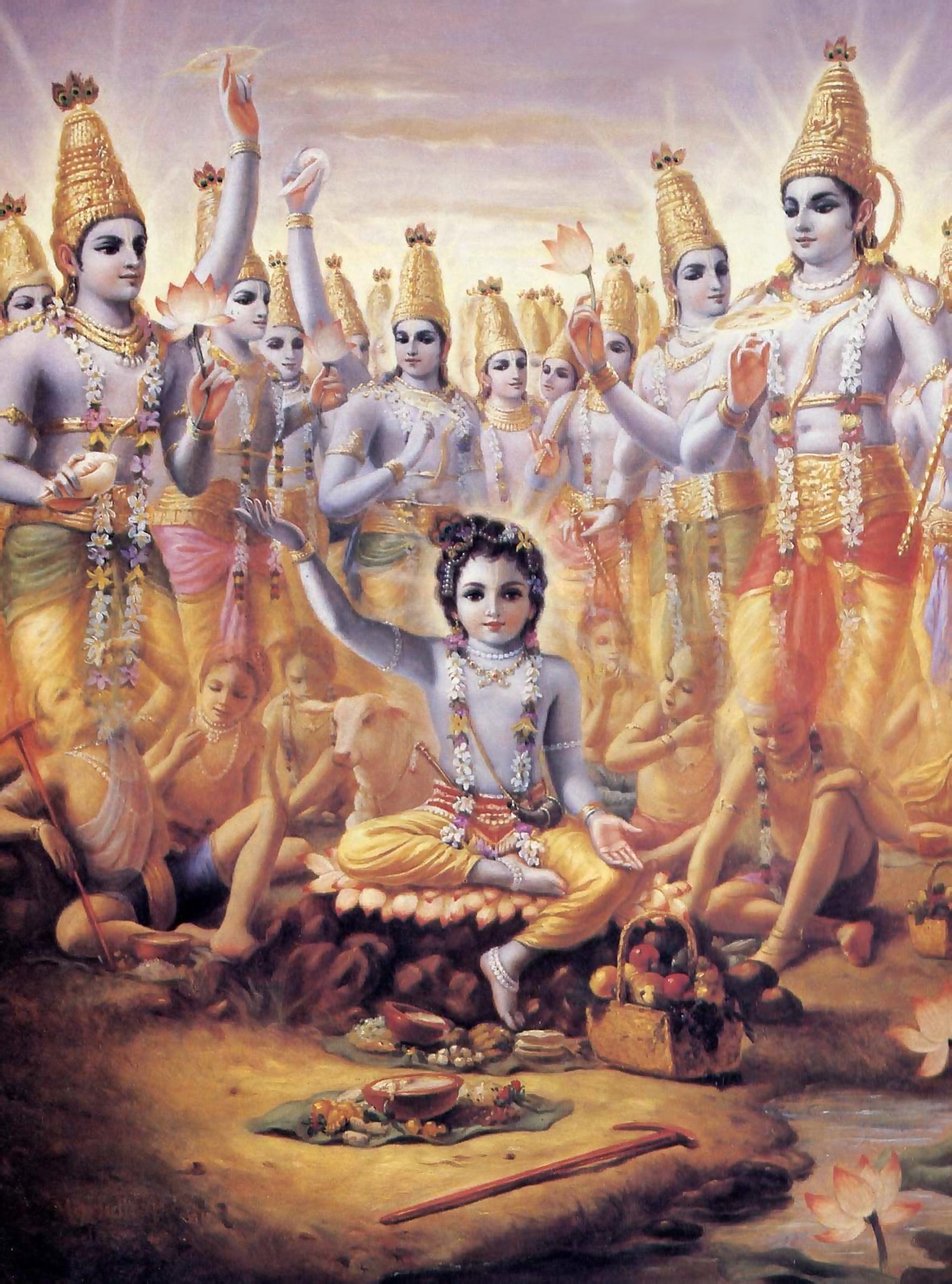
Kṛṣṇa is the essence of everything (Bg 7.9 to 7.12)
After explaining that everything comes from His different potencies and that He is thus the source of everything, Kṛṣṇa now deepens His own explanation, describing Himself as the original, uncontaminated essence of everything. This shows us how to find Him in all manifestations that exist around us.
He is the pleasing fragrance of the earth before it is covered by unpleasant odors; He is the heat of fire, the life of everything that is alive, and the power that is not corrupted by lust and attachment. In the previous sections, we already learned to see His potencies acting throughout the cosmos; now we learn that the very qualities that define things ultimately come from Him. At the same time, however, Kṛṣṇa remains fully independent.
Text 9: puṇyo gandhaḥ pṛthivyāṁ ca, tejaś cāsmi vibhāvasau
jīvanaṁ sarva-bhūteṣu, tapaś cāsmi tapasviṣu
I am the original fragrance of the earth, and I am the heat in fire. I am the life of all that lives, and I am the penances of all ascetics.
Text 10: bījaṁ māṁ sarva-bhūtānāṁ, viddhi pārtha sanātanam
buddhir buddhimatām asmi, tejas tejasvinām aham
O son of Pṛthā, know that I am the original seed of all existences, the intelligence of the intelligent, and the prowess of all powerful men.
Text 11: balaṁ balavatāṁ cāhaṁ, kāma-rāga-vivarjitam
dharmāviruddho bhūteṣu, kāmo ’smi bharatarṣabha
I am the strength of the strong, devoid of passion and desire. I am sex life which is not contrary to religious principles, O lord of the Bhāratas [Arjuna].
Text 12: ye caiva sāttvikā bhāvā, rājasās tāmasāś ca ye
matta eveti tān viddhi, na tv ahaṁ teṣu te mayi
Know that all states of being—be they of goodness, passion or ignorance—are manifested by My energy. I am, in one sense, everything, but I am independent. I am not under the modes of material nature, for they, on the contrary, are within Me.
In a sense, this material world is also Kṛṣṇa, because it is formed from His energy. At the same time, however, it is separated, as Kṛṣṇa Himself declared in text 7.4. A vase is part of Kṛṣṇa, being a fragment of His energy, but we cannot worship a vase as Kṛṣṇa. A good example is the sun and the cloud. The cloud is created from the energy of the sun, so the cloud has no existence independent of the sun. When we see a cloud, therefore, we can see the power of the sun behind it. Still, the cloud is not the sun, and, more importantly, the cloud can cover our vision of the sun, even though it never covers the sun itself. Similarly, Māyā is Kṛṣṇa’s potency. She covers the consciousness of the conditioned soul and produces innumerable transformations, but she never covers or contaminates Kṛṣṇa.
The challenge is thus learning to see Kṛṣṇa behind all these material manifestations, without thinking that the manifestations themselves are Kṛṣṇa. When we see a beautiful woman or man, we should understand that this beauty comes from Kṛṣṇa, and that Kṛṣṇa is thus the object of attraction, and not think that this man or woman is directly Kṛṣṇa.
A materialist sees a beautiful thing and thinks, “This beautiful thing exists for my enjoyment,” and thus becomes entangled. An impersonalist sees beyond the temporary form and perceives the Absolute Truth behind it, but he cannot trace it back to the Supreme Person. A devotee, however, sees a beautiful thing and thinks, “This beauty comes from Kṛṣṇa, belongs to Kṛṣṇa, and should remind me of Kṛṣṇa, who remains transcendental to it.”
The material manifestation can thus either distract us, or make us remember Kṛṣṇa. What creates the distinction? That’s the transcendental knowledge Kṛṣṇa describes here. As Kṛṣṇa later explains, whatever is especially beautiful, powerful, or glorious exists because of a spark of His splendor. One mistake is to see beautiful things as sources of enjoyment; this is like Rāvana kidnapping Sītā. Another mistake is to see them as false, like the Māyāvādīs. The problem is not in noticing beautiful things, but in disconnecting that beauty from its source, or in failing to differentiate the sun from the cloud—the covering from the original source.
This point is made clear in text 7.9. When Kṛṣṇa says puṇyo gandhaḥ pṛthivyāṁ, “I am the original fragrance of the earth,” Prabhupāda emphasizes that it refers to the original, uncontaminated manifestation. As he mentions, everything has a particular original taste, but this taste can be changed by the mixture of other things. We are all attracted to pure, uncontaminated things, and this is yet another manifestation of our intrinsic attraction to Kṛṣṇa.
Kṛṣṇa is also the essence of the fire: heat, which is so essential for our activities. Kṛṣṇa is also the life of all that lives and the penances of the ascetics. These three examples show us how Kṛṣṇa is the essence of everything. If we take away heat, it is not fire; if we take away life, it is not alive; if we take away penance, one is not an ascetic. Kṛṣṇa is thus the very essence of everything. Things can’t be separated from Him, but His presence can be hidden or covered, just as we cannot be factually separated from Kṛṣṇa, but we can be covered by ignorance of this eternal relationship.
The original seed
In text 7.10 Kṛṣṇa declares: bījaṁ māṁ sarva-bhūtānāṁ (I am the original seed of all existences). If we study the process of material creation, the seed of all material existence is pradhāna, the unmanifested aggregate of the material energy. Kṛṣṇa enters there as His creative potency through His glance. After being agitated by the glance of Mahā-Viṣṇu, pradhāna becomes the mahat-tattva, which produces the material elements and so on. Kṛṣṇa is the active principle of this mahat-tattva; therefore, Kṛṣṇa is the original seed. He is also the source of the spiritual planets and all the perfect souls who reside there, not exactly in the sense of having created them (they have no beginning), but in the sense of being their foundation, or support. Material or spiritual, anything we can think of is anchored on Kṛṣṇa.
He also mentions that He is buddhi, intelligence. In his purport to text 7.4, Prabhupāda explains that buddhi, or intelligence “refers to the total material creation, called the mahat-tattva.” So, Kṛṣṇa is the active principle of the mahat-tattva, the seed of all existence, and He is also intelligence itself, but what exactly is the relationship between the mahat-tattva and intelligence?
This is explained in more detail in the teachings of Lord Kapila in the Śrīmad-Bhāgavatam. The term buddhi applies to both the universal intelligence, which is a manifestation of the mahat-tattva, and to the individual intelligence of a person. Both come from Kṛṣṇa. Just like our bodies include a small portion of the earth, water, fire, air, and ether manifested from the mahat-tattva, the same mahat-tattva also includes the total of all intelligence, and a portion of this cosmic intelligence is represented in each person as individual intelligence.
The appearance of this cosmic intelligence is explained in SB 3.26.19-20: “After the Supreme Personality of Godhead impregnates material nature with His internal potency, material nature delivers the sum total of the cosmic intelligence, which is known as Hiraṇmaya. This takes place in material nature when she is agitated by the destinations of the conditioned souls.”
Originally, material nature exists in the unmanifested stage, as pradhāna. This pradhāna is impregnated by the glance of Mahā-Viṣṇu, leading to the manifestation of the mahat-tattva. Inseminated by all the souls who will take part in the material manifestation, the mahat-tattva becomes golden and effulgent. This effulgent combination is called hiraṇmaya, the sum total of the cosmic intelligence, buddhi, which is the source of the individual intelligence.
In this way, Kṛṣṇa is bījam, the universal seed, the active principle of the mahat-tattva, and He is buddhi, the universal intelligence which is the source of the intelligence for all intelligent people. When we see any living being, or in fact anything that exists, we can remember that Kṛṣṇa is the source of it. When we see an intelligent person, we can remember that Kṛṣṇa is the source of that intelligence. And, if we judge ourselves intelligent, we can acknowledge that this intelligence is nothing but a fragment of Kṛṣṇa’s potency, and should thus be used in His service by studying the Bhagavad-gītā and trying to understand Him.
Two powerful forces
Similarly, Kṛṣṇa is the strength of the strong. There are many types of strength: physical strength, moral strength, mental strength, spiritual strength, etc. Kṛṣṇa is the source of all of them. Because Kṛṣṇa is the original source of all types of strength, He can empower us. As Balarāma, the original spiritual master, Kṛṣṇa becomes the source of the spiritual strength that allows us to practice the spiritual process and become free from material contamination. Kṛṣṇa is thus the source of both strength and intelligence, and the goal we should achieve using whatever strength and intelligence we receive from Him.
When we speak about strength, however, there is also a negative: strength is often misused. Strength can be used to oppress the weak, commit acts of violence, etc. However, this exploitative attitude that leads one to misuse his strength is a material transformation, a manifestation of material illusion. Therefore, Kṛṣṇa says: balaṁ balavatāṁ cāhaṁ, kāma-rāga-vivarjitam. I am the strength of the strong, devoid of kāma and rāga. Kāma means passion, the desire to enjoy or dominate, while rāga means material attachment, which binds us to the desired result. These are the two factors that lead one to use strength to exploit others. Kṛṣṇa, however, is the positive characteristic. He is the pure strength that is used to protect others and defeat evil, the moral strength that allows us to follow the path of dharma, the mental strength that allows us to control the senses, the spiritual strength that pulls us out of material conditioning. All these forms of strength are granted by Kṛṣṇa, and we have the free will to use them positively, as we should, or to misuse them, and use strength to exploit.
As Kṛṣṇa mentioned in text 5.15, He does not take anyone’s sinful reactions. If we misuse the potency given to us, Kṛṣṇa is not responsible for it. When, however, we connect these material assets with the source, using them for Kṛṣṇa, we can see their true nature as manifestations of Kṛṣṇa, and this consciousness brings us to Him.
Apart from strength, there is another powerful force that can be used positively or negatively: sex life. Materially speaking, the sexual act is the source of life, for no child can be born without it. At the same time, however, it is the source of many problems. When sex life is properly engaged, within marriage, to produce children who will be educated in Kṛṣṇa consciousness, this sex life becomes a divine manifestation of Kṛṣṇa, and is not contradictory to our spiritual advancement. Again, the secret lies in differentiating the pure state from the material contamination.
Kṛṣṇa remains independent
In the previous verses, Kṛṣṇa emphasized that He is the source and the essence of everything. Now, He concludes, “Know that all states of being—be they of goodness, passion or ignorance—are manifested by My energy. I am, in one sense, everything, but I am independent. I am not under the modes of material nature, for they, on the contrary, are within Me.”
The universe includes a gigantic variety of manifestations; some of them sprout from the mode of goodness, some from passion and some from ignorance. Kṛṣṇa, however, is the original source of all of them, just as the sun is the source of all clouds. At the same time, however, we should not confuse the sun and the cloud. The clouds can block our view of the sun, but they cannot cover the sun itself; that is far, far away.
Kṛṣṇa is the source of all material manifestations; some may remind us of Him, others may bewilder us, but this is a fault of our own consciousness. It does not make Kṛṣṇa contaminated. Above all, Kṛṣṇa is not touched by the three modes of nature, just as a king is not subject to ordinary law. The three modes are a potency of Kṛṣṇa and always remain under Him.
Apart from further clarifying the transcendental nature of Kṛṣṇa, this verse dismantles Māyāvāda philosophy, which claims that when Kṛṣṇa appears in this world, He assumes a material form and acts under the material modes. Here, Kṛṣṇa Himself tells us it is not so. He always remains fully transcendental, just as the sun itself always remains untouched beyond the clouds.
Main points in the purports of Śrīla Prabhupāda:
“I am the original fragrance of the earth, and I am the heat in fire. I am the life of all that lives, and I am the penances of all ascetics.”
a) The word used by Kṛṣṇa is puṇya. This means the original, uncontaminated fragrance in a flower, the earth, etc. Similarly, He is the original, uncontaminated taste, before it is changed by the addition of chemicals or other ingredients.
b) We depend on fire for our activities, to cook, run factories, etc. This fire is Kṛṣṇa. Similarly, He is also the fire of digestion. In Kṛṣṇa consciousness we become aware of the presence of Kṛṣṇa in all material elements and active principles.
c) Kṛṣṇa is also life itself. By the grace of Kṛṣṇa, the duration of our lives can be extended or shortened.
“O son of Pṛthā, know that I am the original seed of all existences, the intelligence of the intelligent, and the prowess of all powerful men.”
a) According to the Vedas, there are 8,400,000 species of life. Some of them move, and others are inert. Kṛṣṇa is the seed of all of them.
b) The Vedas also explain that everything emanates from Brahman, the Absolute Truth. Kṛṣṇa, however, is Para-brahman, the source of Brahman itself. Therefore, Kṛṣṇa is the ultimate source and maintainer of everything, the root.
c) Kṛṣṇa is the source of all life. He is the source of intelligence, without which we cannot do anything. Even the intelligence we use to understand Kṛṣṇa also comes from Kṛṣṇa Himself.
“I am the strength of the strong, devoid of passion and desire. I am sex life which is not contrary to religious principles, O lord of the Bhāratas [Arjuna].”
a) Strength should be properly used to protect the weak, and sex life used for the propagation of children meant to be educated in Kṛṣṇa consciousness.
“Know that all states of being—be they of goodness, passion or ignorance—are manifested by My energy. I am, in one sense, everything, but I am independent. I am not under the modes of material nature, for they, on the contrary, are within Me.”
a) The three modes of nature control all material activities. Kṛṣṇa is their source, but at the same time, He is independent from them. He is thus called nirguṇa—unaffected by the guṇas. He is just like a king who is not subject to the state laws he himself creates.
Next: Four classes of people who do not surrender to Kṛṣṇa (Bg 7.13 to 7.15)
Read the entire book:
« The Song of God—Volume 2, chapters 7-12

This is a publication for thoughtful readers who want to go deeper into Kṛṣṇa consciousness. I publish daily, trying to offer high-quality spiritual content, and all posts are available to free subscribers. If you wish, you can also choose a paid subscription to support this work.
You can also receive the updates on WhatsApp or Telegram.
If you would like to contribute further, you can find the donation links here.