


You can receive new articles directly in your inbox. Subscription is free; donations are welcome.
In the 9th chapter of the Gītā, Kṛṣṇa describes three classes of worshipers who worship Him only indirectly:
jñāna-yajñena cāpy anye, yajanto mām upāsate
ekatvena pṛthaktvena, bahudhā viśvato-mukham“Others, who engage in sacrifice by the cultivation of knowledge, worship the Supreme Lord as the one without a second, as diverse in many, and in the universal form.”
The first worships Him as a manifestation of the Absolute Truth, the second worships a demigod, and the third worships the universe itself. These three are different from the Māyāvādī, the ordinary demigod worshiper, and the ordinary materialist. They are sincere in their worship, but their knowledge is still imperfect.
The universe is Kṛṣṇa’s energy, but it is not directly His transcendental body. Similarly, the demigods are His representatives, and the worshiper himself, as a soul, is part and parcel of Kṛṣṇa, but again, they are not exactly the same.
Then, Kṛṣṇa returns to the devotees, who worship Him directly. To them, He promises:
ananyāś cintayanto māṁ, ye janāḥ paryupāsate
teṣāṁ nityābhiyuktānāṁ, yoga-kṣemaṁ vahāmy aham“But those who always worship Me with exclusive devotion, meditating on My transcendental form – to them I carry what they lack, and I preserve what they have.”
Kṛṣṇa uses the words “vahāmy aham.” Aham means “I,” personally, and vahāmi means to carry a load. Taken literally, vahāmy aham means that He, in His transcendental form, personally carries what a devotee needs.
Arjunācārya, a great devotee from South India, once came to these words while writing a commentary on the Bhagavad-gītā. Because he was so devoted, the idea of the Lord personally carrying the burden of what is needed by His devotees was painful to him. He thus concluded that the carrying must be indirect, through some agents. He thus scratched the word vahāmy (I carry) in the manuscript and replaced it with karomi (I have it done), giving instead the idea that the carrying is performed by Kṛṣṇa’s agents.
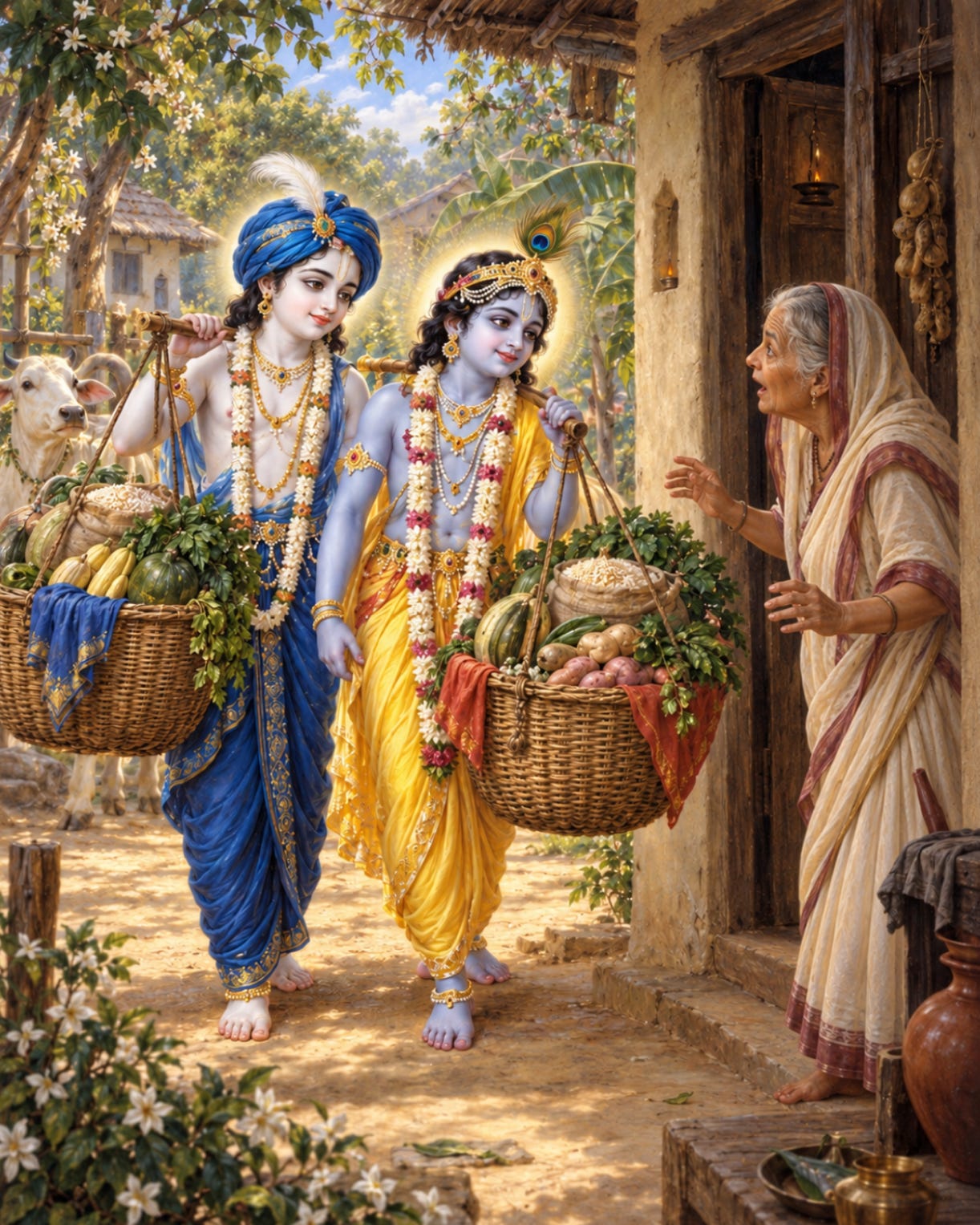
Kṛṣṇa, however, to prove the point, came together with Balarama, the two carrying two heavy baskets of foodstuffs tied to the ends of a bamboo stick. Because Arjunācārya had so emphatically erased the words, Kṛṣṇa took the marks he made in the manuscript as a direct beating, and thus, when He came personally to His house, He acted as if afraid of Him, showing the wife cane marks on his back. Prabhupada tells this story personally in a lecture on Bg 9.20-22 given on December 7th, 1966, in New York:
“That’s a very nice story. When he was writing commentaries, oh, he thought, “How is that, the Lord will come Himself and deliver the goods? Oh, it is not possible. He might be sending through some agents.” So he wanted to cut vahāmy aham, “I bear the burden and deliver.” He wrote in a way that “I send some agent who delivers.” So that Arjunācārya went to take bath, and in the meantime two boys, very beautiful boys, They brought some very nice foodstuff, very large..., in large quantity. And in India there is a process to taking two sides burden on the bamboo. Just like a scale it is balanced.
So these two boys brought some very highly valuable foodstuff and grains and ghee and of the same, and his wife was there. And the boys said, “My dear mother, Arjunācārya has sent these goods to you. Please take delivery.” And “Oh, You are so nice boy, You are so beautiful boys, and he has given. And Ācārya is not so cruel. How is that? He has given so much burden to You, and he is not kind...?” “Oh, I was not taking; just see, he has beaten Me. Here is cane mark. Oh, see.” His wife became very much astonished, that “Ācārya is not so cruel. How he has become so cruel?”
So she was thinking in that way. Then “All right, my dear boys. You come on,” and gave Him shelter. And, “No. I shall go, because Arjunācārya again comes. He will chastise Us.” “No, no. You sit down, take foodstuff.” He [she] prepared foodstuff, and then They went away. And when Arjunācārya came back, then he saw that his wife is eating. Because it is the system of Indian family that after the husband has taken the food, the wife will take. So they don’t take together. After the family members—the boys and the husband—is sumptuously fed, then the housewife takes.”
“So the wife said, “Ācārya, you have become so much cruel nowadays?” “Oh, what is that?” “Now, two boys, very nice boys, They have brought so many foodstuff. You loaded on Their head, and They denied to take it, and you have beaten Them, chastised?” He said, “No. I have never done this. Why shall I do it?” Then she described, “Oh, such a nice, beautiful boy.” Then Arjunācārya understood that “Because I wanted that God does not deliver, so He has delivered these goods, and because I cut these alphabets that He does not give personally, so He has shown that beating mark.”
Śrīla Viśvanātha Cakravartī mentions that Kṛṣṇa accepts the work of maintaining his devotee as a burden of love, just as a householder maintains his own family. In other words, the maintenance of a devotee is not a fruit of his karma like in the case of others: a devotee who worships Kṛṣṇa with exclusive devotion is directly maintained by Kṛṣṇa. To sustain this point, he comments, explaining how Kṛṣṇa sees it:
“My pure ananya-bhaktas are niṣkāma (selfless), and because of this selfless nature, whatever bliss one sees in them is personally given by Me. Even though I am completely neutral, I give this bliss to My bhaktas because of My affection for them, and therefore I am called bhakta-vatsala, always affectionate to My devotees. It is incorrect to say that those devotees are lacking in love for Me because they give Me the responsibility of their maintenance and nourishment, for I willingly accept this responsibility even if they do not completely give it to Me. I am capable of creating all the universes merely by My will, so this is not a burden for Me. Furthermore, because I am attached to My devotees, it is a great pleasure to carry their burden, just as it is a pleasure for a man to carry the burden of maintaining a pleasing wife.”
There is, however, yet another meaning: “I carry what they lack, and I preserve what they have” is also applied in the spiritual sense. Kṛṣṇa preserves one’s spiritual advancement and helps the devotee to advance further, bringing what they still lack.
These two sides explain why devotees sometimes experience material difficulties. The Pāndavas, for example, were at some point extremely prosperous, having just subjugated opposing kings and constructed Indrapastha, their capital. They, however, lost everything, faced many difficulties living in exile, and in the end faced all the challenges of the battle of Kurukṣetra. Similarly, many other devotees face different types of difficulties. How to explain “I carry what they lack, and I preserve what they have” in this context?
The point is that Kṛṣṇa also considers the main priority of bringing His devotee back home, back to Godhead, and carries out what is lacking in this direction. Most of us still struggle with material desires, and thus we live in a situation where material facilities can pull us back into a materialistic life, hampering our progress. Everyone knows that an alcoholic who is trying to give up drinking has to stay away from alcohol, since even one sip can make him relapse. A good friend will thus refuse to supply him with drink, no matter how much he asks.
If a devotee cannot manage material facilities without relapsing into his old habits, Kṛṣṇa withdraws these facilities so he can come to Him and attain the supreme goal. Once one becomes fixed in devotion, then Kṛṣṇa can shower him with oppulences.
Once, Mahārāja Yudhiṣṭhira himself asked a similar question. Kṛṣṇa’s answer is described in the Kṛṣṇa Book, chapter 88:
“Lord Kṛṣṇa answered the question of Mahārāja Yudhiṣṭhira as follows: “If I especially favor a devotee and especially wish to care for him, the first thing I do is take away his riches. When the devotee becomes a penniless pauper or is put into a comparatively poverty-stricken position, his relatives and family members no longer take interest in him, and in most cases they give up their connection with him. The devotee then becomes doubly unhappy.” First of all the devotee becomes unhappy because his riches have been taken away by Kṛṣṇa, and he is made even more unhappy when his relatives desert him because of his poverty. We should note, however, that when a devotee falls into a miserable condition in this way, it is not due to past impious activities, known as karma-phala; the poverty of the devotee is a creation of the Personality of Godhead. Similarly, when a devotee becomes materially opulent, that is also not due to his pious activities. In either case, whether the devotee becomes poorer or richer, the arrangement is made by the Supreme Personality of Godhead. This arrangement is especially made by Kṛṣṇa for His devotee just to make him completely dependent upon Him and to free him from all material obligations. He can then concentrate his energies, mind and body – everything – for the service of the Lord, and that is pure devotional service.”
Later, in the same chapter, Prabhupāda concludes:
“It may be questioned why a devotee is put into such tribulation by the Personality of Godhead. The answer is that this kind of arrangement by the Lord is just like a father’s sometimes becoming unkind to his sons. Because the devotee is a surrendered soul and is taken charge of by the Supreme Lord, whatever condition of life the Lord puts him in – whether one of distress or of happiness – it is to be understood that behind this arrangement is a large plan designed by the Personality of Godhead.”
In this way, Kṛṣṇa personally preserves what a devotee has and carries what he lacks. Pure devotees have devotion in abundance, but they may sometimes lack material facilities. When that’s the case, Kṛṣṇa personally supplies that. Sincere devotees in the intermediate stage, conversely, may have material facilities due to past karma, but they may prevent them from advancing. In this case, Kṛṣṇa may take away these facilities so the devotee can develop the permanent asset of pure devotion to Him and live happily eternally, instead of continuing to struggle in the material world. A neophyte, on the other hand, may have some attraction to Kṛṣṇa, but this faith may be very unstable. In this case, Kṛṣṇa may shower him with material facilities when he comes to Him asking for material benefits, understanding that this will increase his faith. Sometimes, also, Kṛṣṇa uses pure devotees like the Pāṇḍavas or Prahlāda Maharaja to give us valuable examples of how a devotee should remain fixed, even in material difficulty, remaining focused on the final goal. As Prabhupāda mentions:
“When after the dense, dark night there is finally sunrise in the morning, it is very pleasant; when there is scorching heat, cold water is very pleasant; and when there is freezing winter, hot water is very pleasant. Similarly, when a devotee, after experiencing the distress of the material world, relishes the spiritual happiness awarded by the Lord, his position is still more pleasant and enjoyable.”
In this way, we can see Kṛṣṇa’s mercy appearing in different forms, according to what is necessary. This is the meaning of “I carry what they lack.”
Prabhupāda summarizes this conclusion of the protection of the Lord in his purport:
“One who is unable to live for a moment without Kṛṣṇa consciousness cannot but think of Kṛṣṇa twenty-four hours a day, being engaged in devotional service by hearing, chanting, remembering, offering prayers, worshiping, serving the lotus feet of the Lord, rendering other services, cultivating friendship and surrendering fully to the Lord. Such activities are all auspicious and full of spiritual potencies, which make the devotee perfect in self-realization, so that his only desire is to achieve the association of the Supreme Personality of Godhead. Such a devotee undoubtedly approaches the Lord without difficulty. This is called yoga. By the mercy of the Lord, such a devotee never comes back to this material condition of life. Kṣema refers to the merciful protection of the Lord. The Lord helps the devotee to achieve Kṛṣṇa consciousness by yoga, and when he becomes fully Kṛṣṇa conscious the Lord protects him from falling down to a miserable conditioned life.”
There is thus an intrinsic difference in taking shelter of Kṛṣṇa, even if imperfectly, and taking shelter of a demigod or any other material deity. Apart from Kṛṣṇa and His pure devotee, everyone else is under the onslaught of birth and death himself, and therefore cannot offer proper shelter to anyone, not materially, and much less spiritually.
One example in this direction is Hiraṇyakaśipu. After he performed his austerities, Brahmā himself appeared to him and offered blessings. Hiraṇyakaśipu asked for immortality, but Brahmā answered that he himself is not immortal, and therefore could not grant immortality. Hiraṇyakaśipu then asked for an elaborate set of boons, trying to close every different possibility of dying (not dying during the day or night, not inside or outside a house, not being killed by a man or animal, etc.), but in the end he was killed by Lord Nṛsiṁhadeva, who killed him in a situation that kept all the boons he received from Brahmā intact.
Therefore, all other classes of worshippers should come to Kṛṣṇa. As mentioned in the Śrīmad-Bhāgavatam (2.3.10):
akāmaḥ sarva-kāmo vā, mokṣa-kāma udāra-dhīḥ
tīvreṇa bhakti-yogena, yajeta puruṣaṁ param“A person who has broader intelligence, whether he be full of all material desire, without any material desire, or desiring liberation, must by all means worship the supreme whole, the Personality of Godhead.”
Everyone, regardless of having material desires or not, desiring liberation or not, should come to the platform of devotional service to Kṛṣṇa. One may then become one of the four categories of devotees (the distressed, the desirer of wealth, the inquisitive, and he who is searching for knowledge of the Absolute) and from there advance further, gradually coming to the platform of pure devotional service, becoming one of the mahātmās Kṛṣṇa described in texts 9.13 and 9.14 of the Gītā.
Read more:


This is a publication for thoughtful readers who want to go deeper into Kṛṣṇa consciousness. I publish daily, trying to offer high-quality spiritual content, and all posts are available to free subscribers. If you wish, you can support this work with a monthly contribution. When you subscribe, you can choose between a free subscription and a monthly contribution, and you can switch from a free subscriber to a supporter at any time.
You can also receive updates on WhatsApp or Telegram.
If you would like to contribute further, you can find the donation links here.
Thank you, one important point is that the term Yoga kṣema means, personal gain (what we lack) and the protection of current assets.
“yoga and kṣema—comfort and security in this world.
Yoga in this context refers to alabdha-lābha, or gaining what we don’t have—food, shelter, fame, power, influence, social status, the latest gadget, and so forth.
Kṣema refers to labdhasya rakṣaṇam, protecting what we have.
For fear of losing our life, our status, or our property we need contracts, houses, gates, locks, safes, guns, alarm systems, insurance, health care.”
- Kaṭha Upaniṣad commentary by Vasudeva Das