

« The Song of God—Volume 2, chapters 7-12
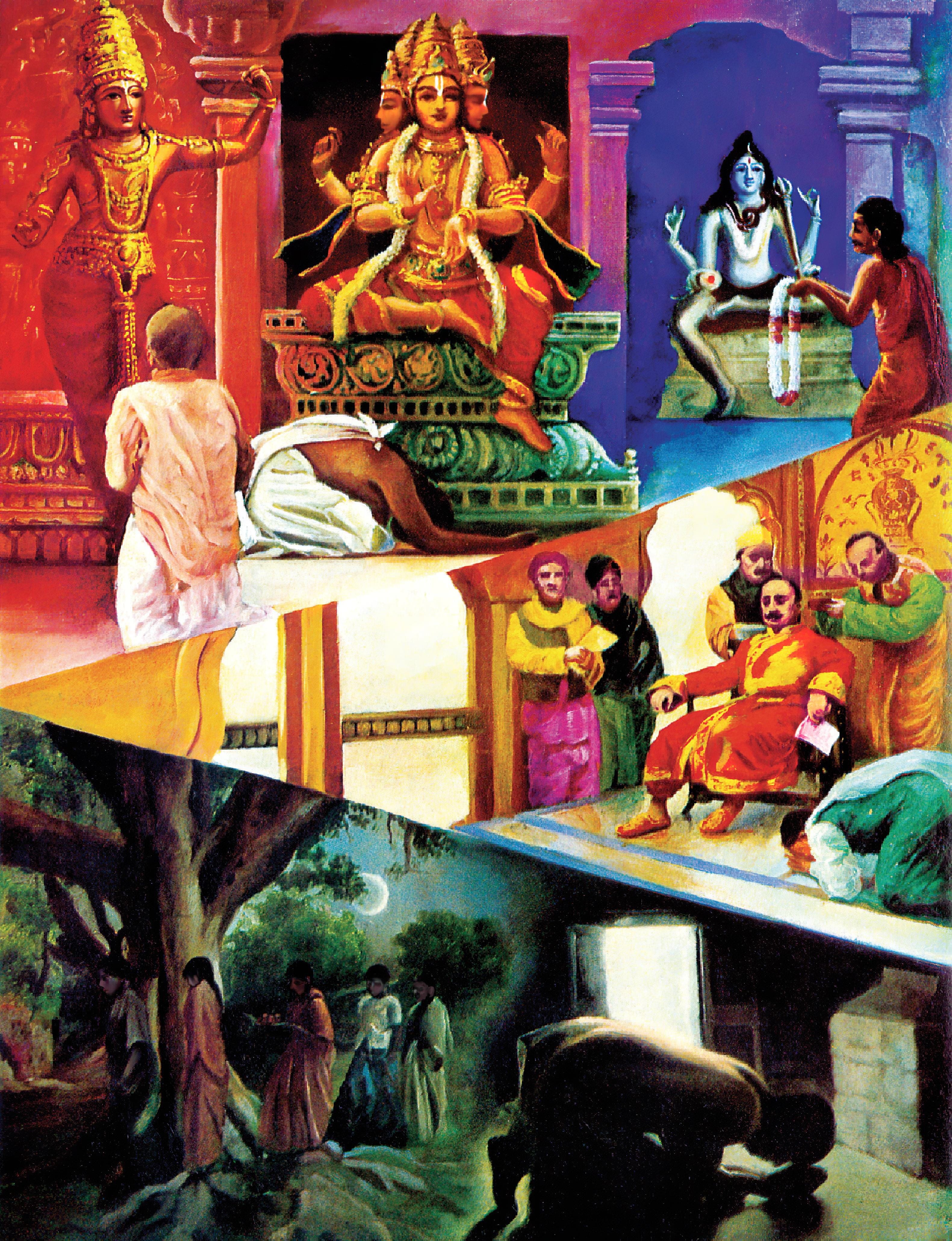
Kṛṣṇa remains hidden from the unintelligent (Bg 7.24 to 7.26)
After describing the worshippers of demigods, Kṛṣṇa describes another group who do not surrender unto Him despite studying the scriptures: the impersonalists. They accept the authority of the Vedas, but they fail to understand Kṛṣṇa as the Supreme Personality of Godhead. Instead, they imagine that the impersonal Brahman is the ultimate reality and that Kṛṣṇa’s personal form is only a temporary manifestation under the material modes. Kṛṣṇa, however, strongly rejects this conclusion. He is eternally the Supreme Person, but He does not reveal Himself to everyone. By His yoga-māyā, He remains hidden from those who envy Him or lack proper understanding.
Text 24: avyaktaṁ vyaktim āpannaṁ, manyante mām abuddhayaḥ
paraṁ bhāvam ajānanto, mamāvyayam anuttamam
Unintelligent men, who do not know Me perfectly, think that I, the Supreme Personality of Godhead, Kṛṣṇa, was impersonal before and have now assumed this personality. Due to their small knowledge, they do not know My higher nature, which is imperishable and supreme.
Text 25: nāhaṁ prakāśaḥ sarvasya, yoga-māyā-samāvṛtaḥ
mūḍho ’yaṁ nābhijānāti, loko mām ajam avyayam
I am never manifest to the foolish and unintelligent. For them I am covered by My internal potency, and therefore they do not know that I am unborn and infallible.
Text 26: vedāhaṁ samatītāni, vartamānāni cārjuna
bhaviṣyāṇi ca bhūtāni, māṁ tu veda na kaścana
O Arjuna, as the Supreme Personality of Godhead, I know everything that has happened in the past, all that is happening in the present, and all things that are yet to come. I also know all living entities; but Me no one knows.
The demigod worshippers were described in the previous verse as alpa-medhas (those of small intelligence). Impersonalists are described as abuddhayaḥ. The word comes from “abuddhi” (without buddhi, or intelligence). The expression is very strong: despite their expertise in Vedānta and philosophy, they have no intelligence for understanding the ultimate feature of the Absolute Truth. Demigod worshippers are men of small intelligence whose knowledge is stolen by their material desires, but impersonalists fail to understand the goal of the Vedas even after studying them repeatedly.
Why is Kṛṣṇa so harsh? The point is that devotional service to Kṛṣṇa is described everywhere in the Vedic literature, but impersonalists can study all the Vedas without finding it. They conclude thus that the Absolute Truth has ultimately no form. In chapter four, Kṛṣṇa explained the process of obtaining spiritual knowledge: We must obtain the correct conclusions of the scriptures by approaching a bona fide spiritual master, offering some service, and hearing submissively. Now, He shows the result of not following this process: one may study all the Vedas and still come to the wrong conclusions. The human mind has no potency to understand Kṛṣṇa’s transcendental form and other transcendental topics. One who rejects the process prescribed by Kṛṣṇa and instead follows a speculative process is guaranteed to come to the wrong conclusion.
Still less intelligent
Modern impersonalists are even less intelligent, because they conclude that Kṛṣṇa’s form is material and His activities are performed under the material modes. In other words, they believe that Kṛṣṇa is covered by māyā, just like us. That’s why their doctrine is known as Māyāvāda. Prabhupāda makes the point that Māyāvādīs are so unintelligent that they don’t even follow their own founder. Śaṅkarācārya explicitly accepted Kṛṣṇa as the Supreme Personality of Godhead.
Śaṅkarācārya opens his commentary on the Bhagavad-gītā with the words: nārāyaṇaḥ paro ’vyaktād aṇḍam avyakta-sambhavam, aṇḍasyāntas tv ime lokāḥ sapta-dvīpā ca medinī. Avyaktād means pradhāna, the unmanifest material nature; “paro” means “beyond.” Nārāyaṇaḥ paro ’vyaktād means that Nārāyaṇa is beyond this cosmic manifestation. Who is this Nārāyaṇa? After a few sentences, he declares: sa ādi-kartā nārāyaṇākhyo viṣṇur bhaumasya brahmaṇo brāhmaṇatvasya cābhirakṣaṇārthaṃ devakyāṃ vasudevād aṃśena kṛṣṇaḥ kila sambabhūva: That original creator, Viṣṇu, known as Nārāyaṇa, desiring to protect the brāhmanas, appeared as Kṛṣṇa in Devakī through Vasudeva. Prabhupāda elaborates on this point in CC Ādi 5.132, and Madhya 20.359.
Māyāvādīs conclude that the impersonal Brahman is the ultimate reality, while Kṛṣṇa’s form is a temporary manifestation. Śaṅkarācārya, however, contradicts them by mentioning (still in the introduction) that, paramārtha-tattvaṁ ca vāsudevākhyaṁ para-brahmābhidheya-bhūtam: The ultimate reality (paramārtha-tattva), called Vāsudeva, the Supreme Brahman (para-brahman). Later, in his commentary on Bg 4.6, Śaṅkarācārya explains that Kṛṣṇa is unborn, imperishable, and the Lord of all beings, from Brahmā down to a blade of grass. He describes the material nature as Kṛṣṇa’s own Vaiṣṇavī māyā, composed of the three modes, and explicitly states that Kṛṣṇa keeps this māyā under His control. Therefore, Kṛṣṇa only appears “as if embodied” and “as if born”; He is not born like an ordinary conditioned soul. In Bg 4.9 he is even more explicit, describing Kṛṣṇa’s birth and activities as divyam aprākṛtam aiśvaram: transcendental, nonmaterial, and divine.
Then, in his commentary to 7.24, the very verse we are studying, Śaṅkarācārya confirms the words of Kṛṣṇa, mentioning that, nitya-prasiddham īśvaram api santam abuddhayo ‘vivekinaḥ paraṃ bhāvaṃ param ātma-svarūpam ajānanto ‘vivekinaḥ mamāvyayaṃ vyaya-rahitam anuttamaṃ niratiśayaṃ madīyaṃ bhāvam ajānanto manyanta ity arthaḥ: Kṛṣṇa is the eternally established Lord, but the unintelligent, devoid of proper discrimination, do not know His supreme nature, which is imperishable, unsurpassed, and absolutely supreme.
These are just a few passages among many. In summary, Śaṅkarācārya emphasized the impersonal aspect in his explanations, speaking according to the capacity of his audience, often in a very indirect way, but he was not a Māyāvādī; he did not agree with the conclusion that Kṛṣṇa has a material body or that He is a temporary manifestation of the impersonal Brahman. Śaṅkarācārya is Lord Śiva himself, the greatest Vaiṣnava, who came with a specific mission of speaking about the Absolute Truth in a way that would bewilder the atheists.
He became thus the doctrinal source of the later Māyāvāda school as part of his divine mission, but his followers pushed conclusions that Śaṅkara himself explicitly did not accept. In his commentaries, he explicitly acknowledges Kṛṣṇa’s transcendental position. The vicious conclusions of the Māyāvāda doctrine as currently propagated appeared later, due to the influence of people who, as Kṛṣṇa puts it, are abuddhayaḥ, devoid of intelligence.
You can see how these arguments develop further in our Vedānta-sūtra: Understanding the Govinda-bhāṣya of Baladeva Vidyābhūṣaṇa, Vol. I, especially sūtras 1.1.5 to 1.1.11.
How Kṛṣṇa remains covered
Even when Kṛṣṇa becomes personally visible, as He did 5,000 years ago, He remains covered to the ignorant. How? He remains covered by His internal potency. Pure devotees can perfectly understand Him as the Supreme Personality of Godhead, but the ignorant usually see Him as a common man. During the Rājasūya ceremony of Mahārāja Yudhiṣṭhira, most of the kings present accepted Kṛṣṇa as the Supreme and elected Him to be worshipped as the most exalted personality present, but Śiśupāla and some of his supporters protested. As mentioned previously, Kṛṣṇa can be known only through devotion. Without it, Kṛṣṇa remains covered by His internal potency, and one cannot understand Him seeing Him personally in front of his eyes.
This is the meaning of nāhaṁ prakāśaḥ sarvasya (7.25). Śiśupāla could see the same Kṛṣṇa that Bhīṣma and the Pāṇḍavas saw, but he saw only an ordinary human being whom he considered unworthy of being worshipped. The difference was not in Kṛṣṇa but in the consciousness of the observer. The essential point, however, comes in text 7.26: “O Arjuna, as the Supreme Personality of Godhead, I know everything that has happened in the past, all that is happening in the present, and all things that are yet to come. I also know all living entities; but Me no one knows.”
Kṛṣṇa remains covered for the ignorant in the sense that they cannot recognize Him, but in reality, Kṛṣṇa is not covered: they are. Just as a cloud cannot cover the sun, the illusory potency cannot cover Kṛṣṇa; it simply covers the vision of the conditioned soul, preventing one from understanding Kṛṣṇa and His opulences. How can this cover be removed? Only through an attitude of service. One has to hear from a self-realized soul, and by practicing devotional service according to this transcendental knowledge, one can come to the point of seeing Kṛṣṇa. This takes us back to 7.1, where Kṛṣṇa promised that one who takes shelter of Him and practices devotional service in full consciousness of Him can know Him in full, free from doubt.
Text 7.26 also gives us yet another proof that Kṛṣṇa’s body is not material. A conditioned soul forgets his previous lives due to the change of body, but Kṛṣṇa remembers everything. As He explained in chapter four, He perfectly remembers instructing Vivasvān, the sun-god, millions of years ago. If Kṛṣṇa had assumed a material body, as the Māyāvādīs claim, He would be subjected to the same limitations. Instead, His knowledge remains perfect in all circumstances.
Māyāvādīs say that māyā covers Kṛṣṇa, but Kṛṣṇa turns it around: Māyā is not a problem for Him; He can perfectly see everything, past, present, and future; He can understand all the thoughts and desires of every single soul. It is the Māyāvādī’s knowledge that is covered.
Main points in the purports of Śrīla Prabhupāda:
“Unintelligent men, who do not know Me perfectly, think that I, the Supreme Personality of Godhead, Kṛṣṇa, was impersonal before and have now assumed this personality. Due to their small knowledge, they do not know My higher nature, which is imperishable and supreme.”
a) Kṛṣṇa is personally speaking the Gītā to Arjuna, and still, impersonalists conclude He has no form. What is the reason? By studying the Vedas, one can come to understand Kṛṣṇa, by His mercy, but those who are in passion and ignorance, demons and nondevotees, cannot, even if they study Vedānta and the Upaniṣads. They are also less intelligent, like the worshippers of demigods.
b) God realization begins with the impersonal Brahman and progresses to Paramātmā realization, but the last word is Bhagavān realization. Someone stuck in Brahman realization is less intelligent, but modern impersonalists are still less, because Śaṅkarācārya has specifically stated that Kṛṣṇa is the Supreme Personality of Godhead. Kṛṣṇa confirms in text 9.11: “Only the fools regard Me as an ordinary person.”
c) No one can understand Kṛṣṇa without performing devotional service and developing Kṛṣṇa consciousness. Those who speculate are unable to know Him even after studying the Vedas for many years. Māyāvādīs think that Kṛṣṇa’s form and pastimes exist under material illusion. Such nondevotees do not know the ultimate truth.
d) Text 7.20 describes worship of the demigods, and 7.23 states that demigod worshippers attain the planets of the demigods while Kṛṣṇa’s devotees attain Him. Still, impersonalists maintain that He is ultimately formless.
e) The Vedas confirm that the Absolute Truth is knowledge and blissful pleasure, that He is the reservoir of unlimited auspicious qualities, and the Gītā confirms He is unborn. The monistic interpretation is thus proved false.
“I am never manifest to the foolish and unintelligent. For them I am covered by My internal potency, and therefore they do not know that I am unborn and infallible.”
a) When Kṛṣṇa was present, only a few people could recognize Him as the Supreme Personality of Godhead. He was not revealed to impersonalists, nondevotees, and common men. For them, He remained covered by His internal potency. Only for the devotee is this covering removed.
b) Kṛṣṇa is not only unborn, but also inexhaustible. His eternal form is bliss and knowledge, and no one can calculate His potency and pastimes in this world. Therefore, no one can understand Him by experimental knowledge.
c) Kuntīdevī compares yoga-māyā to a curtain covering Kṛṣṇa from ordinary vision, and the Īśopaniṣad describes the brahmajyoti as a brilliant covering that must be removed so the devotee can see Kṛṣṇa’s eternal form. An impersonalist may become fixed in the impersonal brahmayoti, but will fail to see the Supreme Person behind it.
“O Arjuna, as the Supreme Personality of Godhead, I know everything that has happened in the past, all that is happening in the present, and all things that are yet to come. I also know all living entities; but Me no one knows.”
a) If Kṛṣṇa’s form were material, as Māyāvādīs conclude, He would forget with the change of body, just as an ordinary living entity. Because He knows past, present, and future, it is clear that He is free from material contamination.
b) Kṛṣṇa remembers instructing Vivasvān, the sun-god. Being situated in everyone’s heart, He knows every living entity. This remembrance and omniscience prove that material illusion does not cover Him. Still, the less intelligent, even if able to realize the impersonal Brahman, cannot realize Śrī Kṛṣṇa as the Supreme Person.
c) Kṛṣṇa is like the sun, and māyā is like a cloud. The cloud may cover part of the sky temporarily, but this is only according to our perspective. The sun is not covered. Māyā can cover our vision, but it cannot cover Kṛṣṇa. One can understand Kṛṣṇa only through Kṛṣṇa consciousness. Not even Brahman or Paramātmā realization is sufficient.
Next: Freedom from delusion at the time of death (Bg 7.27 to 7.30)
Read the entire book:
« The Song of God—Volume 2, chapters 7-12

This is a publication for thoughtful readers who want to go deeper into Kṛṣṇa consciousness. I publish daily, trying to offer high-quality spiritual content, and all posts are available to free subscribers. If you wish, you can also choose a paid subscription to support this work.
You can also receive the updates on WhatsApp or Telegram.
If you would like to contribute further, you can find the donation links here.