

« The ‘Fall’ of the Jīva, as Explained by Śrīla Prabhupāda
Chapter 7: Kṛṣṇa reveals our original nature
As a King, Malayadhvaja was not supposed to directly accept sannyāsa, like a brāhmana, and thus he left his body after attaining perfection in the stage of vānaprastha. A wife can accompany her husband at this stage, but in this case, she just shares in his austerities and offers service; there is no longer any conjugal relationship between them. As prescribed in the scriptures, Malayadhvaja focused his attention on the supreme Lord and left his body as a spiritual hero, having defeated his senses and the pull of material illusion, and attained the Lord.
Ordinarily, a husband is supposed to take care of his wife, but a self-realized soul understands that the Lord is the maintainer of everyone. Malayadhvaja abandoned all concepts of false ego and false proprietorship, ceasing to be a hero of this material world who can protect people, and instead focused on his eternal subordinate position to the Lord, entrusting all necessary arrangements to Him.
As mentioned in the Bṛhad-bhāgavatāmṛta, when a devotee abandons his material duties to simply serve the Lord, it does not mean these duties remain unfulfilled. Rather, the Lord Himself, who is the true maintainer, fulfills these duties either personally or through others. The Lord already maintains the whole creation; therefore, it is not difficult for him to take care of one more woman or a family. This point is exemplified in the conclusion of this passage, when the Lord appears to instruct Vaidarbhī after her husband passes away.
“The daughter of King Vidarbha accepted her husband all in all as the Supreme. She gave up all sensual enjoyment and in complete renunciation followed the principles of her husband, who was so advanced. Thus she remained engaged in his service.
The daughter of King Vidarbha wore old garments, and she was lean and thin because of her vows of austerity. Since she did not arrange her hair, it became entangled and twisted in locks. Although she remained always near her husband, she was as silent and unagitated as the flame of an undisturbed fire.” (SB 4.28.43-44)
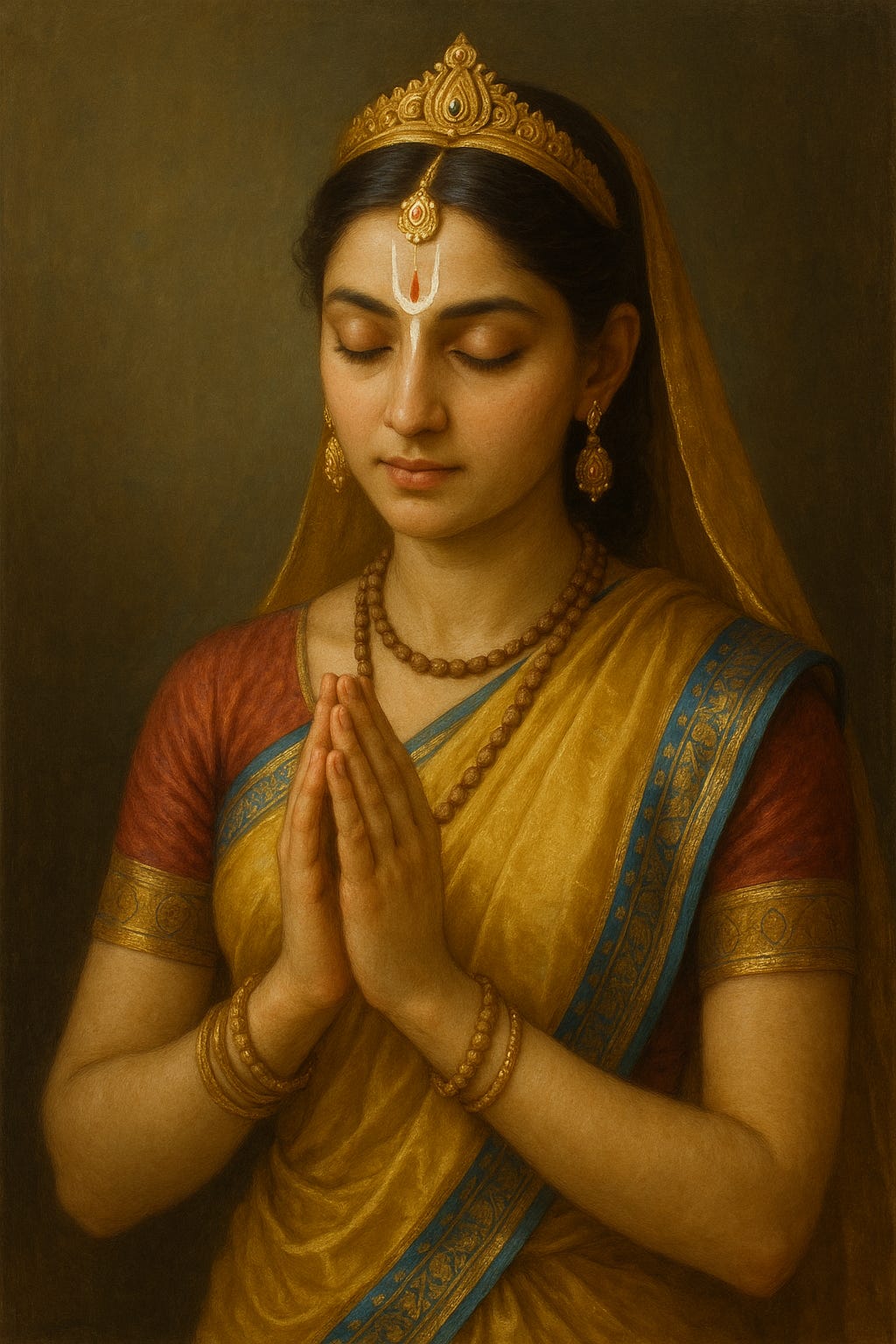
In the allegory, Malayadhvaja represents the spiritual master, and Vaidarbhī the disciple. This passage describing her actions is thus highly instructive to us.
Prabhupāda explains that although a disciple understands that the spiritual master is an individual soul, he understands that the guru is the most confidential servant of the Lord, and therefore should be treated just like the Lord. By serving the spiritual master without reservations, as Vaidarbhī did, one can automatically attain spiritual perfection.
The narration then continues, detailing the vānaprastha life, describing how Vaidarbhī became thin due to austerity and stopped combing her hair, which became entangled, just like the hair of a sage. This indicates she renounced her beauty, becoming detached from her body.
“The daughter of King Vidarbha continued as usual to serve her husband, who was seated in a steady posture, until she could ascertain that he had passed away from the body. While she was serving her husband by massaging his legs, she could feel that his feet were no longer warm and could thus understand that he had already passed from the body. She felt great anxiety upon being left alone. Bereft of her husband’s company, she felt exactly as the deer feels upon being separated from its mate.
Being now alone and a widow in that forest, the daughter of Vidarbha began to lament, incessantly shedding tears, which soaked her breasts, and crying very loudly. O best of kings, please get up! Get up! Just see this world surrounded by water and infested with rogues and so-called kings. This world is very much afraid, and it is your duty to protect her.
That most obedient wife thus fell down at the feet of her dead husband and began to cry pitifully in that solitary forest. Thus the tears rolled down from her eyes. She then prepared a blazing fire with firewood and placed the dead body of her husband upon it. When this was finished, she lamented severely and prepared herself to perish in the fire with her husband.” (SB 4.28.45-50)
Eventually, the inevitable happened. Vaidarbhī, who had already abandoned her house and grown-up children, now saw herself bereft of her only companion, the husband she had served so faithfully her whole life. She lamented for some time, but somehow found the determination to fulfill her last duty, to cremate the dead body of her husband.
Vaidarbhī meets the Lord
Although Vaidarbhī was very devoted to her husband and practiced devotional service following in his footsteps, she was still not fully Kṛṣṇa-conscious at this point. She was husband-conscious, but not exactly Kṛṣṇa-conscious. Seeing the situation, the Lord appeared to her to bring her to perfect spiritual realization. At the beginning of the allegory, there was a mention of Avijñāta, the “unknown one”, who was accompanying Purañjana since the beginning. He was there the whole time, inside his heart, but Purañjana never noticed his presence. Even when he was being dragged to hell, it didn’t cross his mind to approach his friend. However, now the Lord decided to appear to Vaidarbhī in a visible form.
This passage is also significant because it concludes the discussion about how the soul comes to this material world. Different aspects of this delicate question were described in the Second Canto, starting from the question of Parīkṣit Mahārāja on 2.8.7, and continuing through the description of the pastime of Jaya and Vijaya, the detailed explanations given by Lord Kapila, the instructions of Sanat-Kumāra, and the prayers of Lord Śiva. This discussion is now concluded with Nārada Muni describing the personal instructions of the Lord to Vaidarbhī, confirming the eternal connection of the soul with Him.
Just as in the previous passages, Prabhupāda explains in detail the conclusions of the text in his elaborate purports. Some disagree with these conclusions, but when we carefully examine this passage in the context of the previous passages of the Śrīmad-Bhāgavatam, we see that Prabhupāda is just summarizing the conclusions of the text.
“My dear King, one brāhmaṇa, who was an old friend of King Purañjana, came to that place and began to pacify the Queen with sweet words.” (SB 4.28.51)
Some have the idea that Kṛṣṇa doesn’t care about the jīvas, sending some here and some to the spiritual world in a more or less random fashion. However, this idea is clearly dismissed in the Śrīmad-Bhāgavatam. Kṛṣṇa is the friend of everyone, and the proof is that He follows each soul in their adventures in the material world, accompanying each one of us as we go from one material body to the other. No one can thus say that we are here due to the Lord’s indifference. He wants us back; the question is just for us to accept His extended hand.
As Prabhupāda explains in his purport: “The Lord is always eager to have the living entity come home, back to Godhead. Sitting with the living entity as witness, the Lord gives him all chances to enjoy himself materially, but whenever there is an opportunity, the Lord gives good counsel and advises the living entity to abandon trying to become happy through material adjustment and instead turn his face toward the Supreme Personality of Godhead and surrender unto Him.”
Each soul is endowed with free will, which Kṛṣṇa respects. It cannot be otherwise, because without free will, there is no possibility of love. Since our relationship with Kṛṣṇa is based on love, it can come only from a conscious decision on our part; it can’t be forced. The Lord continues thus to follow us from one body to another, until we are ready to turn to Him. When we are ready, He appears to us in the form of the spiritual master. It is not easy to see the Lord in His original spiritual form until one’s eyes are purified, but we can easily receive His instructions transmitted through His devotees, who are acting within this material world.
In this passage, however, the Lord appears personally to Vaidarbhī in the form of a brāhmana. How is this possible? Prabhupāda explains that one can see the Lord in the instruction of the spiritual master. We can’t directly see the Lord using our material eyes, but He can manifest to us through our faith in the instructions of the spiritual master. As Prabhupāda explains:
“When one becomes serious to follow the mission of the spiritual master, his resolution is tantamount to seeing the Supreme Personality of Godhead. As explained before, this means meeting the Supreme Personality of Godhead in the instruction of the spiritual master.”
“In conclusion, if a disciple is very serious to execute the mission of the spiritual master, he immediately associates with the Supreme Personality of Godhead by vāṇī or vapuḥ. This is the only secret of success in seeing the Supreme Personality of Godhead. Instead of being eager to see the Lord in some bush of Vṛndāvana while at the same time engaging in sense gratification, if one instead sticks to the principle of following the words of the spiritual master, he will see the Supreme Lord without difficulty.”
What did the brāhmana say to Vaidarbhī?
“The brāhmaṇa inquired as follows: Who are you? Whose wife or daughter are you? Who is the man lying here? It appears you are lamenting for this dead body. Don’t you recognize Me? I am your eternal friend. You may remember that many times in the past you have consulted Me.” (SB 4.28.52)
How is it possible that Vaidarbhī could see the Lord, if at this point she didn’t reach the perfect stage? Prabhupāda explains that while it is true that one can’t consult with the Supersoul as long as one is not free from material attachment, one can temporarily come to this platform due to the feeling of renunciation arising from the loss of a relative. Material attachments prevent us from hearing the voice of Paramātmā, but suffering and loss can bring clarity. Vaidarbhī had already become purified by serving her exalted husband, and now, the feeling of detachment due to his loss brought her even closer to the Lord, who took the opportunity to give her instructions.
Vaidarbhī had accepted her husband as her spiritual master, and as long as he was physically present, she followed his instructions. The Lord is always present in our hearts as the caitya-guru, the spiritual master within, and simultaneously He becomes visible before our eyes as the spiritual master. There is no difference between receiving instructions directly from the Supersoul or from the spiritual master, but when the spiritual master is not present, the Lord can directly guide us from inside the heart, provided we were purified by following the instructions of the spiritual master during his physical presence.
As Prabhupāda concludes in his purport: “A sincere devotee who follows the instructions of the spiritual master certainly gets direct instructions from his heart from the Supersoul. Thus a sincere devotee is always helped directly or indirectly by the spiritual master and the Supersoul. This is confirmed in Caitanya-caritāmṛta: guru-kṛṣṇa-prasāde pāya bhakti-latā-bīja. If the devotee serves his spiritual master sincerely, Kṛṣṇa automatically becomes pleased. Yasya prasādād bhagavad-prasādaḥ: by satisfying the spiritual master, one automatically satisfies Kṛṣṇa. Thus the devotee becomes enriched by both the spiritual master and Kṛṣṇa. The Supersoul is eternally the friend of the living entity and always remains with him. The Supersoul has always been ready to help the living entity, even before the creation of this material world. It is therefore stated here, yenāgre vicacartha. The word agre means “before the creation.” Thus the Supersoul has been accompanying the living entity since before the creation.”
“The brāhmaṇa continued: My dear friend, even though you cannot immediately recognize Me, can’t you remember that in the past you had a very intimate friend? Unfortunately, you gave up My company and accepted a position as enjoyer of this material world.” (SB 4.28.53)
Kṛṣṇa is one, but He becomes many through his different potencies to increase His enjoyment. Some of these expansions are svāmśa (viṣṇu-tattva) and others vibhinnāmśa (jīva). As Kṛṣṇa explains in the Gītā, the soul is not created at any point, being eternally existent, but it is explained in this way for simplicity, making clear that Kṛṣṇa is the Supreme. Although part of the spiritual potency, the jīvas are called marginal because they have free will, and thus can choose between staying in their original position of service to the Lord or rejecting it.
As Prabhupāda explains:
“The natural position of the living entity is to serve the Lord in a transcendental loving attitude. When the living entity wants to become Kṛṣṇa Himself or imitate Kṛṣṇa, he falls down into the material world. Since Kṛṣṇa is the supreme father, His affection for the living entity is eternal. When the living entity falls down into the material world, the Supreme Lord, through His svāmśa expansion (Paramātmā), keeps company with the living entity. In this way the living entity may some day return home, back to Godhead.
By misusing his independence, the living entity falls down from the service of the Lord and takes a position in this material world as an enjoyer — that is to say, the living entity takes his position within a material body. Wanting to take a very exalted position, the living entity instead becomes entangled in a repetition of birth and death. He selects his position as a human being, a demigod, a cat, a dog, a tree, etc. In this way the living entity selects a body out of the 8,400,000 forms and tries to satisfy himself by a variety of material enjoyment. The Supersoul, however, does not like him to do this. Consequently, the Supersoul instructs him to surrender unto the Supreme Personality of Godhead. The Lord then takes charge of the living entity. But unless the living entity is uncontaminated by material desires, he cannot surrender to the Supreme Lord.”
You can also donate using Buy Me a Coffee, PayPal, Wise, Revolut, or bank transfers. There is a separate page with all the links. This helps me enormously to have time to write instead of doing other things to make a living. Thanks!