

Subscribe to receive new articles by e-mail. It’s free, but if you like, you can pledge a donation:
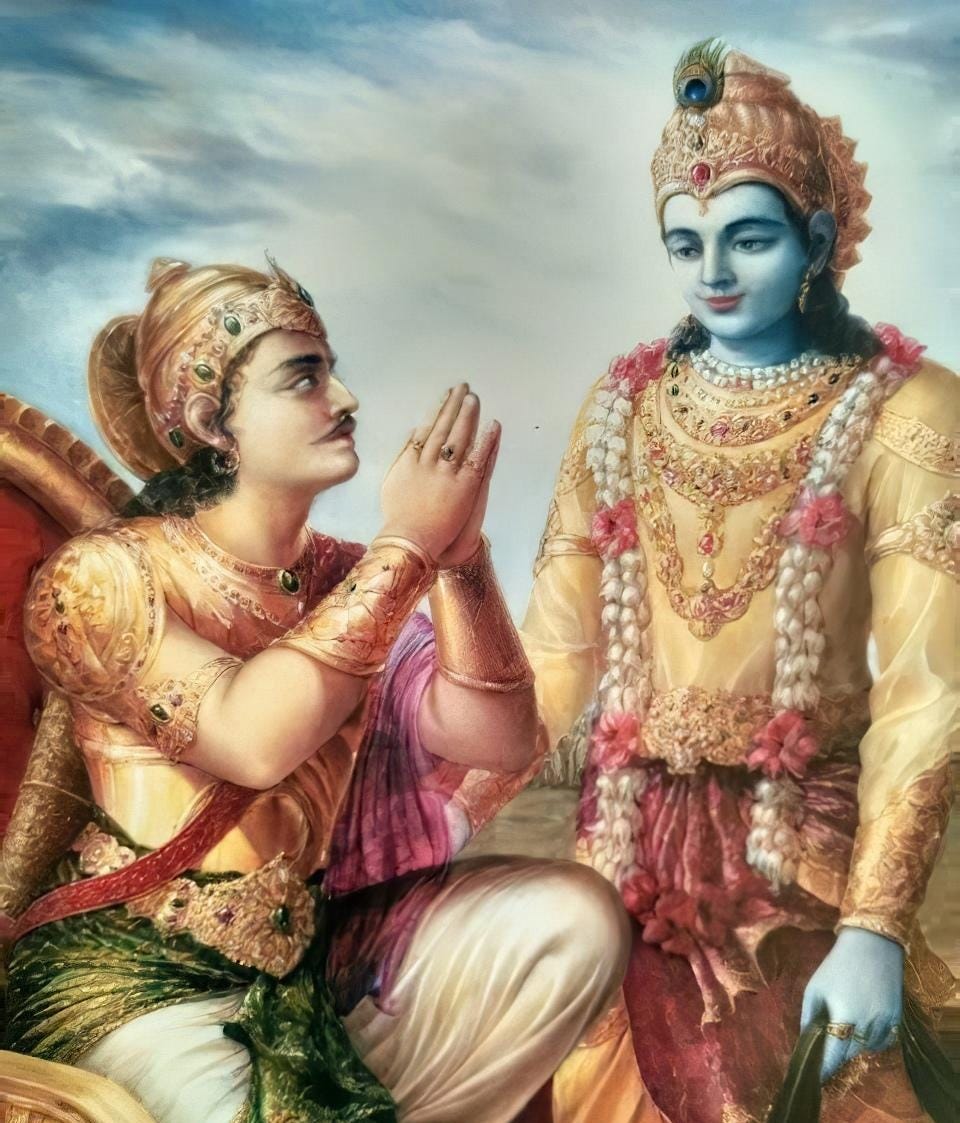
In the Bhagavad-gītā, Kṛṣṇa says: “Abandon all varieties of religion and just surrender unto Me. I shall deliver you from all sinful reactions. Do not fear.” That’s usually the verse everyone remembers, possibly because it’s one of the last verses in the Bhagavad-gītā. However, we often fail to try to understand what it really means, and as a result, we often misapply it, which can lead to serious problems in our spiritual lives.
The first problem is when we try to surrender to Kṛṣṇa without really understanding what it means. Kṛṣṇa says to Arjuna to surrender unto Him at the end of the Bhagavad-gītā, after making sure he understood the whole text. During the Bhagavad-gītā, Kṛṣṇa explains many topics, such as Karma-yoga, how to become free from the three modes of material nature, how to see Him everywhere, how to gradually control our minds and senses, how to gradually become detached while performing our material duties, and so on. Surrendering to Kṛṣṇa means understanding and following these instructions, which is impossible to do if we don’t study the whole text thoroughly. This leads us to the second problem.
Often, people who may not have a completely mature understanding of spiritual life use the verse to press others to agree with whatever understanding they have of the spiritual process. In this case, his followers may not exactly be surrendering to Kṛṣṇa, but surrendering to him as a leader and to whatever ideas he has about spiritual life. There are many who teach adulterated versions of the philosophy and tell their followers to not trust anyone apart from them.
The spiritual process is based on surrendering to Kṛṣṇa’s representative, but without understanding Kṛṣṇa’s instructions, we will not know who to surrender to. Sometimes we may be lucky to, despite our sentimentalism, come into contact with a true representative of Kṛṣṇa, but more often than not, we may end up surrendering to someone who may not be very competent in protecting us in our spiritual journey. Unqualified leaders are usually the same who have the tendency to be abusive and ostracize the followers who don’t fit into the stereotypes they are attached to.
The third problem is surrendering to an institution instead of surrendering to a person. Any institution, as perfect as it may be, is an impersonal entity. An impersonal entity can’t maintain or take care of anyone. That’s a mistake many make in their spiritual lives, surrendering to an institution with the hope that the institution will maintain them, just to become frustrated when it doesn’t. We should depend not on the institution, but on individuals inside or outside the institution whom we consider friends, mentors, gurus, and so on.
An institution can work as a shelter for this whole complex of personal relationships, but it is not sufficient in itself, just as a house can’t replace a family. Kṛṣṇa says to surrender unto Him or His representative. One can only surrender to a person, not to an impersonal entity.
Another meaning of the verse is that Arjuna was unsure about following Kṛṣṇa’s instructions because he feared the karmic reactions of fighting in the battle and killing his relatives. This is similar to our attitude when we become reluctant to follow Kṛṣṇa Consciousness out of fear of the consequences of breaking with social customs or traditions or failing to fulfill people’s expectations. We may have the desire to become more serious in our spiritual practice, but be afraid of doing it out of fear of disappointing parents, friends, or society. Kṛṣṇa assures us that He will protect us in such situations. We can see that many devotees distance themselves from unsupportive friends and relatives, just to be able to find much healthier relationships with other devotees later on, often being able to build families of their own.
Above all that, Kṛṣṇa also protects us from the results of our past karma, which is the cause of these problems in the first place. Because of our previous karma, we are put in situations that not only bring us suffering but are also more often than not unfavorable to our spiritual development. When we sincerely try to follow the spiritual process, sincerely surrendering to Him, or to His representative, Kṛṣṇa arranges for this load of karma to be minimized, creating a much brighter path for us. At the same time, He supports our spiritual growth and guides us from the heart so we can make the proper choices on our path.
Don’t forget to check my books. You can read online or download the PDFs for free.
You can also donate using Buy Me a Coffee, PayPal, Wise, Revolut, or bank transfers. There is a separate page with all the links. This helps me enormously to have time to write instead of doing other things to make a living. Thanks!