


You can receive new articles directly in your inbox. Subscription is free; donations are welcome.
Kṛṣṇa’s relationship with the material creation
There is a verse from the Nārada Pañcarātra that summarizes the process of material creation:
“For material creation, Lord Kṛṣṇa’s plenary expansion assumes three Viṣṇus. The first one, Mahā-viṣṇu, creates the total material energy, known as the mahat-tattva. The second, Garbhodaka-śāyī Viṣṇu, enters into all the universes to create diversities in each of them. The third, Kṣīrodaka-śāyī Viṣṇu, is diffused as the all-pervading Supersoul in all the universes and is known as Paramātmā. He is present even within the atoms. Anyone who knows these three Viṣṇus can be liberated from material entanglement.”
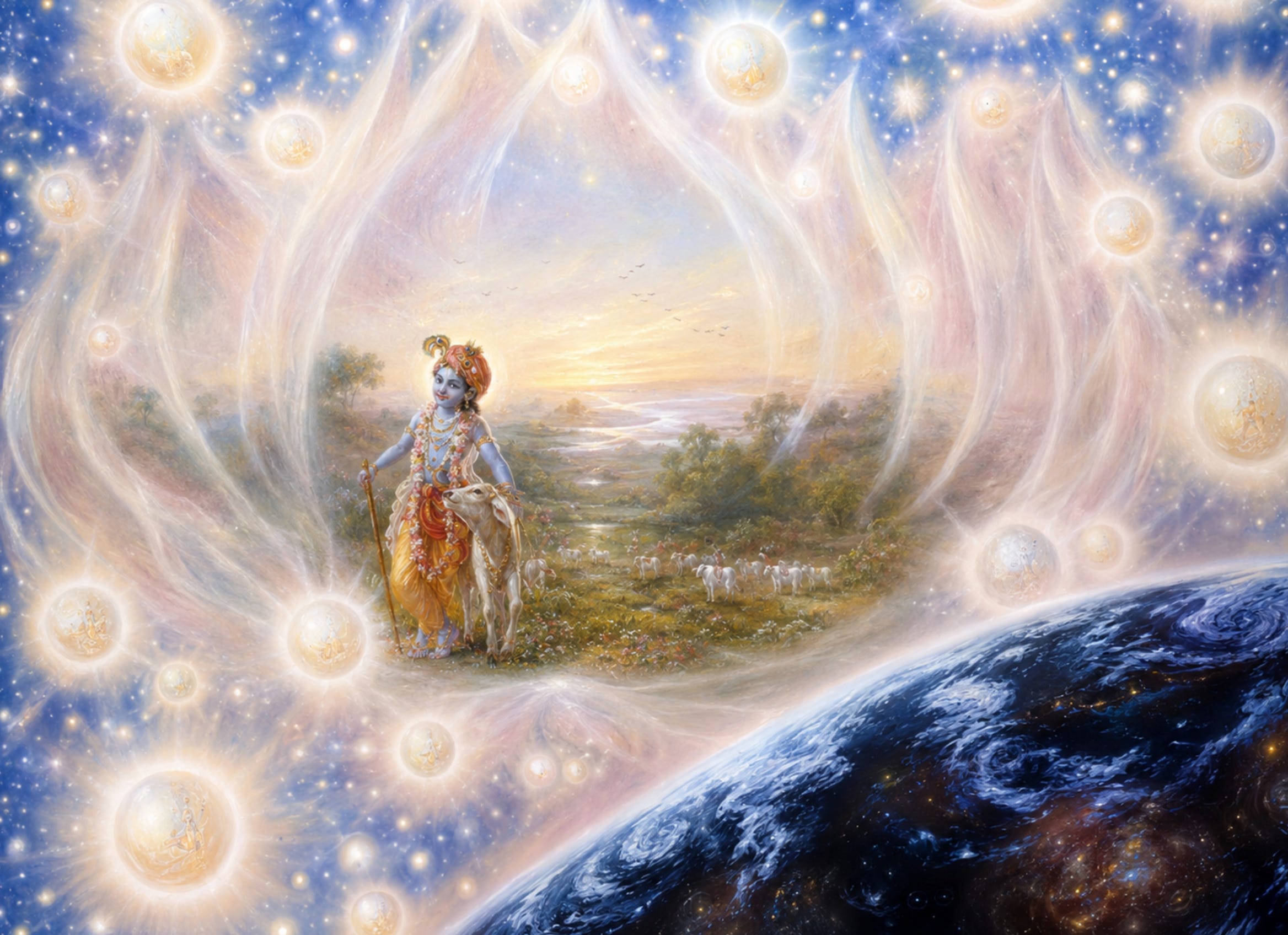
All the stars and everything else we see when we look into the sky at night are part of a single material universe, the universe created by the Brahmā of four heads. There are many other Brahmās, who create many other material universes, but we have no access to them. All these universes are collectively manifested by Mahā-Viṣnu, who lies on the causal ocean. Every time He exhales, countless universes emanate from His breath and from the pores of His body, and every time He inhales, all these innumerable universes are destroyed. The whole cosmic manifestation thus lasts just a moment from His perspective, with creation and dissolution succeeding one another in an endless cycle.
Mahā-Viṣnu activates the material potency simply by His glance, starting the process of creation. Once impregnated by this divine glance, the material potency becomes agitated, manifesting the mahat-tattva, the aggregate material principle. From successive combinations of the mahat-tattva with the three material modes, all the material elements manifest.
The same Mahā-Viṣnu who creates the shells of the universes and activates this process, expands Himself and enters into each universe as Garbhodakaśāyī Viṣnu, manifesting the cosmic lotus flower from which Brahmā appears, and as Kṣīrodakaśāyī Viṣnu (Paramātmā), becoming present everywhere, in the heart of everyone and even inside the atoms. Without His presence, nothing can function.
In the Bhagavad-gītā, 7.4, Kṛṣṇa mentions eight elements, from gross to subtle: earth, water, fire, air, ether, mind, intelligence and false ego. In chapter 13, He gives a longer list with 24 elements, and Lord Kapila gives a slightly different explanation in the Third Canto. This should not be seen as a contradiction. As He explains in the Eleventh Canto of Śrīmad-Bhāgavatam, there are many ways to count the material elements.
The classification of the elements into earth, water, fire, air, and ether may appear primitive, but this nomenclature is used by Kṛṣṇa and throughout the Vedic literature for a simple reason: this is the classification that describes matter in a way that is consistent for all levels of existence. Each of the five elements adds a property, and each property is captured by one of the senses, leading to the whole material experience. In this way, ether comes together with sound and hearing, air comes with touch and the tactile sense, fire appears together with form and vision, water appears with taste and the tongue, and earth appears together with odor and the sense of smell. Each successive element adds one new quality while retaining the qualities already manifested by the previous elements. Ether has only sound; air has sound and touch; fire has sound, touch, and form; and so on.
All living entities receive bodies composed of these five material elements and a particular combination of senses that they use to perceive the world. The structure of matter is different in different planetary systems, going from gross to subtle. We can’t expect that our limited periodic table will describe matter in the subtle planetary systems of the demigods, for example, but Kṛṣṇa’s classification of earth, water, fire, air, and ether, along with their properties, is consistent throughout the whole universe. Everywhere, people see, touch, smell, etc.
What about mind, intelligence and false ego? These are both cosmic principles and subtle material elements that form the subtle bodies of all living entities. The false ego is the force that gives us a concept of material identity, making us identify with different material bodies. The mind is a reservoir for emotions and desires, while the intelligence is the rational force that allows us to plan and act. Every time we take birth, we receive a new body formed by the five gross elements, but the subtle body stays with us for as long as we remain bound to this material world.
Material science studies only the physical elements. Because their process of obtaining knowledge is based solely on using their senses, they have no means of studying refined forms of matter, like the matter that constitutes the abodes of the demigods, much less of detecting or studying the subtle body. Even these, however, are not all:
“Besides these, O mighty-armed Arjuna, there is another, superior energy of Mine, which comprises the living entities who are exploiting the resources of this material, inferior nature.”
All humans, animals, plants, and other living beings we can find are the combinations of a material body (which includes the gross and subtle layers), and a soul, who acts using this body. The body is made from inert material energy, but the conscious self within the body belongs to the superior energy. The entire cosmic manifestation can therefore be understood as the interaction of these two energies: the material energy, which provides the field of experience (kṣetra), and the superior potency, the individual soul, who tries to enjoy it (kṣetra-jña). We are like Kṛṣṇa in the sense of sharing the same eternal, transcendental nature, but we are never like Him in terms of power. Kṛṣṇa is very big, and we are very small. Another difference is that Kṛṣṇa never falls under illusion. Vast as it may be, the material nature is just one of His potencies, and is fully under His control.
This description offers us a more detailed explanation of the concept of being independent from the body we are well familiar with, but the main point here is that both the cosmic manifestation and the souls are potencies of Kṛṣṇa. He is the foundation of both, and He is the ultimate destination of both. This understanding can help us to understand our eternal relationship with Kṛṣṇa, and also solve the apparent contradiction between Kṛṣṇa being a person and Kṛṣṇa being all-pervading. The material creation is His energy, and Paramātmā is His expansion, and therefore He is present everywhere, through His potencies. At the same time, however, He remains a distinct Supreme Person beyond the cosmic manifestation, situated in His own abode. He is thus just like the sun, which is present throughout the whole universe through the diffusion of its light and heat, while at the same time remaining in one place as a celestial body.
Go deeper:

This is a publication for thoughtful readers who want to go deeper into Kṛṣṇa consciousness. I publish daily, trying to offer high-quality spiritual content, and all posts are available to free subscribers. If you wish, you can also choose a paid subscription to support this work.
You can also receive updates on WhatsApp or Telegram.
If you would like to contribute further, you can find the donation links here.
Dear Prabhu
Can you elaborate on why the souls fall down from their original position which is with Krishna in vaikuntha ? Once the soul is back to godhead -then that is apowerdul protected position.