

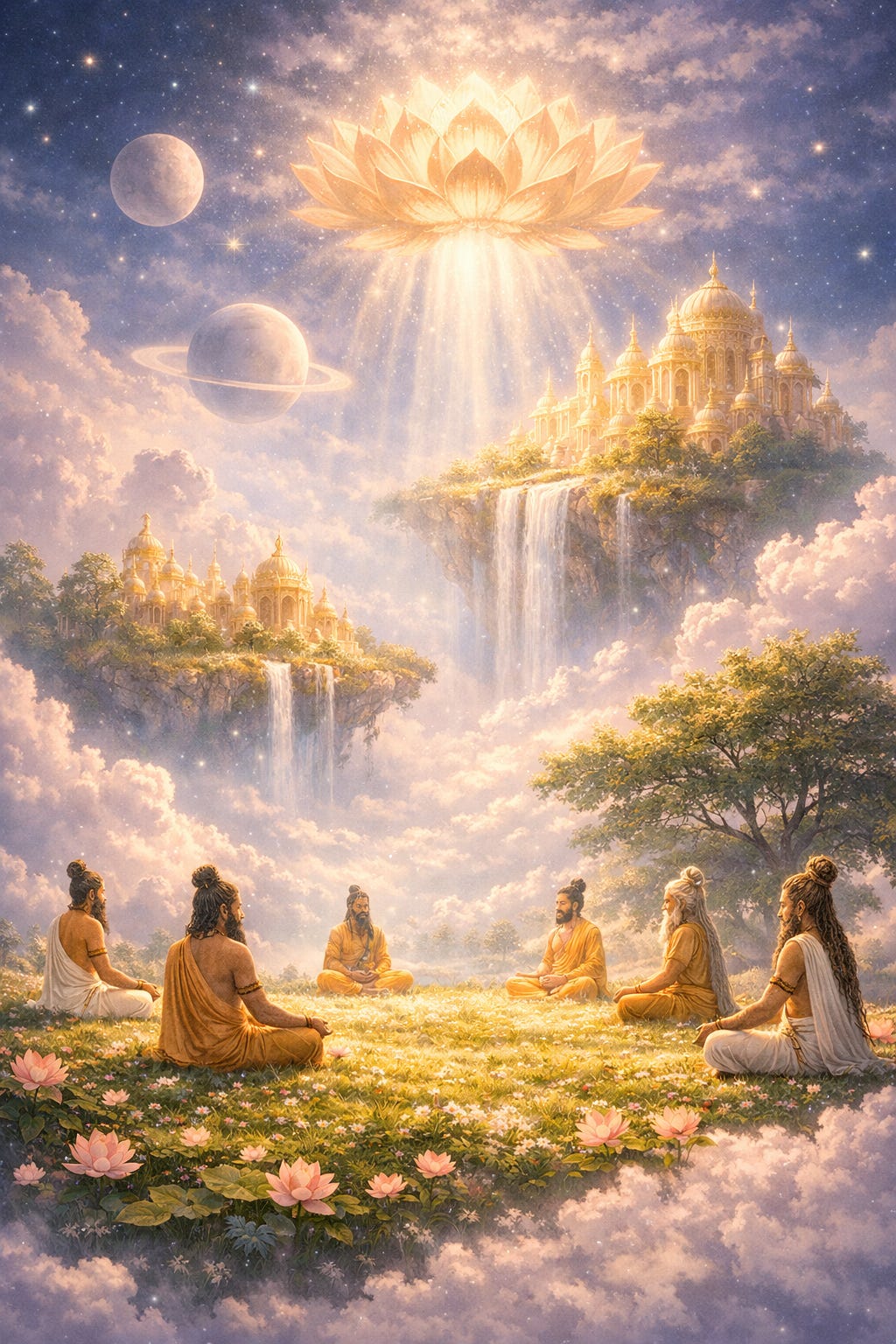
As we studied in other articles, our universe is, according to the Vedas, divided into 14 planetary systems. Beyond earth is Svargaloka, the abode of the demigods, and beyond Svargaloka are the four higher planetary systems of Maharloka, Janaloka, and Satyaloka, which survive the devastation at the end of the day of Brahmā. These extremely subtle and pious abodes will continue to exist until the final devastation at the end of the universe.
The Śrīmad-Bhāgavatam does not give us many details about life there, but we can find a first-hand description in the Bṛhad-bhāgavatāmṛta, describing the experience of Gopa-kumāra in visiting these four abodes in his journey to Goloka Vṛndāvana.
In the second part of the book, Gopa-kumāra visits Svargaloka, where he has the opportunity of becoming Indra and worshiping the Lord in opulence, together with the different demigods. Coming from earth, he was at first not aware that there was something higher. One day, however, something unusual happened: a group of great sages arrived unexpectedly, headed by Bhṛgu. They were coming from Maharloka en route to earth, and thus made a stop there.
All the demigods and celestial sages, including Bṛhaspati himself, worshiped them. After they left, Gopa-kumāra inquired:
“The demigods are worshiped by men, but who were those persons worshiped even by the demigods? What makes them so great? Where do those effulgent persons live?” Jealous and proud, the demigods were embarrassed to tell me. But our guru then spoke.
Śrī Bṛhaspati said: Above this realm shines the world called Maharloka, attainable through the best of pious works. Even when the three worlds are annihilated, that world is not destroyed. As the happiness of Indra is considered millions of times greater than that of a ruler on earth, the happiness of a Prajāpati is millions of times greater than Indra’s.
Endowed with such happiness, the Prajāpatis live on Maharloka enjoying the greatest pleasures and directly worshiping in various places the Lord of sacrifice, who is there in person as their master.” (BB 2.2.40-44)
As he had done before, he chanted the Gopāla-mantra of ten syllables given by his spiritual master with this purpose, and was quickly elevated there.
Maharloka is an extremely subtle abode, almost completely free from the influence of the modes of passion and ignorance. This is the abode of the Prajāpatis, the great universal progenitors. These are great brāhmana sages, like Kaśyapa, Marīci, Atri, Aṅgirā, Pulastya, Pulaha, Kratu, Bhrgu, Vasiṣṭha, and others, who peacefully live with their consorts, performing sacrifices for the satisfaction of Lord Viṣnu.
Different from Svargaloka, however, which is a place for sense gratification, Maharloka is a place for souls free of gross sensual desires and lower qualities, who are on the path of liberation. The family life of these great sages is centered around their duties, and they engage themselves in sexual life only to beget good progeny when it is necessary to populate the universe. As a result, there is no quarrel or material misery there; everyone simply worships the Lord without selfish motives, and all material necessities are fulfilled automatically.
Although the main practice in Maharloka is ritual sacrifices, these are not fruitive sacrifices. The inhabitants offer oblations to the fire with an attitude of devotional service and transcendental love, and the Lord appears personally to accept their offerings as Yajñeśvara, the Lord of sacrifice, and give them back the prasāda. The same Lord accepts the offerings of the sacrifices performed in the lower planetary systems, but there He is not directly seen. This is the special privilege of the inhabitants of Maharloka, who live in great bliss. Although they have no desire to go back to the sensual platform, they periodically visit other planetary systems, including earth, to transmit spiritual knowledge or to perform austerities.
What is the life expectancy of the great sages in Maharloka? Nominally, they live for up to 4.32 billion years, a full day of Brahmā, until the fire of devastation destroys the planetary systems below, and makes their abode too hot for comfort. In practice, however, they are deathless, because when the fire of devastation comes, they can move to Janaloka, the next planetary system. From there, they can continue progressing, up to Satyaloka, where they remain until the end of the life of Brahmā, and have the opportunity of attaining liberation together with him.
Gopa-kumāra remained in Maharloka in the company of the sages until the end of the day of Brahmā and moved to Janaloka together with them.
On earth, the days and nights follow the daily movement of the Sun. In Svargaloka, they follow the annual movement, and thus one year for us is just a day for them. Maharloka, however, is composed of luminous planets, and therefore there are no nights. The sages remain active during the whole day of Brahma, performing sacrifices without interruption.
In Janaloka there is also no night in the sense of darkness, but during the night of Brahmā, Garbhodakaśāyī Viṣṇu performs his pastime of sleeping. Since all activities there are performed for the satisfaction of the Lord, when He goes to sleep, all activities and sacrifices stop. The sages have thus to wait during this long night to start their sacrificial performances again in Brahma’s next morning.
When Brahma awakens in his next day, he recreates the planetary systems that were destroyed, and prajāpatis return from Janaloka to Maharloka to repopulate the universe.
The Bṛhad-bhāgavatāmṛta does not provide many details about Janaloka, but in his commentary, Sanātana Goswami mentions that since the residents of Maharloka frequently travel to Janaloka, the two planets are practically a single system. The sages in Janaloka are also householders and perform fire sacrifices. The main difference is that Janaloka is sufficiently far from the bottom of the universe to not be affected by the fire of annihilation.
At the end of each Manvantara, when the demigods conclude their duties, they are generally elevated to Maharloka. Others, who are able to attain the necessary standard of piety and sense control, also gradually join the planetary system. At the end of the day of Brahmā, they move to Janaloka due to the heat of the fire of devastation. Some return with the beginning of the next day of Brahmā to act as prajāpatis, but the majority remain there, gradually advancing to Satyaloka.
Once one reaches Janaloka, there is no more death. One can live until the end of the universe, serving the Lord and developing his devotional sentiments unimpeded.
What about Tapoloka?
Different from Maharloka and Janaloka, inhabited by householders who perform sacrifices, Tapoloka is the abode of great yogis, who remain most of the time in samādhi, emerging only rarely to hold philosophic discussions.
There is no sexual life there. The qualification for entering Tapoloka is that one has to remain a lifelong celibate, fully controlling his senses while on earth. Souls who attain this planetary system also don’t take birth there by sexual union; they simply ascend there in their subtle bodies, and attain the forms of divine ascetics. That’s a very pure and subtle abode, almost free from the influence of the material modes, inhabited by great mystics, like Kavi, Havis, Antarikṣa, Prabuddha, and Pippalāyana, led by the four Kumāras.
Satyaloka, the highest planetary system in this universe, it is an extremely subtle abode, where there is no material suffering, no sorrow, no old age, no death, no pain, and no anxiety. In fact, Śrīmad-Bhāgavatam describes that the only suffering the inhabitants experience is compassion for the inhabitants of the other planetary systems, who live in difficult material conditions. To attain this planetary system, one has to practice his duties in the Varnāśrama system flawlessly for 100 lives.
Satyaloka, however, is not just a paradise where people spend their time uselessly. The planetary system is constantly in activity, with a constant stream of the longest and most elaborate Vedic sacrifices being performed, under the supervision of the personified Vedas. These are, however, not fruitive sacrifices as performed on earth or in Svargaloka. These are sacrifices performed in the original meaning, as devotional offerings to the Lord. Just as in Maharloka and Janaloka, the Lord appears personally from the sacrificial fire to accept their offerings, but there He manifests even more of His transcendental qualities. Because the Lord appears in so many forms, it is said that He has thousands of hands and legs. Even during the night, when Lord Garbhodakaśāyī Viṣnu goes to sleep accompanied by Brahmā, these great sages come together with the inhabitants of Tapoloka and Janaloka to offer prayers to the Lord.
Inhabitants of Satyaloka live until the end of the life of Brahmā. There is a negative, however: they have to remain in this material world for a very long period. They thus glorify devotees from earth, who can attain love of godhead in just a short life.
Their liberation at the end of the life of Brahmā is also not sure. Even though Brahmā is always a devotee, sometimes he thinks he is independent of the Lord, or that he is an incarnation of the Lord, equal with Him. In this case, Brahma does not go back to Godhead. He reaches Mahā-Viṣnu in the causal ocean at the end of his life, but has to come back for another cycle of creation. In this case, all the inhabitants of his planet also have to come back. Similarly, some of his followers may think that Brahmā is independent of the Lord, or that they themselves are one with the Lord. In this case, they also can’t attain liberation, even if Brahmā goes back to Godhead. As long as one has separate interests from the Lord, one can’t reach the spiritual planets. Even if he attains impersonal liberation in the Pradhāna or the impersonal Brahmajyoti, he has to eventually come back.
This is a publication for thoughtful readers who want to go deeper into Kṛṣṇa consciousness. I publish daily, trying to offer high-quality spiritual content, and all posts are available to free subscribers. If you wish, you can also choose a paid subscription to support this work.
You can also receive the updates on WhatsApp or Telegram.
If you would like to contribute further, you can find the donation links here.