


⤴️ There is a narration of the article in my voice. You have the option to hear it instead of reading.
You can receive new articles directly in your inbox. Subscription is free; donations are welcome.
There are three verses in the eighth chapter of the Bhagavad-gītā that can sound puzzling:
“O best of the Bhāratas, I shall now explain to you the different times at which, passing away from this world, the yogī does or does not come back. Those who know the Supreme Brahman attain that Supreme by passing away from the world during the influence of the fiery god, in the light, at an auspicious moment of the day, during the fortnight of the waxing moon, or during the six months when the sun travels in the north. The mystic who passes away from this world during the smoke, the night, the fortnight of the waning moon, or the six months when the sun passes to the south reaches the moon planet but again comes back.” (Bg 8.23-25)
It’s easy to understand the concept that our consciousness at the time of death determines our next destination, because one life is the continuation of the previous, just like chapters in a book. The next chapter is supposed to continue from the point the last one finished. Our thoughts during life culminate in our thoughts at the final moment, which in turn lead us to our next life, where we will continue to act on these thoughts.
Here, however, Kṛṣṇa appears to suggest something else: that the time of death determines one’s destination. How does it work?
The first point here is that these three verses do not apply to devotees. At this point of the Gītā, Kṛṣṇa already explained the situation of the devotee who goes back to Godhead at the end, simply by always remembering Him:
“For one who always remembers Me without deviation, I am easy to obtain, O son of Pṛthā, because of his constant engagement in devotional service. After attaining Me, the great souls, who are yogīs in devotion, never return to this temporary world, which is full of miseries, because they have attained the highest perfection.” (Bg 8.14-15)
So who does Kṛṣṇa describe in these three verses about the time of passing? Here He describes the paths adopted by other followers of the Vedas.
The first, described in text 8.24, is the path of arci (light), the bright path associated with the mode of goodness, by which one ascends through a succession of demigods. This is the path for jñānis and yogīs who aim to attain the impersonal Brahman. To take this path, one has to leave his body under the appropriate conditions, beginning with the influence of Agni, the presiding deity of fire. In this path, each demigod takes the yogī up to a certain point and hands him over to the next until he reaches his destination.
Prabhupāda explains it in his purport:
“When fire, light, day and the fortnight of the moon are mentioned, it is to be understood that over all of them there are various presiding deities who make arrangements for the passage of the soul. At the time of death, the mind carries one on the path to a new life. If one leaves the body at the time designated above, either accidentally or by arrangement, it is possible for him to attain the impersonal brahma-jyotir. Mystics who are advanced in yoga practice can arrange the time and place to leave the body. Others have no control – if by accident they leave at an auspicious moment, then they will not return to the cycle of birth and death, but otherwise there is every possibility that they will have to return.”
To take this path, one has to leave his body at an appropriate time, when the influences of the relevant presiding demigods are favorably aligned. This adds a substantial layer of difficulty to the task of the mystic yogī. Apart from focusing his mind, moving the vital air, and so on, a yogī has to be concerned about the right time to leave his body, for, if he misses the auspicious time to take the path of light, he may ascend to a certain point, but will have to return. His practice of yoga, thus, increases his chances, because he can choose the time, but does not eliminate his dependency on the cooperation of the demigods.
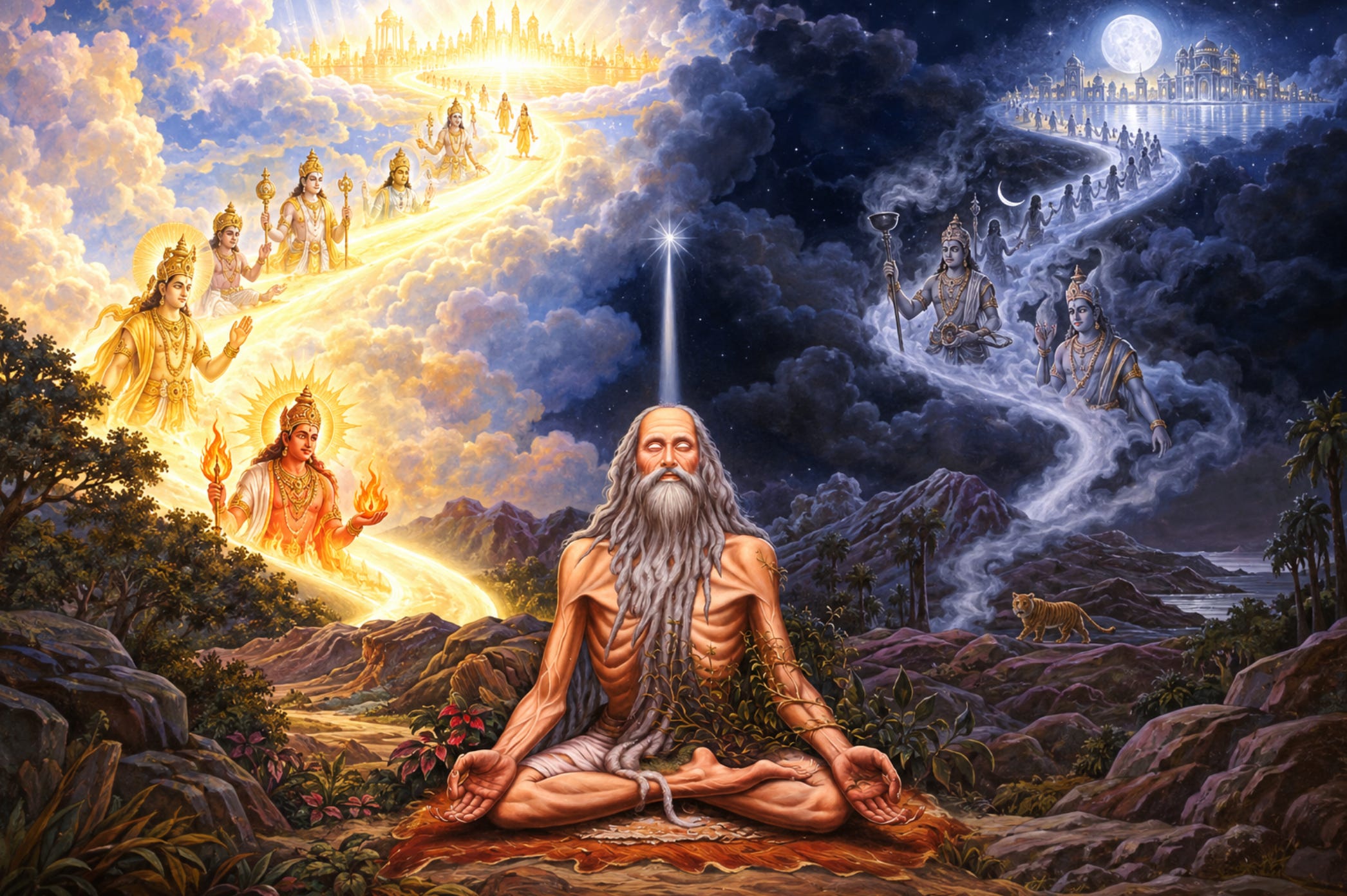
Two other classes are less advanced yogīs, who have not mastered leaving their bodies at the time of their choosing, and jñānis who know Brahman (brahma-vit). These two may understand the goal, but they have no control over the time of death. Their destination is thus uncertain. If they die at the appropriate moment, they may still attain liberation, but if they miss it, they may go up to the celestial planets but will have to eventually return to earth for another go.
Another limitation of this path is that it leads only up to the impersonal brahmajyoti. This is as far as one may go through an independent process. Only those who develop their devotional service can go past this point in the direction of the spiritual planets. One may thus become free from birth and death, but the supreme destination is not reached.
Text 8.25 describes another path, which is taken by karmīs, who follow the path of fruitive sacrifices prescribed in the Vedas. Just as in the previous verse, “smoke,” “night,” and so on refer to the presiding demigods of these times. Again, one has to pass away at the appropriate time to be elevated up to Candraloka, the moon, where they can enjoy heavenly life for 10,000 celestial years. After this, however, they come back to earth.
Although recommended in passages of the Vedas for ordinary materialistic people, this path of worship of demigods and forefathers with the goal of enjoying fruitive results is condemned by Lord Kapila in the Śrīmad-Bhāgavatam, because it simply makes one go up and down. Until one surrenders to Kṛṣṇa, there is no ultimate salvation.
We thus have two sets of times corresponding to two different paths. Text 8.23 mentions the time of departure (kāla), and text 8.26 mentions the paths of light and darkness (śukla-kṛṣṇe gatī). Kṛṣṇa thus describes the paths for the celestial planets and to liberation, and the appropriate times at which their followers have to depart to achieve the fruits they desire, with the cooperation of the demigods. By the bright path, one can achieve liberation, and through the dark path, one can reach the celestial planets and later return.
What about devotees? Kṛṣṇa explains: “Although the devotees know these two paths, O Arjuna, they are never bewildered. Therefore be always fixed in devotion.”
Devotees know the paths of karma and jñāna, as well as the path of mystic yoga. They are discussed in the Bhagavad-gītā and other scriptures. However, they are not bewildered by them. They do not think that there is something else to be gained by these processes that one does not attain by simply serving Kṛṣṇa. As Kṛṣṇa mentions in chapter two of the Gītā, all purposes served by many small wells are immediately served by a great reservoir of water. Similarly, one who becomes fixed in Kṛṣṇa consciousness automatically obtains whatever genuine benefit these lower paths are meant to provide while advancing toward the supreme goal.
Pure devotees, however, are not dependent on either path. They attain the supreme abode not due to personal arrangement, nor due to the influence of demigods. Instead, Kṛṣṇa Himself takes charge and arranges for their deliverance. That’s how they can attain a destination that is beyond the reach of both karmīs and jñānīs. Kṛṣṇa uses the word yoga-yuktaḥ, fixed in yoga, emphasizing the point that being firmly engaged in devotional service is the true yoga, the true connection with Him. Such a pure devotee is directly under the protection of Kṛṣṇa, who can directly bring His devotee back to Godhead without depending on demigods.
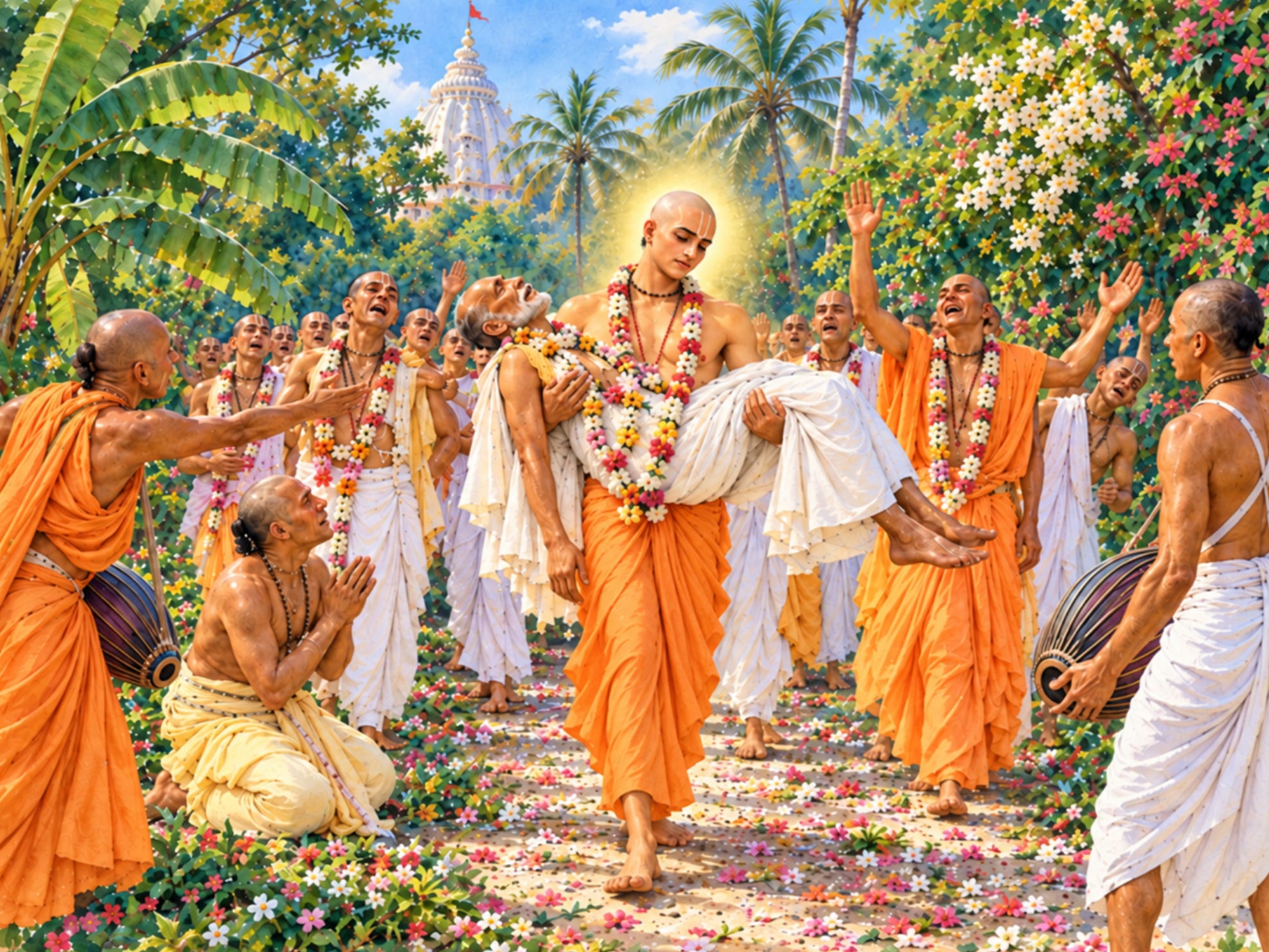
In the Bṛhad-bhāgavatāmṛta, we find the description of Gopa-kumāra attaining perfection in his love of Godhead and being transported to Goloka, the supreme abode. Kṛṣṇa appeared personally to him, and when He disappeared, Gopa-kumāra became so overwhelmed with spiritual emotion that he fell into the Yamuna. From there, a mysterious spiritual vehicle carried him to Goloka in just a moment.
“Then the crest jewel of all who are merciful appeared before me. With His own lotus hand, a hand cool like nectar and always pleased to hold His flute, He wiped the dust from my limbs. It wasn’t easy, but that greatest of cheats playfully stirred me back to consciousness by filling my nostrils with His unique heady fragrances, which I had never known before.
Then, seeing His lotus face, I quickly stood up. Not knowing what I was doing, my heart filling with joy, I tried to catch hold of His splendid yellow cloth. That king of charming heroes blew His flute in His own playful way and escaped behind me. Suddenly He stepped into a grove. And — alas! – though I ran about looking, I couldn’t find Him.
He had disappeared. Unable to see Him, I fainted and fell into the swift current of the Yamunā. And as it forcefully carried me away, I seemed to regain normal awareness and looked around.
I saw myself being transported to another place, along some wonderful path, by a vehicle flying faster than the mind and higher than one could imagine. Collecting my wits, I was amazed to see I was passing through Vaikuṇṭha-loka, and going beyond. I watched with great delight as I passed Ayodhyā and other realms. I arrived at the shining world above all others – Śrī Goloka, which I had long aspired to reach.”
There is no mention of him having to practice mystic-yoga, calculate the time of his death, or depend on the disposition of the demigods. In text 8.23, Kṛṣṇa speaks about kāla, the particular time at which one should depart; in text 8.27, however, His instruction to the devotee is sarveṣu kāleṣu – at all times. The karmī, jñānī, and mystic yogī have to consider the appropriate time of departure, but the devotee has a different concern: he simply remains yoga-yukta, connected with Kṛṣṇa, at every moment. In other words, instead of trying to leave at an auspicious moment, he makes his whole life auspicious by always remembering and serving Kṛṣṇa.
Read more:


This is a publication for thoughtful readers who want to go deeper into Kṛṣṇa consciousness. I publish daily, trying to offer high-quality spiritual content, and all posts are available to free subscribers. If you wish, you can support this work with a monthly contribution. When you subscribe, you can choose between a free subscription and a monthly contribution, and you can switch from a free subscriber to a supporter at any time.
You can also receive updates on WhatsApp or Telegram.
If you would like to contribute further, you can find the donation links here.