

Subscribe to receive new articles by e-mail. It’s free, but if you like, you can pledge a donation:
🔉 Audio of the lesson »
🎙Podcast (Search for “Mysteries of the Vedas” on Spotify, iTunes, etc. to hear all the lessons
Check this post if you would like to join the live lessons. This course is maintained with your donations. Click here to donate.
💬 Text of the lesson
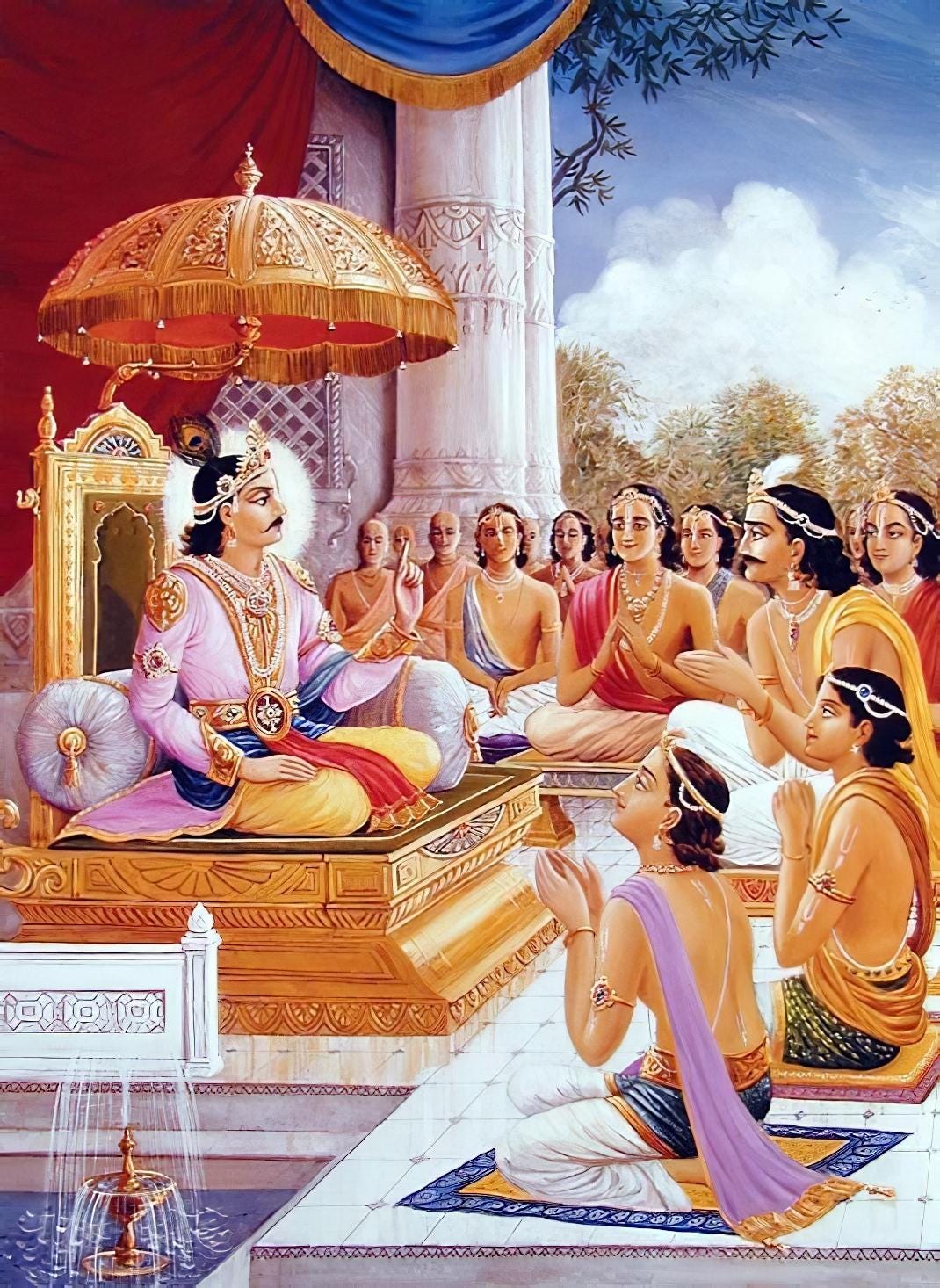
Lord Ṛṣabhadeva instructs His sons
We come then to the central part in this section of the Śrīmad Bhāgavatam, describing the teachings of Ṛṣabhadeva to His sons:
“Once while touring the world, Lord Ṛṣabhadeva, the Supreme Lord, reached a place known as Brahmāvarta. There was a great conference of learned brāhmaṇas at that place, and all the King’s sons attentively heard the instructions of the brāhmaṇas there. At that assembly, within the hearing of the citizens, Ṛṣabhadeva instructed His sons, although they were already very well-behaved, devoted and qualified. He instructed them so that in the future they could rule the world very perfectly. Thus he spoke as follows.” (SB 5.4.19)
Prabhupāda defines these instructions as a description of bhāgavata-dharma, religious principles in devotional service that transcend religious principles for liberation and the mitigation of material misery. In other words, they transcend ordinary Vedic teachings, bringing the hearer directly to the platform of Krsna Consciousness. That’s the reason they are included in the Śrīmad Bhāgavatam. As Prabhupāda mentions, these instructions of Ṛṣabhadeva were not exactly meant for His sons, because they were already very advanced in knowledge. They were meant to elevate transcendentalists, especially those on the path of jñana, to the platform of devotional service to the Lord.
The importance of the human form of life
“Lord Ṛṣabhadeva told His sons: My dear boys, of all the living entities who have accepted material bodies in this world, one who has been awarded this human form should not work hard day and night simply for sense gratification, which is available even for dogs and hogs that eat stool. One should engage in penance and austerity to attain the divine position of devotional service. By such activity, one’s heart is purified, and when one attains this position, he attains eternal, blissful life, which is transcendental to material happiness and which continues forever.” (SB 5.5.1)
The soul is blissful by nature, but in material life, this original nature is covered. We look thus for pleasure outside, connected with the senses and the sense objects. All forms of life share this same search for sense satisfaction, but human life is supposed to be different.
The first point raised by Ṛṣabhadeva is thus to establish that sense gratification is not the goal of life. Instead, he offers a positive alternative: We should act according to superior advice in order to attain eternal happiness, returning to our original blissful condition, back home, back to Godhead.
Spiritual advancement means voluntarily accepting some inconveniences for a higher purpose. In any case, no one can live comfortably in this material world; there is always suffering and anxiety caused by factors that are beyond our control. To just maintain a small apartment and be able to eat three meals a day, a person often has to travel two hours in an uncomfortable train early in the morning, work eight hours or more facing all kinds of pressure, and then come back in the same train, late a night, traveling for two hours more, hoping to catch some sleep, just to repeat the same in the next day. In such a life, one is not even conditioned by material happiness, but by the mere hope of some future happiness that will probably never come.
Instead of living a life of illusion, just to lose everything at the end, it is better to accept some voluntary austerity that will purify us from the material influence and bring us back to our original, healthy condition. As Prabhupāda mentions, “every living entity is trying to enjoy happiness, but as long as one is encaged in the material body he has to suffer different kinds of misery. A higher sense is present in the human form. We should act according to superior advice in order to attain eternal happiness and go back to Godhead.”
Human life starts from the point one inquires about self-realization. All forms of animal and plant life can enjoy their senses, but only human beings have superior intelligence that can be used to inquire about the goal of life. This intelligence should be used to find a solution to the real problems of life, to understand the absolute truth, and find our way out of material entanglement.
This first verse of Ṛṣabhadeva transmits to us three ideas that are conveniently divided by Śrīla Prabhupāda into three separate sentences in his translation.
a) Having received the human form of life, we should not waste our intelligence in the same pursuit of sense gratification as in animal life.
b) What is the alternative? We should engage in penance and austerity to attain the divine position of devotional service.
c) What is the result of this path? Our heart is purified, and we attain eternal blissful life, transcendental to material happiness and distress.
The path to eternal happiness
How can we escape the path of illusion and find this path that brings us to eternal happiness? This is explained in the second verse:
“One can attain the path of liberation from material bondage only by rendering service to highly advanced spiritual personalities. These personalities are impersonalists and devotees. Whether one wants to merge into the Lord’s existence or wants to associate with the Personality of Godhead, one should render service to the mahātmās. For those who are not interested in such activities, who associate with people fond of women and sex, the path to hell is wide open. The mahātmās are equipoised. They do not see any difference between one living entity and another. They are very peaceful and are fully engaged in devotional service. They are devoid of anger, and they work for the benefit of everyone. They do not behave in any abominable way. Such people are known as mahātmās.” (SB 5.5.2)
In the previous passage, Parīkṣit Maharaja had argued that a materialistic person never comes to the path of devotional service. As Śukadeva Goswami stated, this is generally true, but there is a way out: association with great souls.
Ṛṣabhadeva defines this as mahat-sevām, service to the spiritually advanced persons called mahātmās. Prabhupāda clarifies that there are two types of mahātmās: the devotee and the impersonalist. By “impersonalist”, he means a Brahmavādī, who is more attracted to the impersonal aspect, but doesn’t have an offensive attitude.
The goal may be different, but both groups follow the same basic process to get out of the material clutches. By associating with them and offering some service, one can become situated on the same path. Simultaneously, one should avoid the association of materialistic persons, so as not to be again swayed into the path of illusion. This second verse brings thus a positive (something to do) and a negative, something to avoid.
How can we find such mahātmās? We can recognize them for their qualities:
a) The first is that they are equipoised, not discriminating one living entity over the other based on the external body. This is the symptom one is situated in the platform of knowledge that comes from contact with the mode of goodness. As Krsna explains in Bg 18.20, “That knowledge by which one undivided spiritual nature is seen in all living entities, though they are divided into innumerable forms, you should understand to be in the mode of goodness.” This knowledge in goodness contrasts with knowledge tinged by passion, in which one sees difference based on the external body. A transcendentalist in the intermediate stage will discriminate based on practical factors (he will not try to embrace a tiger, for example), but not consider one less important or less worthy than the other.
b) The second factor is that they are peaceful, which shows they are free from material desires. Because they have achieved this freedom, they can also exhibit the third factor: they are fully engaged in devotional service.
c) Another symptom that they are free from the influence of the mode of passion is that they are devoid of anger. Of course, they are also free from ignorance, and thus they work tirelessly for the benefit of others and don’t act in any abominable way.
The influence of the mode of goodness is not always easy to spot, because the peaceful nature of goodness can often be confused with the lethargy of the mode of ignorance. The mode of ignorance, however, comes accompanied by many negative habits that are absent from goodness. Another difference is that goodness includes being enthusiastic in performing spiritual practice and spiritual welfare activities, which are, again, absent in the mode of ignorance. The presence of the mode of goodness is important because only from goodness can one eventually transcend the material modes.
Decreasing the material fever
“Those who are interested in reviving Kṛṣṇa consciousness and increasing their love of Godhead do not like to do anything that is not related to Kṛṣṇa. They are not interested in mingling with people who are busy maintaining their bodies, eating, sleeping, mating and defending. They are not attached to their homes, although they may be householders. Nor are they attached to wives, children, friends or wealth. At the same time, they are not indifferent to the execution of their duties. Such people are interested in collecting only enough money to keep the body and soul together.” (SB 5.5.3)
Materialists are constantly increasing the material fever by making more and more arrangements that increase their entanglement in this material world. By associating with other materialists, they just become more and more determined on this path. A devotee, however, should do the opposite, decreasing the fever by the cultivation of detachment.
One trap we often fall into is confusing detachment with aversion. Aversion is material, just the other side of attachment. Just as a coin has two sides, the material duality is composed of attachment and aversion, and both condition us to this material world. Detachment means to be neutral, without attachment or aversion. To emphasize this, Ṛṣabhadeva mentions that such transcendentalists are not indifferent to the execution of their duties.
In general, we come to a certain position in life according to our previous material attachments. If one is a married man, it generally means he has an attachment to women and family life. If it were different, why would he have entered family life in the first place? The path for becoming detached passes thus through the regulated process of performing duties with a detached mindset, as we learn in the Bhagavad-gītā. Performing our duties, however, does not mean going back into the path of unlimited economic development. To balance this, Ṛṣabhadeva mentions we should only collect enough money to keep the body and soul together, or, in other words, maintain the material situation according to our prescribed duties, without, however, making new arrangements to expand our material footprint.
Prabhupāda adds an extra dimension in his purport, adding that whatever money we obtain should be used to increase our spiritual practice, instead of sense gratification. In other words, we should accept what is favorable to the development of our devotional service, and reject things that may jeopardize it: “As indicated herein, a householder should endeavor to earn money for the execution of bhakti-yoga — śravaṇaṁ kīrtanaṁ viṣṇoḥ smaraṇaṁ pāda-sevanam/ arcanaṁ vandanaṁ dāsyaṁ sakhyam ātma-nivedanam. A householder should lead such a life that he gets full opportunity to hear and chant. He should worship the Deity at home, observe festivals, invite friends in and give them prasāda. A householder should earn money for this purpose, not for sense gratification.”
We thus have a set of instructions that should be balanced:
a) We should avoid material attachment, without falling into aversion.
b) For that purpose, we should perform our prescribed duties in a spirit of detachment, as an offering to the Lord.
c) We should be satisfied with maintaining the status quo, instead of increasing our material entanglement.
d) We should cultivate simplicity, earning just what is necessary, and using the results of our work to practice and spread Krsna Consciousness.
The trap of pious activities
“When a person considers sense gratification the aim of life, he certainly becomes mad after materialistic living and engages in all kinds of sinful activity. He does not know that due to his past misdeeds he has already received a body which, although temporary, is the cause of his misery. Actually the living entity should not have taken on a material body, but he has been awarded the material body for sense gratification. Therefore I think it not befitting an intelligent man to involve himself again in the activities of sense gratification by which he perpetually gets material bodies one after another.” (SB 5.5.4)
Sense gratification is never free. Not only do we have to work to secure the material facilities we need for trying to satisfy material desires, but we also have to deal with the unavoidable sinful reactions of such work. These results don’t appear immediately, but boil under the surface, creating the conditions for future suffering. The body we have now is already the result of past material activities, and by acting materially now, we produce another body that will imprison us in the future.
Generally, sense enjoyment is based on gross or subtle editions of four activities: illicit sex, meat-eating, intoxication, and gambling, which are condemned, because they just produce future misery. Our tendency to perform these activities increases when we associate with materialists; therefore, the only way out is to associate with devotees who understand the goal of life, the mahātmās mentioned by Ṛṣabhadeva in the second verse.
Śrī Caitanya Mahāprabhu expands these instructions in his teachings to Sanātana Gosvāmī:
“‘The spiritually powerful message of Godhead can be properly discussed only in a society of devotees, and it is greatly pleasing to hear in that association. If one hears from devotees, the way of transcendental experience quickly opens, and gradually one attains firm faith that in due course develops into attraction and devotion.’”
“A Vaiṣṇava should always avoid the association of ordinary people. Common people are very much materially attached, especially to women. Vaiṣṇavas should also avoid the company of those who are not devotees of Lord Kṛṣṇa.”
“Without hesitation, one should take exclusive shelter of Lord Kṛṣṇa with full confidence, giving up bad association and even neglecting the regulative principles of the four varṇas and four āśramas. That is to say, one should abandon all material attachment.”
“Lord Kṛṣṇa is very kind to His devotees. He is always very grateful and magnanimous, and He possesses all abilities. A learned man does not give up Kṛṣṇa to worship anyone else.”
“When a devotee thus fully surrenders unto Kṛṣṇa’s lotus feet, Kṛṣṇa accepts him as one of His confidential associates.” (CC Madhya 22.86,87,93,95,102)
Rṣabadeva thus continues:
“As long as one does not inquire about the spiritual values of life, one is defeated and subjected to miseries arising from ignorance. Be it sinful or pious, karma has its resultant actions. If a person is engaged in any kind of karma, his mind is called karmātmaka, colored with fruitive activity. As long as the mind is impure, consciousness is unclear, and as long as one is absorbed in fruitive activity, he has to accept a material body.” (SB 5.5.5)
When we hear about avoiding sinful activity, we often think about doing pious activities, or we may think about using cultivation of knowledge (jñana) as a way to escape misery. Ṛṣabhadeva counters this by clarifying that both pious and impious action binds us to this material world and prevent us from understanding real spiritual knowledge.
When Śrīla Bhaktisiddhānta Sarasvatī Thākura was gathering funds for his theistic exhibitions (great fairs he was organizing to attract the crowds and transmit the spiritual message to them), he was being harassed by the followers of Gandhi, who wanted the same funds to be channeled into their philanthropic activities. Later, they developed the concept of daridra-nārāyaṇa, a combination of mundane welfare and Māyāvāda, where one is encouraged to feed the “poor Narāyanas” living in misery. These are two examples of how emphasis on pious activities can make one completely miss the point.
Prabhupāda emphasizes this point in his purport, stating that even though engaged in pious activity and speculation, one is still defeated by the illusory potency, in the form of ignorance, material desires, lust, and anger. Confused and illusioned, one remains lost in the material maze and finds only death.
This reinforces the point our ācāryas make repeatedly in their works: the paths of karma and jñana are not sufficient to free us from the material influence. To become free, we need to cultivate the positive process of Krsna Consciousness, devotional service. This starts with the cultivation of knowledge, and progresses into working for Krsna, following the process of sādhana-bhakti, and culminates in always remembering Krsna and never forgetting Him, as described on Bg 12.8-12.
As Prabhupāda concludes in his purport: “As long as one is interested in karma and jñāna, he continues enduring the miseries of material life — birth, old age, disease and death. Karmīs certainly take on one body after another. As far as jñānīs are concerned, unless they are promoted to the topmost understanding, they must return to the material world. As explained in Bhagavad-gītā (7.19): bahūnāṁ janmanām ante jñānavān māṁ prapadyate. The point is to know Kṛṣṇa, Vāsudeva, as everything and surrender unto Him. Karmīs do not know this, but a devotee who is one hundred percent engaged in the devotional service of the Lord knows fully what is karma and jñāna; therefore a pure devotee is no longer interested in karma or jñāna. Anyābhilāṣitā-śūnyaṁ jñāna-karmādy-anāvṛtam. The real bhakta is untouched by any tinge of karma and jñāna. His only purpose in life is to serve the Lord.”
This point of being defeated by the material energy as a result of cultivating karma and jñana is further described in the next verse:
Unalloyed devotional service
“When the living entity is covered by the mode of ignorance, he does not understand the individual living being and the supreme living being, and his mind is subjugated by fruitive activity. Therefore, until one has love for Lord Vāsudeva, who is none other than Myself, he is certainly not delivered from having to accept a material body again and again.” (SB 5.5.6)
Generally, we think about fruitive activity as being influenced by passion, and philosophic inquiry by goodness, but there is a tinge of ignorance in both, coming from the lack of positive spiritual knowledge about our eternal position of service to the Lord. This ignorance keeps us bound to this material world. Even if one eventually attains the impersonal brahmajyoti, without at least a tinge of devotional service, one falls back again.
To become situated in the platform of devotional service, we need to come in contact with a self-realized soul, offering some service and asking questions. Without this process, we continue bound to the mistake of identifying the body with the self, and the cycle of selfish action that keeps us bound to the material energy. Just as the work of a karmī wanting to improve his material condition or being elevated to the celestial planets, the efforts of a jñani trying to attain impersonal liberation with the goal of extinguishing suffering are self-motivated. Freedom comes from acting for the satisfaction of Krsna. Step by step, Ṛṣabhadeva is trying to elevate us to this platform, alerting us to the traps on the way.
As Prabhupāda explains: “By acting on the platform of fruitive activity, one wanders throughout the universe in different species and forms. Unless he comes in contact with a devotee of the Lord, a guru, he does not become attached to the service of Lord Vāsudeva. Knowledge of Vāsudeva requires many births to understand. As confirmed in Bhagavad-gītā (7.19): vāsudevaḥ sarvam iti sa mahātmā sudurlabhaḥ. After struggling for existence for many births one may take shelter at the lotus feet of Vāsudeva, Kṛṣṇa. When this happens, one actually becomes wise and surrenders unto Him. That is the only way to stop the repetition of birth and death.”
The difficulty is that it is not very easy to complete separate devotional service from material hankering and philosophical speculation. We tend to mix, and this can undermine our progress. The next verse alerts us to this formidable trap:
“Even though one may be very learned and wise, he is mad if he does not understand that the endeavor for sense gratification is a useless waste of time. Being forgetful of his own interest, he tries to be happy in the material world, centering his interests around his home, which is based on sexual intercourse and which brings him all kinds of material miseries. In this way, one is no better than a foolish animal.” (SB 5.5.7)
This connection is made clear by Śrīla Prabhupāda in his purport:
“In the lowest stage of devotional life, one is not an unalloyed devotee. Anyābhilāṣitā-śūnyaṁ jñāna-karmādy-anāvṛtam: to be an unalloyed devotee, one must be freed from all material desires and untouched by fruitive activity and speculative knowledge. On the lower platform, one may sometimes be interested in philosophical speculation with a tinge of devotion. However, at that stage one is still interested in sense gratification and is contaminated by the modes of material nature. The influence of māyā is so strong that even a person advanced in knowledge actually forgets that he is Kṛṣṇa’s eternal servant. Therefore he remains satisfied in his householder life, which is centered around sexual intercourse. Conceding to a life of sex, he agrees to suffer all kinds of material miseries. Due to ignorance, one is thus bound by the chain of material laws.”
Śrīla Prabhupāda sets the bar quite high on this purport, classifying anyone who is not a pure devotee as being in the lowest stage of devotional life. We should, however, take it with humility and not be discouraged. The point is that attaining the highest goal of life in a single, short human life demands serious commitment, and Śrīla Prabhupāda is trying to shake us out of the comfortable platform of karma-miśra-bhakti or jñāna-miśra-bhakti and become serious in reestablishing our original, pure consciousness.
Prabhupāda uses the term “pure devotee” in different ways in his writings. Sometimes, “pure devotee” is used in the sense of uttama-adhikārī, a devotee who achieved perfection, but he uses it more commonly in the sense of an unalloyed devotee, someone who is not mixing his practice of bhakti with karma and jñana (kevala–bhakti). This makes it easier to understand the progression he is describing here.
In the lowest stage, we have the devotee who is intentionally mixing his practice with material progress and philosophical speculation. At this stage, one is mainly doing material activities or mental speculation, with just a tinge of devotion. This practice is not sufficient to free one from the influence of the material modes, and thus one will remain full of material desires. Prabhupāda urges us to go beyond that.
The next stage is when we understand the goal of life, and we are striving to attain it, seriously practicing the devotional process and trying to gradually get rid of our material attachments and impurities. At this stage, one may not be perfect yet, but he may be called a pure devotee in the sense that he is not mixing his bhakti with karma and jñana. By practicing and associating with other pure devotees, we can gradually develop and attain the platform of purity.
The point made by Lord Ṛṣabhadeva in the verse, that “he tries to be happy in the material world, centering his interests around his home, which is based on sexual intercourse and which brings him all kinds of material miseries. In this way one is no better than a foolish animal” can be taken in the spirit of text 5.4.3, of remaining in family life and fulfilling our duties as appropriate, while simultaneously developing a mood of internal renunciation, associating with enlightened devotees and avoiding the association of mundane people, which increases the fever of material existence.
Ṛṣabhadeva comes then to the core of the question, the center of our attachment to this material world, which is the mutual attraction between men and women. This is a knot that is very difficult to untie.
The greatest material attachment
“The attraction between male and female is the basic principle of material existence. On the basis of this misconception, which ties together the hearts of the male and female, one becomes attracted to his body, home, property, children, relatives and wealth. In this way one increases life’s illusions and thinks in terms of “I and mine.” (SB 5.5.8)
As long as we are attracted to material enjoyment, we will always hanker for a wife or husband, because this association with the opposite sex is the basis of material enjoyment. A materialist may come up to the point of trying to develop relationships out of frustration, but the fact is that there is not much enjoyment in material life when one is alone. Material objects can’t give one much enjoyment, because (different from a spouse or other family members), they can’t reciprocate our affection.
The problem is that when men and women come together with the purpose of material enjoyment, a strong knot is tied in the heart that makes us bound to material life. This attachment to the idea of a happy married life remains even if one later enters into renounced life, or if the relationship ends in divorce. Even if the couple parts in bad terms and the mutual attachment is transformed into hate, still the basic attachment remains and is just transferred to other people to whom we may start relating.
The process of Krsna Consciousness, however, is so potent that it doesn’t exclude the ones who are in married life or married attached. Although celibate life offers the advantage that one can fully focus his or her attention on Krsna, we can also advance within family life, provided we make Krsna the center of our family life, instead of sense gratification.
Prabhupāda illustrates this point with a quote from the Satya-saṁhitā: “Sometimes it is found among exalted personalities like Lord Brahmā that the wife and children are not a cause of bondage. On the contrary, the wife actually helps further spiritual life and liberation. Nonetheless, most people are bound by the knots of the marital relationship, and consequently they forget their relationship with Kṛṣṇa.”
“When the strong knot in the heart of a person implicated in material life due to the results of past action is slackened, one turns away from his attachment to home, wife and children. In this way, one gives up the basic principle of illusion [I and mine] and becomes liberated. Thus one goes to the transcendental world.” (SB 5.5.9)
In any case, even when we anchor our family life in our spiritual practice and practical service, there may still be a certain degree of possession or attachment. Dovetailing our family life with Krsna Consciousness is the best option, but it is not a guarantee that we will instantly attain perfection. What is the solution then?
Ṛṣabhadeva mentions that the knot in the heart must be slackened, and Prabhupāda adds that this is done through the association of sādhus, and engagement in devotional service: “When, by associating with sādhus and engaging in devotional service, one is gradually freed from the material conception due to knowledge, practice and detachment, the knot of attachment in the heart is slackened. Thus one can get freed from conditional life and become eligible to return home, back to Godhead.”
When taken together, these instructions reveal a path that we can travel through to attain perfection, even if at the current moment we still have attachments and are still entangled in family life. By following this path, we may first be able to become fixed in our family life, renouncing the idea of finding gratification outside of it. With time, by making Krsna Consciousness the center of our family life, we can gradually advance to a platform of internal renunciation while performing duties, which can in turn bring us to retired life later on, and give us a chance to attain perfection at the end of life.
This spiritual path to become free from material identification, realizing our eternal spiritual identity, is explained in more detail in the next four verses:
The path to perfection
“O My sons, you should accept a highly elevated paramahaṁsa, a spiritually advanced spiritual master. In this way, you should place your faith and love in Me, the Supreme Personality of Godhead. You should detest sense gratification and tolerate the duality of pleasure and pain, which are like the seasonal changes of summer and winter. Try to realize the miserable condition of living entities, who are miserable even in the higher planetary systems. Philosophically inquire about the truth. Then undergo all kinds of austerities and penances for the sake of devotional service. Give up the endeavor for sense enjoyment and engage in the service of the Lord. Listen to discussions about the Supreme Personality of Godhead, and always associate with devotees. Chant about and glorify the Supreme Lord, and look upon everyone equally on the spiritual platform. Give up enmity and subdue anger and lamentation. Abandon identifying the self with the body and the home, and practice reading the revealed scriptures. Live in a secluded place and practice the process by which you can completely control your life air, mind and senses. Have full faith in the revealed scriptures, the Vedic literatures, and always observe celibacy. Perform your prescribed duties and avoid unnecessary talks. Always thinking of the Supreme Personality of Godhead, acquire knowledge from the right source. Thus practicing bhakti-yoga, you will patiently and enthusiastically be elevated in knowledge and will be able to give up the false ego.” (SB 5.5.10-13)
This can be broken into several points:
a) The first principle described by Lord Ṛṣabhadeva is to accept a spiritual master, who should be a highly elevated paramahaṃsa. Acceptance of a spiritual master is the most basic principle in spiritual life, valid for all processes of realization, and especially for bhakti. Just as we can’t become doctors or engineers without studying in a university under the guidance of qualified teachers, we can’t properly understand the spiritual science without studying it under the guidance of someone who has perfected it. Prabhupāda sustains this with two famous quotes: “śrī-guru-pādāśrayaḥ. To be freed from the entanglement of the material world, one has to approach a spiritual master. Tad-vijñānārthaṁ sa gurum evābhigacchet. By questioning the spiritual master and by serving him, one can advance in spiritual life.”
b) By hearing from the spiritual master and developing faith in his personal example, we learn to place our faith and love in the Supreme Lord and realize that this material world is a place of misery, where we all live in very precarious situations. This leads to the process of brahma-jijñāsā, inquiring about the Absolute truth, and developing a profound philosophical understanding.
c) Being trained by the spiritual master means following a system of spiritual discipline, which helps us learning to tolerate the material duality of pain and pleasure, understanding that they come and go in cycles that are beyond our control, just like the seasons of the year. Instead of trying to fix a situation that can’t be fixed, we learn to focus on solving the underlying problem by developing our Krsna Consciousness. By doing that, we acquire a higher taste, and sense gratification automatically becomes distasteful.
d) After becoming fixed in the process, we should undergo austerities for developing our devotional service. This means accepting inconveniences for performing activities that are pleasing to Krsna, especially spreading Krsna Consciousness. We can see how much of their lives and energy many disciples of Śrīla Prabhupāda sacrificed, especially in the early days of our movement. This is the fastest way to attract the mercy of the Lord.
e) Even while spreading Krsna Consciousness or any other important task, we should not forget about the basics. We should always listen to lectures and discussions about the Lord, associate with devotees, chant the holy names, etc. We should also work on our internal qualities, looking upon others equally, controlling the impulses of the mind, including anger and lamentation, avoiding unnecessary talks, etc.
f) Prabhupāda explains that there are two types of celibacy. One is a brahmacārī or sannyāsi who has no connection with the opposite sex, and the other is a householder who has relations only with his wife, according to religious principles. We can follow celibacy by observing either of the two methods, according to what is more suitable in our circumstances.
g) By following this process, we can gradually develop spiritual taste and always think of Krsna. By this constant contact with the Lord, we can develop perfect, realized spiritual knowledge, which frees us from the false ego, which is the root cause of our material conditioning.
In his purport, Prabhupāda summarizes: “As Śrī Madhvācārya points out, the sum and substance of these four ślokas is that one should refrain from acting out of a desire for sense gratification and should instead always engage in the Lord’s loving service. In other words, bhakti-yoga is the acknowledged path of liberation.”
This process of rules and regulations recommended by Ṛṣabhadeva is not directly bhakti per see, but it is a process that gradually elevates us to the platform of pure devotion, and in this sense it becomes an integral part of the process, just as the process of yoga starting with yama and niyama taught by Lord Kapila in the third canto.
In general, it is not possible for a conditioned soul to be immediately elevated to a platform of pure devotion; we need to shed our material contaminations first. In this sense, rules and regulations performed under the guidance of the spiritual master are an essential and integral part of the process. Sahajiyās reject this process, aiming to jump directly into a stage of spontaneous devotional service, but it doesn’t work. Instead of cleaning the heart, they conserve their material addictions and try to impose them on the lila.
You can also donate using Buy Me a Coffee, PayPal, Wise, Revolut, or bank transfers. There is a separate page with all the links. This helps me enormously to have time to write instead of doing other things to make a living. Thanks!