

« The ‘Fall’ of the Jīva, as Explained by Śrīla Prabhupāda
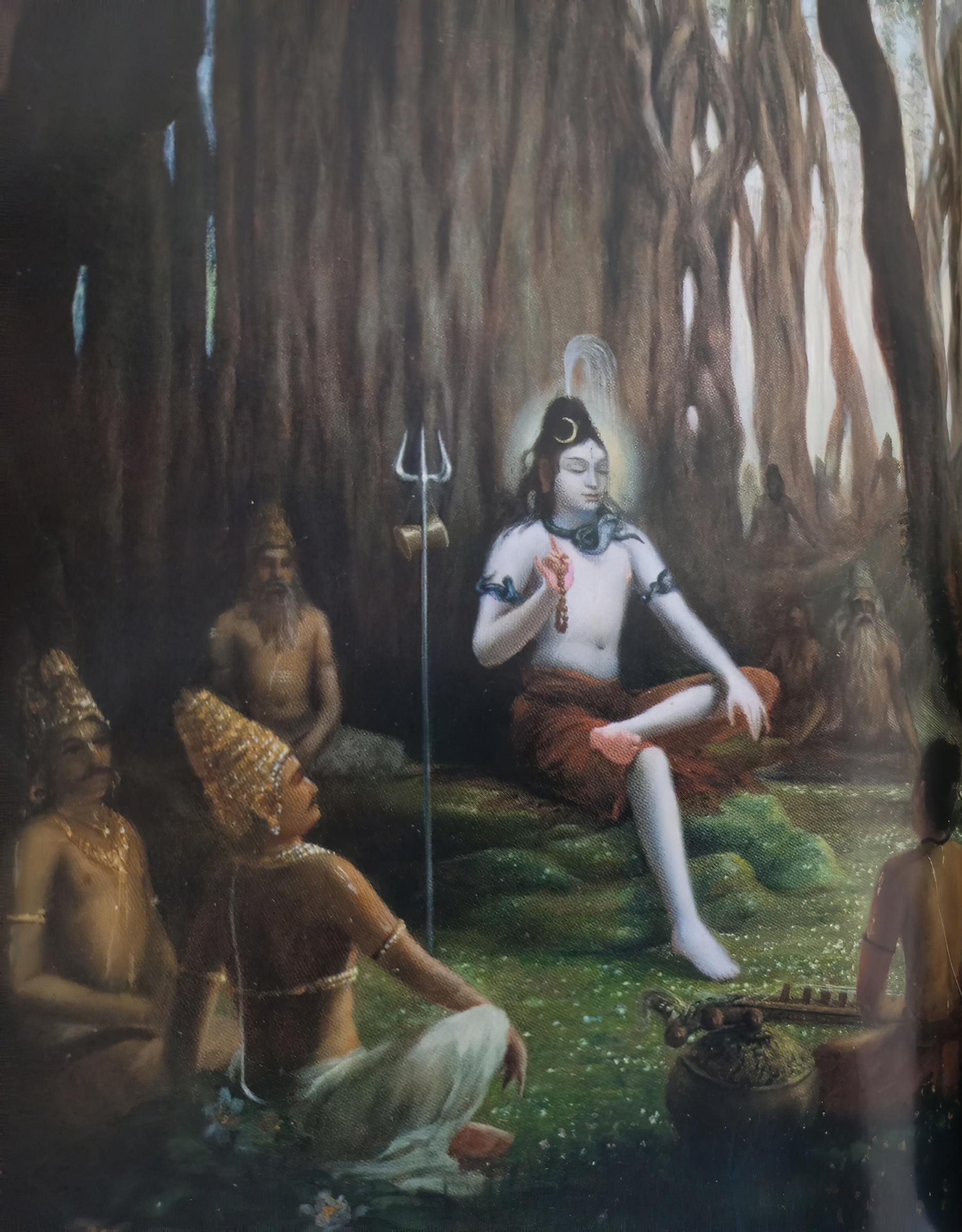
Chapter 5: Lord Śiva instructs us on devotional service
The Pracetās were the ten sons of Prācīnabarhi, the great-grandson of King Pṛthu. Their story is unprecedented because they practiced austerities for 10,000 years inside the ocean, in some great bay or lake, where the waters were peaceful.
The story is that after his sons were sufficiently grown up, Prācīnabarhi ordered them to marry and beget children, which also implied performing austerities, since without first properly purifying oneself, it is not possible to beget exceptionally good children as desired. The Pracetās accepted this order very obediently and left the palace to practice austerities. On the way, they met Lord Śiva, who, out of his great mercy, desired to give spiritual instructions to them. The instructions given by Lord Shiva are prayers called the Rudra-gītā, upon which the Pracetās meditated during their austerities in the water.
Just as the instructions of Sanat-kumāra, the Rudra-gītā is amongst the important sets of instructions contained in the Fourth Canto. Just as the instructions of Sanat-kumāra reveal many details about the eternal position of the soul and his entanglement in the material world, as well as the process of becoming free, the prayers of Lord Śiva reveal details about the potencies of the Lord and our eternal relationship with Him.
Often, we focus on studying the pastimes while studying the Śrīmad-Bhāgavatam, and just skim through the prayers and philosophical discussions. In reality, however, these are the most important parts of the text. Without studying these parts, our study of the Śrīmad-Bhāgavatam may remain superficial.
The verses of the Song of Lord Śiva can be divided into four parts:
a) From texts 4.24.33 to 43, Lord Śiva describes the Lord as the all-pervading Supersoul, and explains how He conducts the cosmic manifestation and how only by His mercy we can become free from it.
b) From texts 4.24.44 to 52, he speaks about the transcendental form of the Lord, an understanding that is the foundation of the process of devotional service. Without becoming attracted to the personal form of the Lord, there is no question of transcendental service in divine love.
c) From 4.24.53 to 59, he speaks directly about devotional service to the Lord, which becomes natural after we get to know the Lord in His personal form.
d) Finally, the last part, which goes from text 4.24.60 to 68, reinforces that the Lord is the ultimate object of worship, countering any last vestiges of impersonalism that may still be lingering in our consciousness and emphasizing our eternal relationship with the Lord.
All four parts are important, but to not make this book too voluminous, let’s focus on the last two parts.
Attaining devotional service, the topmost process
In the third part of his prayers, Lord Śiva speaks about devotional service to the Lord, which becomes natural after knowing the Lord in His personal form. When we see a powerful person at a distance, our feeling may be just of awe and reverence, but if we have the opportunity of coming close to him and see his personal dealings and his personal qualities, the idea of offering some personal service becomes natural, and as the relationship deepens, the idea of friendship or other type of close relationship grows on us.
To elevate us to this comprehension, Lord Śiva prays:
“My dear Lord, those who desire to purify their existence must always engage in meditation upon Your lotus feet, as described above. Those who are serious about executing their occupational duties and who want freedom from fear must take to this process of bhakti-yoga.” (SB 4.24.53)
Yogis who meditate on the transcendental form of the Lord inside their hearts often fail to develop this attitude of service, and thus their realization remains incomplete. The process of practicing devotional service through the performance of our prescribed duties can be practiced even by common people and is recommended by the Lord in the Bhagavad-gītā. The result is that one attains abhaya-daḥ, factual fearlessness, which implies being elevated to the transcendental platform. Without devotional service, simply executing one’s duties in the varṇāśrama system will not bring any transcendental result.
The process of devotional service is essential to realize the transcendental form of the Lord, since the transcendental name, form, pastimes and paraphernalia of the Lord cannot be appreciated using material senses. Only when the senses are purified by the process of bhakti can we finally see the Lord. People are eager to practice meditation nowadays, but Lord Śiva confirms that true meditation means meditation on the lotus feet of the Lord.
“My dear Lord, the king in charge of the heavenly kingdom is also desirous of obtaining the ultimate goal of life — devotional service. Similarly, You are the ultimate destination of those who identify themselves with You [aham brahmāsmi]. However, it is very difficult for them to attain You, whereas a devotee can very easily attain Your Lordship.” (SB 4.24.54)
The Lord is the ultimate destination for all, including jñānis and karmīs. Similarly, the ultimate goal of life is devotional service, for it allows one to attain the Lord. Without bhakti, all other platforms of self-realization are incomplete.
How can we believe that bhakti is higher than other achievements? The answer is given here: Even Indra is anxious to be elevated to the platform of pure devotion, which proves that it is more valuable than life in the celestial planets of other material achievements. Karmīs dream of elevation to Svargaloka, but the king of heaven aspires to become a devotee.
What is so great about devotees? Why are they so special? Devotees are the only ones who can attain the Lord, the ultimate goal and supreme destination, something that is practically impossible for others. Even great jñanis can’t attain perfection until they are elevated to the platform of devotion. Even after attaining the Brahman platform, they still have a long way to go.
Lord Śiva then proceeds, making the point that pure devotional service is beyond the platform of liberation:
“My dear Lord, pure devotional service is even difficult for liberated persons to discharge, but devotional service alone can satisfy You. Who will take to other processes of self-realization if he is actually serious about the perfection of life?” (SB 4.24.55)
The Sanskrit of this verse is: tam durārādhyam ārādhya, satām api durāpayā, ekānta-bhaktyā ko vāñchet, pāda-mūlam vinā bahiḥ. To be liberated means to be free from the influence of the three modes of material nature. However, liberation is not perfection. After attaining the platform of liberation and becoming equally disposed and peaceful, one has still to be elevated to the platform of devotional service, as Krsna explains in the Gītā (18.54).
Why Lord Śiva states that it is not easy for such liberated persons to be promoted to the platform of devotional service, if in the Gītā (8.14) Kṛṣṇa says that He is easy to obtain? Lord Śiva explains that the Lord is durārādhya, very difficult to worship. Not because He is unwilling, but because He is accessible only through a special mood of devotion. He cannot be approached through intellectual effort, renunciation, austerities, or even mystic yoga. Only unalloyed devotion opens the door to Him.
Karmis can’t approach the Lord at all. The word satām in the verse clarifies who the possible candidates are: the jñānīs, yogīs, and bhaktas. Of the three, the jñānīs and yogīs find it very difficult to approach the Lord, because they try to approach the Lord by their own power. In the end, only the bhakta is a suitable candidate, because a devotee abandons his pride and approaches the Lord by fully surrendering to Him. By this surrender, we put ourselves under the control of the internal potency of the Lord, and by her grace, we can approach the Lord without difficulty. In this way, Lord Śiva powerfully concludes: “Who will take to other processes of self-realization if he is actually serious about the perfection of life?”
“Simply by expansion of His eyebrows, invincible time personified can immediately vanquish the entire universe. However, formidable time does not approach the devotee who has taken complete shelter at Your lotus feet.” (SB 4.24.56)
All material activities, including the activities of the karmīs and jñānīs, which are outside the platform of devotional service, are destroyed in due course of time. A karmī may reach the celestial planets by dint of his fruitive performances, but how long can he remain there? Similarly, a jñānī may reach the impersonal brahmajyoti, the frontier of the spiritual world, but without at least a dint of devotional service, it’s sure he will fall back to the material world in due time. As Prabhupāda explains, “the jñānīs undergo severe austerities to attain the impersonal brahmajyoti, but because they do not find the lotus feet of the Lord, they fall down again into this material existence.”
In this way, without bhakti, all results are temporary. Therefore, Lord Śiva prays that, “Simply by expansion of His eyebrows, invincible time personified can immediately vanquish the entire universe. However, formidable time does not approach the devotee who has taken complete shelter at Your lotus feet.”
This verse rhymes with SB 2.3.17, where Śaunaka Ṛṣi describes: “Both by rising and by setting, the sun decreases the duration of life of everyone, except one who utilizes the time by discussing topics of the all-good Personality of Godhead.”
The activities of a devotee rest on the transcendental platform and are therefore eternal. As Prabhupāda explains:
“Even if a devotee cannot completely execute devotional service, in his next life he begins from the point where he left off. Such an opportunity is not given to the karmīs and jñānīs, whose achievements are destroyed. The bhakta’s achievement is never destroyed, for it goes on perpetually, be it complete or incomplete. This is the verdict of all Vedic literatures.”
Now that the indestructible characteristic of devotional service is established, Lord Śiva proceeds in describing the value of association with devotees, which is the source and foundation of this devotional service:
“If one by chance associates with a devotee, even for a fraction of a moment, he no longer is subject to attraction by the results of karma or jñāna. What interest then can he have in the benedictions of the demigods, who are subject to the laws of birth and death?” (SB 4.24.57)
Lord Śiva boldly declares that even a moment of association with a pure devotee can make one free from material attraction. The word used is kṣaṇa-ardhena, or half a kṣaṇa. A kṣaṇa is 1.6 seconds (a moment), and Lord Śiva claims that even half of that is enough to free us from attraction to fruitive results. How is it possible?
The point is that association with a pure devotee can be life-transforming, because it has the power of planting the seed of eternal loving service to the Lord, which in due time rescues us from material entanglement and makes one free from all selfish desires, including even liberation. The seed of devotional service may not grow immediately, but once planted, the final result manifests in due time. Kaivalyam narakāyate tridaśa-pūr ākāśa-puṣpāyate: Impersonal liberation appears hellish to the devotee, and the heavenly planets are like phantasmagoria.
We can see that this point has an inconceivable twist to it. Even though we are eternal servants of the Lord, still, once in the material world, our devotional service to Him has to be awakened, and the only way this can happen is by coming in contact with a pure devotee. This association is so precious that Lord Śiva reveals that even he himself is anxious to obtain it:
“My dear Lord, Your lotus feet are the cause of all auspicious things and the destroyer of all the contamination of sin. I therefore beg Your Lordship to bless me by the association of Your devotees, who are completely purified by worshiping Your lotus feet and who are so merciful upon the conditioned souls. I think that Your real benediction will be to allow me to associate with such devotees.” (SB 4.24.58)
The lotus feet of the Lord are the cause of all auspicious things and the destroyer of all the contamination of sin. Lord Śiva desires to attain these lotus feet, but He doesn’t pray for attaining them directly. Instead, he prays to the Lord to get the association of His pure devotees, who are purified by worshiping His lotus feet, and who are merciful to the conditioned souls. Attaining the service of the Lord is not easy, but if one obtains such association, one can be quickly elevated to the devotional platform. In this way, Lord Śiva again shows us the way.
Such pure devotees are compared to the sacred Ganges, since they are in direct contact with the feet of the Lord. As Prabhupāda comments, “The Ganges water is celebrated in this way because it emanates from the lotus feet of the Supreme Personality of Godhead. Similarly, those who are directly in touch with the lotus feet of the Supreme Personality of Godhead and who are absorbed in the chanting of His glories are freed from all material contamination. Such unalloyed devotees are able to show mercy to the common conditioned soul. Śrīla Vṛndāvana dāsa Ṭhākura has sung that the devotees of Lord Caitanya are so powerful that each one of them can deliver a universe. In other words, it is the business of devotees to preach the glories of the Lord and deliver all conditioned souls to the platform of śuddha-sattva, pure goodness.”
Lord Śiva thus concludes this portion of his prayers:
“The devotee whose heart has been completely cleansed by the process of devotional service and who is favored by Bhaktidevī does not become bewildered by the external energy, which is just like a dark well. Being completely cleansed of all material contamination in this way, a devotee is able to understand very happily Your name, fame, form, activities, etc.” (SB 4.24.59)
The material world is compared to a dark well, but under the spell of māyā, we remain attached to living in this well, even in unpleasant circumstances. Māyā has two features, called āvaraṇātmikā and prakṣepātmikā, which are explained by Śrīla Prabhupāda in his purport to CC Madhya 20.6:
“There are innumerable conditioned souls rotting in the material world, imprisoned by māyā under the spell of sense gratification. The living entity is so entranced by the spell of māyā that in conditioned life even a pig feels satisfied. There are two kinds of covering powers exhibited by māyā. One is called prakṣepātmikā, and the other is called āvaraṇātmikā. When one is determined to get out of material bondage, the prakṣepātmikā-śakti, the spell of diversion, impels one to remain in conditioned life fully satisfied by sense gratification. Due to the other power (āvaraṇātmikā), a conditioned soul feels satisfied even if he is rotting in the body of a pig or a worm in stool.
These two potencies work together, and by their influence, souls can remain in the material world almost eternally. Practically speaking, the only way to get out is when a soul meets devotees and starts the process of devotional service. How does it work? The verse mentions that “The devotee whose heart has been completely cleansed by the process of devotional service and who is favored by Bhaktidevī does not become bewildered by the external energy”
The potency to become free from the grasp of Māyā does not come from ourselves (as believed by the jñānis and yogīs) but from surrendering to the Lord through His representative. If one remains firmly under the shelter of the spiritual master and advanced Vaiṣṇavas, one can wake up from the influence of āvaraṇātmikā and resist the influence of prakṣepātmikā. In this way, one can finally break free.
What is the result of attaining this freedom? “Being completely cleansed of all material contamination in this way, a devotee is able to understand very happily Your name, fame, form, activities, etc.”
The Lord can’t be understood by the material mind or intelligence. Only when we become pure and awaken our spiritual senses can we start truly understanding the Lord. In this way, association with pure devotees is again emphasized, since this association gives us impetus to start and maintain our spiritual practice, which allows us to attain this purity. As Prabhupāda beautifully describes in his purport:
“Simply by the association of pure devotees one can understand the transcendental name, fame, quality and activities of the Supreme Personality of Godhead. Śrī Caitanya Mahāprabhu has repeatedly said: ‘sādhu-sanga’, ‘sādhu-sanga’ — sarva-śāstre kaya, lava-mātra sādhu-sange sarva-siddhi haya (Cc. Madhya 22.54)
Simply by associating with a pure devotee, one becomes wonderfully advanced in Kṛṣṇa Consciousness. Sādhu-sanga, or association with a devotee, means always engaging in Kṛṣṇa Consciousness by chanting the Hare Kṛṣṇa mantra and by acting for Kṛṣṇa. Specifically, chanting the Hare Kṛṣṇa mantra purifies one, and this chanting is therefore recommended by Śrī Caitanya Mahāprabhu. Ceto-darpaṇa-mārjanam: by chanting the names of Kṛṣṇa, the mirror of the heart is cleansed, and the devotee loses interest in everything external. When one is influenced by the external energy of the Lord, his heart is impure. When one’s heart is not pure, he cannot see how things are related to the Supreme Personality of Godhead. Idam hi viśvam bhagavān ivetaraḥ (Bhāg. 1.5.20). He whose heart is purified can see that the whole cosmic manifestation is but the Supreme Personality of Godhead, but he whose heart is contaminated sees things differently. Therefore by sat-sanga, or association with devotees, one becomes perfectly pure in heart.”
The Lord is the only object of worship
The scriptures mention that everything is Brahman, and there is nothing apart from Brahman. One could thus argue that, beautiful as it is, the form of Kṛṣṇa could be a by-product of this impersonal Brahman, something that helps us to get out of material contamination, but has to be rejected later, when we realize our real nature as one with the supreme Brahman. Lord Śiva counters this argument by stating that it is precisely the opposite: the impersonal Brahman comes from Kṛṣṇa and is just a partial manifestation of Him. In other words, the Supreme Brahman that the scriptures mention as being everything is Kṛṣṇa, and the impersonal Brahman, powerful as it is, is nothing but the effulgence of His body.
“My dear Lord, the impersonal Brahman spreads everywhere, like the sunshine or the sky. And that impersonal Brahman, which spreads throughout the universe and in which the entire universe is manifested, is You.” (SB 4.24.60)
Impersonalists can’t understand how the entire cosmic manifestation can rest on a person, but this is exemplified in the example of the sun, which spreads everywhere in the form of heat and light, but at the same time has a form. The Lord has a form, but this form is not restricted by the limitations of time, space, and physical laws, as is the form of an ordinary human being. The form of the Lord is fully transcendental and unlimited.
“My dear Lord, You have manifold energies, and these energies are manifested in manifold forms. With such energies You have also created this cosmic manifestation, and although You maintain it as if it were permanent, You ultimately annihilate it. Although You are never disturbed by such changes and alterations, the living entities are disturbed by them, and therefore they find the cosmic manifestation to be different or separated from You. My Lord, You are always independent, and I can clearly see this fact.” (SB 4.24.61)
An essential point in understanding how the Lord can be the source and maintainer of the whole cosmic creation and at the same time have a personal form is understanding the Lord’s potencies, through which He performs all kinds of wonderful feats. Although the energies may be impersonal, just as the impersonal brahmajyoti, the Lord behind these different potencies has a transcendental personal form.
The Lord has unlimited potencies, but they are grouped into three: the external potency, the internal potency, and the marginal potency (the jīvas). The jīvas are also part of the spiritual potency, but they are called marginal because they are free to choose.
We are affected by all the difficulties of life in the material world, but the Lord is never disturbed. How? Because even though He is the creator and maintainer of this universe, He is beyond it. The cause of our suffering is to see the material manifestation as separate from Kṛṣṇa, which puts us under the influence of Māyā. When we come to the platform of Kṛṣṇa Consciousness, seeing everything as part of the Lord and fit to be used in His service, we can also live here without being disturbed by material miseries, just like the Lord.
In his purport for this verse, Prabhupāda starts by explaining that not all souls come in contact with the material energy. Most souls never come in contact with the material energy; these are called nitya-mukta (eternally liberated), while others (us) are conditioned, thinking themselves as separated from the Lord:
“It is clearly explained that Lord Kṛṣṇa has multienergies, which can be grouped into three, namely the external energy, the internal energy and the marginal energy. There are also different cosmic manifestations — namely the spiritual world and the material world — as well as different types of living entities. Some living entities are conditioned, and others are eternally free. The eternally free living entities are called nitya-mukta, for they never come in contact with the material energy. However, some living entities are conditioned in this material world, and thus they think themselves separated from the Supreme Lord. Due to their contact with the material energy, their existence is always troublesome.”
Prabhupāda makes the point that conditioned life means thinking ourselves separated from Kṛṣṇa. This is the factor that makes our material existence so troublesome. Kṛṣṇa is everywhere, but we cut ourselves off from Him. He explains this concept in more detail in the second part of his purport:
“When the living entity forgets the Supreme Lord and wants to enjoy himself independently, imitating the Supreme Lord, he is captured by the false notion that he is the enjoyer and is separated from the Supreme Lord. This material energy is therefore very much troublesome to the spiritual energy, the living entity, but the material energy is never troublesome to the Supreme Lord. Indeed, for the Supreme Lord, both material and spiritual energy are the same. In this verse Lord Śiva explains that the material energy is never troublesome to the Supreme Lord. The Supreme Lord is always independent, but because the living entities are not independent — due to their false idea of becoming independently happy — the material energy is troublesome. Consequently the material energy creates differentiation.”
By “differentiation”, Prabhupāda refers to bheda-buddhi, the concept of seeing ourselves as independent from the Lord and trying to become happy independently of Him. Because each soul is a separate individual, we have a minute independence. However, when we misuse this independence and fall under the influence of the illusory potency, we see ourselves as the independent enjoyers of this material world. When this misconception is removed, we see ourselves again as the eternal servitors of the Lord. At this point, we see we were never separated from Him. As Prabhupāda mentions, “For a devotee, the Lord is the supreme spirit soul. Since He is supremely powerful, His various powers are also spiritual. For a devotee, there is nothing material, for material existence only means forgetfulness of the Supreme Personality of Godhead.”
In fact, everything that exists is connected with the Lord, be it through His internal or external potency. However, due to being caught under the influence of Māyā, the conditioned soul develops bheda-buddhi, this false dualistic thinking, imagining that “I am separate from God”, or “I was never with the Lord“. Bheda-buddhi is thus the disease of the conditioned soul that makes us divorced from the spiritual reality.
Lord Śiva continues, revealing how the Lord is the only object of worship for all:
“My dear Lord, Your universal form consists of all five elements, the senses, mind, intelligence, false ego (which is material) and the Paramātmā, Your partial expansion, who is the director of everything. Yogīs other than the devotees — namely the karma-yogī and jñāna-yogī — worship You by their respective actions in their respective positions. It is stated both in the Vedas and in the śāstras that are corollaries of the Vedas, and indeed everywhere, that it is only You who are to be worshiped. That is the expert version of all the Vedas.” (SB 4.24.62)
Everything that exists is part of the universal form of the Lord. In this way, demigods and other powerful beings are also forms of the Lord in a sense, being limbs of the universal form. In the Bhagavad-gītā, Kṛṣṇa mentions that even powerful animals such as the lion and the shark are partial manifestations of His opulences. Why then should we worship only Kṛṣṇa? Why not worship different powerful demigods who are also manifestations of His power?
In fact, karmīs worship the Lord through different demigods, but they do so out of ignorance. They still worship the Lord indirectly, but this worship is ineffective due to their lack of knowledge. Although the scriptures appear to recommend the worship of demigods in different passages, the true goal of such performances is to please Lord Viṣṇu. As Prabhupāda mentions, “even when different demigods are worshiped in the Vedic and Tantric sacrifices, the actual goal of sacrifice is Lord Viṣṇu.”
In these ceremonies, the demigods are invited to take their seats, but the beneficiary of all offerings is the Supreme Lord. The demigods attend such ceremonies so they can get the prasāda of the Lord. When one directly worships demigods, one does so in ignorance, acting against the regulative principles. As Kṛṣṇa mentions in the Gītā: “Whatever a man may sacrifice to other gods, O son of Kuntī, is really meant for Me alone, but is offered without true understanding.”
When the scriptures are studied under the proper guidance, the message becomes clear: all passages of the scriptures recommend the worship of the Supreme Lord, and no one else.
You can also donate using Buy Me a Coffee, PayPal, Wise, Revolut, or bank transfers. There is a separate page with all the links. This helps me enormously to have time to write instead of doing other things to make a living. Thanks!